

Sign In to Your Account
Subscribers have complete access to the archive.
Sign In Not a Subscriber?Join NowTHE LP IS DEAD! LONG LIVE THE LP!
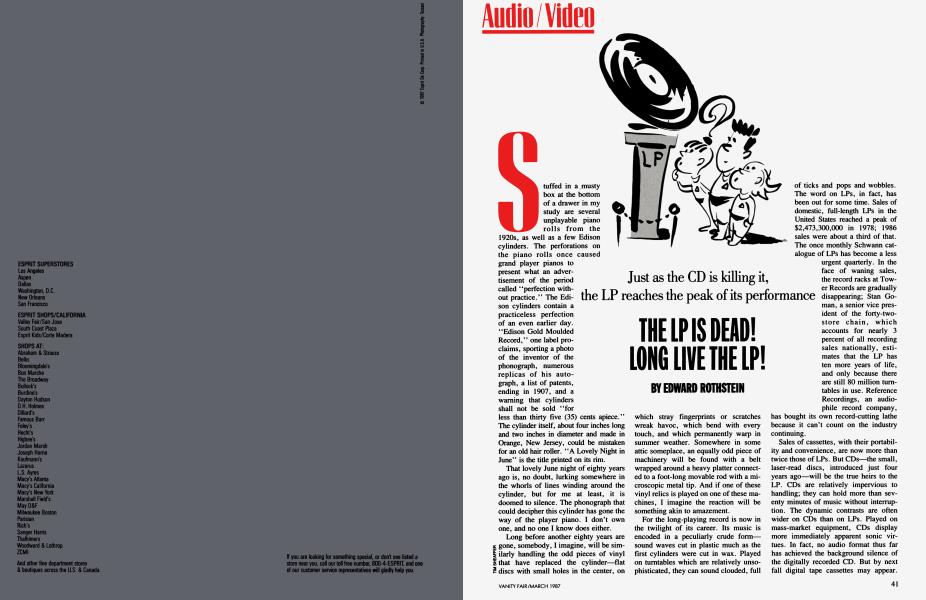
Just as the CD is killing it, the LP reaches the peak of its performance
EDWARD ROTHSTEIN
Audio/Video
Stuffed in a .musty box at the bottom of a drawer in my study are several unplayable piano rolls from the 1920s, as well as a few Edison cylinders. The perforations on the piano rolls once caused grand player pianos to present what an advertisement of the period called "perfection without practice. " The Edison cylinders contain a practiceless perfection of an even earlier day. "Edison Gold Moulded Record," one label proclaims, sporting a photo of the inventor of the phonograph, numerous replicas of his autograph, a list of patents, ending in 1907, and a warning that cylinders shall not be sold "for less than thirty five (35) cents apiece." The cylinder itself, about four inches long and two inches in diameter and made in Orange, New Jersey, could be mistaken for an old hair roller. "A Lovely Night in June" is the title printed on its rim.
That lovely June night of eighty years ago is, no doubt, lurking somewhere in the whorls of lines winding around the cylinder, but for me at least, it is doomed to silence. The phonograph that could decipher this cylinder has gone the way of the player piano. I don't own one, and no one I know does either.
Long before another eighty years are gone, somebody, I imagine, will be similarly handling the odd pieces of vinyl that have replaced the cylinder—flat discs with small holes in the center, on which stray fingerprints or scratches wreak havoc, which bend with every touch, and which permanently warp in summer weather. Somewhere in some attic someplace, an equally odd piece of machinery will be found with a belt wrapped around a heavy platter connected to a foot-long movable rod with a microscopic metal tip. And if one of these vinyl relics is played on one of these machines, I imagine the reaction will be something akin to amazement.
For the long-playing record is now in the twilight of its career. Its music is encoded in a peculiarly crude form— sound waves cut in plastic much as the first cylinders were cut in wax. Played on turntables which are relatively unsophisticated, they can sound clouded, full of ticks and pops and wobbles. The word on LPs, in fact, has been out for some time. Sales of domestic, full-length LPs in the United States reached a peak of $2,473,300,000 in 1978; 1986 sales were about a third of that. The once monthly Schwann catalogue of LPs has become a less urgent quarterly. In the face of waning sales, the record racks at Toww er iwwiw Records «uv are 6muuau; gradually disappearing; Stan Goman, a senior vice president of the forty-two-store chain, which accounts for nearly 3 percent of all recording sales nationally, estimates that the LP has ten more years of life, and only because there are still 80 million turntables in use. Reference Recordings, an audiophile record company, has bought its own record-cutting lathe because it can't count on the industry continuing.
Sales of cassettes, with their portability and convenience, are now more than twice those of LPs. But CDs—the small, laser-read discs, introduced just four years ago—will be the true heirs to the LP. CDs are relatively impervious to handling; they can hold more than seventy minutes of music without interruption. The dynamic contrasts are often wider on CDs than on LPs. Played on mass-market equipment, CDs display more immediately apparent sonic virtues. In fact, no audio format thus far has achieved the background silence of the digitally recorded CD. But by next fall digital tape cassettes may appear. They would threaten all the other formats, for they offer the sound quality of the CD and can be used for recording as well as playback.
Audio /Video
In the meantime, where LPs have slipped, CDs have gained. CDs now account for about $700 million worth of sales a year. More than three million players are in use. Fifty percent of Tower Records' classical sales are CDs; the chain's popular-music buyers—less technologically advanced—spend 20 percent of their recording dollars on CDs. Telarc International, a Grammy Award-winning audiophile label, has begun to release only CDs, except in special cases where the market for a particular LP is significant. Motown has deleted chunks of its LP catalogue for partial CD replacement. Alison Ames, the vice president of the American office of Deutsche Grammophon, says, "I am as certain of the eventual demise of the LP as I am of my own."
But it is bound to be a contentious demise, just as the LP has led a contentious life. From the moment Thomas Alva Edison recited "Mary had a little lamb" into his reproducing machine (which he saw as primarily a business and dictating tool), every advance in the technology of recording has been subject to debate. Some claimed that when microphones and electrical processing replaced the purely mechanical etching of cylinders of the early days, quality declined, leading to gimmickry and distortion; some argued that the outmoded cylinder was also far superior in its fidelity to a flat disc.
The recent controversy over the death of the LP has become more heated than any thus far. Within the last decade, the doomed LP has been met by equipment that can come close to decoding every nuance found within its grooves. And while the CD has been acclaimed for its fidelity, dynamic contrast, and purity of pitch, long-playing recordings cannot be easily surpassed when played on the appropriate turntable. The vinyl grooves contain information about timbre and volume, about harmonic and rhythmic subtleties, and about the three-dimensional world the music came from—recreating the depth and width and height of an aural "soundstage."
I confess, in fact, that I personally have an attachment to the LP that is considered by friends and colleagues to be somewhat retrograde. To my ear, the LP is more musically successful than the CD. Often CDs sound thoroughly unpleasant. Such views have generated more than a little debate, and the arguments would fill another column. But I will continue to subject my discs to fetishistic care, treasuring even the early stereo recordings of the 1950s—such as those on London, RCA, and Mercury— which can often stand comparison with any LP made since. Monophonic Archiv recordings from the early 1950s are also compelling sonic achievements. In fact, these early recordings have become the focus of a cult. Once readily available at flea markets and discarded by the cartonful, a Mercury Living Presence recording from the late 1950s may now be priced as high as $100. A copy of a first pressing of Fritz Reiner's performance of Scheherazade on RCA (LSC 2446) recently sold for $200. At Academy Book and Record Store in New York, the manager, Joseph Ga Nun, reports that for certain used records in the store's 50,000record inventory, customers "aren't worried about price."
This interest, far from being nostalgia for a passing technology, or simply a desire to collect rarities, is based on the remarkable musical and sonic virtues of many of these recordings. Some can sound constricted, anemic, bottled, but far more provide a vivid, three-dimensional image of space, giving each musical line a physical presence, making an orchestra seem an unusual instrument capable of all the timbral and registral variety of the human voice. The vitality comes, in part, from the sense, even in moments of silence, of an actual hall being used, of a physical setting for the music lying behind the hiss and surface noise. This was often accomplished using no more than three microphones connected to electronic equipment built with vacuum tubes.
Some aspects of the art of recording deteriorated beginning in the mid1960s, when solid-state equipment was introduced before the technology was mastered. Also, in the studio, instead of three microphones, thirty were sometimes used, with an engineer eagerly mixing and changing the balance so the final result bore little or no resemblance to the sound of concert music. Then early digital recordings emerged in the 1970s, full of promise, but sounding grating, metallic, hyped; popular recordings took on an aggressively raw sound.
But while the mainstream record companies were sonically slipping in the 1970s, reproducing equipment was growing more and more sophisticated, and a large number of small record companies applied some of the "lost wisdom." Mobile Fidelity Sound Labs began rereleasing older records—remastering them, then taking special care with pressings and packaging; for a while the company made thirty-dollar LPs called Ultra High Quality Records in limited editions which reveal how much information is ordinarily lost from a record because of manufacturing compromises. For similar reasons, high-quality Japanese pressings are treasured even when made of American recordings.
There are also specifically audiophile labels that eschew digital processing— and in some cases solid-state processing—choosing vacuum tubes, custommade lathes, and custom-modified recorders for producing master tapes. Reference Recordings, for example, which releases about four recordings a year, is, according to its president, J. Tamblyn Henderson Jr., "absolutely committed" to the analogue LP for its devoted audiophile market. Along with another audiophile label, Sheffield Lab, Reference Recordings produces some of the best-sounding LPs.
A few small foreign labels have also preserved an individual sonic character that most of the larger labels lack. Harmonia Mundi, based in France, can be relied on for warm, sensuous clarity, a precise impressionism; one of its engineers, Jean-Frangois Pontefract, captures in his recordings of Baroque and Renaissance music an almost eerie elegance and refinement. Lyrita, from England, records English orchestral music of a cinematic cast with rigor and analytic common sense. The American commercial counterpart to these labels might be the ten-yearold Telarc, which, nearly alone in the audiophile market, is devoted to digital recordings, but which has learned from the techniques and goals of the 1950s.
None of these accomplishments were lost on the major companies in the 1980s, although the LP's marketing edge was rapidly disappearing. Vinyl quality, engineering, and pressing procedures have been improving in nearly all the big classical divisions. Given the quality of some playback equipment, the last gasp of the LP may come to be known as its strongest, longest, and most brilliant hour. It may yet be a generation before the LP joins the piano roll and Edison cylinder in musty cartons of collectibles, but even then there will be some who, with great care, clean their antique styli and listen with pleasure to the sound of a lost art.
Subscribers have complete access to the archive.
Sign In Not a Subscriber?Join Now
