










Sign In to Your Account
Subscribers have complete access to the archive.
Sign In Not a Subscriber?Join NowAFTER MIDNIGHT
Letter from India
Forty years on, are time and democracy running out for sect-torn India?
SALMAN RUSHDIE
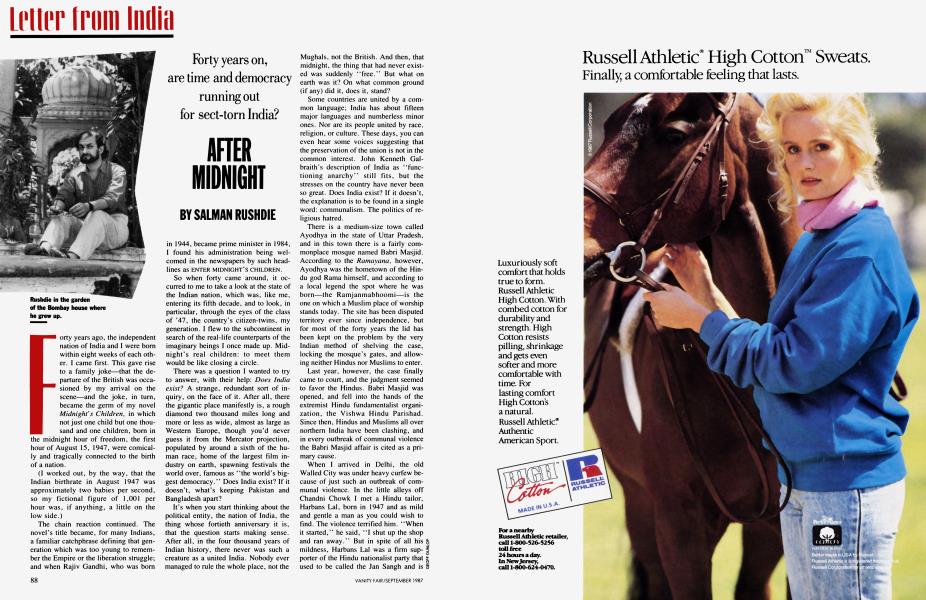
Forty years ago, the independent nation of India and I were bom within eight weeks of each other. I came first. This gave rise to a family joke—that the departure of the British was occaB1™ sioned by my arrival on the scene—and the joke, in turn, became the germ of my novel Midnight's Children, in which not just one child but one thousand and one children, bom in the midnight hour of freedom, the first hour of August 15, 1947, were comically and tragically connected to the birth of a nation.
(I worked out, by the way, that the Indian birthrate in August 1947 was approximately two babies per second, so my fictional figure of 1,001 per hour was, if anything, a little on the low side.)
The chain reaction continued. The novel's title became, for many Indians, a familiar catchphrase defining that generation which was too young to remember the Empire or the liberation struggle; and when Rajiv Gandhi, who was bom in 1944, became prime minister in 1984, I found his administration being welcomed in the newspapers by such headlines as ENTER MIDNIGHT'S CHILDREN.
So when forty came around, it occurred to me to take a look at the state of the Indian nation, which was, like me, entering its fifth decade, and to look, in particular, through the eyes of the class of '47, the country's citizen-twins, my generation. I flew to the subcontinent in search of the real-life counterparts of the imaginary beings I once made up. Midnight's real children: to meet them would be like closing a circle.
There was a question I wanted to try to answer, with their help: Does India exist? A strange, redundant sort of inquiry, on the face of it. After all, there the gigantic place manifestly is, a rough diamond two thousand miles long and more or less as wide, almost as large as Western Europe, though you'd never guess it from the Mercator projection, populated by around a sixth of the human race, home of the largest film industry on earth, spawning festivals the world over, famous as "the world's biggest democracy.'' Does India exist? If it doesn't, what's keeping Pakistan and Bangladesh apart?
It's when you start thinking about the political entity, the nation of India, the thing whose fortieth anniversary it is, that the question starts making sense. After all, in the four thousand years of Indian history, there never was such a creature as a united India. Nobody ever managed to rule the whole place, not the Mughals, not the British. And then, that midnight, the thing that had never existed was suddenly "free." But what on earth was it? On what common ground (if any) did it, does it, stand?
Some countries are united by a common language; India has about fifteen major languages and numberless minor ones. Nor are its people united by race, religion, or culture. These days, you can even hear some voices suggesting that the preservation of the union is not in the common interest. John Kenneth Galbraith's description of India as "functioning anarchy" still fits, but the stresses on the country have never been so great. Does India exist? If it doesn't, the explanation is to be found in a single word: communalism. The politics of religious hatred.
There is a medium-size town called Ayodhya in the state of Uttar Pradesh, and in this town there is a fairly commonplace mosque named Babri Masjid. According to the Ramayana, however, Ayodhya was the hometown of the Hindu god Rama himself, and according to a local legend the spot where he was born—the Ramjanmabhoomi—is the one on which a Muslim place of worship stands today. The site has been disputed territory ever since independence, but for most of the forty years the lid has been kept on the problem by the very Indian method of shelving the case, locking the mosque's gates, and allowing neither Hindus nor Muslims to enter.
Last year, however, the case finally came to court, and the judgment seemed to favor the Hindus. Babri Masjid was opened, and fell into the hands of the extremist Hindu fundamentalist organization, the Vishwa Hindu Parishad. Since then, Hindus and Muslims all over northern India have been clashing, and in every outbreak of communal violence the Babri Masjid affair is cited as a primary cause.
When I arrived in Delhi, the old Walled City was under heavy curfew because of just such an outbreak of communal violence. In the little alleys off Chandni Chowk I met a Hindu tailor, Harbans Lai, born in 1947 and as mild and gentle a man as you could wish to find. The violence terrified him. "When it started," he said, "I shut up the shop and ran away." But in spite of all his mildness, Harbans Lai was a firm supporter of the Hindu nationalist party that used to be called the Jan Sangh and is now the B.J.P. "I voted for Rajiv Gandhi in the election after Mrs. Gandhi died," he said. ''It was a big mistake. I won't do it again." I asked him what should be done about Babri Masjid. Should it be locked up again as it had been for so many years? Should it be a place where both Hindus and Muslims could go to worship? "It's a Hindu shrine," he said. "It should be for the Hindus." There was no possibility, in his mind, of a compromise.
A couple of days later the Walled City was still bubbling with tension. The curfew was lifted for an hour or two every day to enable people to go out and buy food. The rest of the time, security was very tight. It was Eid, the great Muslim festival celebrating the end of the month of fasting, but the city's leading imams had said that Eid should not be celebrated. In Meerut, the mutilated corpses of Muslims floated in the river. The city's predominantly Hindu police force, the P.A.C., had run amok. Once again, Babri Masjid was one of the bones of contention.
I met Abdul Ghani, a Delhi Muslim who worked in a sari shop, and who, like Harbans Lai, India, and me, was 1947-bom. I was struck by how much like Harbans Lai he was. They were both slightly built, mild-mannered men with low, courteous voices and attractive smiles. They each earned about a thousand rupees ($80) a month, and dreamed of owning their own shops, knowing they never would. And when it came to the Hindu-Muslim communal divide, Abdul Ghani was just as unyielding as Harbans Lai had been. "What belongs to the Muslims," he said when I asked about Babri Masjid, "should be given back to the Muslims. There is nothing else to be done."
The gentleness of Harbans Lai and Abdul Ghani made their religious divisions especially telling. And Babri Masjid was not the only issue between the faiths. In Ahmadabad, in the state of Gujarat, Hindu-Muslim violence was once again centered in the old walledcity area of Manik Chowk, and had long ago acquired its own internal logic: so many families had lost members in the fighting that the cycle of revenge was unstoppable. Political forces were at work, too. At Ahmadabad Hospital the doctors found that many of the knife wounds they treated were professionally inflicted. Somebody was sending trained killers into town.
All over India—Meerut, Delhi, Ahmadabad, Bombay—tension between Hindus and Muslims was rising. In Bombay, a (1947-bom) journalist told me that many communal incidents took place in areas where Muslims had begun to prosper and move up the economic scale. Behind the flash points like Ayodhya, she suggested, was Hindus' resentment of Muslim prosperity.
The Vishwa Hindu Parishad has a list of over a hundred disputed sites of the Babri Masjid type. Two are especially important. In Mathura, a Muslim shrine stands on the supposed birthplace of the god Krishna, and in Benares, a site allegedly sacred to Shiva is also in Muslim hands.
In Bombay, I found another "midnight child," a clerical worker on the dock, a Muslim named Mukadam who was such a supercitizen that he was almost too good to be true. Mukadam was absolutely dedicated to the unity of India. He believed in small families. He thought all Indians had a duty to educate themselves, and he had put himself through many evening courses. He had been named Best Worker at his dock. In his village, he claimed proudly, people of all faiths lived together in complete harmony. "That is how it should be," he said. "After all, these religions are only words. What is behind them is the same, whichever faith it is."
But when communal violence came to the Bombay docks in 1985, Mukadam's supercitizenship wasn't of much use. On the day the mob came to his dock, he was saved because he happened to be away. He didn't dare to return to work for weeks. And now, he says, he worries that it may come again at any time.
Like Mukadam, many members of Indian minority groups started out as devotees of the old, secular definition of India, and there were no Indians as patriotic as the Sikhs. Until 1984, you could say that the Sikhs were the Indian nationalists. Then came the storming of the Golden Temple, and the assassination of Mrs. Gandhi; and everything changed.
The group of Sikh radicals led by Jarnail Singh Bhindranwale, the religious leader who died in the Golden Temple storming, could not be said to represent more than a small minority of all Sikhs. The campaign for a separate Sikh state, Khalistan, had similarly found few takers among India's Sikhs. Until November 1984, that is, when Indira Gandhi died and it became known that her assassins were Sikhs.
In Delhi, angry Hindu mobs—among whom party workers of Mrs. Gandhi's Congress (I) were everywhere observed—decided to hold all Sikhs responsible for the deeds of the assassins. Thus an entirely new form of communal violence—Hindu-Sikh riots—came into being, and in the next ten days the Sikh community suffered a series of traumatizing attacks from which it has not recovered, and perhaps never will.
In Block 32 of the Delhi suburb called Trilokpuri, an estimated 350 Sikhs were burned alive. I walked past streets of charred, gutted houses in some of which you could still see the bones of the dead. It was the worst place I have ever seen, not least because, in the surrounding streets, children played normally, the neighbors went on with their lives. Yet some of these neighbors were the very people who had perpetrated the crime of 32 Trilokpuri, which was only one of the many massacres of Sikhs that took place that November. Many Sikh "midnight children" never reached forty at all.
I walked past streets of charred, gutted houses in some of which you could still see the bones of the dead
I heard about many of these deaths, and will let one story stand for all. When the mob came for Hari Singh, a taxi driver like so many Delhi Sikhs, his son fled into a nearby patch of overgrown wasteland. His wife was obliged to watch as the mob literally ripped her husband's beard off his face. (This beard-ripping ritual was a feature of many of the November killings.) She managed to get hold of the beard, thinking that it was, at least, a part of him that she could keep for herself, and she ran into their house to hide it. Then they poured kerosene over Hari Singh and set fire to him. They also chased his teenage son, found him, beat him unconscious, and burned him too. They knew he was a Sikh even though he had cut his hair, because when they found his father's beard they found the son's cut hair too, which his mother had preserved.
Another taxi driver, Pal Singh (bom November 1947), told me that he had never had time for the Khalistan movement, but after 1984 he had changed his mind. "Now it will come," he said, "maybe within ten years." Sikhs were selling their property in Delhi and buying land in the Punjab, so that if the time came when they had to flee back to the Sikh heartland they wouldn't have to leave their assets behind. "I'm doing it, too," Pal Singh said.
Almost three years after the 1984 massacres, not one person has been charged with murdering a Sikh in those fearsome days. The Congress (I), Rajiv Gandhi's party, increasingly relies on the Hindu vote, and is reluctant to alienate it.
The new element in Indian communalism is the emergence of a collective Hindu consciousness that transcends caste, and that believes Hinduism to be under threat from other Indian minorities. There is evidence that Rajiv's Congress (I) is trying to ride that tiger. In Bombay, the tiger is actually in power. The ruling Shiv Sena party, whose symbol is the tiger, is the most overtly Hindufundamentalist grouping ever to achieve office anywhere in India.
Its leader, Bal Thackeray, a former cartoonist, speaks openly of his belief that democracy has failed in India. He makes no secret of his open hostility toward Muslims. In the Bhiwandi riots of 1985, a few months before the Shiv Sena won the Bombay municipal elections, Shiv Sena activists were deeply involved in the anti-Muslim violence. And today, as the Sena seeks to spread its influence into the rural areas of Maharashtra (the state of which Bombay is the capital), incidents of communal violence are being reported from villages in which nothing of the sort has ever happened before.
I come from Bombay, and from a Muslim family, too. "My" India has always been based on ideas of multiplicity, pluralism, hybridity—ideas to which the ideologies of the communalists are diametrically opposed. To my mind, the defining image of India is the crowd, and a crowd is by its very nature superabundant, heterogeneous, many things at once. But the India of the communalists is none of these things.
I spent one long evening in the company of a ('47-bom) Bengali intellectual, Robi Chatterjee, for whom the inadequacies of society are a cause for deep, permanent, operatic anguish. "Does India exist?" I asked him.
"What do you mean?" he cried. "Where the hell do you think this is?" I told him that I meant the idea of the nation. Forty years after a nationalist revolution, where could it be said to reside?
He said, "To the devil with all that nationalism. I am an Indian because I am bom here and I live here. So is everyone else of whom that is true. What's the need for any more definitions?"
I asked, "If you do without the idea of nationalism, then what's the glue holding the country together?"
"We don't need glue," he said. "India isn't going to fall apart. All that Balkanization stuff. I reject it completely. We are simply here and we will remain here. It's this nationalism business that is the danger."
According to Robi, the idea of nationalism in India has grown more and more chauvinistic, has become narrower and narrower. The ideas of Hindu nationalism have infected it. I was struck by a remarkable paradox: that, in a country created by the Congress's nationalist campaign, the well-being of the people might now require that all nationalist rhetoric be abandoned.
Unfortunately for India, the linkage between Hindu fundamentalism and the idea of the nation shows no signs of weakening. India is increasingly defined as Hindu India, and the fundamentalism of Sikhs and Muslims grows ever fiercer and more entrenched in response. "These days," a young Hindu woman said to me, "one's religion is worn on one's sleeve." She was corrected by a Sikh friend. "It is worn," he said, "in a scabbard at the hip."
I remember that when Midnight's Children was first published, in 1981, the most common Indian criticism of it was that it was too pessimistic about the future. It's a sad truth that nobody finds the novel's ending pessimistic anymore, because what has happened in India since 1981 is so much darker than anything I had imagined. If anything, the book's conclusion, with its suggestion of a new, more pragmatic generation rising up to take over from the midnight children, now seems absurdly, romantically optimistic.
But India regularly confo.unds its critics with its resilience, its survival in spite of everything. I don't believe in the Balkanization of India any more than Robi Chatteijee does. It's my guess that the old functioning anarchy will, somehow or other, keep on functioning for another forty years, and no doubt another forty after that. But don't ask me how.
Subscribers have complete access to the archive.
Sign In Not a Subscriber?Join Now

