Sign In to Your Account
Subscribers have complete access to the archive.
Sign In Not a Subscriber?Join NowHe-e-ere's CONNIE!
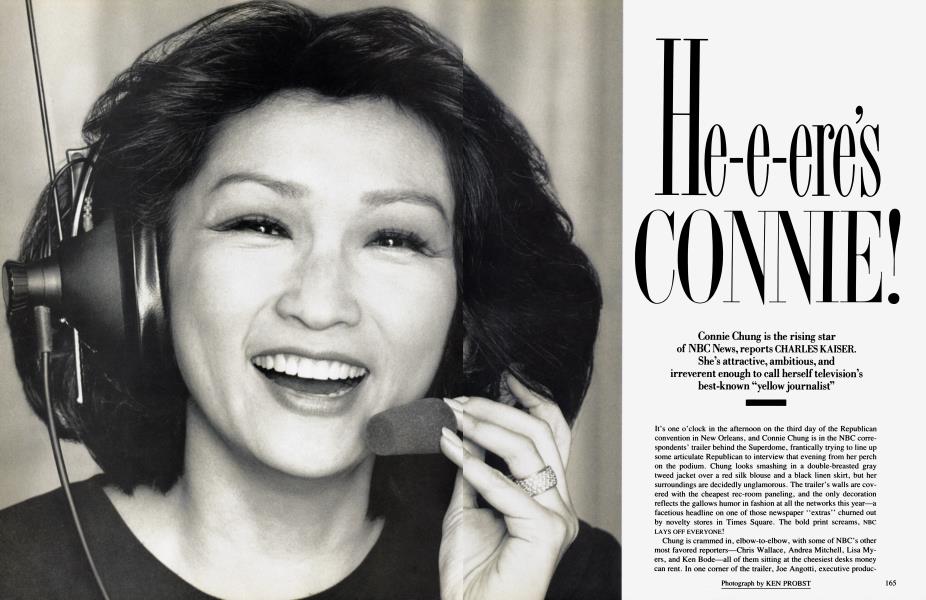
Connie Chung is the rising star of NBC News, reports CHARLES KAISER. She's attractive, ambitious, and irreverent enough to call herself television's best-known "yellow journalist"
CHARLES KAISER
It's one o'clock in the afternoon on the third day of the Republican convention in New Orleans, and Connie Chung is in the NBC correspondents' trailer behind the Superdome, frantically trying to line up some articulate Republican to interview that evening from her perch on the podium. Chung looks smashing in a double-breasted gray tweed jacket over a red silk blouse and a black linen skirt, but her surroundings are decidedly unglamorous. The trailer's walls are covered with the cheapest rec-room paneling, and the only decoration reflects the gallows humor in fashion at all the networks this year—a facetious headline on one of those newspaper "extras" churned out by novelty stores in Times Square. The bold print screams, NBC LAYS OFF EVERYONE!
Chung is crammed in, elbow-to-elbow, with some of NBC's other most favored reporters—Chris Wallace, Andrea Mitchell, Lisa Myers, and Ken Bode—all of them sitting at the cheesiest desks money can rent. In one comer of the trailer, Joe Angotti, executive producer of the convention broadcast, hears pleas from his correspondents in his own, slightly more private cubicle. Chung has just seen Angotti to deflect the suggestion that she interview Charlton Heston this evening. "There's no reason to do 'Moses,' says Chung's producer, Gerry Solomon—who says "Moses'' but seems to be thinking "Michelangelo''—"unless you want to ask him, 'How would you like to paint that ceiling?'
(Continued from page 167)
Back at her desk, Chung places a brown phone to each ear. As one caller puts her on hold, she murmurs into the other receiver in her softest, most seductive tone. The man at the other end of the instrument is James Chung, an aide to Elizabeth Dole. While the aide is actually a Korean-American, and Connie's parents were bom in China, in these situations the reporter "doesn't discriminate.'' Now she is almost whispering to James Chung: "You have to do something for your sister.''
Network floor reporters still try to make their convention interviews look spontaneous, but the practice of just grabbing whoever passes in front of them each evening actually died out years ago. Now most correspondents use elaborate strategies to line up the best possible guests— days, or even weeks, before the appointed moment. "I booked Bob Dole a week ago," Chung explains while waiting for James Chung's voice to return to the other end of the phone. "When he was the man of the hour I thought it was going to be a good thing; now it's. . . " The words trail off as Connie exhales noisily between loosely locked lips: a sound designed to describe Dole's newly deflated status (George Bush has just tapped someone else to be his running mate). This event has made Dole's wife, Elizabeth, the more desirable quarry, because the senator has already discussed his disappointment the night before in an interview with Tom Brokaw. But despite Connie's lobbying, Elizabeth Dole remains out of reach; the correspondent will have to settle for George Bush Jr. for her first interview this evening.
Connie Chung is not the smartest reporter at NBC— and, partly because she lacks a regular beat, she doesn't have the best sources, either. It is Andrea Mitchell, the network's savvy number two at the White House, who has just scooped the world and brought glory to her network by being first with the story of Dan Quayle's selection for the vice-presidential nomination. But what Chung lacks in brilliance she more than makes up for in glamour—and tenacity. She may be only five feet three and a half, but she's a striking figure in her threeinch spike heels ("It's no fun to look like Toulouse-Lautrec")—especially as she bounds across the convention hall, maintaining a pace other forty-two-year-olds would wince at even in their Reeboks.
Tom Brokaw calls her "indefatigable" and a "winning interviewer: she has the ability to get people to sit down and talk, and pursue the salient points in a tough but still-engaging way." It is her particular combination of charm and energy that has transformed Chung into one of TV's hottest properties—and, arguably, the best-known Chinese-American in any profession. But she hates being called a "Chinese-American."
"I'll tell you what I think I am," she begins. "I think I am Chinese..." There is a pause, followed by a laugh—a huge, beguiling, girlish laugh. "Goddamn, I don't know how to describe it. I am Chinese, but I am American—A-mer-i-can through and through." (The "American" comes out with a very exaggerated A-raer-i-can accent.) "I was brought up in a Chinese home—we spoke Chinese. But whenever I hear 'Chinese-American,' it sounds to me like half and half, and I don't feel half and half. I feel the way a Jewish person feels—Jewish but I'm American—it's the way you were brought up. I wouldn't call someone a 'Jewish-American.' " As it happens, she also feels Jewish—and often lapses into Yiddish. That's because her husband, Maury Povich—host of A Current Affair on the Fox network—is Jewish; they were even married by a rabbi. What makes this affinity more unlikely is the background of Chung's parents: in China, they were practicing Muslims. Connie's father didn't meet the wife his parents had selected for him until his wedding day—"just like The Last Emperor," the news woman explains.
Connie was her parents' tenth (and last) child, as well as the first to be bom in the United States, in 1946. Her father had held various jobs in Chiang Kai-shek's government, and "finagled" his way to the Chinese Embassy in Washington before the Communists came to power. After that, he got a job working for the United Nations. Before the Chungs immigrated to the United States, five of their children had died in China—during World War II, when medical treatment was often unobtainable for civilians. Connie's surviving siblings, all sisters, got the job of naming her when their father called home from a Washington hospital. "They went to their movie magazines and said, 'O.K., the first page we turn to is going to be her,' " says Connie. "It could have been a real disaster, but it was Constance Moore. Oh, was I lucky."
Connie grew up "utterly meek," intimidated by her older sisters. She was horrified when an elementary-school teacher wrote "speaks too softly" on her report card: "It was true, and I ran home crying." After that her main problem was "not developing: I looked like a small letter / with long feet. I didn't have any kind of real fun until I got to college and began guzzling beer and there was suddenly some form," but "the hips are the only thing that created definition. Then I discovered eye makeup, and I transformed myself from a refugee/boat person into someone who was finally presentable." (The eyes are very important: "Without my eyes, I don't look like myself." Sometimes at night, she says, after she's taken off the makeup, she teases her husband: " 'Do you want to see something really scary?' I mean, it's like the Twilight Zone, the difference is so dramatic—really dramatic. I think there are only a handful of people who've seen me without my eyes. The good thing is that I know I have a profession to fall back on— doing makeup.")
At the University of Maryland, Chung majored in biology, then switched to journalism before getting a job as a copygirl, and then a secretary, at Channel 5 in Washington. When a writer's position opened up, she was desperate for it—but her boss told her she had to find a replacement for herself first. Chung ran across the street and asked a bank teller she liked if she could type. When she said yes, Connie promised to make her "a star," and the teller got Connie's old job. Within a year, Chung was on the air at Channel 5, which was a Metromedia affiliate. Then, in 1971, just as the Federal Communications Commission began pressuring the networks to hire more minorities, she applied to the Washington bureau of CBS for a job. "They hired four women at the same time and they were every permutation—me, Michelle Clark, who is black, Lesley Stahl, a blonde, nice Jewish girl, and Sylvia Chase, a blonde shiksa." For the next thirteen years, she had only two discernible interests: work and shopping. "I can go into a dressing room with several outfits and not come up for air for hours," says Connie. The shopping doesn't happen all that often, but it's always "a binge," according to her husband. "I've been known to watch her give a fashion show in our bedroom at one in the morning."
During Watergate she pulled all the worst assignments— dawn stakeouts where she got to watch Bob Haldeman dart out of his house at five A.M. to retrieve his newspaper, or tracking Richard Kleindienst as he left the ITT hearings, refusing to speak to anyone. Even so, she loved it: "It was a great time to be in Washington. I always thought that was really one of the best times." After Watergate, she got to cover Rockefeller when he became vice president. "That was a great beat because he would toe the line only part of the time. If you gave him a tough question, he would give a tough answer back. It was the best time for me as a reporter." But when CBS's KNXT (now KCBS) offered her the chance to anchor the local news in Los Angeles, she jumped at it, partly because she was feeling a post-Watergate letdown. "This was a real adventure for me—I'm usually so boring. I lived in a two-bedroom apartment in West Hollywood, which was considered to be not a very good neighborhood, because of the prostitutes on Sunset Strip, but I kind of liked it." In only one respect did she "go L.A."—she bought a black Jensen-Healey with a red racing stripe and a five-speed transmission.
Some reackrs suspect that Chung was the model for the hard-driving Asian-American reporter in John Gregory Dunne's novel The Red White and Blue.
One of Chung's first co-anchors on the five o'clock news was her future husband—until he got fired. "This was a big shock in my life," says Povich, "getting fired for the first time at forty. And I think she helped me through that as a friend and then we just started seeing each other." But until December 2, 1984, neither of them could ever agree on marriage.
Meanwhile, Connie was becoming a star, as her performance on as many as three local broadcasts a day boosted her station's news programs from number three to number two in the nation's second-largest market. And her salary skyrocketed—from about $27,000 a year when she left CBS in Washington to an estimated $700,000 by 1983, a figure that made her TV's highest-paid local news woman. (She now makes just under $1 million at NBC.) Some readers suspect that she was also the model for the hard-driving AsianAmerican reporter in The Red White and Blue, by John Gregory Dunne. In the novel Dunne published last year, "Wendy Chan" kept a police radio going in the bedroom (to alert her to possible stories) "even when she was making love." The narrator found "the nakedness of her ambition engaging, as was her ability to grade any story only by its capacity to advance the career of Wendy Chan." Connie Chung insists she has never heard of Wendy Chan—and at first she couldn't remember who Dunne was, either. "You don't know Mr. Dunne? Married to Joan Didion?"
"Oh God," she replies. "Yes, I think I do. I met Joan Didion, so I must have met John Gregory Dunne."
Role model for Dunne's novel or not, after seven years Chung was getting bored again, so she accepted an offer from NBC that promised the worst schedule in television: "I liked the combination of jobs they offered me." She would anchor the NBC Nightly News on Saturday (a job she's still doing), and then get up in the middle of the night Monday through Friday to do NBC News at
(Continued on page 222)
Sunrise, which began at six A.M. In addition, she offered to do two or three nights of the NBC Newsdigest, the one-minute newsbreaks at nine or ten P.M. "They said, 'You're crazy—you can't do early in the morning and then come back at nine or ten o'clock at night.' And I said, 'Yes I can,' and they said, 'No you can't,' and I said, 7 can do it, I can do it. I can get three hours of sleep in the afternoon and three hours of sleep at night.' It was crazy"— but she did it anyway.
Doesn't this sound like the portrait of a driven woman? "It does," she concedes, then follows with another enormous laugh. "Gosh. Am I driven? Well, I'll tell you what—I may be driven, but I think I finally have my priorities straight. My husband is number one. When we first got married, we didn't really feel married because we were still working in separate cities. But once we started living together, which happened sometipie later, I realized how important that relationship with him is. And I really think he saved me from becoming Holly Hunter in Broadcast News, who only had her work."
Her husband works for Rupert Murdoch as co-anchor of Fox News at 7 and as the anchor of A Current Affair, a program many critics believe comes closer to the National Enquirer than anything else on television. Now it's on 120 stations, but when it was broadcast only in New York, Connie remembers going "after all of his stories and doing them." One of her favorites: the saga of a woman who went into a coma after a stroke. Her husband and children went to court to get her respirator turned off. The judge refused the family's request—and then the mother woke up.
Maury Povich says he identifies with all the characters in Broadcast News, Jim Brooks's sly send-up of the television world. But, says Povich, it was "when the White House reporter showed the other reporter the bedroom she had turned into a closet that I saw Connie slink down into her seat' '—because she had done exactly the same thing in their own spacious three-bedroom apartment on Central Park West in Manhattan. "It's not a closet," says Chung. "It's a CLOSET!"
Like most high-profile media couples, the Chung-Poviches can be quite competitive. "She has consistently made more money," says Povich. "But the ratio at one time was five to one and I've cut it considerably. I never expect to make as much, but lately I seem to be a fast closer. Thank God I'm on a roll. I would hate to be an also-ran." In most parts of the country, Chung is better known than her husband, but in New York he is sometimes recognized first. "I get a lot of attention in Manhattan," says Povich, "and half the people think Connie is Kaity Tong [a local anchor on WABC-TV]— which does not go over well." Connie insists she doesn't mind: "We all look alike, you know," says the woman who has also called herself a "yellow journalist" from time to time.
NBC officials say Chung has the highest recognition and likability factors of anyone at the network—a status it has highlighted by making her the only reporter in a picture with Tom Brokaw and John Chancellor in the print ads NBC has been running to promote its political coverage. Everyone assumes Chung has her eye on Brokaw's job, but she's much too diplomatic to be specific about that ambition. At one point during our interview Brokaw grabbed Chung in the NBC trailer to give her a very photogenic embrace.
A startled Connie tried to jest: ' 'Thanks so much—you just made my career. ' '
"We'll see about that," Brokaw replied.
Then I asked the NBC anchor how he thought Chung would do if she ever did replace him. "Oh, I think she does well when she does it [as a substitute]. But over the long haul, I don't know. I think this job is like running for vice president: you don't know how you're going to do it until you do it. I had done it a lot as a substitute for Chancellor before I got the job; then I found that it's not what I thought it was going to be. There's no cover. You're out there all by yourself. You're supported by terrific people, but ultimately you have to step up and take responsibility for so many things that happen in the news division. And the job description turns out to be a lot wider than I thought it would be. You have to deal with people in-house, and then you're the symbol for NBC News to a greater degree than I anticipated." (In fact, when the network was looking for a new president of NBC News last summer, Brokaw himself approached some of the prospective candidates before the final selection.)
Others wonder how Chung would handle a major breaking story, like the explosion of the Challenger space shuttle, for instance. According to a network insider, she once infuriated Bryant Gumbel when she was filling in as his co-anchor on Today by refusing to go on live with him at the conclusion of a speech that Reagan had delivered. "She said, 'I'm not prepared to go on,' " the source recalls, "but Gumbel thought she was not a player. To say that she has to be heavily produced [given plenty of guidance] and scripted is accurate. But her instincts are right; once something is defined for her, she can take the extra step."
Chung has done some tough stories, including a devastating portrait of the tactics used by the insurance company for Delta Airlines when the heirs of victims of a Delta crash refused to accept the out-ofcourt settlements offered them. In one case, Delta's lawyers argued in court that a dead passenger had been gay—so his life was worth less, since he could have gotten AIDS. The piece was a special segment on the Nightly News, and it was nominated for an Emmy.
But Chung remains self-conscious about her soft-soft image: Washington Post TV critic Tom Shales dubbed her "Connie Funn" in a recent attack on one of her specials, Stressed to Kill, in which she declared, "This is really cold!" after putting her hand in a bucket of ice water. She knows she needs to do more hard news: "When you cover a beat, you can break stories: you know your material. Now I don't feel I can be as good a reporter as I want to be because I don't have a beat." But recognizing shortcomings is the first step toward conquering them, and no one gets as far as Chung has in network television without real talent. "She can play in prime time, no doubt about that," says one of her colleagues. "The viewer at home feels comfortable with her because they know her. She'll stop at nothing when it comes to getting an interview. She's a perfect mixture of China doll and Dragon Lady."
Dragon Lady? Many of her colleagues would demur at that description, even though none of them doubt her determination to make it to the top. One coincidence is currently working in Connie's favor: at the moment, most of the other rising women stars in television news—reporters like Lesley Stahl, Diane Sawyer, and Susan Spencer—happen to be at CBS. Among the women at NBC, only Today's Jane Pauley enjoys anything like Connie's celebrity. This leaves Chung with practically a clear shot at her own network should NBC ever decide that the newswoman with one of the best-liked faces on television could give it a chance to recapture a reliable lead in the early-evening slot. That would be a considerable prize, since NBC hasn't been consistently on top since the heyday of The Huntley-Brinkley Report—more than twenty years ago.
Subscribers have complete access to the archive.
Sign In Not a Subscriber?Join Now


