
Sign In to Your Account
Subscribers have complete access to the archive.
Sign In Not a Subscriber?Join NowBAULIEU'S SOLUTION
Medicine
CHARLES KAISER
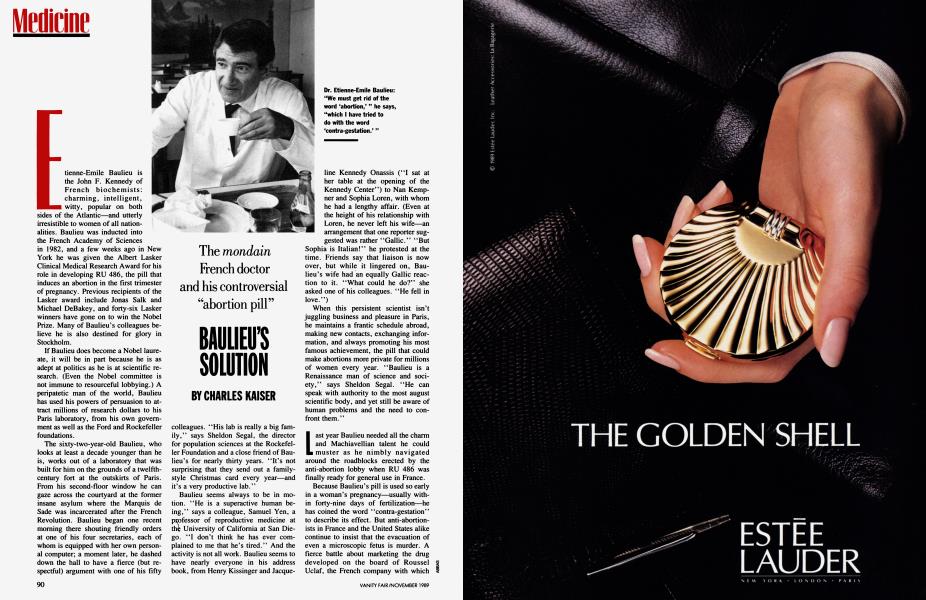
The mondain French doctor and his controversial "abortion pill"
Etienne-Emile Baulieu is the John F. Kennedy of French biochemists: charming, intelligent, witty, popular on both gjP sides of the Atlantic—and utterly irresistible to women of all nationalities. Baulieu was inducted into the French Academy of Sciences in 1982, and a few weeks ago in New York he was given the Albert Lasker Clinical Medical Research Award for his role in developing RU 486, the pill that induces an abortion in the first trimester of pregnancy. Previous recipients of the Lasker award include Jonas Salk and Michael DeBakey, and forty-six Lasker winners have gone on to win the Nobel Prize. Many of Baulieu's colleagues believe he is also destined for glory in Stockholm.
If Baulieu does become a Nobel laureate, it will be in part because he is as adept at politics as he is at scientific research. (Even the Nobel committee is not immune to resourceful lobbying.) A peripatetic man of the world, Baulieu has used his powers of persuasion to attract millions of research dollars to his Paris laboratory, from his own government as well as the Ford and Rockefeller foundations.
The sixty-two-year-old Baulieu, who looks at least a decade younger than he is, works out of a laboratory that was built for him on the grounds of a twelfthcentury fort at the outskirts of Paris. From his second-floor window he can gaze across the courtyard at the former insane asylum where the Marquis de Sade was incarcerated after the French Revolution. Baulieu began one recent morning there shouting friendly orders at one of his four secretaries, each of whom is equipped with her own personal computer; a moment later, he dashed down the hall to have a fierce (but respectful) argument with one of his fifty colleagues. "His lab is really a big family," says Sheldon Segal, the director for population sciences at the Rockefeller Foundation and a close friend of Baulieu's for nearly thirty years. "It's not surprising that they send out a familystyle Christmas card every year—and it's a very productive lab."
Baulieu seems always to be in motion. "He is a superactive human being," says a colleague, Samuel Yen, a professor of reproductive medicine at th$ University of California at San Diego. "I don't think he has ever complained to me that he's tired." And the activity is not all work. Baulieu seems to have nearly everyone in his address book, from Henry Kissinger and Jacqueline Kennedy Onassis ("I sat at her table at the opening of the Kennedy Center") to Nan Kempner and Sophia Loren, with whom he had a lengthy affair. (Even at the height of his relationship with Loren, he never left his wife—an arrangement that one reporter suggested was rather "Gallic." "But Sophia is Italian!" he protested at the time. Friends say that liaison is now over, but while it lingered on, Baulieu's wife had an equally Gallic reaction to it. "What could he do?" she asked one of his colleagues. "He fell in love.")
When this persistent scientist isn't juggling business and pleasure in Paris, he maintains a frantic schedule abroad, making new contacts, exchanging information, and always promoting his most famous achievement, the pill that could make abortions more private for millions of women every year. "Baulieu is a Renaissance man of science and society," says Sheldon Segal. "He can speak with authority to the most august scientific body, and yet still be aware of human problems and the need to confront them."
Last year Baulieu needed all the charm and Machiavellian talent he could muster as he nimbly navigated around the roadblocks erected by the anti-abortion lobby when RU 486 was finally ready for general use in France.
Because Baulieu's pill is used so early in a woman's pregnancy—usually within forty-nine days of fertilization—he has coined the word "contra-gestation" to describe its effect. But anti-abortionists in France and the United States alike continue to insist that the evacuation of even a microscopic fetus is murder. A fierce battle about marketing the drug developed on the board of Roussel Uclaf, the French company with which Baulieu collaborated in the development of the pill, and the "RU" in RU 486. According to Baulieu, Roussel had always been reluctant to push the pill, because it would not make a lot of money—and it would create a huge controversy.
Besides lobbying the French company, anti-abortionists also went after its German parent, Hoechst AG, which owns a 54.5 percent interest in Roussel. They compared the pill to the gas manufactured for the Nazis' ovens by Hoechst's predecessor company, I.G. Farben. Hoechst's chief executive officer, Wolfgang Hilger, is a devout Catholic who was especially vulnerable to the anti-abortion campaign. At the same time, there was additional pressure from Hoechst's American subsidiary, which provides 25 percent of the parent company's profits. American executives feared a boycott of its products even if Roussel limited the sale of the pill to France. Handbills distributed outside Roussel's Paris headquarters called the pill a "chemical weapon" that would "poison the still-tiny children of a billion third world babies." French officials also received threatening letters, although Baulieu predictably makes fun of them. "Can you see a 'right-to-life' person killing someone?" he asks. "It's ridiculous."
Finally, in September of last year, the French Minister of Health, Claude Evin, announced that Rous1 sel could market the pill. The archbishop of Paris, Jean-Marie Cardinal Lustiger, condemned the new product as "extremely dangerous," but Baulieu was still confident that Roussel would stand firm, because its chairman, Edouard Sakiz, has been his close friend since graduate school—and Baulieu had actually recommended Sakiz for his first job at Roussel. But Sakiz caved in, and on October 26, a month after use of the pill had been authorized by the government, Roussel announced that it was removing it from the market.
Baulieu immediately sprang into action, flying to Rio de Janeiro, where 9,500 doctors and researchers had gathered for the World Congress of Gynecology and Obstetrics. A petition was organized to protest Roussel's move, and Baulieu called a press conference to denounce it as "morally scandalous." Then, just two days later, the cause of RU 486 was rescued when Roussel was ordered to put the pill back on the market. The French government owns 36.25 percent of Roussel, and under French law the government could have transferred the patent for RU 486 to another company if Roussel continued to refuse to manufacture the product. Baulieu doesn't say whether he lobbied the Ministry of Health himself, but he does mention that his prominence gives him a distinct advantage in such situations: "I can pick up the phone and call a minister—that's useful."
Since Roussel was forced to make the pill available, more than 17,000 French women have received six hundred milligrams of RU 486 in conjunction with a small dose of prostaglandin. The two drugs together induce the equivalent of a miscarriage in 96 percent of the women who take them. Side effects include nausea and bleeding. Although no definitive study has yet been made, Baulieu believes his method will prove to be less traumatic than a surgical abortion. He says most French women who have undergone both types of procedures say they prefer the pill. And while research remains incomplete, there are indications that RU 486 might facilitate live births at the end of a pregnancy, and reduce the need for cesarean sections.
Even at the height of his relationship with Loren, he never left his wife.
Roussel's revolutionary compound is a kind of anti-progesterone that tricks the uterus into rejecting the progesterone necessary for a fertilized egg to cling to the wall of the uterus. In the early seventies his team of researchers discovered the receptors within the cells of the uterus which receive messages from progesterone, and that discovery led to the search for progesterone impostors. "The receptors are like a keyhole, and we were trying to produce a false key," he explained. It was a chemist at Roussel, Georges Teutsch, who in 1980 finally came up with the compound that would be known as RU 486. In the first series of tests, the drug produced abortions in nine of the eleven women who took it.
Part of Baulieu's strategy for getting wider approval of the pill has been to take a moderate position on abortion. In France, it is legal only through the twelfth week of pregnancy, and Baulieu thinks "twelve weeks is a good number. I think you have to have the courage to make a decision which respects the choice of a woman and at the same time the sensibility of everyone—not just people who are religious. It's good sense. You must avoid excesses in every case. Because of the right-to-life people, abortion means a little baby that one pulls out of the mother. That's horrible. We must get rid of the word 'abortion,' which I have tried to do with the word 'contra-gestation.' "
Baulieu himself does not believe in God. "I think that human beings are the fruit of an extraordinary evolution," he says. "I love man; I respect man—human beings, men and women. I adore children; I adore human life. It must be protected. But I am conscious all the time, from one second to the next, that one day it will be finished for man. We do not comprise the universe. I understand nothing, like everyone else. I regret very much that I don't believe in God. If I could, I would be very happy."
Baulieu's success in battling the antiabortion forces in France has transformed him into one of the most important figures in the worldwide population-control movement. "At the moment, Etienne is the modem knight on a white horse carrying the flag," notes Seymour Lieberman, a leading American biochemist who first worked with Baulieu at Columbia University in 1961. Lieberman thinks some American scientists may resent Baulieu's flamboyance, although he is not among them. "Women may like Frenchmen, but I'm not sure men do," he says. "The fact is, it takes someone of his knowledge and personality and energy to carry this crusade on."
Baulieu's crusade is just beginning, because so far Roussel has refused to make the pill available outside of France, although the government of China has already approved it for use there. A company spokesman says Roussel wants to test the product's effects thoroughly in France for one or two years before selling it anywhere else.
Baulieu has an appropriate background for being the point man on this crusade. He is the only son of Leon Blum (no relation to the politician), a well-known Jewish doctor from Strasbourg who was one of the first physicians in Europe to give insulin to a diabetic. When his father died, Etienne was only four, and his mother took him and his two sisters to Paris, to the large apartment in Neuilly where Baulieu still lives today. Etienne's mother was the twelfth child of a family from Normandy. When she was a young woman, she had traveled to England, where she met members of the suffragette movement. In 1920 she became a lawyer, only to give up her profession when she got married. After her husband died, she resumed the practice of law only once: to act as her own representative in a trial which gave her control of her husband's estate. She also had a Ph.D. in English and played piano at a conservatory. "She was very gifted and very beautiful," says Baulieu, "a strong woman who never wanted to remarry. She made us work extremely hard. I was not very strong, and they made me do gymnastics so that I would be a good athlete. The first time I climbed up the rope I was so scared I fell, and they took me home in an ambulance when I was seven. But later I had the first prize in gymnastics." His mother died three years ago at the age of ninety.
In 1942, the fifteen-year-old Blum became Baulieu (a name of his own invention) to hide his Jewish heritage and protect himself from the Nazis. He joined the Maquis, the Resistance forces in the countryside, and he stayed with them until 1944, when Paris was liberated. Then he enrolled in the Faculty of Medicine there.
In the fifties his mentor was Professor Max-Femand Jayle, who was completely blind from an accident he suffered in the lab. He was also "very right-wing and I think fairly anti-Semitic," Baulieu recalls. "However, he was a man with imagination, and there are not very many of those. I told him I was Jewish, and I think it amused him to have this contradiction." Baulieu said he wanted to emulate his professor by becoming a doctor and a biochemist, so Jayle sent his disciple to England to study the emerging field of chromatography. The two men clashed frequently: "Jayle always said, 'You can't obey anyone,' " Baulieu recalls. "There is a French proverb: 'In order to command, you have to learn by obeying.' I don't believe in that," he says, grinning.
Baulieu's first important discovery was the isolation of a natural hormone in the adrenal gland called dehydroepiandrosterone sulfate, which brought him to the attention of Seymour Lieberman at Columbia. Lieberman wanted to bring Baulieu to America in the fifties, but a Republican State Department refused to grant him a visa, because he had once been a member of the Communist Party. One month after John Kennedy entered the White House, Baulieu's visa came through, and he was on his way to New York. He traveled on the last voyage of the French ocean liner the Liberte. On board, he met a girlfriend of Frank Stella's, and within months of his arrival here he was acquainted with many of the best painters in America, including Jasper Johns and Robert Rauschenberg. "He always seemed to know the right people," says one of his first friends in New York.
Lieberman found Baulieu's willingness to come to America unusual all by itself. "Even to this day, the French— particularly those who come from Paris—are very hesitant to leave their country, because it's such a paradise there. They think there's nothing we can offer them." But Baulieu immediately took to America and Americans—and he particularly enjoyed the spirit of Lieberman's lab. "He could see that it was unlike anything he saw in Europe, where his bosses were tin-hat dictators," says Lieberman. "I think Etienne had already begun to question his mentor, Jayle, who was an autocrat, and very few of his students had the guts to take him on. Whereas Etienne even then had taken him on, and he got no credit from his peers for doing it. They thought he was brash and pushy and trying to be different." Probably because he was blind, Jayle had decided that patient diagnoses could be made strictly on the basis of laboratory results. Baulieu strongly disagreed, favoring a more personal approach.
In a speech before the French Academy of Sciences on the day Baulieu was inducted, Lieberman attributed his colleague's success to three factors: style, taste, and intuition. "Optimistic, enthusiastic, high-spirited, open-minded, cultured, serious but always aware of the comedy, philosophic but never ponderous . . . these characteristics define Etienne Baulieu."
Douring his first visit to America, Baulieu was introduced to Gregory Pincus, the father of the oral-contraception pill. Pincus would change the direction of Baulieu's career forever. (The two men had actually met once before, in the fifties, when Pincus went to visit Jayle in Paris, but on that occasion Baulieu had "hated him—because he didn't know me and he ignored me completely.") Pincus was "very subtle" in his method of seduction: he simply asked the young biochemist to stop on his way back to Paris at the new contraception clinic he had established in San Juan. "He said, 'I'll pay the difference in the cost of the ticket.' So I stayed two days there, and I was astonished. The subject of scientific contraception had never come into my mind before." Because of his work with steroid hormones, Baulieu was familiar with the way the contraceptive pill worked from a scientific point of view, and now his interest was piqued.
Pincus arranged to get him on a population-control committee of the World Health Organization. Then, in 1965, when Francois Mitterrand made the continuing French ban on contraception an issue in the presidential campaign, Charles de Gaulle named Baulieu to a committee of wise men studying the question. Largely because of Baulieu's arguments, the committee recommended approval of the Pill, and the law was changed soon afterward. A year later Baulieu attended a population conference sponsored by the Ford Foundation and chaired by Pincus. There he spoke for the first time of the hormone receptors which would play a crucial role in the development of RU 486. The Ford people asked him if he wanted some money and Baulieu said yes; however, as usual, he wouldn't accept any direction. "I didn't want to do anything they told me to do; I didn't want to look for ways of improving contraception. I said, 'I want to do basic research with receptors. Don't worry; sooner or later you will not regret it. From me or somebody else, there will be some reward.' So they gave me a lot of money." And that was the origin of the research that ultimately produced RU 486.
In Paris, Baulieu had been introduced to Jean-Claude Roussel. "Roussel called me up in 1962 and said, 'Do you want to become our chief of research?' And I said immediately, 'Certainly not.' And he said, 'Why? You don't know what it is to be rich.' " Baulieu says that he had learned early on that "l'argent ne fait pas le bonheur"—money can't buy happiness. "My mother told me that and she was absolutely right." So he became a consultant to Roussel instead, which worked out well because "I could ask them to do things that were interesting even if they were not terribly profitable for them," and "conversely, if I had a good idea and they could make money with it, good for them. With all the problems with RU 486, I'm very happy with this arrangement because I can say anything bad about Roussel I want to."
Baulieu's association with Roussel continues, despite the company's refusal to apply for F.D.A. approval for the drug in America. But that decision is actually one of the smaller obstacles Baulieu faces as he tries to use the prestige of the Lasker award to build support for RU 486 in America.
Last summer's decision by the Supreme Court in Webster v. Reproductive Health Services has guaranteed that the abortion issue will once again be on the agenda of nearly every state legislature. The Court's opinion went a long way toward restoring the power of the states to restrict abortions—the power which had been so severely limited by Roe v. Wade in 1973.
The Webster decision is the latest evidence of the superior political organization of the right-to-life movement, whose anti-abortion position is opposed by a majority of Americans—but supported by the Supreme Court justices appointed by Reagan as well as by Bush's attorney general. Advocates of abortion hope that RU 486 will help them consolidate support for their prochoice position because the pill facilitates earlier abortions—the type that most Americans seem to consider least offensive.
"There has been a lot of commotion over late abortion," says Faye Wattleton, president of the Planned Parenthood Federation of America. "That seems to be an area where people have a lot more conflict in their views about abortion. And one of the largest segments of the late-abortion group is young people— the twelveor thirteen-year-old who tries to conceal her pregnancy because she's afraid of it. A method like RU 486 may not seem so frightening or formidable as a surgical abortion." Early abortions are also safer: "There's less hemorrhaging and fewer cases of infection," says Wattleton. "With every week after the first trimester the complication rate increases significantly." According to estimates from the World Health Organization, more than 100,000 women die from abortions each year.
Baulieu needed all the charm and Machiavellian talent he could muster to navigate around the anti-abortion lobby.
Already, anti-abortionists have acknowledged that the new drug could complicate their task. "We're really very simplistic, visually oriented people," Dr. John Willke of the National Right to Life Committee told one reporter. "And if what [abortions] destroy in there doesn't look human, then it will make our job more difficult."
Prospects for distribution of the pill in America in the near future remain remote, despite the attention Baulieu received for the Lasker prize. "We do hope that this will expedite acceptance—that's the purpose of giving awards: to call attention to an advance," says Deeda Blair, a vice president of the Lasker Foundation. "Years ago we gave the prize to the first automated scanning technology. At that point there were only one or two instruments in this country, and within two years there were several hundred." Planned Parenthood will also campaign for RU 486, but Ms. Wattleton says, "We have no strategy until Roussel permits the drug to leave France." Baulieu doesn't think any big American companies will be interested in marketing RU 486, "because they always react slowly." But he says he has been deluged by offers from venture capitalistsv who would be willing to put up "$100 million tomorrow" if Roussel would grant them a license.
Baulieu is careful to point out that he does not collect royalties from the pill. "I have a problem with the question of money. I love having everything, but I neither want to earn nor to pay. I don't want to take royalties. I feel free. I can tell everyone to go to hell. I don't want any ties. My children aren't like that, and they're right. I'm the one who is wrong."
Baulieu often describes himself as an ascetic who believes in "persistent work," but—unlike his mother—not because he thinks you must work. "One works because one is afraid of doing nothing, and then becoming obsessed with metaphysical problems," he says. The work in his case led to fame, which he seems always to have known was in the cards, although he never had a plan—he just thought "it would happen all by itself." And like so many other major medical advances, his famous pill was an almost accidental discovery: "Honestly, I didn't foresee that we were going to go in this direction. I was just doing my work on an interesting compound."
But the fame turned out to be unexpectedly useful. He explains why it's important for scientists to be "as famous as painters or writers." Baulieu knows that "you have to personalize things a little, because people have the impression that science is a cold profession. But it is something that you do with your heart. Intelligence is very important, but you also need the will, the heart, passion, and persistence. Being a public figure is interesting because you are responsible for explaining the significance of science, not just treating sickness, but explaining how science is done—so that young people will not imagine that we are computers."
Subscribers have complete access to the archive.
Sign In Not a Subscriber?Join Now


