

Sign In to Your Account
Subscribers have complete access to the archive.
Sign In Not a Subscriber?Join NowSpain Events
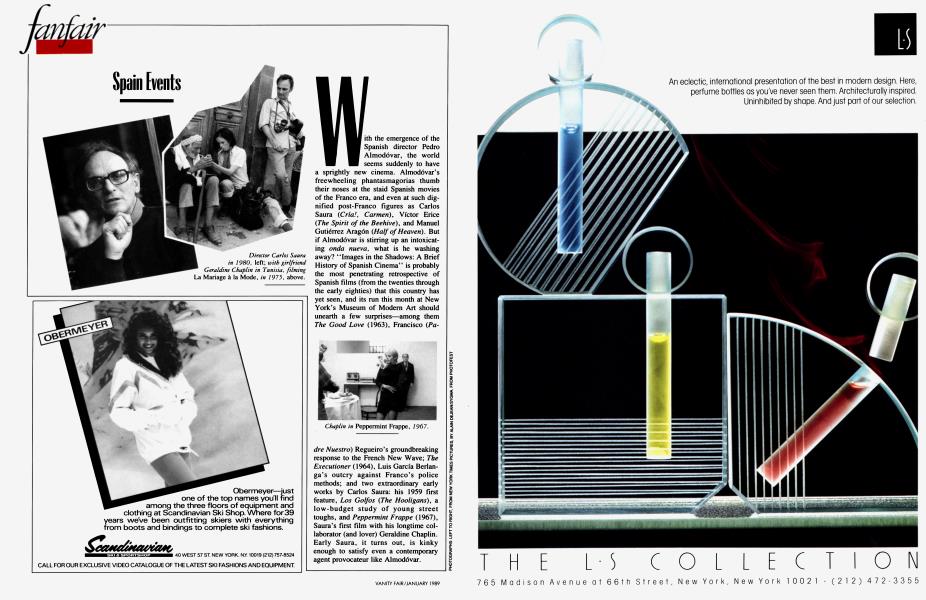
With the emergence of the Spanish director Pedro Almodovar, the world seems suddenly to have a sprightly new cinema. Almodovar's freewheeling phantasmagorias thumb their noses at the staid Spanish movies of the Franco era, and even at such dignified post-Franco figures as Carlos Saura (Cria!, Carmen), Victor Erice {The Spirit of the Beehive), and Manuel Gutierrez Aragon {Half of Heaven). But if Almodovar is stirring up an intoxicating onda nueva, what is he washing away? "Images in the Shadows: A Brief History of Spanish Cinema' ' is probably the most penetrating retrospective of Spanish films (from the twenties through the early eighties) that this country has yet seen, and its run this month at New York's Museum of Modem Art should unearth a few surprises—among them The Good Love (1963), Francisco {Pa- dre Nuestro) Regueiro's groundbreaking response to the French New Wave; The Executioner (1964), Luis Garcia Berlanga's outcry against Franco's police methods; and two extraordinary early works by Carlos Saura: his 1959 first feature, Los Golf os {The Hooligans), a low-budget study of young street toughs, and Peppermint Frappe (1967), Saura's first film with his longtime collaborator (and lover) Geraldine Chaplin. Early Saura, it turns out, is kinky enough to satisfy even a contemporary agent provocateur like Almoddvar.
Subscribers have complete access to the archive.
Sign In Not a Subscriber?Join Now