
Sign In to Your Account
Subscribers have complete access to the archive.
Sign In Not a Subscriber?Join NowTHE MAYOR'S TORMENT
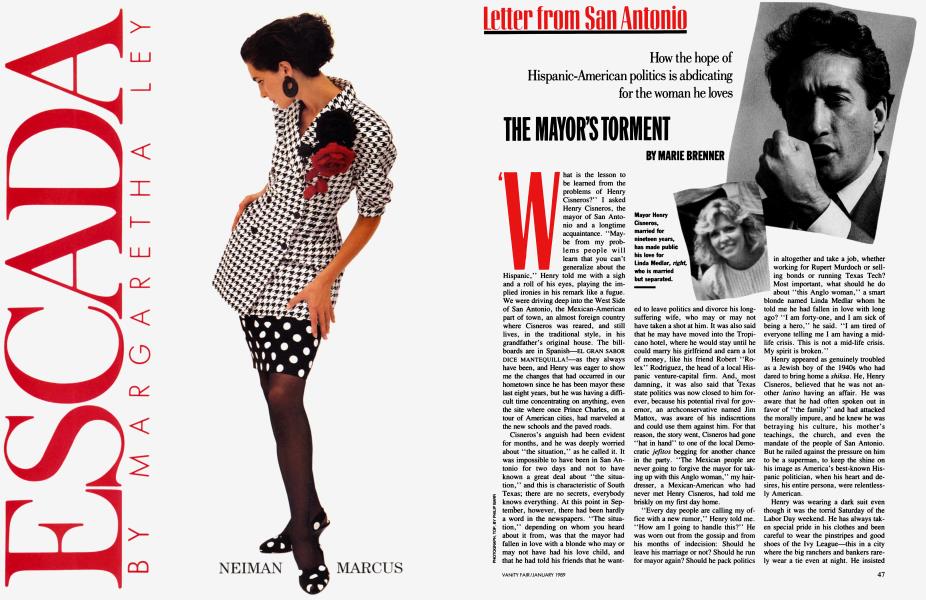
How the hope of Hispanic-American polities is abdicating for the woman he loves
Letter from San Antonio
MARIE BRENNER
'What is the lesson to be learned from the problems of Henry Cisneros?" I asked Henry Cisneros, the mayor of San Antonio and a longtime acquaintance. "Maybe from my problems people will learn that you can't generalize about the Hispanic," Henry told me with a sigh and a roll of his eyes, playing the implied ironies in his remark like a fugue. We were driving deep into the West Side of San Antonio, the Mexican-American part of town, an almost foreign country where Cisneros was reared, and still lives, in the traditional style, in his grandfather's original house. The billboards are in SPANISH-EL GRAN SABOR DICE mantequilla!—as they always have been, and Henry was eager to show me the changes that had occurred in our hometown since he has been mayor these last eight years, but he was having a difficult time concentrating on anything, even the site where once Prince Charles, on a tour of American cities, had marveled at the new schools and the paved roads.
Cisneros's anguish had been evident for months, and he was deeply worried about "the situation," as he called it. It was impossible to have been in San Antonio for two days and not to have known a great deal about "the situation," and this is characteristic of South Texas; there are no secrets, everybody knows everything. At this point in Septemiber, however, there had been hardly a word in the newspapers. "The situation," depending on whom you heard about it from, was that the mayor had fallen in love with a blonde who may or may not have had his love child, and that he had told his friends that he wanted to leave politics and divorce his longsuffering wife, who may or may not have taken a shot at him. It was also said that he may have moved into the Tropicano hotel, where he would stay until he could marry his girlfriend and earn a lot of money, like his friend Robert "Rolex" Rodriguez, the head of a local Hispanic venture-capital firm. And, most damning, it was also said that Texas state politics was now closed to him forever, because his potential rival for governor, an archconservative named Jim Mattox, was aware of his indiscretions and could use them against him. For that reason, the story went, Cisneros had gone "hat in hand" to one of the local Democratic jefitos begging for another chance in the party. "The Mexican people are never going to forgive the mayor for taking up with this Anglo woman," my hairdresser, a Mexican-American who had never met Henry Cisneros, had told me briskly on my first day home.
"Every day people are calling my office with a new rumor," Henry told me. "How am I going to handle this?" He was worn out from the gossip and from his months of indecision: Should he leave his marriage or not? Should he run for mayor again? Should he pack politics in altogether and take a job, whether working for Rupert Murdoch or selling bonds or running Texas Tech? Most important, what should he do about "this Anglo woman," a smart blonde named Linda Medlar whom he told me he had fallen in love with long ago? "Iam forty-one, and I am sick of being a hero," he said. "I am tired of everyone telling me I am having a midlife crisis. This is not a mid-life crisis. My spirit is broken."
Henry appeared as genuinely troubled as a Jewish boy of the 1940s who had dared to bring home a shiksa. He, Henry Cisneros, believed that he was not another latino having an affair. He was aware that he had often spoken out in favor of "the family" and had attacked the morally impure, and he knew he was betraying his culture, his mother's teachings, the church, and even the mandate of the people of San Antonio. But he railed against the pressure on him to be a superman, to keep the shine on his image as America's best-known Hispanic politician, when his heart and desires, his entire persona, were relentlessly American.
Henry was wearing a dark suit even though it was the torrid Saturday of the Labor Day weekend. He has always taken special pride in his clothes and been careful to wear the pinstripes and good shoes of the Ivy League—this in a city where the big ranchers and bankers rarely wear a tie even at night. He insisted that his wife, Mary Alice, who is very attractive, wear designer clothes, and in San Antonio, where the richest women wear denim prairie skirts, her clothes have caused comment. Image has always been crucial to Cisneros's success; he's had to look more Anglo, to try harder, in order to get the Anglo to take him seriously. There is a word in Spanish for this style, bolillo, which refers to Mexican dinner rolls made with white dough.
"I am guilty," says Henry Cisneros. "I have to turn off the klieg lights on me and try to understand what has happened to me."
The hot September morning was like so many we had known as San Antonio children. By nine A.M., the temperature sign on the MBank, which used to be the Alamo National, had already passed eighty degrees. As always on a Saturday in downtown San Antonio, there was hardly a car on Houston Street, the main thoroughfare. Clusters of Mexican-Americans in their gimme caps and work shirts sat fanning themselves on wooden benches, waiting patiently for the bus, never once bothering to get up and peer into the distance to see if a vehicle was on the horizon.
The Mexican-Americans smiling in the heat were a timeless, almost clich6d tableau of a just-about-vanished San Antonio—Dios nos cuida, God will take care of us, the bus will come when it comes. Yet all around us was another San Antonio, the town Henry Cisneros had helped to create with his unshakable belief in the wisdom of a glass-andchrome future, no matter what the cost. This holiday weekend, many of the downtown streets had been cordoned off and made into a racetrack for a national Grand Prix. Rich blond Anglos had come from their homes in Alamo Heights and Monte Vista, an elegant and cooler part of town, where not so long ago the police would sometimes stop Mexican-Americans who were just driving through to look at the stone houses on the shady streets. The Alamo Heights crowd had rented suites at the new posh hotels in order to drink margaritas and watch the race. "Isn't this just fantastic? Can you believe how the town has changed?" Henry asked, waving enthusiastically to the Mexican-Americans at the bus stops, who smiled and waved back at him. He motioned to the flags and the grandstands and pointed out the new Rivercenter mall, the Lord & Taylor, the freeways, and the immense convention center, most of which had been built since he became mayor. There was no question that Henry, with his genius for public relations and his ability to float city bond issues, believed a Grand Prix race would be one more step for progress—a television opportunity!—designed to put our formerly sleepy but charming hothouse of a town into the national psyche. He has been so effective at this that often the city of San Antonio and the name of Henry Cisneros have become almost indistinguishable, a Mdbius strip.
Although he was a week away from announcing that he would not seek reelection, Henry, a traditional Catholic with a paralyzing sense of sin and guilt, had already begun speaking about himself in the past tense. He was a troubled man with an open secret: his querida was an Anglo. And though this indiscretion reportedly wasn't the first for Henry, and nobody was counting, he insisted to his friends that this time it was different. "Cisneros confesses deep love for Medlar," the San Antonio ExpressNews bannered a few weeks later, in the first of many absurd stories on the subject. "He is the love of my life," Linda Medlar told the Express-News reporter. Medlar is separated from her husband, a jeweler. She had once worked in the mayor's office, and, more, she had been by his side, an indispensable aide, as he chafed in the confines of what he frequently called "a miserable marriage." The miseries were compounded by guilt: Cisneros has always blamed himself for his infant son's defective heart. "My wife, Mary Alice, didn't want more children," he told me. "I was the one, after two daughters, who insisted that we have another child. I was the one who was desperate for a son. And then the baby was bom with his terrible problems. You can read all the symbolism in that you want to about our marriage."
This confidence, and many others, Henry gave almost like presents to all his friends who were reporters. He had become baffled by a marriage that had seemed preordained to him as a child. He and Mary Alice grew up together on San Antonio's West Side. "Mary Alice and I have nothing in common anymore," he told me. "I begged her to go back to school, and she wouldn't. Instead, she became a born-again Christian. How can I live my life like this?" In happier days, June of 1987, Henry had described his "affair of the heart" with Mary Alice to Esquire: "My wife and I grew up together, and she's always, frankly, gotten to me in a way that I really can't quite explain. There are other women who are more statuesque.. .but I've always been particularly susceptible to that kind of excitement she generates." Henry has never seen anything wrong with living his life publicly.
When his son, whom he named John Paul after the pope visited San Antonio, was diagnosed as possibly not being able to live past the age of ten, Henry posed with the baby on the cover of Texas Monthly. He is a master of the new personality politics; he takes reporters to his house to display John Paul, and this seems less a calculated gesture than another example of his desire to be "likable," and thus "well liked." P.R., after all, is an important part of the job of being mayor of any town, and Henry has been, in the main, a terrific mayor because of his very high profile, in spite of the fact that he has doubled San Antonio's municipal debt with his freeways, his aquifers, and his plans for "quality of life" bonds and an "industrial corridor" between San Antonio and Austin.
Henry Cisneros has been a boon for a city where for decades the mayors were conservative members of the San Antonio Country Club, an organization with few Jews and not one Mexican-American or black. The mayor's salary of $4,000 a year reflects the traditional attitude of noblesse oblige in the hothouse, and during his years in office Cisneros has had to teach and give lectures in order to support his family. In the old San Antonio, the mayor was usually rich, and for years it seemed that these figureheads ' weightiest concern was who would get to put on the sashes and the sabers of the Order of the Alamo and choose the coronation queen and her court—a group of debs in $25,000 handbeaded gowns and trains who for one glorious fiesta week were anointed with suitable titles which only they didn't see as stand-up comedy—"The Duchess of Tehuantepec Plaza, Abounding with Vibrant Mexican Flowers." The larger tragedy of Henry Cisneros is his affinity for a world that seemed attractive and out of reach to him as a child. Since his election, he has tried to bridge the two San Antonios, the Anglo and the Mexican-American, and perhaps his passionate declaration for Linda Medlar, months before his son was to undergo the surgery that would determine whether he would live or die, was a sign that his fervor to be a crossover figure was causing him a great deal of strain.
"I wish I could believe that women are a dime a dozen. But I am flesh and blood."
The last time I had seen Henry for any length of time was in 1984, a few days after he had come back from being interviewed by Walter Mondale as a possible running mate in his presidential race. "I took him a basket of leche quemadas and pralines," Henry told me then, adding, "What do you know about Dianne Feinstein and Geraldine Ferraro?" He was full of promise, a handsome rising star on the verge of being able to leap into a world much wider than Anglo San Antonio, and he had the right qualifications for the jump. He was the product of an ambitious and good middle-class San Antonio family. He had been educated in a private Catholic school, and in the course of obtaining a graduate degree from Harvard he was a White House staff fellow. He was later appointed to the Kissinger commission on Central America, given the 1987 City Livability Award from the National Conference of Mayors, and praised for his understanding of what he called "the macro-micro" issues of running an American city, by which he meant the need for cities to be run with "public and private partnerships." He understood that San Antonio, suffering from the oil crash, and with its new biomedical industries and hordes of middle-class Mexican nationals buying condos north of the airport, could not be governed in any traditional way.
It was fashionable on the East Coast to think of Cisneros as a star from the barrio, a poor Mexican who had made good; this notion pleased liberals who read his Spanish name and drew their own mistaken conclusions. In fact, Henry's mother is a Munguia, a member of a prominent family that owns a printing business, and she has always expected only the best from her son. "I am very shocked, very upset with him.
. . . He should not have done this," Elvira Cisneros said when Henry announced he would not seek re-election. Henry's father, a military man, also set high standards for his son. When Henry was a child, his father gave him a copy of a speech given by Douglas MacArthur at West Point on the meaning of duty. The Cisneroses were "known to the community," accepted in the San Antonio world where the Hispanic and the Anglo have resided more or less harmoniously for two hundred years, despite the vast historical social and financial gulf between them. Henry Cisneros could never be a reformer fueled by ghetto poverty; unlike the late Willie Velasquez, head of the Southwest Voter Registration Education Project, he would never have made it his mission to lead a Hispanic revolution in South Texas. The mere fact that he was the mayor was enough; it was a certification that finally there was some recognition in the hothouse that time had stopped standing still for the 54 percent of the population of San Antonio that was of Hispanic origin.
"The fault line for the Hispanic here happened the day after Henry was elected," his friend Robert "Rolex" Rodriguez told me. "It is the theory that a rising tide lifts all boats." Henry rose to power as a city councilman who led the long-overdue battle to pave the streets, clean up the slums, and build the drainage ditches that would prevent San Antonio's deep West Side from flooding, but he has always been as desirous of acceptance in the Anglo world as of approval in his own. As mayor, he has admired what he calls "the energy of the new money," by which he is referring to his friends the powerful real-estate developers and car magnates, and he appears to spend as much effort worrying about getting their Sportsdome and Sea World constructed as he does thinking about how he will educate the average Mexican-American, whose current school dropout rate is 33 percent. "The yuppie mayor," he's been called, but Henry is a modem who is burdened by the past, and so he defies easy labels. Since he became mayor, the courthouse is filled with Hispanic lawyers, and all over town Hispanic businessmen flourish. One of his closest friends, Ernesto Ancira, who comes from a rich Monterrey family and who was educated in America, was chairman of the Hispanics for Bush in Bexar County. At times Henry seems so Anglo that my father, who himself emigrated from Mexico when he was seven and who was called "little greaser" as a San Antonio schoolboy, despite his fluency in English, once told Henry that he would have to polish up his Spanish if he wanted to make it in the national arena.
'Good morning, Mayor." A group of tourists stopped Henry as we were walking into the garden of the Spanish Governor's Palace, a squat adobe hacienda across from City Hall where the first Spanish governors used to rule the town of San Antonio. He is popular with visitors to the city. "Where are you from, folks? Wichita, Kansas?" he asked, then offered to pose for a picture before he led me into a shaded part of the garden, perhaps near the spot where the original Latin governors used to decide which Comanches they would throw into cells at the missions in order to convert them to Catholicism. "I always come over from City Hall to relax here," he said. "I feel so peaceful in this garden. It's a good place to come when I can't take the stress of the situation anymore."
We sat across from each other at a picnic table. Although it was now late morning and almost a hundred degrees, it was cool under the live-oak tree. "I wish you could understand what it means to grow up as a Catholic in San Antonio," Henry said. "Look at my life. I married young. It was not a good match or a happy one. The Catholic strictures are binding. They are part of having to live in my grandfather's house. You don't leave the West Side. You don't betray the family_
"I am guilty," he said. "I have to turn off the klieg lights that are on me and try to understand what has happened to me. I am worried that my little boy will not survive. Mary Alice thinks I have turned away from God, and this is at the root of my problems. She has become a born-again Christian, and in the morning I wake up to Jesus tapes and at night that's what I go to sleep with! Mary Alice says because she has found Jesus she was able to go to the Democratic convention as a delegate, and because I have been living the sinner's life I have, I was only offered twelve and a half minutes on the platform and I chose to remain at home. I can hardly talk to her anymore."
"I understand," I said, although I wasn't sure I really did. ''But if you leave politics, it will seem you are throwing away your base because of an Anglo."
"God Almighty, I wish I could be like Lyndon Johnson and just say the deal, the deal, the deal is all that matters, no matter how dirty. I wish I could believe that women are a dime a dozen. But I am flesh and blood. I want to be in love. I can't go forward in my life until I have resolved my problems. I can't go forward without the right support at home. Fourteen years I have given to this city! And now it is enough! I have to figure out who lam."
For a moment, there was a silence between us. "When I was in graduate school, I fell deeply in love with a Canadian girl who was studying city planning. Mary Alice and I were already married, and I decided I had had enough of being burdened by my background. That night I went to bed and I had a dream that my baby daughter, Teresa, was hit by a car on my way to church. Can you believe that? But there it was. And I decided after that dream that I would have to live my life like a priest. I would have to devote myself to a cause and a city. That was fourteen years ago, and that is when I came home and went into politics."
A few weeks later, Henry Cisneros's personal torment became a national news story. I was not surprised to see that Henry talked with reporters from The Washington Post, The New York Times, and The Wall Street Journal about his problems. Mary Alice and their two teenage daughters made frequent visits to her fundamentalist church to pray. "I have fallen back on my faith, and all I can do is go to my church and pray that this mess will go away," Mary Alice told me. She even took John Paul to a faith healer. Although Cisneros's passion for Linda Medlar had become an odd sidebar to this autumn's national political events, Henry remained at home on the West Side, perhaps believing that his mere confession was the first step to self-knowledge. "Henry is a very sick puppy," his political adviser George Shipley told me. Cisneros said that he had made no decisions about whether or not he would divorce, and he announced at City Hall that before he left office in the spring he was determined to pass the bond bill that would ensure the money to pay for the construction of the Alamo Sportsdome, promoted in part by his friend Red McCombs, the owner of the San Antonio Spurs. Henry refused to make a decision about where he would finally live or with whom; it was as if, despite his polish and education and his modem American ways, he was still a part of that other San Antonio, believing that Dios nos cuida.
In November, a state political poll found what anyone in South Texas could have predicted: Henry Cisneros remains the most popular politician in the state. His approval rating is now 54 percent, despite Linda Medlar and all the headlines pronouncing his "fall from grace," as The Wall Street Journal phrased it. He is lengths ahead of the two candidates who would have been running against him for governor had he entered the race. He is leading Ann Richards, the feisty state treasurer and a divorcee, by eighteen percentage points, and he is twentythree points ahead of Jim Mattox, who has never been married. Even the archbishop of San Antonio told Cisneros's advisers that God "would forgive Henry because his sins only make him more human." Henry's friend Red McCombs, eager for the mayor to remain in office through the completion of the Alamo Sportsdome, began a powerful movement to draft Cisneros to run again— despite his announcement that he had had enough. To the amusement of the local wags, Cisneros's dilemma only enhanced his stature. And a new story had begun to circulate in South Texas, spread by Cisneros's friends: from the very beginning, Henry was blameless, and it was the ambitious Linda Medlar who had caused the mayor's distress.
"Imagine if I could have been the first Mexican-American governor in the state of Texas," Henry told me that day in the garden of the Spanish Governor's Palace. "That would really be something. But first I have to have time to strip myself back and figure out what I am about. Then anything is possible."
Subscribers have complete access to the archive.
Sign In Not a Subscriber?Join Now


