

Sign In to Your Account
Subscribers have complete access to the archive.
Sign In Not a Subscriber?Join NowTANKS FOR THE MEMORIES
The comeback of the W.W.II movie-this year's rollout includes Steven Spielberg's brilliant Saving Private Ryan, Terrence Malick's The Thin Red Line, and David Leland's The Land Girls-isn't simply nostalgia. It's the desire to bury the cornball, recruiting-poster legend of John Wayne: to get it right this time
James Wolcott
Every time pop culture comes full circle, it seems to pick up speed. The Gap ad "Khakis swing," a 30second spot that became an instant classic, shows young couples jitterbugging in white space to the raspy summons of Louis Prima's "Jump, Jive an' Wail." Directed by Matthew Rolston, this jukebox explosion pops like a junior version of Paul Taylor's ballet Company B (which was set to the music of the Andrews Sisters). It also recalls the phenomenal jitterbug sequence Steven Spielberg staged in 1941, a crescendo of movement, cutting, and exuberance that left some hoping that Spielberg might be the salvation of the movie musical one day. Quick, elegant, and succinct, "Khakis swing" celebrates the hormonal popcorn burst young people experience on the home front during wartime. The ad does more than sell product—it's a piece of fanfare. Khaki is sexy again, wearing a crisp new crease, not only because of the Gap's marketing skill but because of what's next on the agenda. Through fluke or design, "Khakis swing" serves as a coming attraction for the big rollout of World War II movies about to unramp.
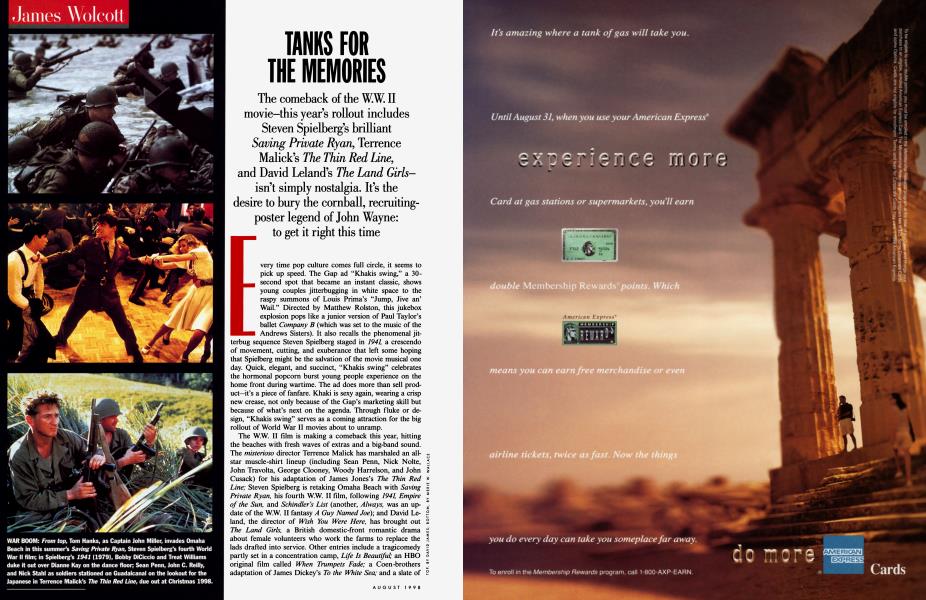
The W.W. II film is making a comeback this year, hitting the beaches with fresh waves of extras and a big-band sound. The misterioso director Terrence Malick has marshaled an allstar muscle-shirt lineup (including Sean Penn, Nick Nolte, John Travolta, George Clooney, Woody Harrelson, and John Cusack) for his adaptation of James Jones's The Thin Red Line; Steven Spielberg is retaking Omaha Beach with Saving Private Ryan, his fourth W.W. II film, following 1941, Empire of the Sun, and Schindler's List (another, Always, was an update of the W.W. II fantasy A Guy Named Joe); and David Leland, the director of Wish You Were Here, has brought out The Land Girls, a British domestic-front romantic drama about female volunteers who work the farms to replace the lads drafted into service. Other entries include a tragicomedy partly set in a concentration camp, Life Is Beautiful; an HBO original film called When Trumpets Fade; a Coen-brothers adaptation of James Dickey's To the White Sea; and a slate projects with titles like U-571, Thunder Below, and Earth, Wings, and Fire. A trend this large and varied couldn't be coordinated by the entertainment superstate that The Nation likes to fret about. It's a spontaneous media cluster bomb.
For armchair generals, the conveyor belt of reading and viewing fodder related to World War II has never run dry: an endless bulkload of nonfiction books has explored every battle, campaign, command decision, brand of military hardware, and cranny of Hitler's psyche; what-if novels such as Robert Harris's Fatherland have explored the ramifications of a Nazi victory; on cable TV, look-alike documentaries (patched together with the same cloudy footage of artillery firing and MacArthur smoking a corncob pipe) seem to be broadcast on a recurring loop on the History and Discovery Channels; in June, the American Movie Classics channel presented a weekend festival of the greatest war films, many of them set during W.W. II; video catalogues are packed with remastered versions of series such as Victory at Sea and Why We Fight; CD-ROMS and computer games enable joystick jockeys to wage their own aerial dogfights (UP YOURS, ADOLF! hollers a cover line on PC Gamer magazine). Such retrovision has even mutated into sci-fi: A special two-part episode of Star Trek Voyager featured the cast in a holographic recreation of the French Resistance, with nightclub scenes, Nazi raids, and Jeri Ryan's Seven of Nine done up as a satin doll. When people picture themselves being brave and stealing a kiss at curfew, their thoughts run irresistibly to Casablanca.
The new World War II films are a neoconservative phenomenon, harking back to a simpler, white-bread era.
At the movies, however, W.W. II films have been spotty since the imperial bluster of Patton and the overreach of A Bridge Too Far. Directors have tended to steer their cameras away from the battle zone and toward the civilian side, reveling in childhood memories (John Boorman's Hope and Glory), engaging in liplocked romance (Yanks, starring Richard Gere), or coping with those left behind (Swing Shift and TV's Homefront). When more traditional war films have popped up in recent years, they've looked out of place, retro. (Memphis Belle, for example, seemed a halfhearted attempt to do for the bombardier film what Silverado and Young Guns did for the Western—re-stage the past as a hunkfest.) To younger audiences, jaded by the amplified firepower of Lethal Weapons and Die Hards, the machine-gun burp of W.W. II weapons sounded as puny as six-shooters in a Saturday matinee. The bullets didn't even leave chunky holes in the bodies. (What a gyp.) The can-do attitudes and teamwork of the W.W. II film were rendered square by the angst-ridden Vietnam film, with its spooky rock 'n' roll psychedelia (Jimi Hendrix and Jim Morrison practicing shamanism from beyond the grave), lost illusions, and existential willies. W.W. II films expressed a collective purpose as broad and simple as a banner headline; Vietnam films revealed the demons lurking beneath the social cracks. The emblematic Vietnam films (Apocalypse Now, Platoon, Full Metal Jacket, Casualties of War) generated their own cliches—the Vietnamese cutie who turns out to be Cong, the helicopter as deus ex machina, the black soldier as brimstonespouting soul brother—but their ferocious insistence on facing the truth of the American involvement in Southeast Asia seemed to have retired the certitudes of the W.W. II genre for good.
So why this sudden resurgence? The most obvious explanation is that the new World War II films are a neoconservative phenomenon, harking back to a simpler, white-bread era, when men were men, mothers wore aprons, and every civic moment was a Saturday Evening Post cover. Save for a few Partisan Review ideologues, the war between the Allies and the Axis powers was a clear-cut conflict of good versus evil, democracy versus dictatorship, right versus might. After the bombing of Pearl Harbor, America was united. Cynicism didn't ride roughshod over the whole enterprise. It was a war in which the press was represented by a comrade soul such as the correspondent Ernie Pyle, who filed human-interest stories about the average G.I., rather than the camera crews feeding like locusts in the Vietnam era. The W.W. II setting allows for male-female relations less spiked with sexual politics, more urgent in embrace, and meltingpot ensembles (what Pauline Kael called "a 40s-movie bombercrew cast"—one Italian, one Jew, one farm boy, one Brooklyn wiseacre, etc.) where its members can mix and spar without the self-consciousness of a hyphenated identity. At a time when America has no mission other than to keep itself entertained, the W.W. II film, like Titanic, re-creates a horizon-slipping momentousness of sacrifice, feeling, spectacle. It's low-tech heavy metal for a culture lost in cyberspace.
As with so much else in pop culture, the WLW. II film answers to the nostalgia of the baby-boom generation.
A s with so much else in pop /I culture, the W.W. II film an/1 swers to the nostalgia of the baby-boom generation. Male babyboomers like myself grew up on war movies. The mere time killers among them inspired the cutups in the audience. Growing up near a military base in Maryland, I would crouch in the front at the base theater and listen to soldiers heckle the screen: they would make knowing noises whenever the hunky co-stars of Merrill's Marauders cast soulful blue-eyed looks at each other and razz the stick-figure actors in now forgotten filler like The Raiders of Leyte Gulf. We had favorites in every genre, from the submarine movie, with its sweat, oil, and gurgling depth charges (Run Silent, Run Deep), to the God-questioning lonelycockpit saga (Twelve O'Clock High, The Battle of Britain), to the blinding-sun sand-trap odyssey (Sahara, starring Humphrey Bogart). True buffs knew the difference between Bataan (superbly directed by Tay Garnett, with its rousing finale of Robert Taylor firing his machine gun into the mist-shrouded jungle) and its follow-up, Back to Bataan (routine heroics supervised by Edward Dmytryk). We preferred beefy mongrels such as Aldo Ray and Gene Evans to vanilla wafers like Van Johnson, or, for that matter, fancy pants like Peter O'Toole, whose foppish manner in The Night of the Generals bordered on decadence. (Albert Goldman, the Jewish-hipster biographer of Elvis and John Lennon who had a passionate sideline obsession with German military history, used to regale listeners with his imitation of James Mason as Rommel in The Desert Fox, positioning tanks as if he were hanging drapes.) Comparing notes, a lot of us found the much-touted cynicism and antiheroism of Billy Wilder's Stalag 17 to be little more than a cute wink, but I never met anyone who didn't find Steve McQueen's motorcycle ride over the barbed-wire fences in The Great Escape a transcendent solo. Even movies set during the Korean conflict—Sam Fuller's The Steel Helmet and Fixed Bayonets, Anthony Mann's Men in War (a characteristic Mann mood study of haunted motives and chewed-up terrain), and Pork Chop Hill— were W.W. II movies as far as we were concerned: same format, different foe.
Like the 60s Western, in which old stars put themselves out to pasture, the W.W. II movie developed significant ass-drag. In an essay in The Georgia Review (Spring 1998), Philip D. Beidler shows how the success of the 1962 film The Longest Day was the inspiration for later folly. Researched by an in-house division of Reader's Digest, Cornelius Ryan's The Longest Day was obtained by producer Darryl F. Zanuck as a movie property. Zanuck's coup was to create a three-layer cake of stunt casting. At the top were the "old war-movie reliables," as Beidler calls them, such as John Wayne, Henry Fonda, Robert Mitchum, and Robert Ryan; in the middle, handsome luggage such as Robert Wagner and George Segal, along with the comedy relief of Red Buttons; at the bottom, to attract teenage squealers, a raft of pretty faces belonging to Paul Anka, Fabian, Sal Mineo, and Tommy Sands. The one featured woman in the cast was the Czech actress Irina Demick—Zanuck's mistress at the time. The result was a sprawling, packed, enjoyable movie event whose influence proved larger than its achievement or boxoffice success. Beidler: "The Longest Day was the great original— docu-epic, cameo-epic, bio-epic, call it what one will—that set the pattern for a great overblown genre." Hoping to emulate and surpass The Longest Day, studios commissioned extravaganzas that became ever more paunchy and flatulent-logistical nightmares such as In Harm's Way, Torn! Torn! Torn!, and Midway. The more swollen the production, the more removed the final result from any recognizable reality. We weren't watching soldiers and officers anymore; we were watching aging actors simulate themselves against a vast diorama. Exhausted, the epic form migrated to television, where it was turned into sweeping soap opera with The Winds of War, in which Robert Mitchum shuttled between Allied bigwigs and domestic crises with a mellow nonchalance that looked like noble understatement amid so much glossy suffering.
A side from The Land Girls, a weak brew that suggests Masterpiece Theatre chaperoning a "chick flick," the new wave of W.W. II movies isn't part of a nostalgia craze. If anything, it represents a desire to get it right this time. The new W.W. II movies seek to wrest the war away from the legend of John Wayne, the totemic beanbag who is synonymous with the genre and symbolizes the unfashionable ideals of both patriotism and patriarchy. As Gerry Lewis, an executive at DreamWorks, told The Independent of London regarding the production Saving Private Ryan, "Steven [Spielberg] wanted to make an in-yourface war movie. It's getting away from the Hollywood gung-ho, John Wayne style of film." Ironically, this shunning of the "John Wayne style of film" coincides with the intellectual overhaul and upgrade of the Duke's reputation as actor and icon, as evidenced by Garry Wills's critically acclaimed John Wayne's America: The Politics of Celebrity (Simon & Schuster, 1997). This ambivalence signifies a genuine, confused desire to rescue Wayne from his actual film work—to detach his lumbering and likably foolish persona from its celluloid wrapping. (Which would explain the popular Coors Light commercial where Wayne's image has been inserted Zelig-like into a boot-camp scenario, his mythic presence making the drill sergeant gulp. It's a successful operation in "recontextualization"—giving us a Wayne that is all aura) Wayne's war films are vulnerable to revisionism. They've worn much worse than his Westerns, especially the war films directed by John Ford. Ford's stoic framing of the actors, the har-dee-har-har comic relief provided by the horseplay of his supporting cast, and the sanctimony starching all his work badly date such films as They Were Expendable.
Still, it seems a curiously rearguard action to distance oneself from John Wayne-type movies more than a half-century after they were made. While it is true that a number of war films released early in the 40s were glorified recruiting posters ("The Marine Corps was first with Wake Island in 1942, which is said to have occasioned a great rush to USMC recruiting stations," Paul Fussell writes in Wartime [Oxford, 1989]), it's not as if everybody was brainwashed at the time into thinking they were getting the raw goods. Reviewing Bataan in The Nation, James Agee praised the movie not for its verisimilitude but for its virile folk poetry, which he likened to a "native ritual dance," and he wrote of another film set in the Pacific theater: "Guadalcanal Diary, an adaptation of the Richard Tregaskis book, is unusually serious, simple, and honest, as far as it goes; but it would be a shame and worse if those who made or will see it got the idea that it is a remotely adequate image of the first months on that island."
Spielberg toughens the genre by portraying W.W. II with the most orchestral fury ever committed to film.
Later films went back and filled in the blanks. For every W.W. II blockbuster that was neutered by Hollywood (Norman Mailer's The Naked and the Dead), there was one whose aggression rumbled through (Fred Zinnemann's adaptation of James Jones's From Here to Eternity). The nerve-snapping toll of combat was best shown in small-unit studies of squads under siege, such as Don Siegel's Hell Is for Heroes, in which Steve McQueen plays an expert killer with psychopathic cool, and, most wildly, in Robert Aldrich's Attack!, where Jack Palance undergoes symbolic castration, his arm crushed beneath a tank tread. When color replaced black-and-white, blood was no longer dispensed with eyedroppers, soldiers dying with an inky trickle from the mouth, but slapped on with a thick brush. No one could sit through David Lean's The Bridge on the River Kwai, where the soundtrack hummed with insects and Alec Guinness was confined to "the oven," and not share the punishment. Sam Peckinpah's Cross of Iron, one of the few films angled from a German perspective, was a godless harvest of heads, limbs, and other appendages, its moiled landscape recalling James Jones's observation "Armies create their own mud, in actual fact." Behind the battlefield exploits lies the looming, shaming shadow of the Holocaust, the depiction of its horrors becoming so graphic in films like Spielberg's Schindler's List that some fear it borders on pornography.
The problem with nearly all war movies (a problem not for audiences but for the filmmakers, who pride themselves on their humanistic motives) is that no matter how grittily they try to deglamorize war, to show the misery, cruelty, and senseless waste of battle, they can't resist making its violence a spectacle. They can't control the adrenaline flow. With the inflicting spirit that informed his Schindler's List, Steven Spielberg both softens and toughens the W.W. II genre in Saving Private Ryan. Softens, by casting as the lead not a macho snake handler like Bruce Willis or George Clooney, someone who might revive the red-blooded tradition of John Wayne, but Tom Hanks—Mr. Everyman. (No one will look at Hanks and think, Warmonger.) Toughens, by portraying W.W. II with the most orchestral fury ever committed to film. The opening battle, in which Hanks's Captain Miller leads a D-day assault on Omaha Beach, his men puking over the sides of the landing craft, the light gray-green, the compositions reminiscent of Robert Capa, becomes a gyroscopic spin of the death wheel. Fortified German positions make meat of the Allied forces. Necks squirt, faces implode, blood pumps from the stump of a soldier trying to retrieve his severed arm, guts squish underfoot. In this open-air madhouse, those charging forward and those crouching for cover are perforated alike with lethal pops. An overture of pure cinema, the Omaha Beach sequence crowds the eye and pounds the synapses. Days after, I was having flashbacks. Like Peckinpah, Spielberg splatters bodies as if they were watermelons, in juicy geysers of red, but unlike Peckinpah, he doesn't lean on slow motion: he doesn't give the slaughter a lyrical flourish, or pause after a particular explosion or lariat of blood for a neato effect. In fact, no other filmmaker has ever shown how fast everything happens in battle. As the movie proceeds, the weather and film stock seem in constant flux to emphasize this rapid discontinuity. The movie's ultra-violence is almost totally devoid of machismo. Courage in Saving Private Ryan isn't so much a matter of character as the basic ability to keep going. The climactic battle, the defense of a bridge against German tanks, is an almost unbearably thrilling firefight and demonstration of peak-form filmmaking.
The W.W. II film is low-tech heavy metal for a culture lost in cyberspace.
James Agee was lighter than he knew when he compared the W.W. II movie to a native ritual dance. It is, in fact, a male initiation rite, a trial by fire in which cocky boys emerge, if they're lucky, as chastened men. The sneak punch of Saving Private Ryan is that it bypasses the usual introductions to its characters and puts the audience through the initiation rite, immersing them in chaos and bringing them out the other side, shaken but grateful. (The film's historical consultant was the celebrated biographer and war historian Stephen E. Ambrose, whose great book Citizen Soldiers is Saving Private Ryan writ large.) The old-fashioned yet non-jingoistic patriotism of the movie—its reverential flutter of the American flag and tribute to sacrifice—may be too much for the media-sawy smartasses, to borrow a phrase from John Updike. What will be interesting to see is whether women go to and for Saving Private Ryan and the other bloodbaths on tap, or if they choose to shy away. Because I've noticed that whenever men discuss their favorite W.W. II films, women get this look on their faces that translates as "Men are so silly." For some reason, women don't seem to fantasize about chucking hand grenades at pillboxes.
Subscribers have complete access to the archive.
Sign In Not a Subscriber?Join Now


