Sign In to Your Account
Subscribers have complete access to the archive.
Sign In Not a Subscriber?Join NowANNUS NOT SO MIRABILIS
A guide to the hype and glory of the 1989 Bordeaux
JOEL L. FLEISHMAN
Wine
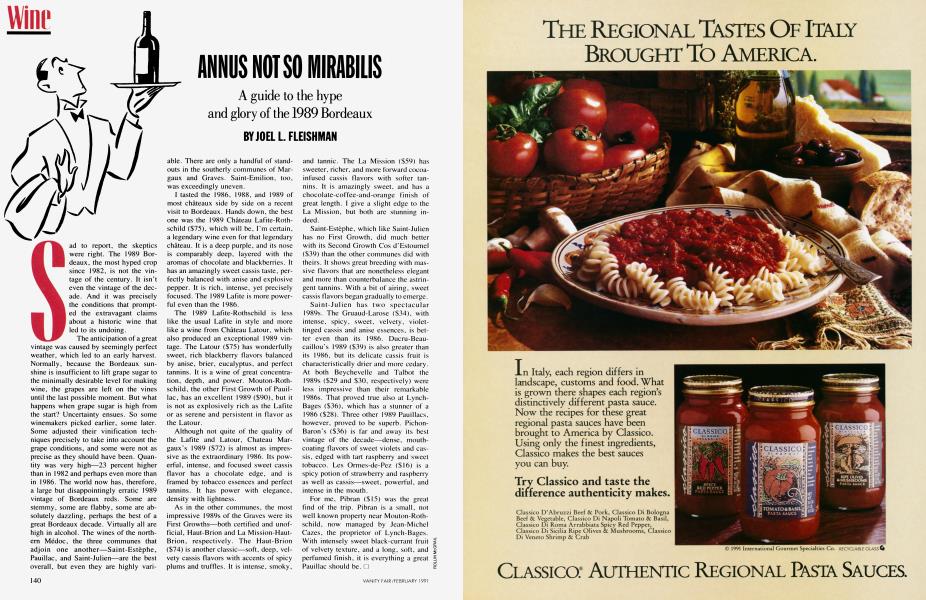
Sad to report, the skeptics were right. The 1989 Bordeaux, the most hyped crop since 1982, is not the vintage of the century. It isn't even the vintage of the decade. And it was precisely the conditions that prompted the extravagant claims about a historic wine that led to its undoing.
The anticipation of a great vintage was caused by seemingly perfect weather, which led to an early harvest. Normally, because the Bordeaux sunshine is insufficient to lift grape sugar to the minimally desirable level for making wine, the grapes are left on the vines until the last possible moment. But what happens when grape sugar is high from the start? Uncertainty ensues. So some winemakers picked earlier, some later. Some adjusted their vinification techniques precisely to take into account the grape conditions, and some were not as precise as they should have been. Quantity was very high—23 percent higher than in 1982 and perhaps even more than in 1986. The world now has, therefore, a large but disappointingly erratic 1989 vintage of Bordeaux reds. Some are stemmy, some are flabby, some are absolutely dazzling, perhaps the best of a great Bordeaux decade. Virtually all are high in alcohol. The wines of the northern Medoc, the three communes that adjoin one another—Saint-Estephe, Pauillac, and Saint-Julien—are the best overall, but even they are highly variable. There are only a handful of standouts in the southerly communes of Margaux and Graves. Saint-Emilion, too, was exceedingly uneven.
I tasted the 1986, 1988, and 1989 of most chateaux side by side on a recent visit to Bordeaux. Hands down, the best one was the 1989 Chateau Lafite-Rothschild ($75), which will be. I'm certain, a legendary wine even for that legendary chateau. It is a deep purple, and its nose is comparably deep, layered with the aromas of chocolate and blackberries. It has an amazingly sweet cassis taste, perfectly balanced with anise and explosive pepper. It is rich, intense, yet precisely focused. The 1989 Lafite is more powerful even than the 1986.
The 1989 Lafite-Rothschild is less like the usual Lafite in style and more like a wine from Chateau Latour, which also produced an exceptional 1989 vintage. The Latour ($75) has wonderfully sweet, rich blackberry flavors balanced by anise, brier, eucalyptus, and perfect tannins. It is a wine of great concentration, depth, and power. Mouton-Rothschild, the other First Growth of Pauillac, has an excellent 1989 ($90), but it is not as explosively rich as the Lafite or as serene and persistent in flavor as the Latour.
Although not quite of the quality of the Lafite and Latour, Chateau Margaux's 1989 ($72) is almost as impressive as the extraordinary 1986. Its powerful, intense, and focused sweet cassis flavor has a chocolate edge, and is framed by tobacco essences and perfect tannins. It has power with elegance, density with lightness.
As in the other communes, the most impressive 1989s of the Graves were its First Growths—both certified and unofficial, Haut-Brion and La Mission-HautBrion, respectively. The Haut-Brion ($74) is another classic—soft, deep, velvety cassis flavors with accents of spicy plums and truffles. It is intense, smoky, and tannic. The La Mission ($59) has sweeter, richer, and more forward cocoainfused cassis flavors with softer tannins. It is amazingly sweet, and has a chocolate-coffee-and-orange finish of great length. 1 give a slight edge to the La Mission, but both are stunning indeed.
Saint-Estephe, which like Saint-Julien has no First Growth, did much better with its Second Growth Cos d'Estournel ($39) than the other communes did with theirs. It shows great breeding with massive flavors that are nonetheless elegant and more than counterbalance the astringent tannins. With a bit of airing, sweet cassis flavors began gradually to emerge.
Saint-Julien has two spectacular 1989s. The Gruaud-Larose ($34), with intense, spicy, sweet, velvety, violettinged cassis and anise essences, is better even than its 1986. Ducru-Beaucaillou's 1989 ($39) is also greater than its 1986, but its delicate cassis fruit is characteristically drier and more cedary. At both Beychevelle and Talbot the 1989s ($29 and $30, respectively) were less impressive than their remarkable 1986s. That proved true also at LynchBages ($36), which has a stunner of a 1986 ($28). Three other 1989 Pauillacs, however, proved to be superb. PichonBaron's ($36) is far and away its best vintage of the decade—dense, mouthcoating flavors of sweet violets and cassis, edged with tart raspberry and sweet tobacco. Les Ormes-de-Pez ($16) is a spicy potion of strawberry and raspberry as well as cassis—sweet, powerful, and intense in the mouth.
For me, Pibran ($15) was the great find of the trip. Pibran is a small, not well known property near Mouton-Rothschild, now managed by Jean-Michel Cazes, the proprietor of Lynch-Bages. With intensely sweet black-currant fruit of velvety texture, and a long, soft, and perfumed finish, it is everything a great Pauillac should be.
Subscribers have complete access to the archive.
Sign In Not a Subscriber?Join Now