
Sign In to Your Account
Subscribers have complete access to the archive.
Sign In Not a Subscriber?Join NowGUNS AND POSES
Mixed Media
A revisionist view of Richard Ford, the lauded novelist
JAMES WOLCOTT
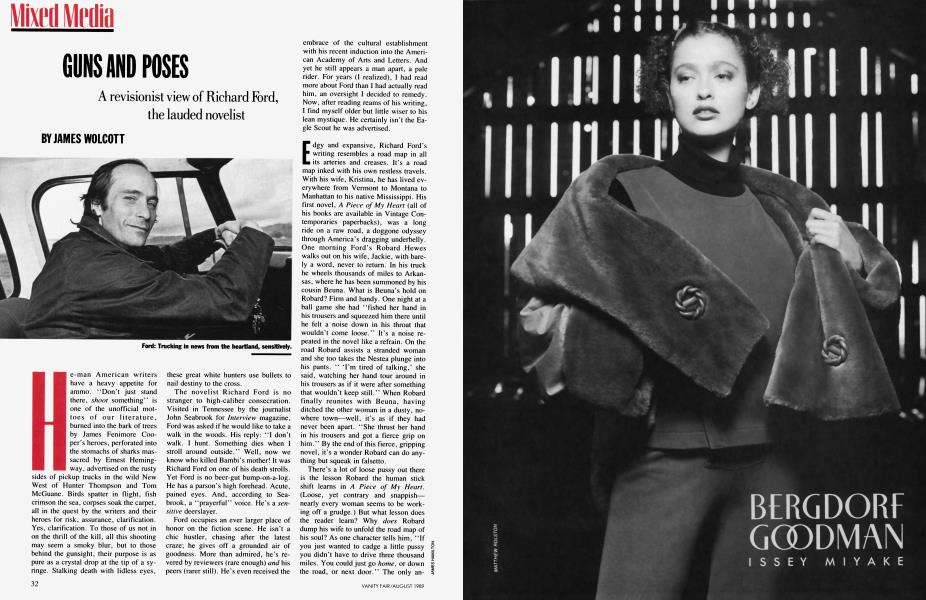
He-man American writers have a heavy appetite for ammo. "Don't just stand there, shoot something" is one of the unofficial mottoes of our literature, burned into the bark of trees by James Fenimore Cooper's heroes, perforated into the stomachs of sharks massacred by Ernest Hemingway, advertised on the rusty sides of pickup trucks in the wild New West of Hunter Thompson and Tom McGuane. Birds spatter in flight, fish crimson the sea, corpses soak the carpet, all in the quest by the writers and their heroes for risk, assurance, clarification. Yes, clarification. To those of us not in on the thrill of the kill, all this shooting may seem a smoky blur, but to those behind the gunsight, their purpose is as pure as a crystal drop at the tip of a syringe. Stalking death with lidless eyes, these great white hunters use bullets to nail destiny to the cross.
The novelist Richard Ford is no stranger to high-caliber consecration. Visited in Tennessee by the journalist John Seabrook for Interview magazine, Ford was asked if he would like to take a walk in the woods. His reply: "I don't walk. I hunt. Something dies when I stroll around outside." Well, now we know who killed Bambi's mother! It was Richard Ford on one of his death strolls. Yet Ford is no beer-gut bump-on-a-log. He has a parson's high forehead. Acute, pained eyes. And, according to Seabrook, a "prayerful" voice. He's a sensitive deerslayer.
Ford occupies an ever larger place of honor on the fiction scene. He isn't a chic hustler, chasing after the latest craze; he gives off a grounded air of goodness. More than admired, he's revered by reviewers (rare enough) and his peers (rarer still). He's even received the embrace of the cultural establishment with his recent induction into the American Academy of Arts and Letters. And yet he still appears a man apart, a pale rider. For years (I realized), I had read more about Ford than I had actually read him, an oversight I decided to remedy. Now, after reading reams of his writing, I find myself older but little wiser to his lean mystique. He certainly isn't the Eagle Scout he was advertised.
Edgy and expansive, Richard Ford's writing resembles a road map in all its arteries and creases. It's a road map inked with his own restless travels. With his wife, Kristina, he has lived everywhere from Vermont to Montana to Manhattan to his native Mississippi. His first novel, A Piece of My Heart (all of his books are available in Vintage Contemporaries paperbacks), was a long ride on a raw road, a doggone odyssey through America's dragging underbelly. One morning Ford's Robard Hewes walks out on his wife, Jackie, with barely a word, never to return. In his truck he wheels thousands of miles to Arkansas, where he has been summoned by his cousin Beuna. What is Beuna's hold on Robard? Firm and handy. One night at a ball game she had "fished her hand in his trousers and squeezed him there until he felt a noise down in his throat that wouldn't come loose." It's a noise repeated in the novel like a refrain. On the road Robard assists a stranded woman and she too takes the Nestea plunge into his pants. " T'm tired of talking,' she said, watching her hand tour around in his trousers as if it were after something that wouldn't keep still." When Robard finally reunites with Beuna, having ditched the other woman in a dusty, nowhere town—well, it's as if they had never been apart. "She thrust her hand in his trousers and got a fierce grip on him." By the end of this fierce, gripping novel, it's a wonder Robard can do anything but squeak in falsetto.
There's a lot of loose pussy out there is the lesson Robard the human stick shift learns in A Piece of My Heart. (Loose, yet contrary and snappish— nearly every woman seems to be working off a grudge.) But what lesson does the reader learn? Why does Robard dump his wife to unfold the road map of his soul? As one character tells him, "If you just wanted to cadge a little pussy you didn't have to drive three thousand miles. You could just go home, or down the road, or next door." The only answer Robard supplies comes when he's asked what's more important than a piece of ass, and he replies, "Another piece.'' Certainly Beuna is portrayed as nothing more than a cheap piece. Her breasts poke out of her blouse, she talks trash in the take-me, hurt-me sound bites of a James M. Cain roadside attraction ("1 want to do it in the back of the truck in the dirt and the rocks and the filthiness''), and she has Jell-O for brains. Her exit from the novel is meant to be the shaming exposure she has earned. Fed up, Robard boots Beuna out of the truck and into a patch of mud, where she lands with "her gauze skirt up over her waist, showing her bare behind to the rain.'' No, Beuna was never worth all this mileage, and Robard's obdurate motivation remains obscure. His whole trip seems a windblown, overblown whim— the puzzle pieces of his search are never fitted together. Ending in aimless death, A Piece of My Heart is motored by the aversion to women that marks wilderness-flight novels from the beginning of our literature.
Women and guns" are what John Seabrook says he and Ford discussed when he was a creativewriting student of Ford's. Women and guns are entwined in Ford's work, emblems of entrapment and treachery and dangerous release. Women suffocate; guns ventilate. Ford's second novel, The Ultimate Good Luck, is an attempt to fuse these conflicting forces into a single true shot. The scene: Oaxaca, Mexico. The temperature: hot. The mood: itchy. Inside a bungalow a girl suffering from "mescal willies" is peddling Ford's female brand of feel-bad sex: "I sucked you off, right? And I don't even know your name." His name is Harry Quinn; his mission in Mexico, to spring his girlfriend's brother from prison before drug baddies ice him. The girlfriend—Rae— isn't a vivid presence on the page, but she's sane and stalwart, an advance over the skags of A Piece of My Heart. In other ways this second novel is an improvement over the first. Structurally, The Ultimate Good Luck is the most compact of Ford's novels, with keen inhalations of dread and decay, implosive tension, explosive terror. But like many novels trying to update the James M. Cain/Jim Thompson canon, The Ultimate Good Luck suffers from too much cornstarch in the dialogue. Primitive itches give way to existential emoting. " 'You're never ironic, Harry,' she said airily. 'That's really what's wrong with you. You need to be more ironic.' " Ironic Harry isn't. A Vietnam veteran, he's the hard works. But like Robard in A Piece of My Heart, Harry is opaque, his motivation filed down to Aman's-gotta-do-what-a-man's-gotta-do. And what a man's gotta do in this situation is blow holes in bodies. Don't just stand there, shoot something. "Shooting somebody raised your personal importance level," he thinks, and after a shoot-out that leaves three dead, he slips into the fdm noir rain. "He wondered, as he walked, if he'd perfected something in himself by killing three people he didn't know, when he had come at the beginning, simply to save one, and if now he had pleased anybody anywhere. Though he thought that if he hadn't pleased anybody, at least he'd tried to, and had performed it under control, and he hadn't coped so bad all by himself at the end. He thought, in fact, that he'd done fine." Or as Mickey Spillane's Mike Hammer (like Quinn, a battle vet) put it more colorfully in One Lonely Night, "I was able to prove that I wasn't a bloodthirsty kill-happy bastard with a mind warped by a war of too many dawns and dusks laced by the crisscrossed patterns of bullets." Killing with steady hands is satisfying and sanctifying. Baptized in blood, Quinn has been symbolically reborn.
Like his late friend Raymond Carver, Ford isn't meretricious. Ponderous, pretentious, but not meretricious.
Set over an Easter weekend, Ford's third novel, The Sportswriter, is even more baptismal than The Ultimate Good Luck. But this is no baptism of blood or fire. Waves of words baptize America's brow as Ford pipes his prayerful tone from a portable pulpit. His narrator is—ah, but let him introduce himself. "My name is Frank Bascombe. I am a sportswriter." Author of a book of short stories, Bascombe finds himself treading air as a fiction writer. Admitting defeat on that front, he adapts to covering the thrill of victory/the agony of defeat for a magazine modeled on Sports Illustrated. The red-eyed fan fever of sports—the noise in the stands, the cabalistic fascination with stats—is rinsed clean in this novel. Sports in The Sportswriter are what movies are in Walker Percy's The Moviegoer, thin spectacles that allow the narrator to hang his sagging doubts on the line. (As if to acknowledge kinship, Percy provided a blurb for The Sportswriter.)
If the men in Ford's earlier fiction lacked interior life, Frank Bascombe overflows with it, flooding every situation with informal address. Something of a self-portrait, Bascombe represents the loneliness of the long-distance writer. His sense of isolation is heightened by the still-haunting death of his son. Bascombe's direct pleas to the reader and his Everyman plight help make this the most poignantly accessible of Ford's novels. And it's probably the only novel of his which has crossover appeal to women. More than popular, The Sportswriter is considered by many critics a modern classic. A masterpiece of malaise.
This Cub Scout finds The Sportswriter maddening. The novel does have humor, scope, shifting scenery, slipsliding moods. It doesn't paw a small patch; it swings for the fences. But it's also swimming up to its ennui-soaked eyeballs in a bookish banality and condescension doing its best to pass itself off as bruised wisdom. On nearly every page is the plop of platitude: "A change to pleasant surroundings is always a tonic for creativity." "A life can simply change the way a day changes—sunny to rain, like the song says. But it can also change again." "Some life is only life, and unconjugatable, just as to some questions there are no answers." "Being a man gets harder all the time." Hey, tell me about it. Don't worry, Bascombe will and does, dropping cliches into the slot until he gets a dial tone and a dead ear at the other end of the line. The Sportswriter probably has more message units than any novel this side of Saul Bellow, but at least Saul Bellow's characters are brainy oddballs—their messages carry a static buzz. Frank Bascombe, however, prides himself on being a dreamy blur, lonely as a cloud. "Dreamy people often do not mix well, no matter what you might believe. Dreamy people actually have little to offer one another, tend in fact to neutralize each other's dreaminess into bleaiy nugatude." (Nugatude: the chewy candy three out of four alienated intellectuals prefer.)
A dreamikins on deadline, Ford's sportswriter presents himself as a representative case. Divorced, two kids, adrift. Oh, he ponders new roots. He has a nurse girlfriend named Vicki. "Maybe we'll get married in Detroit, fly back and move out to Pheasant Run, and live happily like the rest of our fellow Americans. What would be wrong with that?" Nothing—everything. The sentiment seems snide and insincere. The phrase "our fellow Americans" carries too much ironic snot, and the character of Vicki is smeared with too much cheap lipstick. Everything about her screams no-taste, including her name. "Vicki sounds like a name you'd see on a bracelet at Walgreen's," she complains. A minty airhead, Vicki seems to have Tic Tacs rolling around like BBs in her brain. She's not as coarse as Beuna, but she doesn't seem much more substantial. So what is her attraction for a man who uses "nugatude" in a sentence? "She is a girl for every modem occasion, and I find I can be interested in the smallest particulars of her life," he explains patronizingly. Her charms are more basic than that. Cut to the hotel room: "I have a good handful of her excellent breast now, and what a wonderful bunch she is, a treasure trove for a man interested in romance."
Ass or breast, a piece is just a piece, at least to a Ford hero. And although other women appear in The Sportswriter, it's Vicki whose shortcomings carry metaphorical import. You have the feeling that this is what Ford thinks America is: a tacky bimbo. She epitomizes the tawdry future. In his epilogue, Bascombe confides, "From Vicki Arcenault I have not heard so much as a word, and I wouldn't be surprised to leam that she has moved to Alaska and reconciled with her first husband and new love, skinhead Everett, and that they have become New Agers together, sitting in hot tubs discussing their goals and diets, taking on a cold world with Consumer Reports, assured of who they are and what they want. The world will be hers, not mine." As a parting shot, he speculates that Vicki will someday discover that she never liked men anyway and then parade this hostility in public.
What a gent. And this, this! is the character saluted by Tobias Wolff as "a bird rare in life and nearly extinct in fiction—a decent man." Afloat in bad faith, Frank Bascombe isn't a decent man, he's a sensitive creep pulling the long face of a decent man. It's a pious impersonation that fooled the critics, and maybe Ford himself. He allows the sportswriter's podium to become a pedestal.
For some readers the real Richard Ford is to be found not in the novels but in the stories, where he compresses the wayward strains of life out West into a crushed snowball shaped like a heart. In the stories collected in his most recent book, Rock Springs, he chronicles lives undone by a single misdeed or bad bounce, avoiding the canned soup of The Sportswriter for a clearer broth. The ghosts of Hemingway and Raymond Carver and the badlands ballads of Bruce Springsteen haunt the gun barrels of these stories, in which the characters find themselves courting trouble or cornered by it, caught without consolation or shelter. The limited space of these tales leaves less room for Ford to inflate. Yet here too there are problems. Perhaps it's an easy out built into the short-story form, but many of the stories in Rock Springs pump with action, only to step back in the last few paragraphs, pause—and punt. These afterthoughts have a lot of hangtime. Sometimes they're affecting, as in "Communist," where the narrator memorializes his mother's voice. (Ford, whose mother died the year he started The Sportswriter, strikes his most sorrowful notes when he mourns missing or ineffectual mothers—mourns the warmth their absence has withdrawn from their sons' lives.) But some of these fade-outs fog the action with rhetoric. At the end of the title story, for example, a car thief cases a Pontiac in the parking lot of a Ramada Inn. He looks back at the motel and sees two lighted rooms, one of them his. And the other? Perhaps he's being observed.
Now we know who killed Bambi's mother! It was Richard Ford on one of his death strolls.
And I wondered, because it seemed funny, what would you think a man was doing if you saw him in the middle of the night looking in the windows of cars in the parking lot of the Ramada Inn? Would you think he was trying to get his head cleared? Would you think he was trying to get ready for a day when trouble would come down on him? Would you think his girlfriend was leaving him? Would you think he had a daughter? Would you think he was anyone like you?
No, I'd probably be wondering if some sum'bitch is trying to break into my car.
Nevertheless, through such stories Ford has become a symbol of rootless America. Evidence of this was the appearance of his face in the May issue of Money magazine to illustrate an essaymeditation on motels. The article itself read like The Sportswriter checking into a clinic and getting the shakes. "If there's a gaunt sinking feeling comes over us when we push our bag through the doorway and peep inside, a feeling of bearable indignation, of inconsequential undoing, of losing things we know we can't lose. . . " etc. To Ford, low-cost motels are space stations of soullessness, orbiting in oblivion. "And Lord knows, if I couldn't in such a room even force myself to tweak the woof on the hand towels or pull the drapes to take the view or check the rate card on the door—if all devolved to erasure and denatured spirit—what chance could frail desire ever have? Or mystery? Or illusion?" Ma, it's that damned prayerful tone again. That Ford would climb upon such stilts to write about motels in Money means that he's come to accept his role as scarecrow to the masses. What a joyless vigil!
Moral seriousness does lend a certain aura, however. After reading Richard Ford's books in succession, I've come to the notion that it's the idea of Richard Ford that accounts for his success as much as his writing. Like his late friend Raymond Carver, Ford brings news of spiritual breakage from the far horizons of the heartland while still harboring hope. And like Carver, he isn't meretricious. (Ponderous, pretentious, but not meretricious—he doesn't take shortcuts in his fiction to sure responses.) Loaded with ammo, Ford has the Hemingwayesque part down pat. Who else could fit the bill? Tom McGuane and Barry Hannah are too weirdly flip, James Dickey too baroque. Ford's American Gothic features provide a living testament to his craft and calling, his laconicism sliced not from ham but from some leaner stripe of manhood. His whole outlook on life doesn't do much for me. But then, I've never wanted Bambi's mother on my conscience. When I walk in the woods, I'm content to look.
Subscribers have complete access to the archive.
Sign In Not a Subscriber?Join Now

