Sign In to Your Account
Subscribers have complete access to the archive.
Sign In Not a Subscriber?Join NowCLASS STRUGGLE
There's big trouble at St. Albans, D.C.'s power prep school
TOBY THOMPSON
Letter from Washington
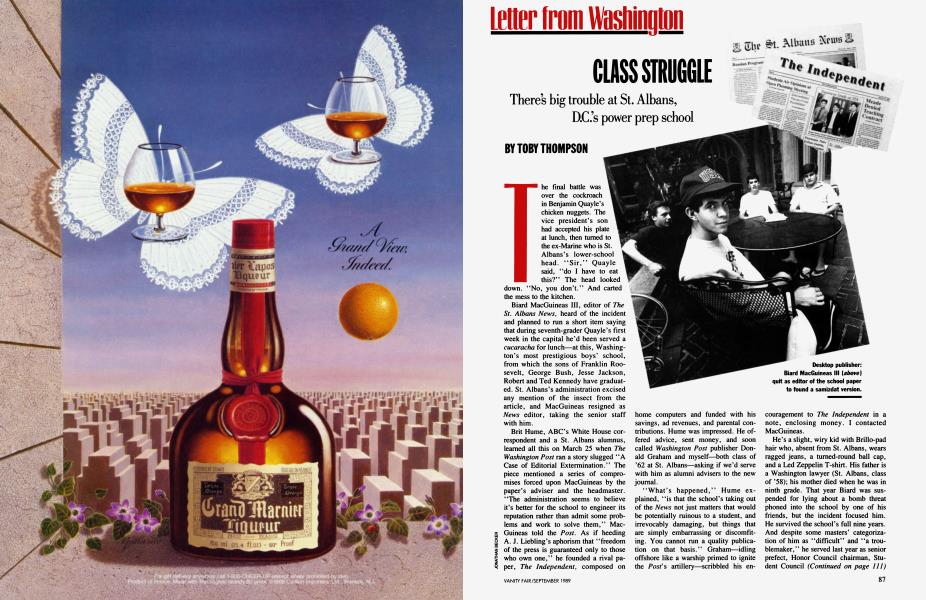
The final battle was over the cockroach in Benjamin Quayle's chicken nuggets. The vice president's son had accepted his plate at lunch, then turned to the ex-Marine who is St. Albans's lower-school head. "Sir," Quayle said, "do I have to eat this?" The head looked down. "No, you don't." And carted the mess to the kitchen.
Biard MacGuineas III, editor of The St. Albans News, heard of the incident and planned to run a short item saying that during seventh-grader Quayle's first week in the capital he'd been served a cucaracha for lunch—at this, Washington's most prestigious boys' school, from which the sons of Franklin Roosevelt, George Bush, Jesse Jackson, Robert and Ted Kennedy have graduated. St. Albans's administration excised any mention of the insect from the article, and MacGuineas resigned as News editor, taking the senior staff with him.
Brit Hume, ABC's White House correspondent and a St. Albans alumnus, learned all this on March 25 when The Washington Post ran a story slugged "A Case of Editorial Extermination." The piece mentioned a series of compromises forced upon MacGuineas by the paper's adviser and the headmaster. "The administration seems to believe it's better for the school to engineer its reputation rather than admit some problems and work to solve them," MacGuineas told the Post. As if heeding A. J. Liebling's aphorism that "freedom of the press is guaranteed only to those who own one," he founded a rival paper, The Independent, composed on home computers and funded with his savings, ad revenues, and parental contributions. Hume was impressed. He offered advice, sent money, and soon called Washington Post publisher Donald Graham and myself—both class of '62 at St. Albans—asking if we'd serve with him as alumni advisers to the new journal.
"What's happened," Hume explained, "is that the school's taking out of the News not just matters that would be potentially ruinous to a student, and irrevocably damaging, but things that are simply embarrassing or discomfiting. You cannot run a quality publication on that basis." Graham—idling offshore like a warship primed to ignite
the Post's artillery—scribbled his encouragement to The Independent in a note, enclosing money. I contacted MacGuineas.
He's a slight, wiry kid with Brillo-pad hair who, absent from St. Albans, wears ragged jeans, a turned-round ball cap, and a Led Zeppelin T-shirt. His father is a Washington lawyer (St. Albans, class of '58); his mother died when he was in ninth grade. That year Biard was suspended for lying about a bomb threat phoned into the school by one of his friends, but the incident focused him. He survived the school's full nine years. And despite some masters' categorization of him as "difficult" and "a troublemaker," he served last year as senior prefect, Honor Council chairman, Student Council president, and News editor. "I was accepted at Harvard and Stanford," he said. "But I was afraid Harvard would be too much like St. Albans. I'm going to Stanford." Along with other Independent staffers, including Kim Roosevelt (T.R.'s greatgreat-grandson), he graduated cum laude in June.
(Continued on page 111)
(Continued from page 87)
But both boys—children of this privileged 5 schooling—are bitter. "I don't think St. Albans gives its students any kind of moral education," Roosevelt told me in his dryly bookish voice. "The administration is more concerned with preserving or promoting an image of St. Albans." MacGuineas noted of headmaster Mark Mullin, an Episcopal priest, that "he really does not have students' respect. He's shown some blatant hypocrisy, favoritism, and double standards this year."
St. Albans is an Episcopal school, founded on the National Cathedral Close in 1909 from a trust established by Harriet Lane Johnston, President James Buchanan's niece. A good percentage of the school's 540 boys come from families engaged in government or diplomatic service, the rest from Washington's ancien regime. It was named for the protomartyr of the English and is attached sentimentally to the oldest public school in Britain. It takes its lead pedagogically from British public schools, emphasizing the goal of building character through discipline, abstinence, and stiff competition. As senior Dory Ruderfer wrote in The Independent, "At St. Albans we receive an incredible education, but for the most part it comes from pounding and flogging us with vast quantities of information. That kind of work does not inspire personal intellectual inquiry; more often it drives students to rebel. . . and it drives some to acts of insanity."
Last fall, Episcopal bishop John Walker's son, a St. Albans senior, took a baseball bat to the windshields and/or side mirrors of sixteen parked cars after being refused entrance to a rival school's party. He was allowed to withdraw from St. Albans, angering many students, who felt Headmaster Mullin was evading his responsibility to make an example of any student involved in such incidents. Young Walker was best friends with Mullin's son, also a senior; Bishop Walker was Mullin's superior on St. Albans's board of governors and within the National Cathedral Chapter.
MacGuineas assigned a News editor to the story, Ethan McSweeny (his father is president of Occidental International), who was already reporting a piece on interschool violence. "It had escalated from fists to golf clubs to baseball bats," McSweeny said. "There was a group of about ten St. Albans fighters known as 'the Hosses.' They were extremely athletic and heavy weekend drinkers." The fighting was primarily among boys from St. Albans, Landon, and Sidwell Friends—rival prepsters— who flaunted their school jackets like gang colors. "They'd crash each other's parties and fight," McSweeny said, "resulting in broken arms, legs, and jaws."
"These kids just felt they were above the law... because they went to the best school, because they were richer and more privileged."
The terror of this violence was described vividly to me by Tom Wilner, a Washington lawyer and St. Albans alumnus, who until 1988 served on its board of governors. He told of a Sidwell party next to his home being crashed by "twenty kids with St. Albans letter jackets on, yelling, cursing and screaming, and throwing beer bottles at the house. I went out and tried to stop them. One of the kids took a swing at me. I ducked and sort of threw him over a car, called the police, and they all scattered.
"I went to pick my son up at another party, and this same crowd of boys were doing the same sort of thing. Again I got into this altercation with them. I remembered that three years ago there'd been a Sidwell-St. Albans J.V. football game where suddenly there was a huge fight. A St. Albans boy yelled, 'You kids from Sidwell are nothing but niggers and dirty Jews.' "
Wilner vented his anger in schoolboard meetings and told Mark Mullin, "You are responsible for setting a tone of moral leadership that allows this continually to go on. And for looking at it and blaming it on other people."
Mullin wrote a series of tough parent letters that condemned the fighting and urged a close monitoring of student parties. "A group of unsupervised teenagers is a problem waiting to happen," he said. The fighting diminished, then intensified. Wilner stepped down from the board. He remains critical, as do other alumni and parents, of what one characterizes as "an aura of chill and fear" on campus. But many parents with graduating sons were reluctant to voice their distaste, fearing possible retribution by the school.
"This violence while wearing St. Albans jackets," Wilner said, "and being so arrogant to think that you're the smartest, the richest, the most powerful. These kids just felt they were above the law... because they went to the best school, because they were richer and more privileged, and nobody said, 'Hey, nobody is above the law.' "
Mullin parried: "When the issue of who is and who isn't a wimp is a major source of discussion in the election of the president of the United States, what message are these kids getting? Violence is glorified in our society. The president of the United States says, 'Make my day,' and we all know what he's referring to."
At forty-nine, Mullin is a husky, black-haired ex-athlete who was chaplain at Choate before coming to St. Albans in 1977. Though praised for raising faculty salaries and for permitting a master with AIDS to continue teaching, he's been a controversial head. He's in the unenviable position of succeeding Canon Charles Martin, a bulldog of a cleric who ruled St. Albans for twenty-eight years. Martin composed parent letters so thoughtful they've become part of the school's legacy. "Each boy has a right to be a person, the right to make his own mistakes," Martin wrote. "It is natural to seek to pass on one's experience; but it is natural too, and right, that the young person learn through his own actions, even though it be to his own hurt and to our hurt." I recalled this advice as MacGuineas detailed his jousting with Mullin.
"It started in November, when he told us we couldn't mention the Bishop Walker incident. We were writing an article about interschool violence. Unarguably that was a chapter. At first we planned to print the boy's name, because we'd never been taught anything against printing minors' names." Once advised, "we were happy not to print his name. Then the headmaster told me we really couldn't mention Walker or the incident at all. That bothered us. He said it would cause the family 'unnecessary grief.' "
"If a story's news," Mullin stated, "it can be written. If it's pillorying an individual, St. Albans isn't interested in that."
Mullin asked to preview the issue, and bridled when he saw a photo of Cum Laude Society inductees on its front page, posing in their boxer shorts. Among them was David Galbraith, John Kenneth's grandson. "Fifteen years from now, when David wants to become secretary of state," one master argued, "a journalist is going to question that picture. It happened to Evan Bayh." Mullin told MacGuineas to replace the photograph. Publication of the News was delayed, and the Walker story died.
MacGuineas then scheduled a piece about sophomore parents meeting "to discuss complaints about the school and the faculty." The parents drafted a letter citing "an alleged lack of respect for students and assignment of excessive workloads." Mullin killed the story, claiming it was "not compassionate" to the principal teacher involved— a math instructor who, in advanced classes, required three or four hours' work a night, assigned the cleaning of blackboards, desks, and floors for wrong answers or insubordination, and insisted, according to Kim Roosevelt, that for homework students "use a Uni-Ball Micro pen on blank white paper, an inch-and-a-quarter margin drawn on the left side."
The headmaster established a board of three former News advisers to comb each issue prior to publication for problematic material. And then came Ben Quayle's cockroach—"an issue of taste," Mullin declared. The News's adviser, Wallace Ragan, had told MacGuineas he couldn't run the word "cockroach" in the paper, because "it was too gross." He suggested changing it to "foreign substance." MacGuineas rejected that idea but changed "cockroach" to "cucaracha." (In an earlier article, Ragan had told MacGuineas to remove the word "penis": "Put it in braces and change it to the Latin.") Ragan still balked, ordering MacGuineas to print out the entire contents of the paper for his approval. "That would have been the third time that weekend I'd printed it all out for him," MacGuineas said. "It also meant that would be the third issue delayed by the administration's review. I'd been thinking of resigning for the whole issue, because censorship was getting more and more ridiculous."
He did. And chartered The Independent, producing its first issue despite Mullin's refusal to permit use of the school's computers, software, darkrooms, address lists, or refectory for distribution. The headmaster also refused all requests for interviews by the new paper. "I consider The Independent divisive," he said.
"We were treated like outlaws," MacGuineas recalled. "There was no adult in the school who trusted us. They clearly expected us to put out some kind of hate literature. But we came out with a decent first issue, for which I got a lot of compliments from parents and students."
"There was no adult in the school who trusted us. They clearly expected us to put out some kind of hate literature."
Then, on April 14, a group of St. Albans boys detonated eleven homemade bombs on the golf course at Kenwood Golf and Country Club, damaging greens, ball washers, a shed, and other property. Eight students were arrested, ten suspended from St. Albans, and three expelled, as Mullin said, "for disgracing the school." Cries of dismay arose. Why hadn't the expelled three been allowed to withdraw, as had the bishop's son? ("No parent asked," Mullin told me.) Or been suspended, as was the pot-smoking son of a board member who'd raised substantial money for the school? ("For a first offense for drug use it is normal to suspend," Mullin said.) There was precedent for leniency: in 1956, a senior had placed a fire-and-light bomb in the triforium level of the cathedral, set to explode during graduation. "It went off twelve hours early," retired assistant head John Davis recalled, "during a Choral Society performance of Arthur Honegger's King David oratorio." The senior was allowed to graduate.
But this was different. The school was stymied as to why, a few months after four Bethesda teenagers had been killed in the explosion of another bomb, St. Albans students would prove so rash at Kenwood. "I don't think it was because they belonged to Chevy Chase Club," Davis quipped. Mullin was more sober: "If they didn't learn from that, they needed something pretty drastic to make them learn."
The Independent, in its second issue, scooped every paper in Washington with a front-page photo of a bomb exploding at Kenwood, and reported the story from inside sources. It also ran a piece about eight teachers' departures from St. Albans, voluntary or otherwise, plus a poll suggesting that "92 percent of students at St. Albans have broken the Honor Code, which forbids students to lie, cheat, or steal." A third article documented a greater journalistic latitude in the past, stating that "new rules were established this year restricting the freedom of both The St. Albans News and The Albanian [the yearbook]. ' '
Something was happening at St. Albans that warranted closer scrutiny.
I'd examined in detail my own experience there; it had been less than smooth. What I recalled were shadowy classrooms beneath Gothic arches and stained-glass windows, no girls, and a darkness of blue-chinned masters and black-oak paneling. One of my masters had been kind, even warm, but after sports he showered with us, clutching boys to his bare chest. This was preferable to the behavior of another master, who disciplined eight-year-olds with excruciating neck squeezes and by standing them alone in a darkened cloakroom.
In fifth grade I drew an ex-sheriff from New York—a shambling gorilla of a man, blond, with a bullet-shaped head and tiny gray eyes—who carried his nickel-plated revolver to class and enjoyed locking boys in closets. On his desk he kept a firm rubber ball which he'd palm, waiting for boys to lose attention. He'd sling the ball fast at an offender's head; sometimes he'd throw an eraser. One afternoon he knocked a boy senseless with a basketball to the head. Another day he opened a boy's scalp with the stone on his class ring (he struck us regularly), and the student complained. The sheriff retired.
Course work at St. Albans was heavy, with three hours' study each night during lower school, four or five during upper. The competition was fierce, a kind of cutthroat Christianity. Of thirty-eight boys enrolled in fourth grade, only fourteen graduated. My class produced twelve National Merit finalists and seventeen boys who would attend Harvard, Princeton, or Yale. (Only nine members of the class of '89 would join the big three.) It included a Graham, a Marriott, a Burden, two ambassadors' sons, a senator's, a defense secretary's, and an eventual suspect in 1969's Tate/LaBianca murders. These were sons of men who ran the country; many would help run it—even aspire to the presidency, as did A1 Gore (class of '65) last year.
We were fondled by some masters, and treated by others as chattel. There was the pervasive atmosphere of being owned. If violence or hysteria was not explicit in a master's behavior, it raged beneath the surface. This turned boy against boy. In eighth grade, I was regularly, if good-naturedly, stomped during recess—beatings which seemed to be a school tradition.
My senior year, after enormous sacrifices by myself and my parents, I risked it all by swiping two beers from a master's refrigerator and tossing the empties beneath the Glastonbury Thom. This was a hallowed tree at St. Albans, purportedly cut from the staff of Saint Joseph of Arimathea, which was said to bloom when British royalty visited the cathedral. A schoolmate betrayed me, and I was disciplined with three weeks' manual labor on the close. I took meals in the kitchen; no student or master was permitted to speak to me outside of class. As a result, I became something of a legend. And I learned that attention at St. Albans, aside from the physical, was best won by smashing rules.
Though we were forever being told we were the brightest and most privileged students in Washington, each day we were humiliated or denigrated by masters who had no respect for our persons and who took glee in torturing or controlling the sons of prominent families. This impossible paradox, maddeningly familiar to generations of British public-school boys, may have suited Victorian England, with its rigid class structure and quest for empire. But in America, then as now, it was decidedly out of place.
Today, the brighter students react by founding independent newspapers, or by setting off bombs. The less inventive drink to excess and wield baseball bats. If we'd had Hosses in 1962, I'd have empathized with their rage.
On a bright Sunday in May, Biard MacGuineas and compatriots assembled at a parent's Georgetown office to lay out the spring's final Independent. Discipline was on everybody's mind. After many skirmishes, Mullin had removed Biard as senior prefect and Student Council president.
"I'd heard a widespread rumor," MacGuineas explained, "that the dormitory master, who had a reputation for checking students' rooms, was questioning sophomores about the Kenwood bombings with a hidden tape recorder. I was appalled at that idea. I made a lunch announcement, saying, 'All sophomores being questioned by Mr. Evans be careful, because he might have a hidden tape recorder. ' ' '
Evans, who is also a school chaplain, did not in fact have the tape recorder. MacGuineas apologized publicly, but was disciplined, Mullin asserted, for failing as senior prefect to unify the school and for his "attack against the very core of clergyman James Evans."
The News wished to run a story about MacGuineas's removal. "They asked if I minded. And, honestly, I didn't mind, but as a test I told them they didn't have my permission to write it. The story would not be 'compassionate' and it would cause me 'unnecessary grief.' " MacGuineas smiled. "I just wanted to see whether the headmaster would let them write it without my permission. Using a double standard." (Mullin allowed the piece to run in full detail, except for Biard's name.)
I asked staffers whether St. Albans's academic pressures were as great as in our day.
"Yes," Ethan McSweeny said. "It's a great education, but the old-line, prepschool tradition needs to be updated. There's a sink-or-swim attitude that washes a lot of people out. It's not a caring environment."
Did teachers still employ physical abuse? "Not as much," McSweeny told me. "But some poke hands inside boys' shirts playfully, and I've heard that one master insists boys take showers and then joins them."
Kim Roosevelt, who studied French with Henri Billey, dean of students, said, "He hits students and prods them with a stick called 'Maxim' when they don't know the answers to questions. He generally just slaps them, or pokes them in the stomach." It hurts, Kim says, "but not significantly. People generally laugh it off." At least one boy, MacGuineas added, was so amused by this he burst into tears.
Mullin acknowledged that Billey "does wave a stick around a room a great deal. I wouldn't be surprised if occasionally he bopped it down somewhere. But boys write poems to Maxim."
MacGuineas described an encounter of his own, in the headmaster's study, that terrified him. "I asked if I could review the minutes of an Honor Council meeting, of which I was chair, and Mr. Mullin became furious. He got bright red, screaming, 'Don't give me that bullshit, Biard. This is for The Independent. Get out of my office.' He rushed toward me. I was afraid he was going to physically attack me."
The brighter students react by founding independent newspapers, or by setting off bombs. The less inventive drink to excess and wield baseball bats.
Afterward, MacGuineas said, Mullin accused him of harboring "a martyr complex" and of having "dragged the school's name through the mud," implying he wouldn't graduate if more trouble arose. "I had that feeling of being owned. My father'd spent all this money, $7,750 a year since fourth grade for tuition, and Mr. Mullin could just expel me. It was depressing."
MacGuineas was not in such disfavor with faculty members. He was praised in speeches at graduation, and his editorialpage editor, Dory Ruderfer, was voted the Socrates Prize, for raising "the deepest and most important questions of the school year. "
This Sunday, with a fresh Independent in the Macintosh and printers churning, MacGuineas was upbeat. Under his supervision, William Rhee, junior editor and next year's senior prefect, directed operations. I asked under what conditions Rhee would agree to fold the paper. "Only if Mr. Mullin grants a hands-off policy to The St. Albans News," he said. A junior wearing a CHANGE THE WORLD IN A WEEKEND T-shirt added, "We might keep The Independent anyway. Two school papers are better than one. And if you own and are legally responsible for a paper, you're much more careful."
"I don't want them to go back without a promise as to what issues are censorable," MacGuineas said, "and definitions of what's 'compassionate' and 'in good taste.' "
But, as Mullin pointed out to me later, "whether a matter of the school talking about good taste or the Supreme Court talking about pornography, these are very hard terms to define. And in some ways they are changing terms. The Supreme Court and Congress have not been clever enough to write a clear definition of these things. I'm not sure we could write one for the school. Maybe we could, and maybe we ought to try. "
Mark Goodman, of Washington's Student Press Law Center, told me that since 1988's Supreme Court decision allowing public-school administrators broad control over student publications, he'd received "somewhere between 650 and 700 calls per school year' ' from student journalists begging assistance. "The moment school officials start making decisions about what will or won't run in their publication, that publication ceases to be a useful educational tool."
Mullin disagreed: "I can't imagine this school saying that a group of adolescents can do anything they want in the name of St. Albans and we'll take no interest in what they do. It's inconceivable to me. It's irresponsible education."
Yet the computer age makes it much harder for schools to exercise control. It cost Independent staffers $500 to $1,000 an issue to produce their paper. "I invested eight hundred of my own savings and was going to take that back," MacGuineas said. "But I'm leaving it as a contribution."
The stress and mononucleosis he'd endured were in abeyance. And some parents were grumbling that Mark Mullin should be removed. MacGuineas leaned forward, toyed with his cap. "It's been a rough year. But we succeeded in what we were trying to do: show that independent students can put out a solid newspaper. ' '
Brit Hume said proudly, "When headmasters go against kids with names like MacGuineas and Roosevelt, who have access to computers and money, they don't stand a chance."
Subscribers have complete access to the archive.
Sign In Not a Subscriber?Join Now


