

Sign In to Your Account
Subscribers have complete access to the archive.
Sign In Not a Subscriber?Join NowCLASSICAL MUSINGS
Two shows bring the elusive Cy Twombly, America's great, underknown artist, into focus
MARK STEVENS
Art
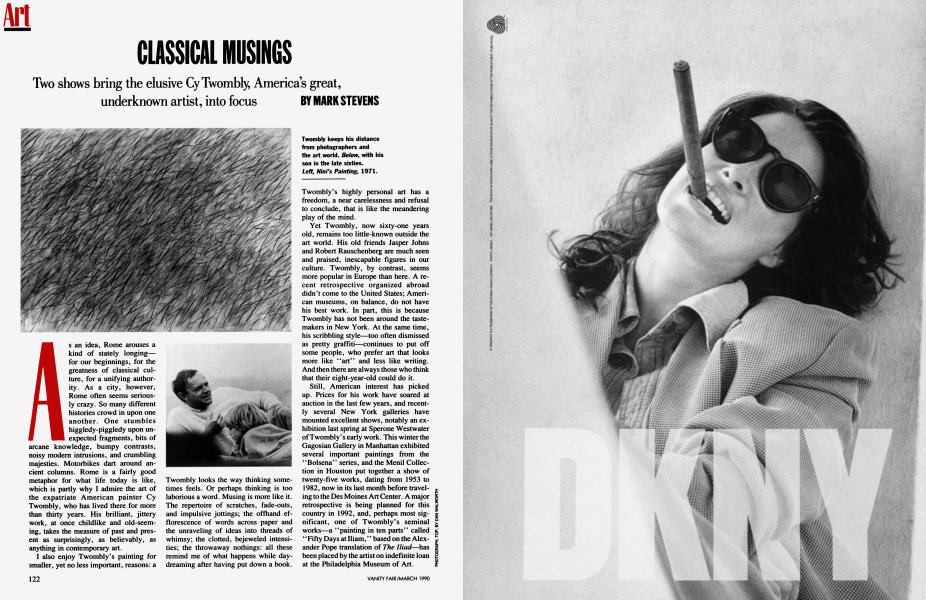
As an idea, Rome arouses a kind of stately longing— for our beginnings, for the greatness of classical culture, for a unifying authority. As a city, however, Rome often seems seriously crazy. So many different histories crowd in upon one another. One stumbles higgledy-piggledy upon unexpected fragments, bits of arcane knowledge, bumpy contrasts, noisy modem intrusions, and crumbling majesties. Motorbikes dart around ancient columns. Rome is a fairly good metaphor for what life today is like, which is partly why I admire the art of the expatriate American painter Cy Twombly, who has lived there for more than thirty years. His brilliant, jittery work, at once childlike and old-seeming, takes the measure of past and present as surprisingly, as believably, as anything in contemporary art.
I also enjoy Twombly's painting for smaller, yet no less important, reasons: a Twombly looks the way thinking sometimes feels. Or perhaps thinking is too laborious a word. Musing is more like it. The repertoire of scratches, fade-outs, and impulsive jottings; the offhand efflorescence of words across paper and the unraveling of ideas into threads of whimsy; the clotted, bejeweled intensities; the throwaway nothings: all these remind me of what happens while daydreaming after having put down a book.
Twombly's highly personal art has a freedom, a near carelessness and refusal to conclude, that is like the meandering play of the mind.
Yet Twombly, now sixty-one years old, remains too little-known outside the art world. His old friends Jasper Johns and Robert Rauschenberg are much seen and praised, inescapable figures in our culture. Twombly, by contrast, seems more popular in Europe than here. A recent retrospective organized abroad didn't come to the United States; American museums, on balance, do not have his best work. In part, this is because Twombly has not been around the tastemakers in New York. At the same time, his scribbling style—too often dismissed as pretty graffiti—continues to put off some people, who prefer art that looks more like "art" and less like writing. And then there are always those who think that their eight-year-old could do it.
Still, American interest has picked up. Prices for his work have soared at auction in the last few years, and recently several New York galleries have mounted excellent shows, notably an exhibition last spring at Sperone Westwater of Twombly's early work. This winter the Gagosian Gallery in Manhattan exhibited several important paintings from the "Bolsena" series, and the Menil Collection in Houston put together a show of twenty-five works, dating from 1953 to 1982, now in its last month before traveling to the Des Moines Art Center. A major retrospective is being planned for this country in 1992, and, perhaps most significant, one of Twombly's seminal works—a "painting in ten parts" called "Fifty Days at Iliam, ' ' based on the Alexander Pope translation of The Iliad—has been placed by the artist on indefinite loan at the Philadelphia Museum of Art.
Twombly is a southerner, bom in Lexington, Virginia. Unlike many who leave the South, he has the distinction of having remained a southerner. A tall, deliberate man whose accent still contains plenty of molasses, he has the courtly, father halting manner sometimes found in cultivated southerners of the old school. It is not just his manner, however, that identifies him as being from someplace else. In a more general way, Twombly has the slightly uneasy aspect of an exile—of one who, though determined to be gracious, looks around half expecting to be surprised.
While attending Washington and Lee in Virginia, Twombly would often visit New York and look at painting. He met Robert Rauschenberg, a live wire who encouraged both Twombly and another painter from somewhere else, Jasper Johns, to make art. In 1951, Rauschenberg asked Twombly to come to Black Mountain College in North Carolina, then a kind of floating seminar of radical thinking in the art world. There he met Robert Motherwell and Franz Kline. The next year he traveled with Rauschenberg to the Mediterranean—and, in a way, Twombly never came back.
In 1957 the young artist officially moved to Italy. Since then, he has remained a wanderer in classical culture, steeping himself in the ancient texts and art. At the risk of pressing the exile analogy too far (the artist regularly visits the United States), I think Twombly has found standing apart useful in many ways. To begin with, he has discovered in classical culture what many modernist poets before him also discovered, a rich world that excites the imagination with both its vivid sensuous immediacy and its melancholy separation from contemporary life. To be modem, it sometimes seems, is to feel like an exile from the past, abandoned in the present.
Twombly has not allied himself with a particular strain of classicism: one wouldn't want, for example, to call him either an Apollonian or a Dionysian. Instead, he has drawn on its great and scattered variety, finding every human motive and story represented. "He's the only man I know who can keep the emperors straight," says a friend. "But more important, he responds very personally: it's inwardly digested."
Apart from the imaginative allure of classical culture, Twombly also seems to love the day-to-day life. One of the charms of being a foreigner in Italy, of course, is that the old is there to be newly discovered, right now. Twombly married an Italian (they have a son, Alessandro, who is a painter), and has an apartment in Rome and a country house in Bassano. He lives among antiques and pieces of ancient sculpture and stacks of books (some modem things too) but not so the old rooms become closed-in. Italian places with high ceilings, open spaces, and walls grown beautiful with age seem to suit him. Friends say he has a particular gift for picking out from the passing parade interesting things to observe, not just the highfalutin stuff like art, but also a chair leg with a curious form, perhaps, or an unexpected book. "There's a feeling of nonchalance and casual elegance about where he lives," says one acquaintance. "It seems otherworldly but not precious and formalized or with any kind of restored or installed feeling. The word I would use is airy—free, spontaneous, like his painting."
Being an expatriate may have served him in one final way: it has allowed him to keep his distance from the art world. By the mid-fifties, when Twombly left for Europe, the American art world was fast changing from a small, overlooked ghetto into the large, brassy bazaar it is today. The pressure for novelty and success was intensifying. It may have been a pleasure to go where the past could still be present. In any case, Twombly remains understandably wary of the contemporary-art scene. Some dealers have treated him badly, and he seems to have a horror of being hustled. A successful artist today must contend with a swarm of gallery owners, dissertation writers, friends of friends, sleazy collectors, looking for a private price, and assorted hangers-on with who knows what in mind. Some artists thrive in this environment; Twombly does not. "He likes to see people's houses and their pictures," according to one friend, "but doesn't necessarily want to get hooked into dinner. He likes to get in on the fun, but still keep his distance." Of all the artists he has met, the Swiss art dealer Thomas Ammann says Twombly is the least competitive.
For many artists in Europe, Twombly is a particularly important figure, a man who knows both Italy and New York. He takes an interest in unknown artists, if he thinks they're in the game for the right reasons. "When I speak to young artists," says Ammann, "Cy Twombly's name comes up more than any other." Just why remains mysterious— artists can rarely explain such things— but Ammann thinks it has something to do with how personal Twombly's art remains, however grand the backdrop.
When Twombly started out, a great problem for many was how to make important art that did not copy the achievement of Abstract Expressionists like de Kooning or Pollock. Twombly's early work owed a particular debt to Kline's bold calligraphy and fascination with whites, blacks, and grays. Whereas Johns and Rauschenberg employed images appropriated from mass culture, Twombly retained the gestural line and, sometimes, the famous "allover" picture field of Abstract Expressionism. Like Kline and de Kooning, whom Harold Rosenberg called "action painters," he used the canvas as a kind of stage on which to make his personal mark.
Yet he shared with Johns and Rauschenberg a cooler, more quizzical approach to painting. In a way, Twombly stripped down Abstract Expressionism: his early marks and pencil scratches look curiously naked compared with the fulldress razzle-dazzle of a de Kooning or a Kline. The lines appear less fixed, floating a little on the paper or canvas. Sometimes Twombly allows the gesture of the hand to fade out into a visual whisper. The "childish" aura often remarked upon in Twombly's art removed some of the grandiloquence from Abstract Expressionism, with its talk of the heroic struggles of the self.
In painting, this kind of reduction does not necessarily mean a loss of power. Twombly's naked marks sometimes appear as spare, humorous, and bleak as the sentences in a Beckett story. Like the work of Beckett, Twombly's art of this period also seems steeped in a lovely feeling of twilight and aftermath, of little faith that art could ever again attain the size and scope of, say, Abstract Expressionism, and still tell the truth. Over the years, however, Twombly's marks have gathered fresh sorts of meaning, becoming much less naked. The pale backgrounds they wander across begin to reflect a Mediterranean light, and the colors sometimes have a sun-washed appearance. The marks themselves often evoke sexual shapes or elements of landscape. Words, numbers, jottings, equations—sometimes readable and sometimes not—appear on the paper or canvas. Not least, the marks begin responding to certain subjects in literature, often classical myth. In a way, this has provided Twombly's art with a replacement for the metaphysical scale lost to art since the waning of Abstract Expressionism.
Twombly's naked marks sometimes appear as spare, humorous, and bleak as the sentences in a Beckett story.
There are only twenty-five works (drawn mostly from the collection of the Dia Art Foundation in New York) in the beautifully installed selection of Twombly's art at the Menil Collection in Houston. But the grouping nonetheless displays many of the artist's moods. Poems to the Sea (1959) contains more than twenty small sheets, most with a horizon line drawn near the top of the page. The "poems" are diaristic, almost conversational. While they include hints of the sea, such as wavy splotches of white of varying intensity, many of the notations (numbers running along the horizon lines, scratched-out lists, mysterious equations) evoke another kind of wave—the day-to-day flow of thought, which seems as ceaseless as the sea.
In the Houston show, a work called Nini's Painting (1971) is hung beside one called Bay of Naples (1961). The first is a dimly radiant picture, an allover composition of wavy lines that look as varied, and as singular, as a field of grass blowing in the wind. By contrast, Bay of Naples appears broken, disjunctive. In the upper left, an arc of empty space may refer to the actual curve made by the shoreline and sea in the Bay of Naples; a spot of turquoise elsewhere may suggest the color of the bay; a pyramid may evoke the mountains. But the spitting look of the picture—the inspired smearings, the splotches of acidulous color squeezed out of the tube, the puckered impasto— implies a mood far different from that found in Nini's Painting.
Twombly's calligraphy is a particularly supple instrument. A word can be read as a word, with its attendant meanings, and also as a meaningful form; often his words seem poised in a ghostly space somewhere in between. Words expand into form, form finds a word, thought takes shape and dissolves. Twombly's shadowy words and classical allusions are not easily penetrated—in this, Twombly's art sometimes resembles modernist poetry, in which meaning is more glimpsed than possessed.
All the Houston show lacks is one of Twombly's summary works, such as the ten paintings in "Fifty Days at Iliam," which he completed in 1977-78. The Iliad, of course, tells the story of the war between the Greeks and the Trojans, inspired by Paris's abduction of Helen. We see the event itself through several changeable, ghostly scrims—Homer's poem, Pope's translation, and Twombly's own reading and personality. The artist concentrated on certain characters and events in the story, but the paintings taken together still preserve the epic sweep of the poem. They possess a narrative drama rarely found in contemporary painting.
An anteroom in Philadelphia contains the first of the paintings, Shield of Achilles, a powerful circular thunderclap of dark reds and oranges that seems to presage the high drama to come. In the main room hang the other nine paintings. Each is well worth looking at individually, but the initial impression is of a visual cacophony, a battle surrounding one on all sides. The plumes of color, the furious scribbles, the smoky erasures and—especially—the scalding reds fill the eye. Twombly scrawls the names of the combatants all over the pictures, and his script often has the feverish, moving intensity evocative of fighting itself. The words suggest not only Achilles or Hector but also the verse that followed: sometimes a word will come in and out of focus and have the strangely ethereal quality of bits of remembered poetry.
Each painting offers a different perspective on the war. In Achaeans in Battle, we see the battle as if from a distance. In The Fire That Consumes All Before It, we seem to be at the center of a fire storm. Each painting leads, visually and conceptually, to the next in the narrative. For example, there is a blackening and a kind of rolling-ball motion in The Fire That Consumes All that lead into the dramatic climax of the series, a painting of three circular forms that commemorates the death of heroes. The livid color and shape of The Fire That Consumes All also finds its reflection, in a kind of lovely reverse mirror, in a work of watery gray and blue on the other side of the room, a dreamy afterimage of fire and death. Here the battle has already receded into poetry, becoming a more beautiful but also a paler thing. The words "Shades of Eternal Night" intensify and turn blue as they pass through a gray cloud.
In Western culture, there is a rich tradition of musing over ruins. Among his other achievements, Twombly, I think, has found a way to advance this tradition—and not just in the more obvious sense of engaging pieces of the classical past in his work. There are other ruins. Memory is the ruin of experience, and Twombly's art is full of such remembering. Art itself seems to be eroding: Twombly makes decomposition part of his composition. Most of all, his painting seems to collapse time itself. The skittish Twombly line appears all present tense, a moment's impulse, an "as if nothing" that is everything. Yet a moment's thought can also catch the reflection of a world as old and large as The Iliad.
Subscribers have complete access to the archive.
Sign In Not a Subscriber?Join Now

