Sign In to Your Account
Subscribers have complete access to the archive.
Sign In Not a Subscriber?Join NowDESIGNING ANARCHIST
After seven years of burlesquing status fashion, Franco Moschino's reached the top of the system he mocks
BEN BRANTLEY
Fashion
It was fashion week in Milan, and a happy time for the clothing company called Moschino, which had just shown its spring collection. Buyers were pleased, sales were up, the press was exceptionally positive. At Cova—the tea shop where the season's style arbiters congregrate to scowl at overpriced canapes and assess one another's attire— there were lots of women in Moschino (the previous season's "dinner suit," with knives, forks, and spoons for buttons, was especially in evidence), a sure confirmation of arrival in the city's design pantheon. And outside the seven-month-old Moschino boutique, a twittery overflow crowd which mixed teenagers with dowagers thronged daily to view a special exhibition of Moschino's own paintings: Magritte-like studies of bodiless items of apparel floating against blue skies.
But, for the eponymous designer, it was not a happy time. After all, buyers were pleased, sales were up, and the press was exceptionally positive. In the unilluminated office of his recently acquired four-story headquarters, the somber-featured Franco Moschino—wearing self-effacing dark clothes and a convict's haircut—sat in the October twilight looking funereal and complaining about the compliments he'd received. A reporter from a New York fashion magazine had been up to see him that morning and had dared, he recalled, to say things like " 'I love your short jacket, I love your long dress, I love your black skirt. . . ' Ugh, please." Moschino shuddered. "I mean, if you want to come here and interview me, you're welcome, but about what I don't know. Because the first question you ask me about clothing, I throw you out the window, because I don't have anything to say." He had formally expressed his contempt for the bovine herds of fashion followers, in typical prankster style, at his show earlier that week, when he'd left a gift for his audience in each chair. It was a small, circular box, and when you turned it upside down it made a tortured mooing sound.
The afternoon I visited Moschino, he had bluish pouches under his eyes, and while his speech was, as always, manic in its speed and precision, his voice sounded broken and weary. He said he hadn't slept in nights. "Now all this press is saying wonderful things about this show," he said, stressing his words with sardonic italics, "and I think this was the most stupid, silly, commercial fashion I've done. All these adjectives should have been used in the past, when we really did new things and it was worth it to talk or write about." When I'd first spoken to Moschino, a year earlier, he was going on, with relative equanimity, about "the pureness of the concept" behind his work, and how "once you sell the idea, of course it becomes dirty—with money." Clearly it was a line of thought that had come to rankle him even more. "I want to stop this," he said last October, "because I don't like this feeling. I want trouble. I want trouble. Write that down."
One month later, Franco Moschino came up with a fresh way to make trouble. He developed a new advertising campaign—the one currently appearing in the upscale glossies. It features a Moschino drawing, in black marker, of a predatory-looking, expensively coiffed female ("a vampiress," Moschino calls her), splattered with bloodlike red ink and a giant red X over her face; running down the page beside her are the words STOP THE FASHION SYSTEM! His target, Moschino explains sweetly, is "the system that wants you to be a transvestite every morning, in a different way." The alternative? "A clothing system that would let people be more free about the clothing they wear. ' '
"My co-op accounts are really going to love that," groans one American Moschino sales rep, referring to the stores that split ad costs with the designer. She probably has nothing to worry about. In the seven years Moschino's been designing under his own label, the more vociferous his denunciation of the "fascism" of clothing designers, the more attention he's received and the more his clothes have sold. Today, securely anchored by a lucrative cluster of licensed products—jeans, children's wear, men's wear, underwear, neckties—the fortyyear-old Moschino does more than $100 million a year in wholesale business. The industry's most vocal proponent of antifashion is, indeed, one of the most fashionable designers working.
Franco Moschino came of age as a designer in an era in which fashion was beginning to appear a tired old game. Unconstructed clothing had been taken to the limit with the tattered creations of the Japanese vanguard, and it seemed time to plunder the past again. So, like much of contemporary art, fashion passed through the eighties in a bright haze of referential irony. Sartorial elements spanning the past century—from Poiret's odalisques to the mods and hippies of the sixties—were appropriated and restyled in bright quotation marks. The Chanel suit—reinterpreted by the house's new designer, Karl Lagerfeld— was widely and shamelessly copied, and became once again the uniform of the haute bourgeoise. And a lot of what filed down the runways took on the aspect of a desperately competitive costume party.
But if fashion seemed moribund, popular interest in the subject was perversely vital. Style magazines proliferated, and, in a decade of freshly minted fortunes, clothes assumed strengthened significance as an index of success. Even as the mass-clothing industry, and the retail structure it supported, floundered, designer celebrity swelled, and the status label acquired ever greater talismanic power.
Moschino has used his collections to create a droll, increasingly sophisticated running commentary on what he perceives as fashion's existential crisis. (He presented one show under the rubric "To be, or not to be, that's fashion!" and his enduring symbol, printed on clothes and in ad campaigns, is a question mark.) He acknowledges what other designers are loath to admit: that clothing, after all, has a limited vocabulary, and newness-for-the-sake-of-newness is absurd. Unlike such iconoclastic peers as Vivienne Westwood and Jean-Paul Gaultier, who subvert traditional design with radical forms of cut and tailoring, Moschino has always shown extremely classic clothes (literal-minded copies of looks from Chanel, Saint Laurent, Hermes), adorned with surreal details (a fried-egg brooch, a clothes-hanger hat, pockets shaped like miniature jackets or handbags) which turn an outfit into a parody of itself. "I redesign what I see without any interpretation," he says.
"The only interpretation comes when I surround these things with something else."
He has never claimed to be a designer, insisting his sensibility is that of a painter, the profession he first aspired to. In fact, he is more like a political cartoonist, sending up established symbols of power and affluence. Exquisitely proper jackets and blouses spell out their raisons d'etre in bold letters embroidered on their backs: EXPENSIVE JACKET
or QUESTA CAMICIA COSTA LI,000,000. And brand-name status accessories are reinterpreted in the distorting Moschino image: a Louis Vuitton sack stamped with Ms instead of LVs; a T-shirt printed with CHANNEL N°5 on a television screen (items which aroused the ire of the legal departments at Vuitton and Chanel).
Though his business, formed in 1982, was slow to take off, it has soared in recent years as the actual Moschino product has become more polished and better-made. "It's kind of chic to be anti-fashion," says Macy's Ellin Saltzman. "On the other hand, it's chic to be anti-fashion and still wear anti-fashion clothes." But as Moschino's commercial success has increased, his clothes— with prices on his most expensive line ranging from $600 to $2,000 retail— have themselves become badges of prestige for big-spending consumers who may not always get the joke of what they're wearing. One top American retailer says that Moschino sells well, "but often for the wrong reasons, to the wrong people—old ladies who want to feel young and groovy." Another says that, while there is a "savvy" customer who appreciates Moschino's intent, many women respond to the clothing simply because it has "that extra detail, and the woman who wants that extra detail is oftentimes tasteless."
The more vociferous his denunciation of the "fascism" of clothing designers, the more his clothes have sold.
Clad in an armor of irony which obviates criticism, Moschino can answer that such consumer response simply confirms the "sickness" of the fashion system. "It's not my fault if the Moschino concept is, Wear your used clothes the way you want—make a creation of yourself instead of buying my designs, which have become so expensive," he says. "Anyway, real product is necessary to me to prove what I'm talking about." He also admits, "Of course, you can't be really 100 percent honest if you sell something." But he thinks that the philosophy behind the clothing is still viable, and demands constant reiteration. Even his business partner, Tiziano Gusti—who describes himself as the "Jiminy Cricket" on Moschino's shoulder, constantly reminding him of his commercial obligations—says Moschino is "nearly more important as a message than as a product. . .that fashion's not just a question of clothes, but a social problem."
As Moschino sees it, his fundamental message is almost childishly simple: Be yourself, don't let anyone else dictate your tastes, respect the individualism of others. His theme song, which played throughout his early shows, is "I Am What I Am," from La Cage aux Folles. And the hearts and peace symbols which adorn many of his clothes are not intended ironically. "I really, really, really believe that love is the thing that makes everything work," he says. On the other hand, "I don't force people, saying, 'This is my jacket, it has a heart on it, it means love, you have to believe in it.' "
Moschino's speech—even in English, his third language—is circular, syllogistic, and dense with elaborately developed metaphors. But he can also seem deeply naive, suggesting the earnest solipsism of an adolescent who's made a cult of introspection. "We're all made of different elements," he says, "and of course we see things in different ways. Your emotions can not be compared to mine." Accordingly, he thinks it's a waste of time to read a book or see a movie—things which reflect someone else's point of view. Besides, he says, he lacks the attention span. "I get confused by words in a book. I see a nice letter, which is well printed, and I get distracted by the design of the letter." Rather, he lets things enter him randomly. At home, for instance, where he does most of his designing, he looks at television with no sound, while the radio plays whatever happens to be on. "I'm always a watcher," he says. "The world is living its life around me, but it never takes me." This creed of passivity may echo Warhol, but Moschino insists this is not deliberate. Neither are the obvious parallels between his own work and that of the Surrealists, Dadaists, and Appropriationists. He says he knows the name Immanuel Kant only "because I've been told many times that Kant has said something I've said," and adds, "I'm not trying to make relationships between what I do and what's going on in the intellectual world. Sometimes you probably see a relationship, because you get in touch very easily with what's in the air. But not because I mean to; it's just by coincidence. I just keep my ears and my eyes open, and once inside, it's filtered, and when it comes out, it is what it is."
It seems fitting that, in the past two years, Moschino has forsaken some of his designing responsibilities to concentrate on a public-relations campaign that pointedly places him at its center. "He decided to become more a personality... a more public figure," says his longtime design associate, Russell Bennett. "I think he was getting a little frustrated in having to deal with all the day-today design problems. And the only person who can really explain [his theory] properly is him." "I'm very egoist," Moschino says cheerfully. "[Fame] is frustrating, it is heavy, it's work, but you have to choose it. I think I'm sick enough to say I prefer to have it."
"Marilyn or Macho or Popeye-I see myself in any one of them."
When he opened his boutique last March, he converted a stretch of the Via Sant'Andrea into his own personal Pop-flavored Luna Park, and stocked it with more than a hundred people dressed as "the characters belonging to my memory, a visual and emotional reminder of different periods." On a catwalk above the crowd, Santa Claus and Superman, nuns and streetwalkers, Popeye and Marie Antoinette streamed by on eclectic parade. Moschino himself sat on a dais surrounded by a stout lordmayor type, a man dressed as a bishop, a Haile Selassie look-alike, and an extremely convincing Queen Elizabeth impersonator, flown in from London. Whether self-consciously delivering some sentimental Italian songs with the band or parting the crowds (surrounded by a phalanx of Roman centurions recruited from the local gyms), he was a curiously detached and disquieted-looking center of attention, who never seemed to be enjoying himself that much. "I was too tense," he said the next day. "There were people touching me, calling me Franco. I think, What's going on in their minds at that moment? Why do they think that by calling me they might get something? It was hysterical. Even the ego aspect wasn't happy."
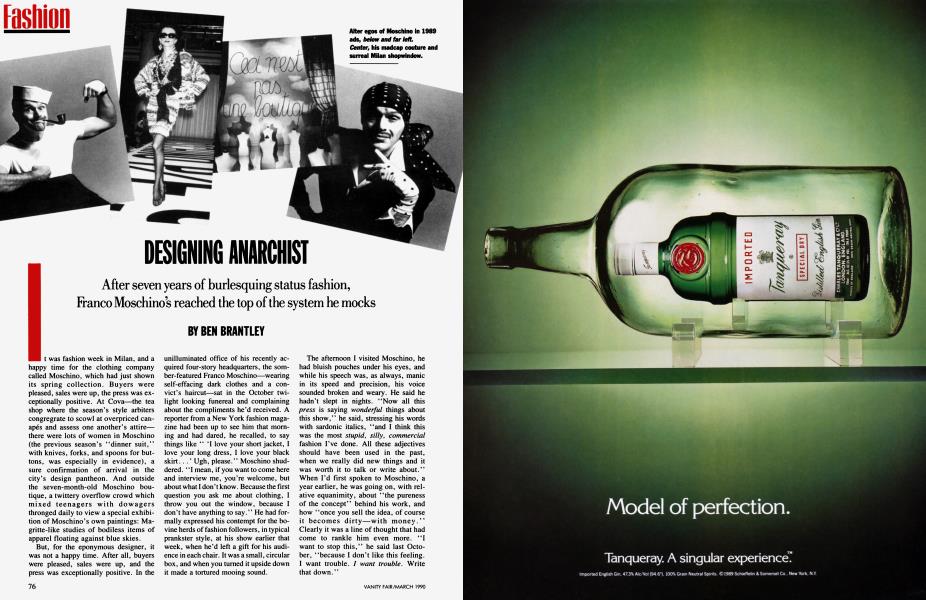
He is, however, supremely at ease with more distanced displays of ego. His most controversial advertising campaign, launched last year, centered on portraits of the then mustached Moschino in a variety of incarnations appropriate to his different licenses: for couture, he was a hirsute Marilyn Monroe, in a blond wig and a delirious expression; for men's wear, a brooding mafioso; for underwear, his face was grafted onto a naked iron-muscled man's torso; for children's wear, his head was on the body of a little girl in a party dress. Other poses ranged from surly machismo to the floridly feminine, and represented, says Moschino, a celebration of different aspects of his character. "There is a very strange average of how much man and how much woman there is in a human," he says, "and I think this average is even more difficult to evaluate when one is a fashion designer.
Marilyn or Macho or Popeye—I see myself in any one of them. And I know I can play any one of these roles in public. But in private I'm all of them together." He prides himself on having acquired the courage "to expose a side of me that is very ambiguous," something he says he couldn't have done when he started his business seven years ago. "What's happened in between may have made me lose my wildness, my childishness, but it gave me the. . .security. Big quotes."
Franco Moschino grew up in the industrial town of Abbiategrasso, thirteen miles southwest of Milan, where his parents owned an iron foundry. His father was killed in a factory accident when Franco was seven, leaving his mother, he says, "scared of life" and reluctant to push her son into the family business. In school, he was "a silent rebel. I didn't say, 'I don't want to do this.' I just wouldn't pay attention." He was routinely beat up by his classmates on his way home and became an isolated child who devoted himself obsessively to drawing (especially "feminine religious characters and Madonnas") and, later, to studying foreign languages, which he enjoys, he says, "because they're sounds I'm not used to; it's like making jokes, using your tongue in a different way."
At seventeen, he enrolled in Milan's major art academy, where he lasted two years. He hired himself out as a fashion illustrator and eventually went to work for a clothing company called Cadette, where he specialized in simple, somber clothes that aroused some curiosity but little commercial interest. In his early thirties, he was approached by Tiziano Gusti, a local fashion businessman, who suggested he and Moschino create their own company.
"In 1982 it was really too late," says Moschino, who felt the business was already an anachronism. "That was what brought me to the freedom concept, a nonfashion concept, because it was the only thing I found that could be an excuse for making more clothes." His first collections articulated that concept by showing a range of familiar clothing prototypes in random sequence and combinations. Quirkiness was limited to the presentation: a model in evening clothes carrying a shopping bag stuffed with celery, for example. "That's how the jokes started, actually," says Russell Bennett, who began working with Moschino at that time. "Although we could put these things together, and they were amusing on the catwalk, once the client bought the dress, she just bought the dress; she didn't buy the bag of celery."
As the designs themselves began to incorporate sight gags, the presentation of them became correspondingly parodistic—absurdist send-ups of the overhyped fashion spectacles popular in Europe. For one show, Moschino sent his mannequins (usually the same cadre of eccentrically beautiful women, many of whom have exceeded their professional life expectancy) down the runway on their hands and knees; he staged a men's-wear show in a restaurant and had the models act as waiters and the waiters wear the clothes. It all came to a dizzying climax two years ago at a cavernous Milan discotheque in a surreal carnival of a show, replete with marching band, circus performers, and models carried onto the stage in gilt sedan chairs by hulking, near-naked men. The following season—in the middle of what looked like a modest, straightforward presentation—Moschino leapt onto the runway to hustle the models offstage. A video followed in which the designer, in searing close-up, told his audience that fashion shows were really out of fashion. "And in the next six months, another show? LET'S HAVE A BREAK!"
Since then Moschino shows have been small, quiet, seriously professional. The organization is more professional, too—a big corporation, smoothly run, with a design staff of ten. And the clothes themselves are far more expertly crafted—sophisticated enough to warrant the hefty prices they command.
Moschino laments the loss of "spontaneity" in the company, adding, "The process of materialization has never been loved by any philosopher." He himself is presenting a more polished, composed persona to the world. The plump, rough-edged "bad boy" designer, usually dressed like a refugee from a leather bar, has given way to an often studiedly courteous man in dark tailored jackets—the man I saw after a recent show solicitously asking key store executives if their seats were O.K.
In other ways, he is much the same. He still lives in the small one-bedroom apartment he rented twelve years ago. He is still, say his associates, gentle and soft-spoken with his staff, and has little social life. "The life I have," he says, "is really sleeping, taking a shower, brushing my teeth, and a few other things I don't tell you." He remains deliberately haphazard in his work habits—letting his assistants interpret his rough sketches as they see fit, to bring a greater element of "accident" into the clothing; putting off decisions for as long as possible. "The point is, if you do something at the last minute—without thinking about it too deeply—what you get is so spontaneous," he says.
For one show, Moschino sent his mannequins (usually the same cadre of eccentrically beautiful women) down the runway on their hands and knees.
But at the peak of his celebrity, Moschino has arrived at a cul-de-sac. "The thing is, now he's stuck," says his colleague Russell Bennett. "He has to re-educate people yet again." But if fashion is, as Moschino insists, finite, there would seem to be a commensurately finite number of ways of letting us know this. His detractors point out that Moschino has never really developed a satisfactory, fully thoughtout alternative to the system he rails against. "He's an intellectual showoff," says one longtime fashion journalist, "who talks better than he thinks."
In his bleaker moments, the designer might be willing to agree. "I still think the most fascinating thing is the psychology of why people are attracted by these objects: garments," he was saying after his most recent collection. "But the system is so old and slow and complicated. I tell you something, it's probably not even worth it to change it.
"The words behind [my] clothes are the same, but they are old words, because I've already said them. So at this point, more than usual it's difficult to decide: do we take the traditional, powerful, glamorous, prestigious way of grown-up fashion and magnify that level and become more rich, or do we continue being Moschino, concentrating and insisting and screaming what we want?
"But this is my crisis," he said finally, with a theatrical moroseness he seemed, on some level, to be enjoying thoroughly. "I have no answers anymore."
Subscribers have complete access to the archive.
Sign In Not a Subscriber?Join Now


