









Sign In to Your Account
Subscribers have complete access to the archive.
Sign In Not a Subscriber?Join NowCHARACTER FACTOR
Wine
How to tell the difference between a good wine and a real glass act
JOEL L. FLEISHMAN
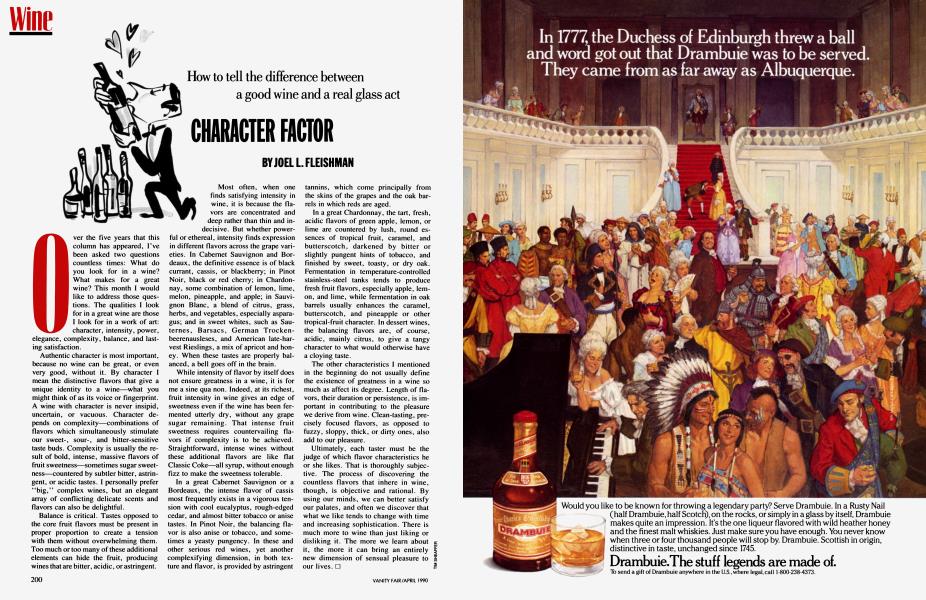
Over the five years that this column has appeared, I've been asked two questions countless times: What do you look for in a wine? What makes for a great wine? This month I would like to address those questions. The qualities I look for in a great wine are those I look for in a work of art: character, intensity, power, elegance, complexity, balance, and lasting satisfaction.
Authentic character is most important, because no wine can be great, or even very good, without it. By character I mean the distinctive flavors that give a unique identity to a wine—what you might think of as its voice or fingerprint. A wine with character is never insipid, uncertain, or vacuous. Character depends on complexity—combinations of flavors which simultaneously stimulate our sweet-, sour-, and bitter-sensitive taste buds. Complexity is usually the result of bold, intense, massive flavors of fruit sweetness—sometimes sugar sweetness—countered by subtler bitter, astringent, or acidic tastes. I personally prefer "big," complex wines, but an elegant array of conflicting delicate scents and flavors can also be delightful.
Balance is critical. Tastes opposed to the core fruit flavors must be present in proper proportion to create a tension with them without overwhelming them. Too much or too many of these additional elements can hide the fruit, producing wines that are bitter, acidic, or astringent.
Most often, when one finds satisfying intensity in wine, it is because the flavors are concentrated and deep rather than thin and indecisive. But whether powerful or ethereal, intensity finds expression in different flavors across the grape varieties. In Cabernet Sauvignon and Bordeaux, the definitive essence is of black currant, cassis, or blackberry; in Pinot Noir, black or red cherry; in Chardonnay, some combination of lemon, lime, melon, pineapple, and apple; in Sauvignon Blanc, a blend of citrus, grass, herbs, and vegetables, especially asparagus; and in sweet whites, such as Sauternes, Barsacs, German Trockenbeerenausleses, and American late-harvest Rieslings, a mix of apricot and honey. When these tastes are properly balanced, a bell goes off in the brain.
While intensity of flavor by itself does not ensure greatness in a wine, it is for me a sine qua non. Indeed, at its richest, fruit intensity in wine gives an edge of sweetness even if the wine has been fermented utterly dry, without any grape sugar remaining. That intense fruit sweetness requires countervailing flavors if complexity is to be achieved. Straightforward, intense wines without these additional flavors are like flat Classic Coke—all syrup, without enough fizz to make the sweetness tolerable.
In a great Cabernet Sauvignon or a Bordeaux, the intense flavor of cassis most frequently exists in a vigorous tension with cool eucalyptus, rough-edged cedar, and almost bitter tobacco or anise tastes. In Pinot Noir, the balancing flavor is also anise or tobacco, and sometimes a yeasty pungency. In these and other serious red wines, yet another complexifying dimension, in both texture and flavor, is provided by astringent tannins, which come principally from the skins of the grapes and the oak barrels in which reds are aged.
In a great Chardonnay, the tart, fresh, acidic flavors of green apple, lemon, or lime are countered by lush, round essences of tropical fruit, caramel, and butterscotch, darkened by bitter or slightly pungent hints of tobacco, and finished by sweet, toasty, or dry oak. Fermentation in temperature-controlled stainless-steel tanks tends to produce fresh fruit flavors, especially apple, lemon, and lime, while fermentation in oak barrels usually enhances the caramel, butterscotch, and pineapple or other tropical-fruit character. In dessert wines, the balancing flavors are, of course, acidic, mainly citrus, to give a tangy character to what would otherwise have a cloying taste.
The other characteristics I mentioned in the beginning do not usually define the existence of greatness in a wine so much as affect its degree. Length of flavors, their duration or persistence, is important in contributing to the pleasure we derive from wine. Clean-tasting, precisely focused flavors, as opposed to fuzzy, sloppy, thick, or dirty ones, also add to our pleasure.
Ultimately, each taster must be the judge of which flavor characteristics he or she likes. That is thoroughly subjective. The process of discovering the countless flavors that inhere in wine, though, is objective and rational. By using our minds, we can better satisfy our palates, and often we discover that what we like tends to change with time and increasing sophistication. There is much more to wine than just liking or disliking it. The more we learn about it, the more it can bring an entirely new dimension of sensual pleasure to our lives.
Subscribers have complete access to the archive.
Sign In Not a Subscriber?Join Now