
Sign In to Your Account
Subscribers have complete access to the archive.
Sign In Not a Subscriber?Join NowVINTAGE VINTAGES
How everyone can afford not to drink any wine before its time
JOEL L. FLEISHMAN
Wine
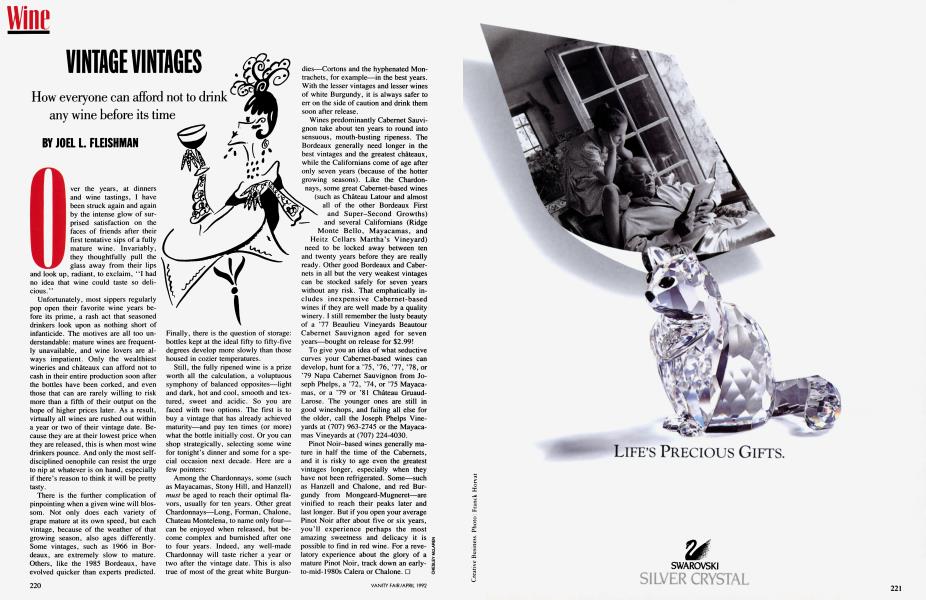
Over the years, at dinners and wine tastings, I have been struck again and again by the intense glow of surprised satisfaction on the faces of friends after their first tentative sips of a fully mature wine. Invariably, they thoughtfully pull the glass away from their lips and look up, radiant, to exclaim, "I had no idea that wine could taste so delicious."
Unfortunately, most sippers regularly pop open their favorite wine years before its prime, a rash act that seasoned drinkers look upon as nothing short of infanticide. The motives are all too understandable: mature wines are frequently unavailable, and wine lovers are always impatient. Only the wealthiest wineries and chateaux can afford not to cash in their entire production soon after the bottles have been corked, and even those that can are rarely willing to risk more than a fifth of their output on the hope of higher prices later. As a result, virtually all wines are rushed out within a year or two of their vintage date. Because they are at their lowest price when they are released, this is when most wine drinkers pounce. And only the most selfdisciplined oenophile can resist the urge to nip at whatever is on hand, especially if there's reason to think it will be pretty tasty.
There is the further complication of pinpointing when a given wine will blossom. Not only does each variety of grape mature at its own speed, but each vintage, because of the weather of that growing season, also ages differently. Some vintages, such as 1966 in Bordeaux, are extremely slow to mature. Others, like the 1985 Bordeaux, have evolved quicker than experts predicted. Finally, there is the question of storage: bottles kept at the ideal fifty to fifty-five degrees develop more slowly than those housed in cozier temperatures.
Still, the fully ripened wine is a prize worth all the calculation, a voluptuous symphony of balanced opposites—light and dark, hot and cool, smooth and textured, sweet and acidic. So you are faced with two options. The first is to buy a vintage that has already achieved maturity—and pay ten times (or more) what the bottle initially cost. Or you can shop strategically, selecting some wine for tonight's dinner and some for a special occasion next decade. Here are a few pointers:
Among the Chardonnays, some (such as Mayacamas, Stony Hill, and Hanzell) must be aged to reach their optimal flavors, usually for ten years. Other great Chardonnays—Long, Forman, Chalone, Chateau Montelena, to name only four— can be enjoyed when released, but become complex and burnished after one to four years. Indeed, any well-made Chardonnay will taste richer a year or two after the vintage date. This is also true of most of the great white Burgundies—Cortons and the hyphenated Montrachets, for example—in the best years. With the lesser vintages and lesser wines of white Burgundy, it is always safer to err on the side of caution and drink them soon after release.
Wines predominantly Cabernet Sauvignon take about ten years to round into sensuous, mouth-busting ripeness. The Bordeaux generally need longer in the best vintages and the greatest chateaux, while the Californians come of age after only seven years (because of the hotter growing seasons). Like the Chardonnays, some great Cabernet-based wines (such as Chateau Latour and almost all of the other Bordeaux First and Super-Second Growths) -— and several Californians (Ridge
Monte Bello, Mayacamas, and Heitz Cellars Martha's Vineyard) need to be locked away between ten and twenty years before they are really ready. Other good Bordeaux and Cabernets in all but the very weakest vintages can be stocked safely for seven years without any risk. That emphatically includes inexpensive Cabernet-based wines if they are well made by a quality winery. I still remember the lusty beauty of a '77 Beaulieu Vineyards Beautour Cabernet Sauvignon aged for seven years—bought on release for $2.99!
To give you an idea of what seductive curves your Cabernet-based wines can develop, hunt for a '75, '76, '77, '78, or '79 Napa Cabernet Sauvignon from Joseph Phelps, a '72, '74, or '75 Mayacamas, or a '79 or '81 Chateau GruaudLarose. The younger ones are still in good wineshops, and failing all else for the older, call the Joseph Phelps Vineyards at (707) 963-2745 or the Mayacamas Vineyards at (707) 224-4030.
Pinot Noir-based wines generally mature in half the time of the Cabernets, and it is risky to age even the greatest vintages longer, especially when they have not been refrigerated. Some—such as Hanzell and Chalone, and red Burgundy from Mongeard-Mugneret—are vinified to reach their peaks later and last longer. But if you open your average Pinot Noir after about five or six years, you'll experience perhaps the most amazing sweetness and delicacy it is possible to find in red wine. For a revelatory experience about the glory of a mature Pinot Noir, track down an earlyto-mid-1980s Calera or Chalone.
Subscribers have complete access to the archive.
Sign In Not a Subscriber?Join Now