




Sign In to Your Account
Subscribers have complete access to the archive.
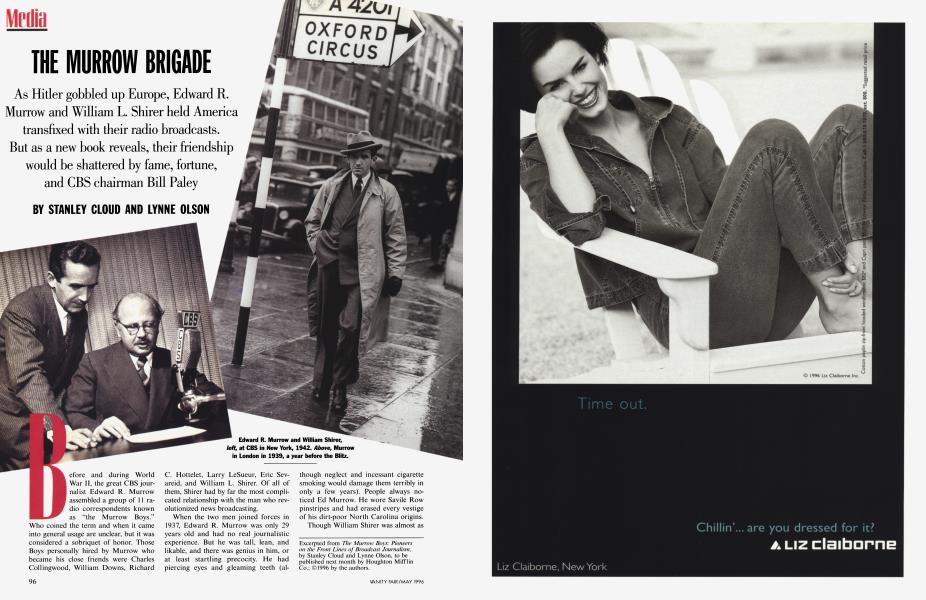
Sign In Not a Subscriber?Join NowTHE MURROW BRIGADE
As Hitler gobbled up Europe, Edward R. Murrow and William L. Shirer held America transfixed with their radio broadcasts. But as a new book reveals, their friendship would be shattered by fame, fortune, and CBS chairman Bill Paley
Media
STANLEY CLOUD
LYNNE OLSON
Before and during World War II, the great CBS journalist Edward R. Murrow assembled a group of 11 radio correspondents known as "the Murrow Boys." Who coined the term and when it came into general usage are unclear, but it was considered a sobriquet of honor. Those Boys personally hired by Murrow who became his close friends were Charles Collingwood, William Downs, Richard C. Hottelet, Larry LeSueur, Eric Sevareid, and William L. Shirer. Of all of them, Shirer had by far the most complicated relationship with the man who revolutionized news broadcasting.
When the two men joined forces in 1937, Edward R. Murrow was only 29 years old and had no real journalistic experience. But he was tall, lean, and likable, and there was genius in him, or at least startling precocity. He had piercing eyes and gleaming teeth (although neglect and incessant cigarette smoking would damage them terribly in only a few years). People always noticed Ed Murrow. He wore Savile Row pinstripes and had erased every vestige of his dirt-poor North Carolina origins.
Though William Shirer was almost as tall as Murrow, he somehow appeared short and dumpy. He came from a very intellectual, though relatively poor, midwestern family. He was only four years older than Murrow, but his sandy hair was already receding at an alarming rate. He wore a small, mannered mustache. His glasses were thick and metal-rimmed, and he had a blind eye (the result of a skiing accident in 1932). His off-the-rack clothes were rumpled, his shoes in need of polish.
Excerpted from The Murrow Boys: Pioneers on the Front Lines of Broadcast Journalism, by Stanley Cloud and Lynne Olson, to be published next month by Houghton Mifflin Co.; ©1996 by the authors.
They set in motion a chain of events that would lead, in only one year, to radio's emergence as America's chief news medium and to CBS's decades-long dominance of broadcast joumalism.
While Murrow's rich baritone was one of his many striking features, Shirer's voice was thin and reedy. Murrow strove to create a bon vivant's persona, but it was Shirer who actually lived the good life, who savored fine food and wine, who appreciated and pursued (deep into old age) beautiful women. Murrow was a man's man in an era when that meant hunting, fishing, smoking, drinking, and working. He was not an especially deep thinker or voracious reader. Shirer, on the other hand, was an experienced foreign correspondent who cultivated intellectuals.
Despite their differences, or because of them, Ed Murrow and Bill Shirer were, for a few intense years, closer to each other than either would ever be to anyone else, wives and lovers included. Theirs was an extraordinary friendship, and after it shattered a decade later, the shattering would haunt them both for the rest of their lives.
For most foreign correspondents stationed in Europe at the time, "radio news" was an oxymoron. America's two largest radio networks—William Paley's CBS and David Sarnoff's NBChad no reporters of their own crisscrossing the globe to find the news and relay it, with explanation and analysis, to the people back home. Instead, the networks had people like the early Murrow: functionaries whose job was not to report but to arrange broadcasts of various kinds— debates at the League of Nations, for example, or coronations, or the speeches of statesmen. Or, to cite a pre-World War II highlight of international broadcasting: CBS's live presentation in 1932 of a nightingale singing from England's Surrey woods. So successful was the program that radio editors voted it the most interesting of that year.
Murrow had been transferred to London in 1937 to become CBS's European "director of talks." Before he left New York, he was advised that the broadcast of the nightingale was the standard by which his performance would be judged. When he tried to join the American foreign correspondents' association in London, his application was summarily rejected. He clearly wasn't a foreign correspondent, and nothing in his background suggested he ever would—or could—join that elite fraternity.
His real name was Egbert Roscoe Murrow. He was born April 25, 1908, in Polecat Creek, North Carolina, a hamlet with no automobiles, telephones, or electricity. His father was an impoverished dirt farmer, badly henpecked by his humorless, pious wife. After graduating from Washington State College in 1930, Murrow worked for the National Student Federation of America and, later, the Institute of International Education as an organizer of student conferences in the United States and Europe. In 1934 he became involved in helping Jewish academics immigrate to America from an increasingly antiSemitic Germany. That same year he married Janet Brewster, from a prominent but not wealthy Connecticut family. In September 1935, Murrow was hired by CBS, and in April 1937 he was dispatched to London as European representative.
Later that year, when New York agreed to expand the network's European operations, Murrow decided to hire an honest-to-God foreign correspondent. At the suggestion of Ferdinand Kuhn of The New York Times, he got in touch with Bill Shirer in Berlin.
A graduate of Coe College in Cedar Rapids, Iowa, Shirer had come to Europe 12 years before. He had traveled extensively and had worked for both the Paris Tribune, an offshoot of Colonel Robert McCormick's Chicago Tribune, and the rival Paris Herald. Then, for Hearst's Universal News Service, he had covered Hitler's rally in Nuremberg in 1934. By 1937 he was in the top rank of foreign correspondents and friendly with the most famous of his Europe-based colleagues—John Gunther, Frank Gervasi, Vincent Sheean, Dorothy Thompson, James Thurber, and Sinclair Lewis. Moreover, after six years of marriage, his Austrian wife, Tess, was pregnant. Life, Shirer thought, was finally what he had hoped it could be. Then, on August 14, he was informed that Universal was shutting down. Ten days later Shirer was out.
That same day he received a cablegram from London. It read: CAN YOU MEET ME ADLON [HOTEL] 8/27 EOR DINNER? MURROW, COLUMBIA BROADCASTING. Shirer had no idea what it was about, and frankly he didn't much care. He had left America before radio amounted to anything, and he rarely listened to it in Europe. Still, if you're out of work, a free dinner is a free dinner.
Hitler had ordered all correspondents, foreign and German, to be flown back to Berlin. Nuts to that, Shirer thought. He would damned well stay and, if possible, broadcast from Compiégne.
Shirer at first dismissed Murrow as just another handsome face in a custom suit. By the time they adjourned to the Adlon bar for drinks, though, he had revised his opinion. Murrow was an evangelist for radio. He acknowledged that the new medium hadn't yet fulfilled its promise, especially where news was concerned. But it would someday, and he and Shirer could help make it happen. He offered Shirer a job at the same salary Hearst had been paying—$125 a week.
"Is it a deal?" Murrow asked, and Shirer said, "I . . . I . . . guess so." They celebrated over brandy. "Oh, there is one little thing I forgot to mention," Murrow said. "The . . . uh . . . voice."
CBS's New York executives were demanding a voice test before agreeing to Murrow's choice for the job. Nine days later, practically paralyzed with nervousness, Shirer reported to a dingy room in the government telegraph office in Berlin. The official German broadcasting studios were not available to CBS, he was informed, because German radio had an exclusive arrangement with NBC. But he could have a microphone and anything else he needed.
It turned out to be hopeless. When he started talking, his voice quivered and, more than once, jumped an octave. Afterward, he didn't hear anything for nearly a week. Then Murrow called with astounding news: "The bastards in New York finally came through. They think you're terrific."
Actually, the bastards in New York had hated Shirer's voice and tried to prevent Murrow from hiring him. Paul White, the director of news and special events, was particularly opposed. Having listened to the tryout broadcast, he decreed that Shirer just wouldn't do. Murrow argued that White, as a former newspaperman, should know better than to expect a golden-throated announcer. War was coming. Finally White caved.
CBS decided that the best place for Shirer wasn't Berlin but Vienna. After he and the pregnant Tess moved to the city of her birth, however, Shirer felt that his hands were tied. Austria was one large tinderbox, and Hitler, determined to annex his homeland, was ready to put a match to it. The country's economy was declining, its people disaffected; anti-Semitism was on the rise. In those early months of 1938, Shirer and Murrow tried to persuade New York to allow them to report what was happening, but Paul White refused, saying that was not the job they had been hired for.
In February the Austrian chancellor, Kurt von Schuschnigg, capitulated to Hitler's demand that Austria lift its ban on the Nazi Party. It was Austria's death warrant. Shirer asked CBS for 15 minutes of airtime to explain what had occurred. New York wasn't interested; Shirer was ordered to Sofia for a broadcast of a Bulgarian children's choir.
By the time he returned home from Sofia on February 26, the Austrian government was crumbling. Tess required an emergency cesarean section to save her life and the baby's. To make matters worse, Shirer was promptly dispatched to Yugoslavia for yet another music broadcast. He returned on March 11 to find that Tess had phlebitis. Outside the hospital, a Nazi mob was rampaging. The chancellor had resigned. Austria was about to be swallowed by Hitler.
Shirer had the biggest story of his life, and he seemed to have it to himself— NBC's correspondent Max Jordan was out of town. This time Shirer wasn't going to listen to New York. He was going to report what he knew. He rushed to the Austrian state radio building, where men in Nazi uniforms refused to let him use a studio. Dejected, he returned to his apartment and was having his second beer when Ed Murrow called. He told Shirer to get on a plane to Fondon. As soon as he arrived, he should go on the air and give the first uncensored, eyewitness account of the Anschluss. Meanwhile, Murrow would come to Vienna to cover for him.
For Shirer, nothing was more important than this story, not even his critically ill wife. Seventeen hours later he was sitting in a BBC studio in Fondon, earphones on, listening to the CBS announcer in New York say, "We take you now to Fondon." After six of the most frustrating months he'd ever known, Bill Shirer was finally, triumphantly, broadcasting the news.
But he wasn't first. NBC's Max Jordan, on learning of Austria's fate, had hustled back to Vienna. While Shirer's plane to Fondon was still in the air, Jordan had talked his way into the Austrian radio studio and submitted his hastily typed script to the censor.
In New York, hearing of Jordan's broadcast, Bill Paley was frantic. Until the Nazi takeover of Austria, he had sided with Paul White and stuck to CBS's policy of opposing any reporting by the network's employees in Europe. Reporting could easily lead to editorializing, to taking sides. But the Anschluss changed Paley's mind. NBC was trouncing CBS! White phoned Shirer in London. "We want a European roundup tonight," White said—a 30-minute broadcast on the European reaction to the Anschluss, with Shirer and a member of Parliament in London, Murrow in Vienna, and American newspaper correspondents in Paris, Berlin, and Rome. Nothing like this had ever been put together before, and Shirer and Murrow had eight hours to do it. Murrow persuaded the Germans to give him a phone line from Vienna to Berlin, where his broadcast could be picked up and relayed by shortwave to New York. Special lines were arranged for Paris, and newspaper correspondents were tracked down. With little more than two hours to go, Shirer still hadn't located a member of Parliament, and one of the correspondents he'd found, Frank Gervasi of the International News Service, reported that the Italians could not arrange his broadcast on such short notice. Shirer told Gervasi to dictate his story to London and he would read it for him. Then Shirer at last located Labour M.P. Ellen Wilkinson in the country, and she agreed to rush back to London. Fifteen minutes before the roundup was to go on the air, a breathless Wilkinson arrived at the BBC studios, and Gervasi was still dictating his piece to a stenographer.
Finally, on March 14, at one A.M. London time, eight P.M. in New York, an exhausted Shirer put on his earphones and heard announcer Robert Trout say, "The program St. Louis Blues will not be heard tonight." In its place would be a special report, a "radio tour of Europe's capitals, starting with a transoceanic pickup from London."
And Shirer was on. Nothing in his soft, flat voice indicated either the excitement he felt or the crushing pressure he had endured over the last few hours. He opened by predicting that Britain would do little to stem the aggression of Hitler. The other correspondents and Ellen Wilkinson took their turns analyzing the apathetic reaction of European governments to Hitler's rapacity. As promised, Shirer read Gervasi's dispatch. And Murrow sketched a subtly sinister picture of a transformed Vienna: "The crowds are courteous as they've always been, but many people are in a holiday mood; they lift the right arm a little higher here than in Berlin and the 'Heil Hitler' is said a little more loudly."
Thirty minutes later the first European roundup ended, on time to the second. A jubilant Paul White was on the phone to Shirer. The broadcast was a triumph, he said, "so much so that we want another one tomorrow night—tonight, your time. Can you do it?" Shirer didn't even pause. "No problem," he shouted.
With that first roundup, CBS and radio in general were on their way to becoming full-fledged news sources. Shirer and Murrow proved that radio was able not only to report news as it occurred but also to put it in context, to link it with news from elsewhere—and to do all that with unprecedented speed and immediacy. They set in motion a chain of events that would lead, in only one year, to radio's emergence as America's chief news medium and to the beginning of CBS's decades-long dominance of broadcast journalism.
Shirer and Murrow had agreed that when Tess was strong enough the Shirers would move to neutral Geneva, where Bill could cover Hitler's next move free of Nazi censorship. Murrow flew from London to join the Shirers for a short holiday in nearby Lausanne, and for several blissful days they swam, drank, and talked of the war they were sure was coming and of their need for more correspondents to help cover it. The problem was that Paley, White, and most Americans were losing interest again in foreign news as the Anschluss crisis faded. The news roundups were discontinued.
Then, in September of that year, Germany turned its gaze on Czechoslovakia, and Hitler claimed the Sudetenland. On September 10, Shirer went to Prague to monitor the crisis. Before he left, he suggested to New York that he do daily fiveminute broadcasts from Prague. They consented—if Shirer would promise to relinquish the time whenever there was not enough news to fill it. "My God!" he later wrote. "Here was the old continent on the brink of war . . . and the network was most reluctant to provide five minutes a day from here to report it!"
Soon, though, Americans sat riveted to their radios, intently listening for the cues from CBS in New York—"Calling Edward R. Murrow" and "Come in, William L. Shirer"—then listening for the voices themselves, cutting through the shortwave whine and stutter and crackle. On September 30, Shirer was in Munich when the leaders of Europe's two greatest democracies, British prime minister Neville Chamberlain and French premier Edouard Daladier, handed the Sudetenland to Hitler.
"Ed cast his lot with Bill Paley, who wasn't worth a hundredth of Murrow," Willim Shirer said. "I remember saying to Ed, 'You'll get just what I got.' And he did in the end."
There was no question that CBS outshone NBC—not to mention the other, smaller network, Mutual (ABC would not come along until 1943)—in the days leading up to Munich and at the conference itself. An exhilarated Bill Paley cabled Murrow and Shirer, "Columbia's coverage of European crisis superior to its competitors and is probably the best job ever done in radio broadcasting."
More and more American reporters
headed across the Atlantic during the summer of 1939, drawn by the knowledge that in journalism war meant good jobs. Murrow let it be known that CBS was in the market for journalists who thought they could make the transition from print to radio. Soon he hired Thomas Grandin, a 30-year-old Yalie, and Eric Sevareid, a handsome 26-year-old reporter at the Paris Herald.
In Berlin on August 31, Shirer listened on headphones to a German broadcast of the Nazi terms for peace in Poland and simultaneously translated for his American listeners. That night, Germany shut down its longdistance phone lines. Shirer went to bed feeling completely shut off from the rest of the world. At six the next morning, he was awakened by a call from Sigrid Schultz, the Berlin correspondent of the Chicago Tribune. "It's happened," she said. Germany had invaded Poland. World War II had begun.
A week after Germany invaded Poland and direct communications between England and Germany were cut off, Murrow was telling American listeners what this war had done to his friendship with Shirer. "Other than official news broadcasts, his is the only voice from Berlin I'm likely to hear in a long time— and his voice reaches me by way of New York," said a wistful Murrow. He could only listen in on headphones now as Shirer did his broadcasts from Berlin to still-neutral America.
In Berlin, Shirer was cut off not only from Murrow but also from Tess and their little daughter in Geneva and, of course, the real news. Most of the news he received had a distinctly Nazi slant. Shirer used insinuation and irony to work his way around network rules and Nazi censorship. When the German press insisted that the Poles were firing on their own capital city, Shirer reported in a bemused voice, "There was a headline that struck me tonight: POLES BOMBARD WARSAW. I thought it was a misprint until I read the story under it, which turned out to be an official communique of the [German] High Command." The fine print of the communique, Shirer noted, acknowledged that the Polish bombardment was actually aimed at the attacking German troops.
Shirer also used popular American slang to get some of his dispatches past German censors. There were times, however, when he couldn't quite disguise his passion. In late September Shirer and other journalists watched the Luftwaffe bomb the virtually defenseless Polish town of Gdynia. German officers, he reported, "reminded me of the coaches of champion football teams at home, who sit calmly on the sidelines and watch the machines they created do their stuff. It was both tragic and grotesque. Grotesque that we should be watching the killing as if it were a football game."
As 1940 began, Murrow cabled Berlin and instructed Shirer to meet him for a little rest and recreation in neutral Amsterdam. Dazzled by the lights and abundant food, delighted to be in each other's company again, the two friends behaved, as Shirer wrote in his diary, "like a couple of youngsters suddenly escaped from a stern old aunt or reform school."
Their exuberance was evident in the one broadcast they did there together:
Shirer: You have no idea what it's like to get into a city and see the streets all lighted up.
Murrow: What do you mean I've got no idea? I saw streetlights, automobiles with real headlights, and lights pouring out of windows tonight for the first time in five months.
Murrow ended the broadcast by saying, "Bill, let's go out and throw snowballs." Which is exactly what they did.
In June, Shirer was having lunch in Berlin when he heard about the fall of Paris. He rushed to Paris and picked up a tip from one of his Germanarmy sources that the armistice would be signed in the woods of Compiegne, north of Paris, where Germany had been forced to sign the humiliating surrender that ended World War I. In Compiegne, Shirer discovered German-army engineers tearing out the wall of the museum that housed the railroad car in which the 1918 surrender had been signed. The car, he was told, was to be moved to the exact spot where it had stood 22 years earlier.
The next afternoon, Shirer watched the armistice participants arrive. First came Hitler, who stepped from his black Mercedes and strode toward the clearing and the railroad car. The Fuhrer's expression was grave, but Shirer remarked "in his springy step, a note of the triumphant conqueror." The French generals, their faces like marble, arrived and climbed into the railroad car. They listened, expressionless, as General Wilhelm Keitel began reading the terms of the armistice.
Murrow began a passionate affair with Pamela Churchill (later Pamela Harriman), the beautiful daughter-in-law of the prime minister. "She just bowled him over," said Charles Collingwood.
The actual signing of the armistice was to take place the following day, but at breakfast Shirer learned that Hitler had ordered all correspondents, foreign and German, to be flown back to Berlin. Nuts to that, Shirer thought. He would damned well stay and, if possible, broadcast from Compiegne.
Minutes after the armistice was signed, Shirer sat in front of a microphone next to the German communications van and repeated over and over, "William L. Shirer calling CBS and NBC in New York, calling CBS and NBC from Compiegne, France." Shirer's army source had asked him to broadcast to both networks, and he agreed, even though he was sure his effort was futile. He went ahead anyway, speaking for almost 30 minutes, outlining in precise and painful detail Hitler's humiliation of the French.
Shirer's report turned out to be the biggest story of his career. The next morning he learned that a technician in Berlin had thrown the wrong switch and sent his broadcast directly to CBS. He had beaten everyone, including the Germans, to the story by nearly six hours.
The London Blitz, which began in September 1940, was in a sense what Edward R. Murrow had been preparing for since he arrived in Europe in 1937. It had immediacy, human drama, and sound— sirens, bombs falling, antiaircraft guns. Murrow had been arguing that the future of radio news lay in onthe-scene reporting. He and Larry LeSueur and Eric Sevareid, who had joined him in London, were ideally positioned to prove his point.
In a program called London After Dark, Murrow, LeSueur, and Sevareid reported on the nighttime sights and sounds of the city. In Trafalgar Square, Murrow kept silent for a moment, letting his audience listen to the air-raid siren in the background. Then he said, "I'll just ooze down in the darkness alongside these steps and see if I can pick up the sound of people's feet." He laid his microphone on the steps of St. Martin's-inthe-Fields church, picking up the clickclick and grind of heels and soles. "One of the strangest sounds one can hear in London in these dark nights," Murrow said, "is the sound of footsteps along the street, like ghosts shod with steel shoes."
Listening to Murrow's reports was like hearing an old friend describe the threatened destruction of other friends and their entire world. Murrow's listeners trusted him. If he implied, as he did more and more often, that England couldn't go it alone, that America would have to join the fight, maybe he was right.
Murrow became the most soughtafter American in London. He dined with the Churchills, was courted by society hostesses, was invited to country-house parties by aristocrats. The apartment he and Janet maintained at 84 Hallam Street became a gathering place for generals, dukes, members of Parliament, and Cabinet officials.
A month after the Blitz began, Eric Sevareid decided to return home. He was sick and exhausted, and he hadn't seen his wife and twins, born in Paris before it fell, in four months. His final broadcast from London was one of the greatest of his career:
London may not be England, but she is Britain and she is the incubator of America and the West. Should she collapse, the explosion in history would never stop its echoing. Someone wrote the other day, "When this is all over, in years to come, men will speak of this war and say, 'I was a soldier,' 'I was a sailor,' or 'I was a pilot.' Others will say with equal pride, 'I was a citizen of London.' "
Bill Shirer was also going home. The Nazis had begun to find censors who understood the nuances of American speech that Shirer had used to such good effect. More and more, they were shredding his scripts until they made no sense at all. He could no longer use the words "Nazi" or "invasion" on the air. He couldn't call Germany "aggressive" or "militaristic" or anything else that might create an unfavorable impression in neutral America. When Shirer complained about the censorship to Paul White, White cabled back: BILL WE
THOROUGHLY UNDERSTAND, SYMPATHIZE CONDITION IN BERLIN BUT FEEL WE MUST CARRY ON WITH BROADCASTS EVEN IF ONLY READING OFFICIAL STATEMENTS AND NEWSPAPER TEXTS.
The hell with that, Shirer thought. He advised New York that a friendly German official had told him the Nazis were building an espionage case against him. For this reason, if no other, he had to leave. Joseph Harsch, who reported from Berlin for The Christian Science Monitor and who was a friend of Shirer's, doubted that the Germans were preparing any trumped-up spy charges. "I don't believe he was ever in any danger," Harsch said.
One reason Shirer wanted to return was to publish his diary. He had witnessed Hitler's rise and had recorded in his diary what he saw, heard, thought, and believed, censoring nothing. If ever there was a time to share his musings with the world—and to do it profitably— now was that time. Besides, his wife and daughter had already returned to the States. He went directly to Bill Paley, who agreed to an unpaid three-month leave. Smuggling the diaries past Gestapo officials at the airport, Shirer left Berlin on December 5, 1940.
He arrived in New York to full-courtpress publicity treatment, SHIRER BACK FROM BERLIN, said the headline in The New York Times. Shirer gloried in the acclaim and quickly began to doubt the wisdom of returning to Berlin. So what if Paley and White were pressuring him? He didn't have time to worry about that now, not with every book editor in New York clamoring to publish his Berlin Diary and every magazine editor, from Time s Henry Luce to the Reader's Digest's DeWitt Wallace, wanting articles from him. In the end, Shirer gave the book to Blanche Knopf, the wife and partner of Alfred Knopf, who paid a $10,000 advance for it, an impressive figure at the time.
Berlin Diary, which the Book-of-theMonth Club chose as its July 1941 main selection, was an immediate commercial and critical success. Within weeks it was at the top of the best-seller lists and eventually sold more than 500,000 copies. With the book's triumph, CBS finally agreed that Shirer could remain in the United States. Paul White went up to Cape Cod, where the Shirers were vacationing that summer, and offered a new contract, including an increase in Shirer's already substantial salary and a Sunday show of his own.
"I wish goddamned television had never been invented," Murrow grumbled. In 1946 there were 6,000 sets in the entire United States. the next year there were 190,000, and by 1949 one million.
Before leaving Europe, Shirer had promised Murrow he would go to London in the fall of 1941 to pinch-hit while Murrow took home leave. He stressed in a letter that spring that he would return only for the time Murrow was away. In the end Shirer reneged on even a temporary return to London. Things were going too well for him in New York. Shirer had been all but flat broke when Murrow hired him in 1937. Now he had money and the perquisites of fame: invitations to lecture and to join New York's exclusive Century Association and the Council on Foreign Relations. He even went to Hollywood as a consultant for a movie called Passage from Bordeaux.
The principal victim of Shirer's egomania was his wife, Tess. Just when it seemed that she and Bill could have a normal life, the marriage was confronted with a new challenge: Tilly Losch. When Shirer was in his mid-20s, he had seen the dancer in a Noel Coward musical and had been smitten. More than a decade later, Shirer was in his office in New York one day when his old friend John Gunther stopped by. With Gunther were movie directors Frank Capra and Anatole Litvak— and Tilly Losch. At '21' that night, Shirer and Losch became engrossed in each other. "I felt myself falling in love with her," he wrote years later. Soon, his wife and his new mistress would each be pleading with him to give up the other. He refused.
Ed Murrow was now taking his turn on the celebrity whirl, having returned to the States for an eightmonth break in November 1941. He was to do a national tour, then rest. At a banquet hosted by CBS at the WaldorfAstoria, poet Archibald MacLeish paid eloquent tribute to the things Murrow had already accomplished in his war reporting: "You burned the city of London in our houses and we felt the flames that burned it. You laid the dead of London at our doors and we knew that the dead were our dead . . . were mankind's dead."
Among the notables on the dais with Murrow were Bill Paley, Paul White, and the network's other top news attraction, Bill Shirer. Murrow and Shirer had been so close once, but now there were strains in the relationship. Murrow resented Shirer's reneging on his promise to sit in for him in London. He disapproved of the way Shirer was profiting from his war experiences with his book and lecture tours. (The money Murrow made from his lecture tour that year went to charity.)
Ed and Janet Murrow were invited to have dinner with the Roosevelts at the White House on December 7. After the news of the Japanese attack on Pearl Harbor, Mrs. Roosevelt called to say the invitation still stood. The president did not dine with them, but the First Lady said her husband wanted Murrow to remain afterward. A few minutes past midnight, Murrow was ushered into the Oval Office, where Roosevelt soberly sketched for him the magnitude of the disaster: the Pacific fleet badly crippled, 75 percent of the American warplanes in the Pearl Harbor area destroyed on the ground, thousands killed or wounded. That the president would confide all this to Ed Murrow alone was a remarkable indication of the great distance Murrow and CBS had traveled in four years.
Before D-day, there was a lot of poker and partying in London, where conventional morality had in many circles been laid to rest for the duration. The fever infected even Ed Murrow, who began a passionate affair with Pamela Churchill (later Pamela Harriman), the beautiful daughter-in-law of the prime minister. Estranged from Winston Churchill's son, Randolph, the bright and charming Pamela was known for her sparkling dinners and soirees. "She just bowled him over," said Charles Collingwood.
Murrow even considered divorcing Janet, but in the end he could not bring himself to do it. His decision probably stemmed from guilt and his love for Janet, who, after 11 years of marriage, gave birth to their son, Charles Casey.
The Murrow Boys who were still with CBS when the war ended—Eric Sevareid, Larry LeSueur, Charles Collingwood, Winston Burdett, Howard K. Smith, Bill Downs, Richard C. Hottelet, and William Shirer— had achieved a status beyond what any of them could have imagined. They were, said publisher Michael Bessie, who knew them well, "the class act" of American journalism—"golden boys!"
Murrow, for professional and personal reasons, wanted to keep the group together under the CBS umbrella, or, more accurately, under his umbrella. He gained the power to do so by moving from London to New York in 1946 and accepting a job that Paley had been urging on him since before the war ended: vice president and director of public affairs. In effect, Murrow would be in charge of CBS News, which had only just become a separate division. He would outrank news director Paul White and have direct control over the Boys' destinies.
"Television was never the same after the first See It Now," said Don Hewitt, who directed the premiere episode and later borrowed bits of the format to create 60 Minutes. "EdMurrow made television respectable."
Initially, Murrow had wanted Bill Shirer to replace him in London as chief European correspondent. But Shirer refused. He was now one of New York's most noted and best-paid journalists. He and Tess were fixtures on the New York social circuit. And Shirer's affair with Tilly Losch continued unabated. Sometimes the Shirers got together with Ed and Janet for old times' sake, but the spark just wasn't there anymore.
On March 10, 1947, Shirer's lovely world collapsed. He received a telephone call from an executive at the J. Walter Thompson advertising agency, who told him that the J. B. Williams Company, the large soap manufacturer, after almost three years of sponsorship, had decided to drop his Sunday broadcast. Shirer was stunned. His weekly 5:45 P.M. program had not long before received a 6.9 Hooper rating, the highest of any Sunday news program. (More recently, though, the ratings, like news ratings generally, had been slipping.) Moreover, Shirer insisted later, no one at Williams or CBS had expressed any dissatisfaction with his performance. Shirer immediately suspected that he was being punished for the outspoken, liberal positions he took on the air.
It was not an illogical assumption. As relations between the United States and the Soviet Union started to decline almost immediately after the war, American liberals were more and more on the run. To conservative watchdogs, liberals had become "fellow travelers," "pinkos," "Reds," or "Commies."
When President Truman declared what became known as the Truman Doctrine and asked Congress for $400 million in aid for the governments of Greece and Turkey to help them resist Communist-backed guerrilla insurgencies, Shirer, among other liberal commentators, attacked the plan. The government in Athens, he said, was the same corrupt, repressive oligarchy that had ruled Greece before the Germans occupied it in 1941.
Shirer's criticisms of the Greek government (and of Chiang Kai-shek's regime in China) drew increasing fire from the right. That must be why I am being dropped, Shirer thought. But he was sure Murrow and Paley would never stand for it. They would find Shirer another sponsor and keep him in the same Sunday slot. Shirer phoned Murrow. Was the program his or the sponsor's? After saying he'd get back to him, Murrow went to Paley. He reminded the chairman of the huge contribution Shirer had made to CBS, and argued that he should keep the program and the time.
But Shirer had crossed the chairman of CBS before, and now Paley saw his chance to get even. Murrow, who had had plenty of experience of his own with Shirer's arrogance, and who felt that Shirer had grown lazy in his reporting, went along with the boss. Finally he picked up the phone and called Shirer's office. Sponsor or no sponsor, Shirer was to be replaced on the Sunday program by another commentator. CBS would try to find him a new time slot and, eventually, a new sponsor. Until then he would be "sustaining"—that is, unsponsored.
As it became clear to Shirer that he had lost the battle, his anger increased. At the very least, he insisted to Murrow,
he had the right to tell his listeners that he was being taken off the air. The two men agreed on a vague statement, which Shirer delivered on March 23. When Shirer emerged from the studio after the broadcast, several reporters were waiting to question him about what was going on. He was being throttled by his sponsor, he said. But that was hardly the worst of it: CBS, by forcing him to give up his regular broadcast time, was making it easy for the sponsor. In effect the network was endorsing the authority of Williams—or any other sponsor—to dictate the content of news broadcasts.
Among the protesting telegrams that Murrow and Paley received was one signed by Dorothy Parker, Arthur Miller, Gregory Peck, and—most painful for Murrow—several of his own good friends, including John Gunther and Vincent Sheean. There were even direct attacks on Murrow from others he respected. Now that he was a CBS vice president, they suggested, he had turned into just another corporate hack.
Murrow asked Joseph Harsch to take over Shirer's Sunday program. Harsch, who had a daily news-and-analysis program on CBS at 11:15 P.M., was as outspokenly liberal as Shirer, a fact Murrow hoped would help quell the escalating controversy. In announcing the shift from Shirer to Harsch, Murrow said, "We believe that Mr. Harsch, with his long experience in Washington and abroad, and his access to news sources in Washington, will improve Columbia's news analysis in this period." The statement was salt in Shirer's wounds, as Murrow must have known it would be.
Murrow made one last try at patching things up. On March 28, he and Shirer met in the bar at the Berkshire Hotel, near CBS headquarters, and agreed they had been acting like idiots. Over a couple of drinks they worked out a compromise in which Shirer would be given a new, sponsored time slot on Saturday evening. In return the protests against the network would end. Exhilarated, they prepared a statement for the press. All they had to do was run it by Bill Paley.
But when Murrow and Shirer presented the compromise to Paley in his office, he rejected it out of hand. He was mortified by the onslaught of criticism against his network and was certain Shirer had engineered it. "As far as I'm concerned," Paley told Shirer, "your usefulness to CBS has ended."
There was stunned silence. According to Shirer, all Murrow could say was "We had an agreement. But if you don't like it, Bill, you're the boss." At that moment the Murrow-Shirer friendship ended.
After Shirer left CBS, he did a weekly 15-minute news-and-comment program for Mutual until 1949, but he never again found a full-time job in broadcasting. In 1950 he was listed in Red Channels, the anti-Communist blacklisting bible of broadcasting, as a Communist sympathizer. With that he became unemployable.
Early on in this troubled time, Shirer began work on a monumental history of Nazi Germany. In 1960, The Rise and Fall of the Third Reich was published by Simon & Schuster. It became a phenomenal best-seller—more than two million copies sold by the Book-of-the-Month Club alone. It also won the National Book Award, and suddenly money, fame, and prestige, which meant so much to Shirer, were restored to him.
'I wish goddamned television had never been invented," Murrow grumbled. But nothing, certainly not Murrow's grumbling, could stop it. People were buying television sets as fast as they could be built. In 1946 there were 6,000 sets in the entire United States. The next year there were 190,000, and by 1949 one million. By 1951 there were 10 million and counting. And the three TV networks—CBS, NBC, and the ill-fated DuMont (ABC didn't move into national TV until 1954)—seemed to be creating new entertainment programming as fast as the manufacturers were turning out sets. On June 8, 1948, The Texaco Star Theater, featuring Milton Berle, was launched, quickly followed by Ed Sullivan's Toast of the Town, Arthur Godfrey's Talent Scouts, and, in 1950, Your Show of Shows, with Sid Caesar and Imogene Coca. Ed Murrow and the Boys, grumbling all the way, were forced to come to terms with television.
"This is an old team trying to learn a new trade," Murrow said into the camera on November 18, 1951, squinting through his own cigarette smoke, as he began the premiere broadcast of See It Now, the first documentary series in television history. "My purpose," he continued, "will be ... to lean over the cameraman's shoulder occasionally and say a word which may help illuminate and explain what is happening."
He switched to a report from Eric Sevareid in Washington on Korean War casualties. From Paris, Howard Smith described the latest nuclear-disarmament proposals. Done in a "magazine" format now familiar to television viewers but new at the time, the first See It Now put everyone on notice that the series would not dabble in the mindless trivia of what then passed for television news. "Television was never the same after the first See It Now," said Don Hewitt, who directed the premiere program and who, a couple of decades later, borrowed bits of the format to create 60 Minutes. "Ed Murrow made television respectable."
The truth was, however, that Paley had never felt as strongly about Murrow and the Boys, or their calling, as they had imagined. By the mid-50s, Paley's priorities were clear. Television news programs were generally relegated to late night and the Sunday-afternoon "cultural ghetto." See It Now was one of the victims of Paley's new priorities. In 1955 the program lost its sponsor and its scheduled weekly slot. From then on it appeared fewer than 10 times a year—"See It Now and Then," wags called it. Content wasn't the problem so much as revenue. Far more money could be made with such programs as I Love Lucy, The Ed Sullivan Show, and Gunsmoke. Even better, for a while, were the high-powered, bigbuck quiz shows such as CBS's $64,000 Question and NBC's Twenty-One.
"This instrument can teach," Murrow said, denouncing television's hunger for profits in speech in 1958."It can illuminate. Yes, and it can even inspire. Otherwise, it is merely wires and lights in a box."
After Sig Mickelson took over the combined television and radio news operations at CBS in 1954 and subsumed Ed Murrow's proudly independent fiefdom, Murrow seemed lost. He still had Person to Person, his lighterthan-air, split-screen celebrity-interview show, and his nightly radio broadcast. But he was beginning to think he might be Finished at CBS.
When Murrow learned that The $64,000 Question and other quiz shows had been rigged by their producers, he found it just too much to take. In October 1958 he lashed out at his own bosses in a scorching speech to the Radio and Television News Directors Association in Chicago. He denounced recent cutbacks at CBS News and said the hunger for profits of network executives had turned television into little more than a medium of "decadence, escapism, and insulation." "This instrument can teach," he declared. "It can illuminate. Yes, and it can even inspire. But it can do so only to the extent that humans are determined to use it to those ends. Otherwise, it is merely wires and lights in a box."
Paley was livid. Murrow had embarrassed the chairman in public, just as Shirer had done in 1947. Murrow would not be dumped as Shirer had been, but he would soon know what it felt like to be a pariah. On the night of the 1958 elections, instead of doing commentary, Murrow was put in charge of the eastern states' returns, chalking up the latest numbers on a blackboard and reporting them to anchor Walter Cronkite. He accepted the assignment without protest, but, said Howard Smith, "he had been number one for so long that that was quite a blow."
In January 1961 the great Edward R. Murrow-CBS epic ended. Murrow accepted an offer from newly elected president John Kennedy to become director of the United States Information Agency—"a beautiful and timely gift," said Janet Murrow.
Four years later, Edward R. Murrow was dying of cancer at the age of 57. His left lung had been removed in October 1963, and a few months after that he had stepped down as U.S.I.A. director. He tried recuperating in California, then returned east to friends and his beloved farm in Pawling, New York. But the cancer soon metastasized to his brain, and he had to undergo surgery again. During his long illness, the Boys would visit.
Murrow and Shirer had barely spoken since 1947. Murrow, however, had hoped all along to repair their shattered friendship. Janet Murrow called Tess Shirer one day and invited them to lunch. Tess said she would do her best to persuade Bill, and Shirer grudgingly agreed to go.
Over lunch the two couples laughed and reminisced about the years before the war when two young men, best friends, traipsed about Europe and did things no one thought could be done. Then Murrow, impossibly emaciated, asked Shirer to ride around the farm with him in his Jeep. Shirer did not want to be alone with Murrow and protested he didn't think Ed was up to the drive. Murrow insisted.
Twice in the circuit around the farm, Murrow tried to turn the conversation to the hows and whys of Shirer's departure from CBS. Both times Shirer cut him off and changed the subject. Murrow, defeated, fell silent. He started the Jeep and drove back to the house. Everyone chatted amiably enough over a civilized pot of tea. Then the Shirers rose to leave, and the Murrows walked them out to their car and thanked them for coming. It had been, Murrow said with a weak smile, "much too long a time."
After Shirer's marriage to Tess ended in divorce in 1970, he married two more times. In late 1993, when he was almost 90 and had only a few more months to live, he still had not forgotten or forgiven his CBS bosses. "Ed cast his lot with Bill Paley, who was not worth a hundredth of Ed Murrow," he said. "I remember saying to Ed, 'You'll get just what I got.' And he did in the end." So why didn't Shirer reconcile with Murrow in Pawling, knowing how desperate Murrow was to end their feud before he died? "Ed didn't have to do what he did to his best friend. I just didn't want to make up after 20 years. I may have been wrong," he said softly, "but that's the way I felt about it."
Subscribers have complete access to the archive.
Sign In Not a Subscriber?Join Now


