Sign In to Your Account
Subscribers have complete access to the archive.
Sign In Not a Subscriber?Join NowWHAT'S IT All ABOUT, ALFA?
Cars
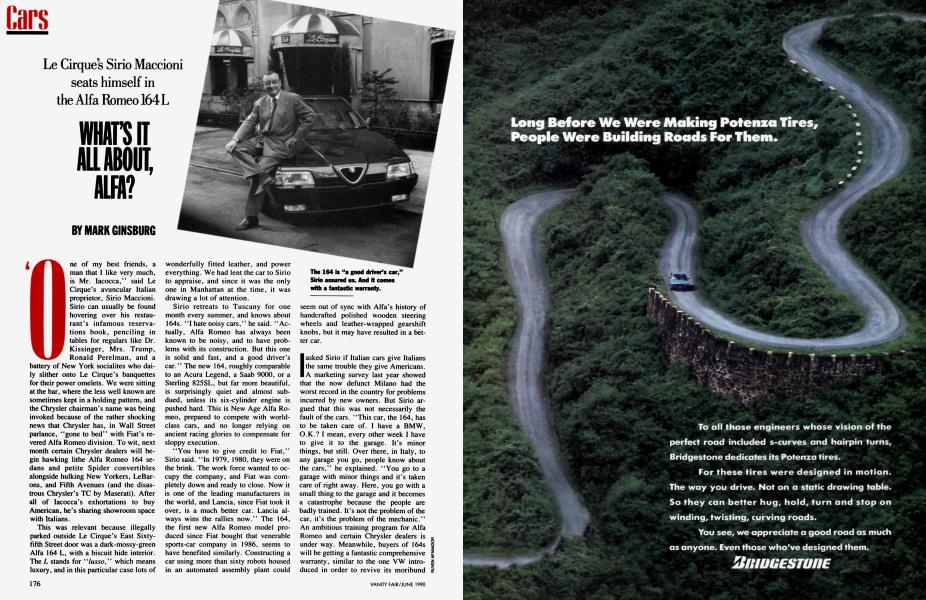
Le Cirque's Sirio Maccioni seats himself in the Alfa Romeo 164 L
MARK GINSBURG
'One of my best friends, a man that I like very much, is Mr. Iacocca," said Le Cirque's avuncular Italian proprietor, Sirio Maccioni. Sirio can usually be found hovering over his restaurant's infamous reservations book, penciling in tables for regulars like Dr. Kissinger, Mrs. Trump, Ronald Perelman, and a battery of New York socialites who daily slither onto Le Cirque's banquettes for their power omelets. We were sitting at the bar, where the less well known are sometimes kept in a holding pattern, and the Chrysler chairman's name was being invoked because of the rather shocking news that Chrysler has, in Wall Street parlance, "gone to bed" with Fiat's revered Alfa Romeo division. To wit, next month certain Chrysler dealers will begin hawking lithe Alfa Romeo 164 sedans and petite Spider convertibles alongside hulking New Yorkers, LeBarons, and Fifth Avenues (and the disastrous Chrysler's TC by Maserati). After all of Iacocca's exhortations to buy American, he's sharing showroom space with Italians.
This was relevant because illegally parked outside Le Cirque's East Sixtyfifth Street door was a dark-mossy-green Alfa 164 L, with a biscuit hide interior. The L stands for "lusso," which means luxury, and in this particular case lots of
wonderfully fitted leather, and power everything. We had lent the car to Sirio to appraise, and since it was the only one in Manhattan at the time, it was drawing a lot of attention.
Sirio retreats to Tuscany for one month every summer, and knows about 164s. "I hate noisy cars," he said. "Actually, Alfa Romeo has always been known to be noisy, and to have problems with its construction. But this one is solid and fast, and a good driver's car." The new 164, roughly comparable to an Acura Legend, a Saab 9000, or a Sterling 825SL, but far more beautiful, is surprisingly quiet and almost subdued, unless its six-cylinder engine is pushed hard. This is New Age Alfa Romeo, prepared to compete with worldclass cars, and no longer relying on ancient racing glories to compensate for sloppy execution.
"You have to give credit to Fiat," Sirio said. "In 1979, 1980, they were on the brink. The work force wanted to occupy the company, and Fiat was completely down and ready to close. Now it is one of the leading manufacturers in the world, and Lancia, since Fiat took it over, is a much better car. Lancia always wins the rallies now." The 164, the first new Alfa Romeo model produced since Fiat bought that venerable sports-car company in 1986, seems to have benefited similarly. Constructing a car using more than sixty robots housed in an automated assembly plant could
seem out of sync with Alfa's history of handcrafted polished wooden steering wheels and leather-wrapped gearshift knobs, but it may have resulted in a better car.
I asked Sirio if Italian cars give Italians the same trouble they give Americans. marketing survey last year showed that the now defunct Milano had the worst record in the country for problems incurred by new owners. But Sirio argued that this was not necessarily the fault of the cars. "This car, the 164, has to be taken care of. I have a BMW, O.K.? I mean, every other week I have to give it to the garage. It's minor things, but still. Over there, in Italy, to any garage you go, people know about the cars," he explained. "You go to a garage with minor things and it's taken care of right away. Here, you go with a small thing to the garage and it becomes a catastrophe because the people are badly trained. It's not the problem of the car, it's the problem of the mechanic."
An ambitious training program for Alfa Romeo and certain Chrysler dealers is under way. Meanwhile, buyers of 164s will be getting a fantastic comprehensive warranty, similar to the one VW introduced in order to revive its moribund Audi division. For three years or 36,000 miles, everything is covered. Even the oil, brake pads, and wiper blades will be replaced free. Tune-ups are also included.
But is the 164 still an Alfa, or has it become just another Fiat? "It's still Alfa Romeo," Sirio assured me, "just as Ferrari is still Ferrari. Look, every small car company needs someone behind them in order to continue to function. Even before Mr. Ferrari died he was connected to Fiat. And now Jaguar has gone to Ford. Many years ago Maserati was the car everyone wanted, but the company didn't have much backing and they finally lost the prestige."
The liaison between Chrysler and Fiat has given the 164 American-style creature comforts. The air-conditioning is superb—even though it has to be operated through designer-y, Lego-like push buttons—and the Chrysler Infinity sound system is first-class. These two items are usually the weakest components of any European luxury car, whether it be a Mercedes or a Jaguar.
"I like to sit quite low and also close to the wheel," said Sirio. "And I could do that in the Alfa." The 164 is the first Italian car sold in the United States to eschew the favored Italian monkey position, i.e., arms stretched out, hands barely holding on to the wheel, and knees jutting against the steering-wheel rim. Our car had a tilt/telescope steering wheel (with an air bag, no less), though its movement was marginal, and power seats—adjustable for height, rake, and lumbar support—that slid back far enough to accommodate tall people. The leather-covered seats lacked thigh support, however, and were somewhat fatiguing on long drives. But still, the cabin was a vast improvement over that of the 164's short-lived predecessor, the Milano.
"This car has two things," said Sirio. "It's for a very good driver, because it can be very sporty, and it can be a good general touring car. I don't like any car to have an automatic, but when you can only drive 55 m.p.h., officially, sometimes it's better to have an automatic because then you don't get upset." As a concession to ladies who lunch, and who usually alight at Le Cirque's door from Mercedes 560SELs and Lincoln Town Cars, Alfa Romeo has equipped the 164 with an optional four-speed automatic transmission. Our car had the delightfully smooth five-speed manual, but I drove an automatic as well, and found the gearbox too jerky for an otherwise refined car.
Marco, Sirio's twenty-two-year-old son, had also driven the car and had some complaints about the interior. "The switchgear was too much for me," he recounted. "The rows and rows of buttons take up a lot of space on the dashboard, and they could have made it simpler. The BMW has three settings for air direction on one button; the 164 uses four buttons for it. It's overkill. Also, the tachometer and speedometer should be closer together, because the way they are spaced now your eyes fall on a blank spot behind the steering wheel. Alfa used to have them perfectly located.
"The steering in the BMW is probably the most precise you'll find in any car," Marco went on, "but the 164's steering is almost as good. The acceleration is powerful, but not so powerful that the car is jumpy. Through the steering wheel you can feel it's a heavy car. I wouldn't say that it was glued to the ground, but it was certainly solidly planted, even in the quick turns, especially for a front-wheel-drive car. In the cop movies in Italy, they always use Alfa Romeos. The gearshift action was also very good, much less stiff than in past Alfas." I asked Marco if having Goodyear tires instead of the homegrown Pirellis offended him. "They're good. We use them on all our cars in Italy," he answered. "Ferrari uses Goodyears in Formula One racing, which is why everyone wants them on their cars now.
' 'The flat missile nose and the aerodynamics of the car make it very appealing," Marco continued with a hint of understatement. The 164 is the most handsome sedan around; Pininfarina's design is infinitely more seductive than that of its computer-generated Lexus, Sterling, and Acura counterparts, and much warmer than that of the boxy Volvo 740 or the tubular Saab 9000. Chances are the Alfa will remain more exclusive than those cars, too, even though it's a huge success in Italy and, at $24,500 for the base model, priced aggressively here.
I asked Sirio if his appraisal of the 164 hadn't been tainted just a little bit with chauvinism. "No, no, no!" he exclaimed. "The 164, I know people who have had one for two years, close friends of mine, who go from Florence to Milano in two hours, and also have a Mercedes, and they stay with this car because it's much more fun to drive. They say finally they can drive an Alfa Romeo. They aren't the richest people in the world, but they like to drive very fast, and drive the car mostly after dark, when it's still a rather open race—in Italy, the carabinieri use photo radar, which doesn't work very well at night. If you have a driver, or a son to drive you, take the big Mercedes. If you want to be one with your car, take a BMW or an Alfa Romeo."
MANUFACTURER'S SPECIFICATIONS
Alfa Romeo 164 L
• Vehicle type: five-passenger four-door sport sedan.
• List price: $27,500.
• Engine type: 183-bhp V-6.
• Transmission: five-speed manual; four-speed automatic optional.
• Acceleration 0-60 m.p.h.: 8.0 seconds.
• E.P.A fuel economy: 18 m.p.g.. city; 27 m.p.g., highway.
Subscribers have complete access to the archive.
Sign In Not a Subscriber?Join Now
