Sign In to Your Account
Subscribers have complete access to the archive.
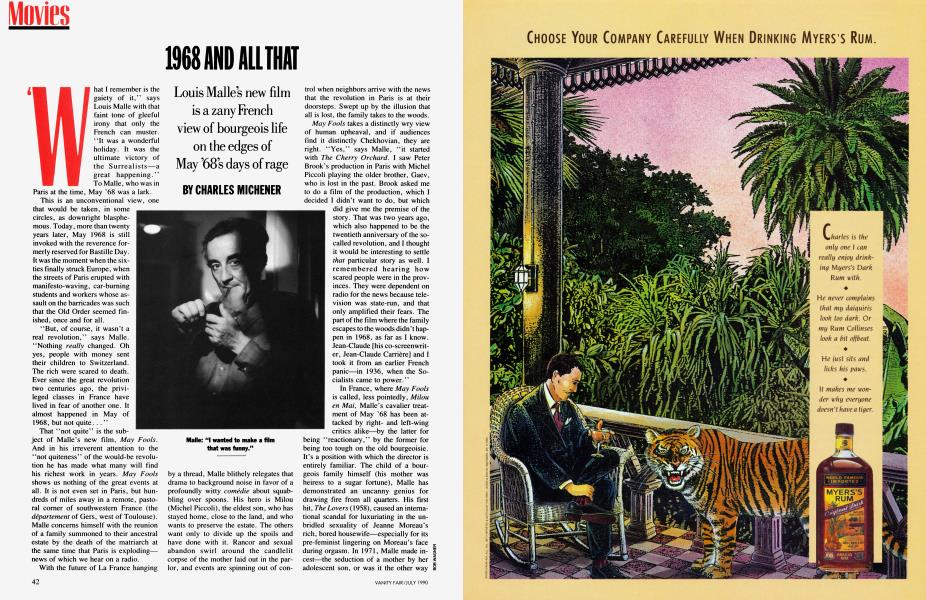
Sign In Not a Subscriber?Join Now1968 AND ALL THAT
CHARLES MICHENER
Louis Malle's new film is a zany French view of bourgeois life on the edges of May '68' s days of rage
Movies
What I remember is the gaiety of it," says Louis Malle with that faint tone of gleeful irony that only the French can muster. ''It was a wonderful holiday. It was the ultimate victory of the Surrealists—a great happening." To Malle, who was in Paris at the time, May '68 was a lark.
This is an unconventional view, one that would be taken, in some circles, as downright blasphemous. Today, more than twenty years later, May 1968 is still invoked with the reverence formerly reserved for Bastille Day. It was the moment when the sixties finally struck Europe, when the streets of Paris erupted with manifesto-waving, car-burning students and workers whose assault on the barricades was such that the Old Order seemed finished, once and for all.
''But, of course, it wasn't a real revolution," says Malle.
"Nothing really changed. Oh yes, people with money sent their children to Switzerland.
The rich were scared to death. Ever since the great revolution two centuries ago, the privileged classes in France have lived in fear of another one. It almost happened in May of 1968, but not quite.
That "not quite" is the sub-
ject of Malle's new film, May Fools. And in his irreverent attention to the "not quiteness" of the would-be revolution he has made what many will find his richest work in years. May Fools shows us nothing of the great events at all. It is not even set in Paris, but hundreds of miles away in a remote, pastoral comer of southwestern France (the departement of Gers, west of Toulouse). Malle concerns himself with the reunion of a family summoned to their ancestral estate by the death of the matriarch at the same time that Paris is exploding— news of which we hear on a radio.
With the future of La France hanging by a thread, Malle blithely relegates that drama to background noise in favor of a profoundly witty comedie about squabbling over spoons. His hero is Milou (Michel Piccoli), the eldest son, who has stayed home, close to the land, and who wants to preserve the estate. The others want only to divide up the spoils and have done with it. Rancor and sexual abandon swirl around the candlelit corpse of the mother laid out in the parlor, and events are spinning out of control when neighbors arrive with the news that the revolution in Paris is at their doorsteps. Swept up by the illusion that all is lost, the family takes to the woods.
May Fools takes a distinctly wry view of human upheaval, and if audiences find it distinctly Chekhovian, they are right. "Yes," says Malle, "it started with The Cherry Orchard. I saw Peter Brook's production in Paris with Michel Piccoli playing the older brother, Gaev, who is lost in the past. Brook asked me to do a film of the production, which I decided I didn't want to do, but which
did give me the premise of the story. That was two years ago, which also happened to be the twentieth anniversary of the socalled revolution, and I thought it would be interesting to settle that particular story as well. I remembered hearing how scared people were in the provinces. They were dependent on radio for the news because television was state-run, and that only amplified their fears. The part of the film where the family escapes to the woods didn't happen in 1968, as far as I know. Jean-Claude [his co-screenwriter, Jean-Claude Carriere] and I took it from an earlier French panic—in 1936, when the Socialists came to power."
In France, where May Fools is called, less pointedly, Milou en Mai, Malle's cavalier treatment of May '68 has been attacked by rightand left-wing critics alike—by the latter for
being "reactionary," by the former for being too tough on the old bourgeoisie. It's a position with which the director is entirely familiar. The child of a bourgeois family himself (his mother was heiress to a sugar fortune), Malle has demonstrated an uncanny genius for drawing fire from all quarters. His first hit, The Lovers (1958), caused an international scandal for luxuriating in the unbridled sexuality of Jeanne Moreau's rich, bored housewife—especially for its pre-feminist lingering on Moreau's face during orgasm. In 1971, Malle made incest—the seduction of a mother by her adolescent son, or was it the other way around?—a family joke in Murmur of the Heart. Three years later, Lacombe, Lucien raised the specter of French collaboration with the Nazis, showing how natural it was for an ordinary French boy to become a traitor. In Pretty Baby (1978), child prostitution was turned into a bittersweet love idyll between an eccentric photographer and his nymphet (well-bred Brooke Shields). Just when the French were beginning to forget their wartime shame, Malle reminded them of their anti-Semitism in Au Revoir les Enfants (1987), a memoir of his own wartime school days.
May Fools is animated by a faith in the value of zaniness—the spirit of Jacques-Henri Lartigue's lyrically nutty boyhood photographs. Like Lartigue,
Malle views the family, for all its jealousies and resentments, as the ultimate container for human folly. These "fools" are as disparately "extended" as any family you might imagine: they include a pompous (and secretly failed) journalist, utterly mismatched with his lubricious English wife; an excessively proper Parisian matron (Miou-Miou) who is filled with improper longings; and an angry lesbian antiques dealer who is losing her hold over her heterosexual-leaning girlfriend. By some mysterious alchemy, it is precisely when things turn craziest that the family is pulled together. "I was interested in the idea of the family as a commune," says Malle, who as the father of three children, each with a different mother, has presided over quite a menage himself in the large country house to which he regularly retreats. (Like the house in the film, it is near Toulouse, but in a "more severe landscape.")
At their best, Malle's films make their points with an almost throwaway casualness. There is a marvelous moment near the beginning of May Fools when Milou, working happily with the estate's old beekeeper, suddenly remarks that he's worried about being late for the lunch his mother's been making. It's a moment that registers in the deftest way the tyrannical hold she's exercised over him all his life—a line that will anchor the rest of the film without our realizing it.
Malle speaks in nearly unaccented English—his r is thoroughly American—and yet May Fools is deeply, unmistakably French, reminiscent of the films of Jean Renoir. "Of course I thought of Renoir," Malle admits, "because I love him. I also remembered how much I enjoyed the large-cast French films of the thirties and forties with all those wonderful supporting actors—in contrast to today, when you have films with Depardieu or Deneuve and everyone else is an extra. And it was a situation Renoir would have liked. The characters are silly but looked at with warmth."
Was the film autobiographical? "Only in that I was aware of the vast changes in that part of France," he says. "For example, with the arrival of the Common Market in Europe came the end of the old wine estates that produced the wonderful vin ordinaire Milou stores in his cellar. Milou belongs to a lost culture. I had a great-uncle like that who would only talk Latin to us."
Indeed, at the very end, May Fools seems to have become part of that "lost culture' ' itself as the dead mother rises for a ghostly dance with Milou around the parlor of the house whose future is still uncertain. The scene is beautiful—the crowning moment of Piccoli's elegantly juicy performance—but it may leave audiences scratching their heads over its seeming inconclusiveness. Which is all to Malle's point. "I wanted to keep the ending ambiguous," he says, "because what I'm saying is that there's nothing really left to save but the memories. All Milou's finally left with is his fantasies."
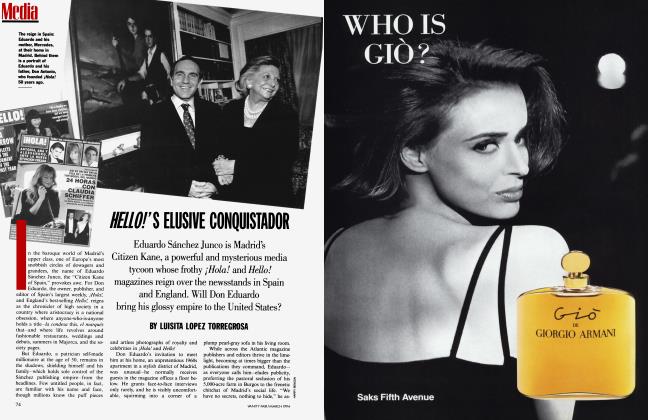
Malle is fifty-seven now, as trim and energetic as ever after twenty-seven films made over a career of thirtyfour years. Restless and self-challenging—he is perhaps the only major feature-film maker to have consistently produced major documentaries as well— Malle went through a tough time in the 1980s, trying to find a home in Hollywood for his idiosyncratic talent. His initial successes with Atlantic City and My Dinner with Andre, offbeat collaborations with compatibly quirky sensibilities like John Guare, Wallace Shawn, and Andre Gregory, were followed by the disappointments of Crackers and Alamo Bay. Discouraged, he returned in 1986 to the place where artists have always gone to replenish themselves—his roots. "With Au Revoir," he says, "I really had a good time getting back to my childhood, working with the French language and French actors again. I wasn't sure I'd be doing another film in French, but after Au Revoir I wanted to do one that was funny."
Malle has been a man of many homes—besides the country house near Toulouse, he has apartments in Paris and New York—and he is talking now in the house in Beverly Hills where his wife, Candice Bergen, has been based during her recent stardom in the title role of CBS's series Murphy Brown. On the other side of the world from his roots, from Milou's "lost" estate, he seems not at all discontented. "Let's face it," he says, "the eighties were pretty awful. There was a point when I thought this country had become hopeless, that it was really not my scene. But now I sense that things are really changing, even in Hollywood. The success of films like Dead Poets Society and Driving Miss Daisy—serious, smaller movies about the human race, about people—has to mean something. So I'm very encouraged to be here. Not that I'll ever be able to do Gremlins XII." He pauses, then says emphatically, "But I'll only work here if I have as much creative control as I had in France."
Given the shortness of Hollywood's attention span for "serious, smaller" films, Malle's optimism may be wishful thinking. Certainly, his next "American film" will be made entirely outside the system—a video of an untitled performance piece by the actor/playwright Wallace Shawn. He saw it done in a basement in New York and found it, he says, "overwhelming." "It's very personal, very powerful. Like My Dinner with Andre it forces people to reconsider themselves. It's very much part of this world that's being shaken up today— which is the best subject for a film."
Subscribers have complete access to the archive.
Sign In Not a Subscriber?Join Now
