





Sign In to Your Account
Subscribers have complete access to the archive.
Sign In Not a Subscriber?Join NowKEILLOR ON THE LOOSE
In his new novel, small-town America's resident humorist runs wild on the wrong side of the tracks
Mixed Media
JAMES WOLCOTT
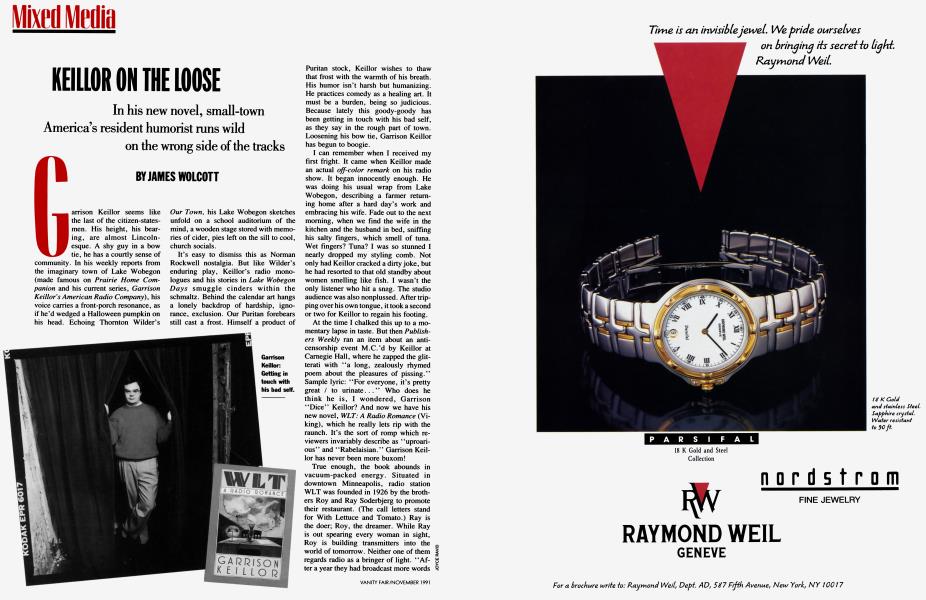
Garrison Keillor seems like the last of the citizen-statesmen. His height, his bearing, are almost Lincolnesque. A shy guy in a bow tie, he has a courtly sense of community. In his weekly reports from the imaginary town of Lake Wobegon (made famous on Prairie Home Companion and his current series, Garrison Keillor's American Radio Company), his voice carries a front-porch resonance, as if he'd wedged a Halloween pumpkin on his head. Echoing Thornton Wilder's Our Town, his Lake Wobegon sketches unfold on a school auditorium of the mind, a wooden stage stored with memories of cider, pies left on the sill to cool, church socials.
It's easy to dismiss this as Norman Rockwell nostalgia. But like Wilder's enduring play, Keillor's radio monologues and his stories in Lake Wobegon Days smuggle cinders within the schmaltz. Behind the calendar art hangs a lonely backdrop of hardship, ignorance, exclusion. Our Puritan forebears still cast a frost. Himself a product of Puritan stock, Keillor wishes to thaw that frost with the warmth of his breath. His humor isn't harsh but humanizing. He practices comedy as a healing art. It must be a burden, being so judicious. Because lately this goody-goody has been getting in touch with his bad self, as they say in the rough part of town. Loosening his bow tie, Garrison Keillor has begun to boogie.
I can remember when I received my first fright. It came when Keillor made an actual off-color remark on his radio show. It began innocently enough. He was doing his usual wrap from Lake Wobegon, describing a farmer returning home after a hard day's work and embracing his wife. Fade out to the next morning, when we find the wife in the kitchen and the husband in bed, sniffing his salty fingers, which smell of tuna. Wet fingers? Tuna? I was so stunned I nearly dropped my styling comb. Not only had Keillor cracked a dirty joke, but he had resorted to that old standby about women smelling like fish. I wasn't the only listener who hit a snag. The studio audience was also nonplussed. After tripping over his own tongue, it took a second or two for Keillor to regain his footing.
At the time I chalked this up to a momentary lapse in taste. But then Publishers Weekly ran an item about an anticensorship event M.C.'d by Keillor at Carnegie Hall, where he zapped the glitterati with "a long, zealously rhymed poem about the pleasures of pissing." Sample lyric: "For everyone, it's pretty great / to urinate..." Who does he think he is, I wondered, Garrison "Dice" Keillor? And now we have his new novel, WLT: A Radio Romance (Viking), which he really lets rip with the raunch. It's the sort of romp which reviewers invariably describe as "uproarious" and "Rabelaisian." Garrison Keillor has never been more buxom!
True enough, the book abounds in vacuum-packed energy. Situated in downtown Minneapolis, radio station WLT was founded in 1926 by the brothers Roy and Ray Soderbjerg to promote their restaurant. (The call letters stand for With Lettuce and Tomato.) Ray is the doer; Roy, the dreamer. While Ray is out spearing every woman in sight, Roy is building transmitters into the world of tomorrow. Neither one of them regards radio as a bringer of light. "After a year they had broadcast more words than Shakespeare ever wrote, most of it small talk, chatter, rat droppings." And both fear that the open mike is an invitation to disaster. Who knows what nut case might wander in off the street? "Someone who'd burst into a joke about humping a sheep, or launch into the one about the young man from Antietam who loved horse turds so well he could eat 'em." Despite an occasional rattler from WLT's Studio B, which seems stricken by an ancient curse (' 'Reed Seymour once got the hiccups so bad he lost his partial plate and had to gum the newscast"), the station becomes a license to print money. Every local business elbows to become a sponsor. Its on-air talent become stars. Only the advent of television begins to close the flaps on this bazaar.
With its wingspan of sixty-some years, WLT is a pop history of heartland America, as full of bustle as a Preston Sturges film, crammed with period decor, bygone products, and slang ("the big stoopnagel!"). At times the book spills out of its frame. There are also smooth passes, such as this aside about a culture snob: "Vesta always held to the If-I-can-help-but-one-person-out-there standard of success, a standard that leaves little room for failure." At the other end of the spectrum is Roy the dreamer, who claims literacy has sissified radio. True radio reached into the ether, aspiring to the condition of soundscape. "It is dreamlike, precognitive, primitive, intimate," the playground of the unconscious. But whatever hopes Roy harbored for radio have been trampled underfoot by rampant commercialism. The very air seemed plastered with billboards. And television, even more packaged than radio, puts the audience into an even busier trance. Salesmanship has plugged another pathway to the soul.
But such ideas have to be picked like sound bites out of the stomach rumble of filler, flimsy characterization, and minor intrigue that make up so much of WLT. After a while the entire cast seem to have their candied faces smushed against the sound-booth glass. Solitude doesn't seem so bad after you've been clogged in a studio for several hundred pages with all these "colorful" characters from yesteryear.
The novel's sexual exploits release little steam. They add to the blockage. Even though Ray, sporting sea-horsepatterned silk socks and smoking Cuban cigars, seems like an S. J. Perelman dandy, the hedonism in WLT tends to be on the backward side. "Darrell's sister Sally had a lot of boyfriends and when one of them drove in the yard and honked, she went out and pulled up her skirt and lay in the back seat with him on top of her, his hairy butt bumping like a sonofagun, and she barked and howled like a barnyard dog." The limericks in the novel are cut from the same hickory switch.
There was an old fellow named A1 Who wouldn't take any old gal He preferred one with boobs And Fallopian tubes And perhaps a vaginal canal.
In WLT, the vaginal canal isn't explored as intently as the digestive tract. Along with a limerick which zealously rhymes fairies with dingleberries, Garrison "Dice" Keillor bangs the pipes in his odes to personal plumbing. "Sometimes they suffered from the runs and . . . sometimes they made gorgeous stools the size of rats and other times they shot out tiny pellets as hard as shotgun shells, but whenever you were around The Rankins [a gospel group], the main topic was shit."
Outhouse humor per se isn't the problem. It's that in his desire to shuck his homespun image Keillor commits overkill. It's not enough for him to expose a female vocalist who sounds young and svelte on the air as a broken-down barge with "fat, big blocks of blubber around her knees." No, he compounds her supposed offense by having her nicotinestained accompanist testify, "I can tell the moment she gets cramps, she sort of grins, a death's-head grin, and she leans slightly to the left and out it comes, silent and deadly, smells like death on a bun. If you had to spend time with an old fartsack like her, you'd smoke too." Keillor even makes hemorrhoid jokes. O Lord, has it come to this?
Let's extend Keillor the benefit of the doubt (I'm in a madcap mood), and concede that Mr. Poo-poo Doo-doo found himself in an honest bind. Taking his cue from Constance Rourke's classic study, American Humor, the critic Richard Chase observes that our homespun legends veer wildly between extremes, from being "meditative, soliloquizing, oddly indirect, covert, and sad" to strutting around the henhouse, being loud, boastful, rhetorical. In his Lake Wobegon legends Keillor has mastered the reclusive, melancholy mode. His blue notes send shadows across the still waters. With WLT he's trying to load his horn and bust a hole in the sentimental mist, belly up with the boys in the back room. More grog, innkeeper! He's out to shed his folksy image. Not only are WLT's listeners derided as a bunch of potato-heads, but the epilogue to the novel is a weirdly out-of-whack chapter about the parasitic nature of celebrity identification. So cranky is this epilogue that it's as if he's extracting a pound of flesh from the reader for whatever pleasure he provided in the earlier pages. That's the strange ambivalence of WLT. Keillor seeks to solidify his standing as an eminent crowd pleaser in the tradition of Mark Twain, yet ring himself with bug repellent. There's a band of tension around WLT, as if Keillor were itching to tell his more deadbeat admirers, Buzz off.
They won't buzz. For fans and reviewers alike, Garrison Keillor has become a beloved institution. To booksellers, he's a blue-chip franchise. Along with a thumping 250,000-copy first printing, WLT: A Radio Romance features a special limited edition signed by the author and an audiocassette tie-in. (I wonder if Keillor will immortalize those limericks on tape.) There will also be an author tour, store displays featuring a reproduction of a vintage radio, major ad expenditure—a complete media blitz.
It's going to be a strain on our faces, pretending to have this much fun. It'll certainly put a strain on his glum puss. You feel that Keillor sympathizes with his radio philosopher Roy and wishes he could stroll to the end of the dial and start from scratch, under cover of darkness. That's the great thing about radio, it affords you a secret identity. The indignity Keillor dishes out against the human body in WLT ("Her sharp fingers dug into his wounded rear end") may be an expression of the disgust he feels at being on such blatant public display. He feels cheap. He feels used. He feels so dirty inside. Unless he thinks this is all good clean fun. Naw, he's smarter than that. Isn't he?
There's a band of tension around Keillor's new novel, as if he were itching to tell his more deadbeat admirers, Buzz off.
Subscribers have complete access to the archive.
Sign In Not a Subscriber?Join Now
