Sign In to Your Account
Subscribers have complete access to the archive.
Sign In Not a Subscriber?Join NowRED STAR FALLING
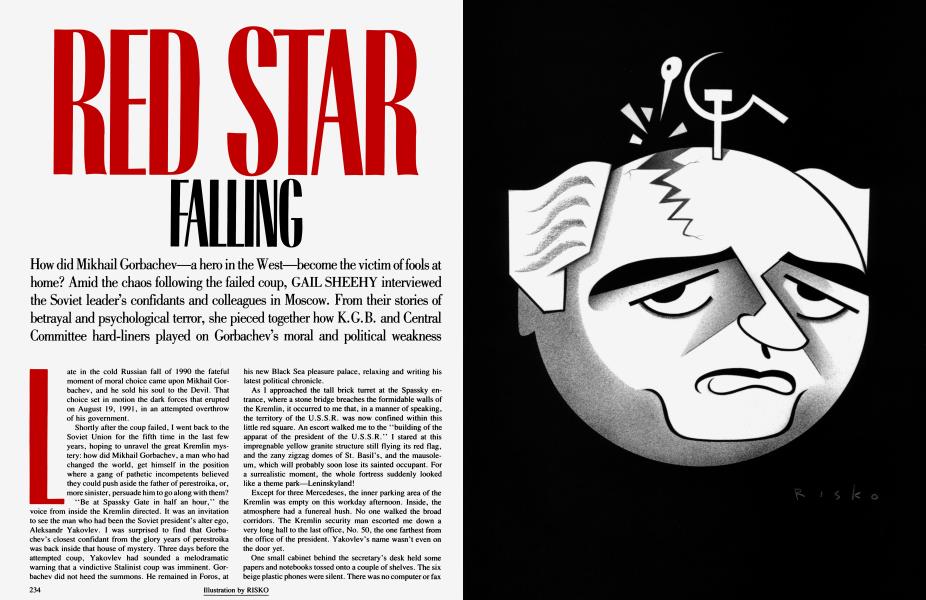
How did Mikhail Gorbachev—a hero in the West—become the victim of fools at home? Amid the chaos following the failed coup, GAIL SHEEHY interviewed the Soviet leader s confidants and colleagues in Moscow. From their stories of betrayal and psychological terror, she pieced together how K.G.B. and Central Committee hard-liners played on Gorbachev's moral and political weakness
Late in the cold Russian fall of 1990 the fateful moment of moral choice came upon Mikhail Gor bachev, and he sold his soul to the Devil. That choice set in motion the dark forces that erupted on August 19, 1991, in an attempted overthrow of his government.
Shortly after the coup failed, I went back to the Soviet Union for the fifth time in the last few years, hoping to unravel the great Kremlin mystery: how did Mikhail Gorbachev, a man who had changed the world, get himself in the position where a gang of pathetic incompetents believed they could push aside the father of perestroika, or, more sinister, persuade him to go along with them?
"Be at Spassky Gate in half an hour,'' the voice from inside the Kremlin directed. It was an invitation to see the man who had been the Soviet president's alter ego, Aleksandr Yakovlev. I was surprised to find that Gorbachev's closest confidant from the glory years of perestroika was back inside that house of mystery. Three days before the attempted coup, Yakovlev had sounded a melodramatic warning that a vindictive Stalinist coup was imminent. Gorbachev did not heed the summons. He remained in Foros, at his new Black Sea pleasure palace, relaxing and writing his latest political chronicle.
As I approached the tall brick turret at the Spassky entrance, where a stone bridge breaches the formidable walls of the Kremlin, it occurred to me that, in a manner of speaking, the territory of the U.S.S.R. was now confined within this little red square. An escort walked me to the "building of the apparat of the president of the U.S.S.R." I stared at this impregnable yellow granite structure still flying its red flag, and the zany zigzag domes of St. Basil's, and the mausoleum, which will probably soon lose its sainted occupant. For a surrealistic moment, the whole fortress suddenly looked like a theme park—Leninskyland!
Except for three Mercedeses, the inner parking area of the Kremlin was empty on this workday afternoon. Inside, the atmosphere had a funereal hush. No one walked the broad corridors. The Kremlin security man escorted me down a very long hall to the last office, No. 50, the one farthest from the office of the president. Yakovlev's name wasn't even on the door yet.
One small cabinet behind the secretary's desk held some papers and notebooks tossed onto a couple of shelves. The six beige plastic phones were silent. There was no computer or fax machine in sight. A lone assistant giggled sheepishly. They had had a computer in Aleksandr Nikolayevich's old office at the party's Central Committee complex, he said, "but we didn't have a chance to take it out'' before Russian president Boris Yeltsin forced Gorbachev to hand over the building.
"You Americans and the Europeans created this
Yakovlev came strolling in—a short, well-larded man dressed like a banker, his conservative gray three-piece suit and white shirt with fine green stripes bearing the unmistakable stamp of Bond Street. He greeted me with cordial informality, so I decided to ask him why the portrait of Lenin was still hanging high on his wall.
"Oh, I never paid any attention to things like that," he scoffed, flicking his hand at the father of Soviet socialism. Yakovlev looked surprisingly relaxed and fit in contrast to the bloated, haunted man I remembered interviewing in May 1990. Then, the tension one sensed inside him had been all but unbearable. He was bursting out of his vest, unable to relax, heaping scorn on President Bush and Secretary of State Baker for being able to "play games and go fishing, because they have no responsibility for economic problems." In that long interview, he had never once mentioned the name Mikhail Sergeyevich, and he had never smiled. Now I learned why.
"Moral terror." Yakovlev proceeded to describe the special campaign conducted against him and other key progressives in Gorbachev's circle by operatives in the Central Committee and the K.G.B. "I was allegedly in the center of an anti-Gorbachev and anti-government conspiracy. The K.G.B. informed Mikhail Sergeyevich I had a special secret name among democrats—they called me khozyain," the Russian word for lord and master.
"Gorbachev loved Yakovlev," I'd been told by a number of their colleagues. Yakovlev was a war hero and an unorthodox figure who had opened Gorbachev's eyes to a new world; early on, Mikhail Sergeyevich had visited him in Canada, where Yakovlev was serving as Soviet ambassador. But in recent years Yakovlev had championed self-determination for the republics, as well as freedom for the press and opposition voices, a market economy, and, especially, liberation from Leninist ideology. Such ideas made him the prime target of reactionary forces that Gorbachev feared offending. The Soviet president had distanced himself from his key adviser during the past year and a half, until they split completely last summer.
Over and over again, Yakovlev was accused of having wrecked Communist ideology while he was a member of the Politburo. In our interview, he described the effect on him. "In such a psychological atmosphere, step by step you begin to think maybe you are the fool. Why not, if all of them are speaking against you? Sometimes I began to think that maybe I"—he choked up, pointing a finger at his temple and making a screwing motion—"maybe something happened up here."
Corbachev's chief of staff, Valery Boldin, had been gradually, sadistically, removing all of Yakovlev's perks of power, from his limousine to his vertushka— the coveted telephone and four-digit number that connects the members of the inner circle directly with the Kremlin. And so, last June, Yakovlev went to his old friend Mikhail Sergeyevich and offered his resignation. Gorbachev refused to accept it.
In July, Yakovlev asked again to see the now distant Soviet leader. This time Gorbachev invited him for a long talk. "We had four hours; we talked about everything. I asked him to free me, because it was impossible to work in this atmosphere. You begin to feel like"—again he gropes for a word sufficient to describe the suffering that clamps down all expression on his face for a few seconds—"like the enemy."
Gorbachev agreed to let his alter ego leave. They parted on friendly terms, but as he went, Yakovlev tried one last time to warn his obstinate comrade: "The people you have around you are rotten. Please, finally, understand this." "You exaggerate," Gorbachev said, dismissing him.
I wanted to know how the exceptionally intelligent Gorbachev could have surrounded himself with narrow-minded yes-men like Gennady Yanayev, his handpicked vice president, and Vladimir Kryuchkov, his choice for K.G.B. chief, whose conspiratorial views of the West would have been laughable if they hadn't been so dangerous.
"These people are not all the same," said Yakovlev. "Kryuchkov was not stupid, but foxy. Gorbachev used to say, 'You know, Aleksandr, you overestimate their abilities, their mentality.' But I know that I didn't overestimate. I knew them." Heavy with the bitter memory, Yakovlev leaned on his Russian-birch coffee table and set his glasses down. "But, uh, he trusted them. Because they behaved themselves, they agreed with him on all points. They sucked up to him." As a result, he added, Gorbachev believed they were the very best assistants, because they were personally beholden to him. The second reason for Gorbachev's blindness, he suggested, was the great pressure he was under from the military complex and from the apparatus of both the state and the party.
"I don't have any feelings of pride or satisfaction in what has happened," he added, although the sniff that preceded his smile belied his words, "but I was right. It happened in three days!" And he chuckled with unabashed delight.
"It is not easy for him now," he intoned, balefully Russian. This sixty-eight-year-old man sounds slow, ponderous, heavy with experience so intertwined with self-protection and treachery, smears and self-doubts, that he seems, like Gorbachev, still to be in shock and living in the recent past, trying to sort it all out. Following the aborted coup, Gorbachev had turned handsprings to coax this darling of the "democrats" to come back to work for him. After spuming him twice, Yakovlev finally agreed to return, but in only the most tentative of roles, something called—he could hardly remember the title—the president's state adviser for special projects.
monster—Gorbachev fell in love with his own image."
Gorbachev's cruel position now "is the reason why I agreed to come back, only this reason.'' With a sudden outburst of emotion, slapping the arm of his chair for emphasis, Yakovlev added, "Because I did not like, I don't like, probably I will not like, this kind of work.'' And he swept his arm around this relic of a Kremlin office, with its heavy wooden shutters and fringed silk Venetian curtains and standardized appointments and utter lifelessness.
"Do you still love this man?" I asked Yakovlev, pointing to the regal picture of Mikhail Sergeyevich on the wall. He hesitated. The animation drained from his face, and he seemed to push the words out of his throat.
"I like him."
Gorbachev himself was mysteriously unavailable in mid-September. No new government had yet been formed. With all governing structures shattered, the people didn't know what country they belonged to, who would pay them, who owned what, or what their republic, their city, or their street would be called tomorrow. It was a massive societal identity crisis.
While the republics fought over what kind of new treaty might bind them into what kind of "common economic space," the state bank was burning up its presses printing money around the clock. And while inflation blazed, the country's budget-deficit figure was casually adjusted upward by 100 billion rubles. In the midst of the chaos, one Muscovite quipped, "We need to lock up our leaders in a 'common psychiatric space.'
Gorbachev merely shrugged and stated that he was responsible now only for paying the army and the research institutes, and he didn't know if he could even meet their payrolls. He articulated no new policies, but insisted the union state must be preserved. Meanwhile, Boris Yeltsin, so recently the conquering hero for democracy, was being attacked by his own deputies for squandering the opportunity to impose unpopular measures to stanch the economic hemorrhaging. As his legislature awaited his first major policy speech, Yeltsin simply called in sick.
In fact, as October began, there was no one home minding the store. Both leaders of record were busy cashing in, using capitalism for their own purposes but not bringing it to their people.
Gorbachev had already slipped away to update his chronicle with the events of the aborted coup for the Western publisher HarperCollins. Even on the first day of the attempted coup, when their fate was hanging in the balance, Raisa had led her husband and his assistant-cum-ghostwriter to a gazebo and found some notebook paper and a stub of pencil, instructing them, "Time to work." Mrs. Gorbachev subsequently contacted HarperCollins owner Rupert Murdoch, with whom she had negotiated personally last spring on the price of her own book. (She had demanded an advance four times greater than her husband's—$2 million—and landed it.)
Yeltsin, inevitably, had to compete. He dropped out in mid-September for two weeks to rush his own book on the putsch into print for another Western press. While he was away, his prime minister and two deputy prime ministers quit, leaving the skeleton executive authority even weaker and more fractured. The bizarre behavior of the leadership was only the latest in a series of virtually incomprehensible events. For more than a year, Mikhail Gorbachev had been lurching from one extreme of the political spectrum to the other.
'You Americans and the Europeans created this monster—Gorbachev fell in love with his own image" is the view of Nikolai Shishlin, an old hand at the Central Committee international department. "He wasn't always that way," Shishlin adds. Dmitry Golovanov, a university classmate and old friend of Gorbachev's, agrees about the Soviet leader's growing narcissism. "If that putsch hadn't happened, it's likely that [from Gorbachev] we would have received a new cult of personality."
Mikhail Gorbachev is known the world over as a master of improvisation. Time and again he has appeared to be lashed to the tracks before a speeding train, only to spring up with a new face, as if reborn into another political life. But the same breathtaking dexterity that won him ovations abroad was seen at home as an addiction to maneuvering, marked by indecisiveness and half-measures, which would ultimately prove lethal.
"I think that he grew accustomed to the idea that he is the cleverest manipulator of events," says Aleksandr Pumpiansky, the editor in chief of a prestigious political-affairs magazine, New Times. "He was playing many cards, and each time he was winning, really winning," both in political maneuvers and in real achievements. "He grew accustomed to the idea that he was the genius leader of them all."
Hubris can take a leader far in the face of obstacles that would boggle the mind of most mortals. Gorbachev's dream was to be revered as the first reformer in Russian history to make a revolution without allowing blood to flow—"to atone for all the bloodsuckers who came before him, from Lenin up through his mentor Andropov," adds Ales Adamovich, a prominent writer who knows Gorbachev. He also committed himself to preserving the territorial integrity of the Soviet Union.
In 1987, Gorbachev described his mission in a private and prophetic remark to Colin Powell, then Ronald Reagan's national-security adviser: "I intend to run as fast as I can, as far as I can, for as long as I can, and then someone will stop me."
Gorbachev became more and more self-pitying and
That someone turned out to be Boris Nikolayevich Yeltsin. The real coup was not the tragicomic bungling of the Gang of Eight on August 19-21, but the rapid transfer of power from the Center to the Russian government that followed. It was Yeltsin who set in motion the centrifugal forces that predominate today in the F.S.U.—Former Soviet Union.
Yeltsin and Gorbachev had once been close. Both regional party bosses, they bartered goods to the benefit of each. When Gorbachev came to power, he groomed Yeltsin for the plum position of Moscow party boss. Much later, when an adviser confronted Yeltsin with the question "Could you have begun perestroika like Gorbachev began it?" Yeltsin answered "No." Perestroika's roots were intellectual, they agreed.
But there had been bad blood between the two ever since Gorbachev forced Yeltsin's resignation in autumn 1987. "I won't let you back into politics," Gorbachev swore, and refused to shake hands with Yeltsin or even to look at him thereafter. That same year, Gorbachev treated the Siberian radical in the manner of a czar dealing with a cheeky serf, calling him to say, "I don't think your role in politics is legitimate. Work in construction, do anything you want. But you will never be a politician."
The level of vilification directed at Boris Yeltsin by the party and press over the next few years was equal only to the Brezhnev-era campaigns against Sakharov and Solzhenitsyn. Yeltsin still remembers how, when he and his wife, Anastasia, accepted a rare invitation to a party of the nomenklatura, only one person at the gathering—Nanuli Shevardnadze, wife of Gorbachev's nobly bom foreign minister—would speak to Mrs. Yeltsin.
The rivalry between Yeltsin and Gorbachev took on proportions of monumental pettiness, until, by last winter, the fate of the country was held hostage to their personal power struggle.
"Again he's doing something totally stupid!" Boris Yeltsin would slam down the telephone in his soaring two-story office in "the White House" and curse the president of the Soviet Union. His rival might be sitting in his office in the Central Committee complex, sanctum sanctorum of the Communist Party, or relaxing in one of his four country houses, or sunk in the velour seat of his hand-built limousine as it ran the red lights of Moscow. For they spoke constantly, these two, after midnight and in the early-morning hours between December 1990 and April 1991, when conventional wisdom had it they were completely estranged. Yet so strained were their top-secret communications, Yeltsin had to close his eyes, physically screw up his face, and stiffen his body simply to be civil to the man on the opposite end of the phone.
"And I could tell that on the other side there was precisely the same kind of torment," says Soviet journalist and Yeltsin ghostwriter Valentin Yumashev, who was present in the Russian leader's office during several of these conversations. "The two men couldn't tolerate each other, even on a personal level."
As Yeltsin's power and credibility grew, from January to summer, Yumashev noticed a profound change in the tone of their conversations. "Yeltsin already could press his policies on Gorbachev."
On June 12, 1991, Boris Yeltsin became the first leader to be popularly elected in a thousand years of Russian history. The era of Mikhail Gorbachev's singular leadership of the Soviet empire had come to an end. Yeltsin could now sprawl on the sofa in his office and stare up at the vast map of Russia on his wall, congratulating himself on controlling two-thirds of the Soviet landmass and most of its valuable resources. He enjoyed stiffing the union president on Russia's traditional tax contribution to the Center. His voice began to take on a rough, aggressive tone, rising as he confronted Gorbachev: "Mikhail Sergeeeeyevich.
"They say it's not personal, but I've observed them both, and in my personal opinion it's self-love, almost childish egoism, in two adults," observes Yuri Karyakin, the Russian intellectual who worked closely with Andrei Sakharov. After three heart attacks last year, Karyakin resigned from the Congress of People's Deputies and accepted an invitation to join Yeltsin as an adviser. "With the little strength I had left I had one goal: to bring Gorbachev and Yeltsin together. Two people, a year ago, could have made everything happen. The forcefulness of one—I mean Yeltsin—and the flexibility and civilized nature of the other—Gorbachev—could have been so very powerful together. But they were like two aircraft on a collision course, and they both knew it." After all, they are politicians, Karyakin says. And men, I add. "Yes. There is competition. And that's our tragedy, that they weren't able to rise above what they are."
By the time the putschists thrust their emergency measures upon Gorbachev, they had good reason to believe they might find favor with the shaken leader. They had done everything in their power to force him, psychologically and politically, into a comer, where he and Raisa stood alone. Utterly alone.
Tortured by criticism for his domestic failures, he had become more and more self-pitying and paranoid, until he turned on his closest friends.
One by one, Gorbachev had sacrificed his political soul mates—Yeltsin, Yakovlev, Eduard Shevardnadze, Vadim Bakatin, and Nikolai Ryzhkov. He didn't think he needed them. Brought down by hard-liners in the military, K.G.B., and Communist Party, politically shattered, they often suffered grave illnesses. Gorbachev didn't lift a finger to defend them. In his mind, it was they who had betrayed or abandoned him.
Aleksandr Pumpiansky, the editor, has a harsh explanation: "As a democratic czar, as a czar with good temper, he would like to be loved by people, he likes loud applause and kisses. When he doesn't get that applause, someone is to blame—either the media or liberals or conspirators."
paranoid, until he turned on his closest friends.
Yakovlev is more forgiving. "I am sure that Gorbachev became the victim of very cruel disinformation," he told me, clearly tom between love and hate for his old soul mate. "Every day he was given reports about secret plots of democrats to grab power. ' '
Unprepared by his Bolshevik upbringing as a party boss for the concept of loyal criticism, Gorbachev became convinced over the past two years that he was being "vilified" by the liberals and persecuted by "adventurists."
Writer Ales Adamovich describes how easily Gorbachev's reactionary advisers were able to take advantage of his political paranoia. On the eve of the First Congress of People's Deputies, in May 1989, Adamovich and a group of liberal intellectuals got together to show off their brand-new deputy's pins and to talk about this new game—politics—at which they were all rank amateurs. Gavril Popov and Anatoly Sobchak were among them, along with Yeltsin and Yuri Chemichenko, a commentator on agriculture for Central Television.
Anatoly Lukyanov, a comrade from Gorbachev's student days who would later become known as "the ninth man" in the coup, asked to join the gathering. "We had a half-serious conversation about how bad our ministers were," says Adamovich.
"Can't Yuri Chemichenko become a minister of agriculture?" Adamovich teased. "And why don't we make Popov a prime minister? And while we're at it, let's make Yakovlev a minister of ecology."
The next day, Gorbachev called together all the Russian deputies. And when they dared to criticize his apparat, Adamovich remembers, he lashed out at them. "Don't you think I know that not only have you already created an underground government, you have also divided the posts among yourselves!"
The deputies realized that Lukyanov had twisted their joke to make Gorbachev take it as a serious threat. That was their first clue that Lukyanov was a major intriguer, who found a ready ear in a somewhat paranoid and quite gullible Gorbachev.
any of Gorbachev's friends from the halcyon days at Moscow State University were also kept at arm's length by the men surrounding Mikhail Sergeyevich.
In June 1990, Gorbachev surprised them by attending their class reunion for the first time in a decade, and he seemed hungry for their love and support. "I'm so pleased," he mumbled thickly, touching each of them, "I'm almost in tears. I embrace you all." He told his old friend Dmitry Golovanov, a media professional, "I need you a lot." And he told both Golovanov and another close classmate, Vladimir Lieberman, "Raisa needs help."
"What does that mean, what kind of help?" Golovanov asked.
"Help to make a good image of her," said the concerned husband.
"Of course we are ready," agreed Golovanov. But he knew nothing would come of it when he saw two treacherous faces in Gorbachev's entourage.
The first was Lukyanov, "whom Gorbachev believed endlessly," and who was now in a key power position in Gorbachev's parliament. Lukyanov would pretend to be a democratic cohort when it served his purpose, as Yakovlev told The Washington Post, and then speak as a superhawk during Politburo sessions. "You know, Mikhail Sergeyevich, [the democrats] are aiming at you. . .to overthrow you," Lukyanov would say. "Suppress them totally, mercilessly."
"The second figure, the most terrible one," Golovanov remembers, "was Boldin."
Valery Boldin began his career by answering the phone and taking messages at the Central Committee. Loyal and talentless enough to be trusted by the party as a journalist, he was sent to the Central Committee's Academy of Social Sciences to be made a "specialist" in agriculture. Boldin then wormed his way into Gorbachev's affections by traveling to Stavropol and writing a splashy paean of praise to the great forward-looking socialist experiments being carried out in the region where Mikhail Sergeyevich happened to be first secretary. Soon after, Gorbachev was summoned to Moscow by Brezhnev to become the Communist Party secretary of agriculture. In 1981, he picked Boldin as his chief aide, and when he ascended to the post of general secretary, Boldin became a member of his inner circle. Convincingly sycophantic, according to one of the president's men, Boldin "had Gorbachev in a stranglehold."
As chief of staff, Boldin controlled the president's schedule and discouraged unwanted callers. He told Gorbachev that his old university pals didn't respect him, that they had the nerve to consider themselves peers, that they wanted only to criticize him. Golovanov, a jaunty and cultivated man from an old Moscow family, was the deputy director of the nightly TV news show Vremya when Gorbachev came to power, but was subsequently "exiled" to work in Bulgaria. He remembered how Mikhail Sergeyevich had introduced him to Boldin, urging Boldin that if his old pal telephoned, "don't even ask him what he wants, just connect him to me." But, Golovanov says, with evident pain, "after that I never talked to Gorby again. And I don't want to call Gorby now."
Raisa trusted Boldin completely. "We have been so close for fifteen years. He was like next of kin to us; we shared all our intimate secrets with him!" she exclaimed in shock during the coup.
Continued on page 278
Continued from page 239
While her husband had surrounded himself with weak personalities who could never overstep him, or so he thought, Raisa had helped to arrange the mirrors around him so that they would reflect only the image of the genius leader. But, if anything, Raisa Gorbachev was more paranoid and dependent on the apparat for her sense of security than her husband. She was even suspicious her own phone was bugged. As a child, she had seen her father imprisoned for speaking out against collectivization; her mother often broke down and wept over their plight; her talented younger brother became an alcoholic. Such a grim background seems to have marked her personality with deep pessimism—as she expressed it herself, "the feeling that people are doomed."
Another of Gorbachev's oldest friends, then foreign minister Eduard Shevardnadze, had warned the president repeatedly about the "two-faced partners that he himself had put in power. ' ' In his new book, The Future Belongs to Freedom, Shevardnadze writes, "With amazing stubbornness, he refused to see that the circle of the coup was closing in on him." He adds the deadly rhetorical question "Did he not want to see it?"
The day of the putsch, outside the White House, Shevardnadze held out the dark possibility that under pressure Gorbachev had gone along with the hard-line takeover and could re-emerge as its figurehead. Many citizens of the Soviet Union had the same suspicion.
Shevardnadze and Gorbachev also had once loved each other. The friendship between these two southerners goes back almost forty years to when they met as starry-eyed Stalinist youths in regional Communist organizations. Then, several years before Gorbachev became general secretary, the two men took a walk on a lonely beach together and agreed that "everything is rotten" in the country and the Communist Party. Unless serious reforms were made, they concluded, the Soviet Union would perish.
I interviewed Shevardnadze in September in a building on Yelizarov Street donated to him by a group linked to the K.G.B. It was stone-cold and the furnishings sparse. (Shevardnadze complained privately that after his resignation Boldin had stripped him of everything but an apartment, TV set, and VCR.) The jobless former foreign minister was attempting to establish his Foreign Policy Association here.
The princely Shevardnadze appeared in a dark and sober blue suit, warmed with a vest. After a long talk with Gorbachev, he said, he no longer believed the president sanctioned the coup. The passion he had felt during the days of the putsch seemed somewhat tempered, perhaps by a rethinking of his own political role in a postcoup Soviet government. He said, "Thank God Gorbachev is a person of character. Only a person of character could have started perestroika. Gorbachev will enter history as a great reformer, a great revolutionary. It was not so easy to begin."
Still, there were flashes of lasting disillusionment. "He enjoyed maneuvering too much. There is a moment when one has to say tactical considerations are not uppermost—my stake is with democracy and democratic forces. And in this he was too late, my dear, dear friend."
Although Shevardnadze would like to think Mikhail Gorbachev has become a different person since the putsch, he told me that the Soviet leader is "still a prisoner—of his own nature... his way of thinking and acting. .. his poor judgment of people, his indifference toward his true allies, his distrust of the democratic forces, and his disbelief in. . . the people."
Like Yakovlev, Shevardnadze had privatelydisagreed with his boss—an unknown concept in Soviet leadership circles. Gorbachev didn't like it a bit. And all through 1990 the Soviet foreign minister warned his counterparts in the U.S., Britain, and France that a dictatorship was imminent. For this, "Gorbachev thinks that Shevardnadze betrayed him, not the other way around," says Vladimir Lieberman. And so, in an astonishing incident, Gorbachev attempted to offer up his old friend as a sacrifice to the hard-liners.
On August 3, 1990, Secretary of State James Baker stopped in Moscow to solicit a joint Soviet-American declaration condemning Iraq's aggression against Kuwait. Honor and trust count for a great deal with Shevardnadze. He was proud of the trust he had cultivated with his American counterpart. And now, as he was accompanying Baker to the airport, an agreement declaration safely in his briefcase, he received an urgent call on behalf of what he called "a competent authority."
"Today the U.S. attacked Baghdad," he was told. Preposterous as it sounded, Shevardnadze had no way of knowing it was blatant disinformation. He had to ask Baker, "Is it true? Tell me the truth. It is a question of my honor." Baker, Shevardnadze records, gave him a look of hurt and regret.
Then came the angry call from Gorbachev. He implied he was holding Shevardnadze responsible for any surprise attack by the Americans. Representatives of the military complex, which smiled upon Iraq as one of its largest arms customers, were clearly desperate to drive a wedge between Americans and Soviets on the issue. Gorbachev, writes Shevardnadze, was offering him up "to the caprice of our own internal Saddam."
Shevardnadze later saw this incident as part of a whole smear campaign organized against him and his family. For eight months, he lived in a miasma of depression and fear for his life. Only at dawn on August 19, when he was awakened by a loudspeaker giving the edict of the Emergency Committee, did the fog of dread lift and allow Eduard Shevardnadze a clear insight: the dangerous lies fed to the president, the intimidating phone calls warning him not to speak out anymore— all of it had been psychological preparation for the coup.
Beyond his predilection for maneuvering, his hubris, and his paranoia, Gorbachev was also weakened by ideological blind spots. "Democracy seemed dangerous to Gorbachev," says his old classmate Vladimir Lieberman. "He saw the democrats as extremists, organizers of confrontations." And that meant potential bloodshed, perhaps leading to civil war. "So, emotionally, he got the feeling that to go forward was impossible."
A year ago this November, on what is known as "the night of the black colonels," military hard-liners and their conservative allies confronted Gorbachev with what was, in effect, a threatened coup. They told him they were willing to draft plenipotentiary presidential powers for him, provided he would use them to oust the reformers around him, restore central control over the economy, and issue a blanket decree authorizing the military to use force against civilians to "restore order." Faced with this ultimatum, Gorbachev capitulated.
"I don't want to think that Gorbachev acted this way only because he wanted power," muses the normally ebullient Golovanov. "But I'm afraid that the very structure of our society is absolutely totalitarian—they just told him the rules of the game and he agreed.
"He was convinced that the apparat was running everything and he could never get rid of it," Golovanov adds.
At the time, Boris Yeltsin thought he had a serious working partner in the Soviet leader. Their two teams were laboring together toward a swift, radical transition to a market economy. "My personal mistake is that I was too trusting," Yeltsin would later say.
Gorbachev believed that the only force in the society powerful enough to shield him from his enemies was the apparats of the party, the K.G.B. and the army. They had all the directors of the huge state industries, all the security forces, the marshals and troops—real power. And who were these democrats? he would inveigh to his old socialist comrade ZdenSk Mlynar. Popov? (Moscow's mayor.) He's only a professor. Sobchak? (St. Petersburg's mayor.) Another professor. What power do these democrats have? he would mock them. A few newspapers, a few TV programs, some meetings in the streets where no more than 4 or 5 percent of the population is present.
And so, last winter, to please the hardliners, Gorbachev reimposed censorship on Soviet television, ordered the unleashing of army and K.G.B. goons to patrol the streets of Soviet cities, and tightened the noose on the Baltics. In January 1991, he sanctioned the army actions that led to a slaughter of civilians in Lithuania, and later the raid by Black Berets in Latvia. Outcries ricocheted around the world. Gorbachev's lifelong yearning to have his country accepted as one of the "civilized" nations of Europe hung in the balance.
Mikhail Sergeyevich hit bottom with the infamous speech on February 26 condemning the "so-called democrats" before a hall of intellectuals in Minsk. "They have a common aim: to weaken and, if they can, demolish the union," he charged. In what sounded like a paranoid reference to his closest political soul mate, Yakovlev, he warned, "The slogans that inspired these forces for perestroika. . . are being used to cover up far-reaching intrigues, which in a number of cases have been born in alien scientific centers and in alien heads." While discounting the threat on the right, Gorbachev dismissed the "democrats" as bungling amateurs—a fateful mistake.
In fairness, the beleaguered leader was being squeezed into a comer. Even as he rendered himself hostage to his hard-line enemies, there were unending attempts by the party aristocracy to push him to resign as president. Simultaneously, Yeltsin was bringing a hundred thousand people into the streets to protest against Gorbachev and his policies. And on April 5, Yeltsin showed he could do just what Gorbachev always did: wrest "special powers" from his own legislature.
Finally, it came to the point where either Gorbachev would have to continue to deal with "the old mafia," says Valentin Yumashev, "or the second possibility would be to turn sharply from those circles and begin to work with those who had already received the trust of the people." As the political center caved in beneath him, Gorbachev had to acknowledge he couldn't manage without Yeltsin. He made a conciliatory approach to the burly Siberian.
On April 23, Gorbachev secretly gathered the leaders of nine republics, including Yeltsin, at a dacha outside Moscow. A breakthrough was soon publicly announced: the Russian president and eight others had agreed to work with Gorbachev on achieving a new union treaty.
But the Soviet leader's desperate improvisation came too late. Four months later, on the eve of the signing of that treaty, the hard-liners moved to overthrow him.
The horror for Mikhail and Raisa was to have their world turned upside down by mere subordinates. Their ordeal began on a beautiful Sunday afternoon by the beach on the Black Sea, where Raisa had directed the building of a luxurious hideaway to accommodate their small family for their annual vacation.
"It was like a bolt from the blue," Raisa later said, describing the moment when, as she sat in an armchair, Boldin and Valentin Varennikov, the deputy defense minister, cruised by as if they didn't even see her. Gorbachev himself had been aghast when, as he was about to "invite the visitors in," they appeared in his office without being asked—"an unheard-of lack of respect," as he later described it. After being presented with a decree authorizing a state of emergency, which he refused to sign, Gorbachev emerged and handed Raisa a small piece of paper. On it were written the names of the members of the Emergency Committee. Lukyanov's name was on the list, but with a question mark.
Gorbachev told his wife that Boldin had tried to lecture him. According to Anatoly Chernyayev, Gorbachev's assistant, whose diary was published by Time, Boldin said cheekily, "Don't you realize we're in a terrible plight?" "You mudak [schmuck], shut up!" Gorbachev shot back. In his own retelling of the scene to Chernyayev, the Soviet leader kept reassuring himself, "I was absolutely calm. I am still calm. I am convinced that I am right."
The world waited on tenterhooks for the return of President Gorbachev and his family after the ominous three-day blackout on their condition. Gorbachev looked anything but calm by the time he arrived at Vnukovo Airport in Moscow at 2:15 on Thursday morning. One of those who met him had the impression the president may have had a stroke. His eyes wandered in different directions. His speech was slurred. "And Raisa looked fifteen or twenty years older. She was just an old lady. She didn't have the strength to walk down the staircase from the airplane."
Indeed, Raisa seems to have suffered hysterical paralysis, which under the traumatic conditions temporarily impaired her speech and paralyzed part of a limb. "I suffered from the bitterness of the treachery," she disclosed. Gorbachev himself admits, "I was shaken to the depths." As Pumpiansky analyzes the impact on Gorbachev, "When all his creatures appeared there in the Crimean dacha, without his calling them, and changed their tone of addressing him.
this was a stroke, a political, emotional, human stroke."
On the morning of his return, the people at the barricades waited for Gorbachev to come and greet them. Their searing disappointment is described by Ales Adamovich, one of the few defenders the Soviet leader still had among the intelligentsia. "First, people forgave him, thinking that he must be sick after all he had gone through. Then people thought that he would come to the first session of the Russian parliament. But he did not come." The defenders of the White House called a demonstration later that morning, bringing out a sea of 200,000 jubilant faces. Some raised signs: GORBACHEV, REMEMBER UNDER WHAT BANNER YOU WERE SAVED!
Yakovlev tried one last time to warn Gorbachev. 'The people you have around you are rotten. Please, finally understand this."
Adamovich went to a phone to call Chernyayev and plead, "What are you doing! Why don't you come?"
"He went to the Kremlin," Chernyayev reported.
Adamovich's heart sank. "You lost everything."
Chernyayev recognized the mistake, he says. Adamovich learned that the demonstrators were on their way to the Kremlin. He phoned back and reached Chernyayev's secretary. "Tell him Gorbachev can meet us at Red Square."
"I counted on the fact he'd meet us there," says Adamovich sadly. "Instead, he met with some apparatchiks and foreign ambassadors. But the main thing he just didn't do."
One plausible thesis is that Gorbachev was afraid of the crowd. If he had appeared at that time, inevitably there would have been cries for his resignation, though Adamovich believes that most people would have accepted him. When he finally did appear in public, it was not before the people but at a formal press conference, where he could control the situation.
Arrogant, strong-willed, and occasionally jovial as ever, Gorbachev told his tale with great theatricality. "Personally, this has been a hard drama for me," he said. Though he came close to tears once or twice, his long chronicle began to sound self-congratulatory and self-obsessed to the crowd of correspondents. In his mind, the frontline battle of the coup had been fought not on the barricades of Yeltsin's White House but in Gorbachev's Black Sea country house. Gorbachev depicted himself first as a victim and ultimately as a hero who had conquered the forces of darkness with his calm.
"I was absolutely cool," he repeated. And then, like a Rip Van Winkle who failed to see he had awakened in a new country, Gorbachev gave a ringing endorsement to the future of socialism and a renewed Communist Party.
Nikolai Shishlin, the Western-oriented Central Committee consultant, was disgusted. His thirtysomething children had come home from the barricades calling Mikhail Sergeyevich a criminal. This transgenerational trauma was being replayed across the eleven time zones of the shattered Soviet Union. Shishlin approached Georgy Shakhnazarov, a close aide who had been working with Gorbachev when the Foros dacha was invaded, and demanded, "How could Gorbachev say such things at this press conference?"
"Well, you know, Nikolai, there was really nothing so bad about the putschists' measures, it was their methods," Shakhnazarov replied, according to Shishlin, who concluded that the real reason Gorbachev had spurned the ultimatum of the Gang of Eight was his own overweening ambition. "He just didn't like them taking power out of his hands to do it."
Aleksandr Yakovlev described to me seeing three successive Gorbachevs in the days after his return from Foros. The First was the unrepentant apologist for the Communist Party who appeared at the press conference. "I criticized him publicly, because I was surprised"—the word is inadequate—"shocked, and I told him so, that I would never return to this Gorbachev." Yakovlev sliced the air with his hand.
The second Gorbachev was the chastened man who was forced by Yeltsin to read aloud and in public the names of his betrayers. "After his speech to the Supreme Soviet of Russia, it was a little better. He began to understand what happened. And / began to understand him: why he failed to understand that the country was absolutely different after the putsch."
Why did he fail to understand?
"Because, I suppose"—the intellectual waves his hands impatiently as if to indicate that some new thought wave finally got through to Gorbachev—"it's my opinion—young people, students, made their choice." Before, Yakovlev recalled, young Soviets were written off by everyone as politically passive, believers in nothing but quick thrills from sex, drugs, and crime. At street demonstrations, according to Yakovlev, almost all the participants were in their forties or fifties. No young people. "Now, around 'the White House' "—he giggled as he gave the phrase a frisson of irony—' 'just young people!' '
And that impressed Gorbachev?
"Yes. He could see what will be. And he understood probably what happened before. Now he knows that he was misinformed."
The third Gorbachev was the man Yakovlev met in the Kremlin on Saturday, August 24. A discussion took place between the two that apparently convinced Yakovlev his wayward leader had sincerely changed. "Now he understands everything," Yakovlev told me, as if still seeking to convince himself of Gorbachev's transformation. "I feel that he has suffered. I think that the three nights and days were terrible, terrible. Probably he recollected, in his mind, where he was wrong as far as the people are concerned, and where he was right."
In his hasty little (seventy-nine-page) book, The August Coup: The Truth and the Lessons, Gorbachev tries to assure the world that "I have now got everything together.
"The man who returned from the Black Sea to a different country now looks at everything—the past, the present, and the future—with different eyes." He says the coup destroyed his hopes of reforming the party, and promises no more compromise with a vaguely described enemy. While congratulating himself for the complete change of atmosphere over the past five years that has allowed "those now eighteen to twenty to become the most courageous defenders of democracy," he can't resist a swipe at the democrats for their "insufficient sense of responsibility for the common cause."
Gorbachev appears to have fully internalized an image of himself as the injured party in the coup attempt; he presented himself as the object of pity. The Russian people, like Americans, love to forgive. But few loved Gorbachev when he came back. The Communists cursed him. The rabid Russian nationalists called him a traitor. And the intelligentsia could not forgive him—or themselves—for having been co-opted.
After a month in seclusion, too shaken even to venture outdoors, Raisa appeared briefly on Russian television. She was asked how the Foros experience had affected her family. "A new spirit has appeared in our lives," she said softly. "We are gloomier."
If anything, Raisa was more paranoid and dependent on the apparat for her sense of security than her husband.
Throughout history, great leaders have undergone the sort of deep personal transformation that enables them to endure rejection, to return from the wilderness, literal or figurative, and to become the catalyst for a transformation of the society out of which they came. This would be everyone's hope for Gorbachev. But such a transformation is spiritual, even for an atheist. It requires an excruciating personal honesty.
"You need a mirror," believes Karyakin. "We have lived for seventy-three years without a spiritual mirror. We didn't see who we were." I asked this literary philosopher if he believed that during his ordeal in the Crimea Gorbachev had looked at himself in the mirror.
"I'd like this to happen," he answered quietly. "But I'm afraid that he wants to break the mirror."
It would be naive to imagine that a person can undergo a complete ideological and spiritual transformation in a matter of days or weeks. For Gorbachev, socialism has been an ideal, a religion, his icon. "My dear party brothers, nowhere, before no audience, am I embarrassed to say that I am a Communist and adhere to the socialist idea," he emoted before the Academy of Sciences in Minsk only last February. "/ will go into the next world with it." He must now deal with losing "the church" and the fact that "God the Father" is dead. And it turns out Lenin wasn't a good father after all.
Gorbachev hesitated fatally on the edge of his own political transformation. He feared the new. Once he had turned sharply to the right, he forfeited his political identity and all his true friends. The only thing that saved him was the force he most feared—democracy—and the man he most despised: Boris Yeltsin.
It seems to me that Yeltsin has come closer to making a personal transformation. After being stripped of his post on the Politburo, cast out into the wilderness by his political benefactor, and shunned by Shevardnadze and Yakovlev as well, he descended into a passage of hellish depression and disequilibrium. He was forced to find life beyond the party. The irony is, if Gorbachev hadn't banished him, Yeltsin probably never would have made the transformation into a pathleader for the new era.
And yet a squirming unease is already apparent among some of President Yeltsin's most ardent supporters in the intelligentsia. Despite their stylistic differences, Gorbachev and Yeltsin are two old Communist Party bosses of the same vintage, and their approach to leadership has fundamental similarities. Within a month and a half of the failed coup, the Russian president had issued 134 decrees—an average of 3 a day. It was Gorbachev's decree-happy high-handedness that lost him support among the people.
While they recognize that nothing can be accomplished in a formerly despotic society without strong executive power, Russian intellectuals have begun to make open references to Yeltsin's "high and mighty" behavior. Some call it by a new term—"demokratura," denoting a marriage between democracy and diktatura— while others label it more bluntly as "neoBolshevism."
The new Russian boss seems to be obsessed with organizing his personal apparat: a weak team of mostly nonprofessionals, according to leading Moscow journalists. Already they are shutting off access to Yeltsin by his old comrades-in-arms. Yelena Bonner couldn't get in to see him despite two weeks of persistent attempts. "Shades of Boldin," mutters one prominent journalist.
"Yeltsin's advisers have influence over him," sighs Andrei Malgin, the editor of a smart new Moscow magazine, Capital. "He is given poorly decided decrees and he signs them without attention." While ignoring his emasculated legislature, Yeltsin has been sending representatives across Russia to enforce his orders and appoint his creatures to fill local government posts. Some see it as necessary to oust incumbent Communists, while others say he is effectively nipping democratic self-rule in the bud. No one wants to hear about setting up a balance of power: too time-consuming. "Objectively, the [elected local] councils were critical to launch the process of democratization, but now they have become only brakes," Yeltsin's top assistant, Gennady Burbulis, told The New York Times.
Muscovites mutter at seeing the Russian leader whiz around town in an entourage with four Zil limousines, only one fewer than Gorbachev, but flying the Russian rather than the Soviet flag. He is also quickly developing a taste for luxury. "It gives him joy to be building himself a big dacha," says his ghostwriter, Yumashev. Yeltsin simply appropriated several acres of prime woodland in "the Land of Kings" off Rublovskoye Highway, ostensibly for the residence of the first Russian president. His two-story mansion will be built in the same dacha colony where Kremlin big shots, including Gorbachev, have had their splendid country houses. To top it off, the Tass news agency reported that a regent of the Russian monarchy had conferred upon Yeltsin the honorary title "Grand Prince."
The victorious democrats are already bemoaning the loss of their erstwhile enemy. In opposition, their fractious ranks were able to close around resistance to the monoliths of party and K.G.B., with which everybody struggled. "Now these enemies are destroyed, and people are in despair," worries Yumashev. "They don't understand with whom, and for what, to fight."
In fact, the enemy is far from destroyed; rather, it is stunned, disoriented, and, to put it delicately, embarrassed. Communists may have taken cover in the major cities, but in the provinces they still occupy many elective positions. And a leading Russian writer has charged that some of them are co-opting democrats who were humiliated by not being rewarded with important positions after the coup attempt. The Communists have the property and means to bribe them, and the former progressives can rationalize to themselves that they will reform these old thinkers.
The hangover of privilege for party aristocrats has not disappeared, either. I phoned an old Moscow connection to hear his assessment of the chaos. "Everybody's talking, talking, but no action," said Nikolai Shishlin.
"It does seem the government is paralyzed—yes?" I said.
A familiar groan greeted my question. "It's difficult for me to talk over the phone freely." I asked if I could visit him. "I'll call to find out if they will accept a foreigner here."
The last time I had seen this highly placed operative from the international department of the Central Committee, a year ago, he looked "perestroyed." Breath thick with stale cognac, his skin a ghastly blotch of oxygen-deprived tissue, he was in the same terrible shape as most of the politicos of Gorbachev's generation. Yakovlev, for instance, spent a month in the hospital shortly before the putsch. Yeltsin's serious heart condition has required his hospitalization several times. These men are only in their sixties, but they seem to be wearing out prematurely (all except Gorbachev himself). They have been living a roller-coaster existence ever since Gorbachev began his revolution.
I found Shishlin, like many of the survivors, I suspect, in recovery. He was spending the month in a sanatorium for party aristocrats. An hour from central Moscow the street came to a sudden dead end, where I had to obtain a pass at a guardhouse before walking a couple of kilometers inside the tall iron gates. No foreign cars are allowed on this "territory," as Shishlin put it.
The sanatorium was a two-story white stone affair, very Frank Lloyd Wright, its glass-walled dining room ostentatious with Czech crystal chandeliers. Women in peaked white caps and old-fashioned nurse's uniforms shuffled softly up and down the highly polished oak parquet corridors carrying linen-covered trays.
"They have everything here," Shishlin said, showing off the swimming pool, tennis courts, and a winter garden with big cages full of parakeets. The pampered inmates were walking about in expensive foreign running shoes and designer tracksuits. Shishlin himself, clad in a sweat suit with the Rodeo label, his hair well barbered, had just been fitted for a brandnew set of teeth. (Most older Soviets have big gold caps where their teeth went bad.) He noted only one drawback here: no booze. Russian sanatoriums are very strict. Even so, certain bigwigs have found these surroundings more agreeable than prison. In the corridor Shishlin stopped to greet the former minister of foreign economic relations, Konstantin Katushev.
"He was with the coup plotters," Shishlin chuckled. Indeed, Katushev and the leadership of his ministry had given instantaneous backing to the putsch.
This old Central Committee hand was guardedly optimistic about the future. The biggest problem he sees is that "nobody knows how to do anything in this country. Nobody. And nobody wants to work. These are the realities of the country." It's true that this is a country of lawyers who have never practiced law, priests who don't know how to preach, psychologists who don't know how to conduct therapy, and new economic managers who have never managed so much as a cafe on a profit-and-loss basis. I asked about Gorbachev himself. Does he know how to write a check? Figure the interest on a credit card? Has he ever seen a balance sheet? Has he ever had to make a budget?
No, said Shishlin, none of those things. "He doesn't have to. It's all done for him. This is Communism!" His laughter gurgled with irony.
Indeed, these simple actions that Westerners take for granted are completely foreign to Yeltsin as well. Having seen Soviets squirm when a Westerner writes a check or asks for a receipt, I had asked Valentin Yumashev if he'd noticed that Yeltsin has the same knee-jerk resistance to handling money.
"Maybe it is uncomfortable for him, because those are things he just doesn't deal with," he said. ''Like most Soviet men, he turns over his entire salary to his wife. She decides how the money will be spent. She orders his suits abroad. She pays a high price in rubles, because the scant hard-currency allowance he receives is not enough to allow him to buy any clothes."
As I left the sanatorium, I was struck by the scene in a large carrot field less than one kilometer outside of this lavish oasis of privilege. It had been recently and sloppily harvested by the local kolkhoz. Bent over the earth were about fifty Muscovites, digging with their hands or toy shovels, helped by their children, hoping to find enough leftover roots to make "carrot cutlets." Everyone knew it was going to be a long, meatless winter. An armed guard stood nearby. "But so far," said one woman thankfully, "he isn't shooting us."
It is a society of victims and tyrants. The victim complex is deeply ingrained by Soviet history. What secret yearning lies, at least subconsciously, in the soul of every victim? To become the tyrant. "Dostoyevsky explained that; we can only affirm it again," says Adamovich.
Gorbachev became a hero to the world, but a victim of fools at home. The putschists stripped away his facade of power. The drama that followed was played out with all the mythic quality of a Russian folktale: The czar is locked up in his palace. In seventy-two hours his whole kingdom is shattered. New, young princes charge to center stage, many never seen before. It's like magic. The rough peasant man jumps on top of a tank and wins the people's hearts—not because of his elected legitimacy, but because he embodies defiance of authority.
After seven decades of being victimized by those twins of illusion and deception— the party and the K.G.B.—people identified to the depths of their souls with this strong, reckless, impulsive man who spoke plainly and acted boldly to express their own immense frustration. Yeltsin defied the party bosses, the secret police, and the army all at once. He acted for the people. And just as they waited for him to slay the dragon of Communism, they will wait for him to deliver democracy to them.
But no sooner does the former victim become the new hero—beloved all the more for having saved the scared, enfeebled czar—than he must demonstrate his new powers. So, at a raucous session of the Russian Parliament, Yeltsin towered over Gorbachev, grinding down his famous arrogance into gasps of humiliation. It was as if Yeltsin had been transformed into the mighty bogatyr of Russian folktales, able to introduce his small friend, Gorbachev, as a hollow man who was no longer dangerous or powerful: See, he must do exactly as I tell him.
This is the essential transformation desired by the Russian people, according to several leading Russian psychologists, among them trauma specialist Fyodor Konkov: "So, Yeltsin becomes the new Good Tyrant, because our peopie psychologically are not yet ready to be free."
The horror for Mikhail and Raisa was to have their world turned upside down by those they had seen as mere subordinates.
Despite his current eclipse, Gorbachev has proved himself a politician with many lives. Don't be surprised if six months from now his political star is once again on the rise, even though he has little real power.
The more Yeltsin speaks in favor of purely Russian interests, the more he will become the lightning rod for discontented republics that feel dwarfed and threatened by this historically monolithic neighbor. As the economy inevitably continues to decline, and depending on how roughly Yeltsin breaks up the party mafias in the provinces, imposes land reform, and meddles in ethnic territorial disputes, he will become the favorite target of frustrated expectations and fear of the new.
Being a "sincere pragmatist," Gorbachev was lying back in early autumn and preparing the ground for what he surely hopes will be his re-emergence as the Superczar, who alone can mediate among all the unruly, Russophobic republics competing for attention and rewards.
His old friend George Bush has already thrown him a lifeline. Bush's sweeping nuclear-arms initiative was intended to encourage destruction of the huge number of short-range nuclear weapons scattered among the newly independent Soviet republics. Nationalist leaders couldn't be expected to lose face by surrendering their warheads to Yeltsin, but Gorbachev is a different story. He has the international prestige to orchestrate an arms agreement that will protect them all from nuclear blackmail. And, indeed, before Gorbachev came back with his own dramatic denuclearization proposal, he found consent in the four republics where the bulk of the weapons are deployed. While Yeltsin vows "the complete destruction of the Center," Gorbachev insists the international community is eager to deal with a new union of sovereign states, or what he now calls "the great Eurasian democracy."
"The republics that previously abandoned Gorbachev will appeal to him, and agree to trust him, precisely because he has no power," predicts Adamovich. "Hisrole will be like that of an English queen or a Spanish king." (Or the president of the European Community.) "And that will relieve the complex of defeat for Gorbachev. "
But what will relieve the victim complex of his countrymen? In opinion polls, Soviets register their disastrous lack of trust in any of their leaders except Yeltsin; they have no new ideas. And, after a thousand years of the absence of democracy, Yakovlev believes, it is a great stupidity to think they can simply adopt the American or European idea. "Procedures, only procedures, can be adopted. The rest must be learned. Democracy is something you have to practice."
Neither he nor Shevardnadze rules out the possibility of another hard-right coup. But even if the Stalinist ghost has finally been laid to rest, Yakovlev wonders whether his countrymen are ready for freedom. Like most Russian intellectuals, he seems to thrive on pessimism. His final words to me were brooding: "The beast of Communism has left the land. I am afraid that the beast of democracy will pass over the land in the same way."
Mark Doctoroff, director of the Soviet Elites Database Project at Columbia University's Harriman Institute, provided research assistance on this article.
Subscribers have complete access to the archive.
Sign In Not a Subscriber?Join Now


