

Sign In to Your Account
Subscribers have complete access to the archive.
Sign In Not a Subscriber?Join NowTHE SWINGING DETECTIVES
The prime-time crime beat takes a hip turn with Britain's "Prime Suspect" and Americas Law & Order
JAMES WOLCOTT
Mixed Media
op entertainment has become fixated on the steel web of the psychotic mind— on its flashy sense of entitlement. In The Silence of the Lambs, Anthony Hopkins expresses his superiority to the dumb human meat he devours with Shakespearean glee, syllabizing like mad. Nick Nolte and Jessica Lange are mere stick people in Cape Fear compared with Robert De Niro, a white-trash Rasputin straight from the tattoo parlor. He wears his Antichrist credentials on his skin like a road map to hell. (The designer names in Bret Easton Ellis's American Psycho also functioned as tattoos.) At a time when bubbling evil creates so many lava veins on-screen, it's useful to be reminded that a rational mind has its own power-sway. A cool brain can stem the bloody tide.
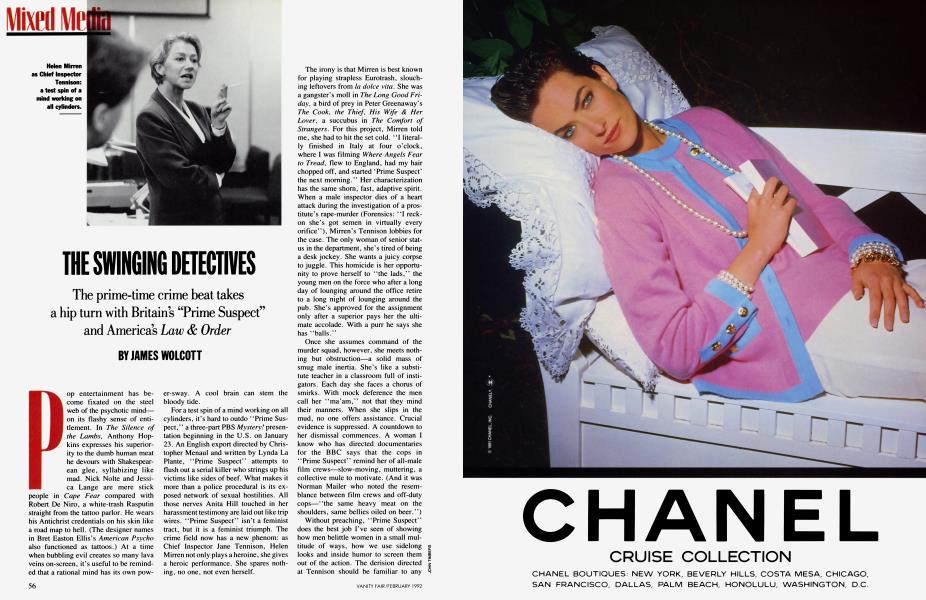
For a test spin of a mind working on all cylinders, it's hard to outdo "Prime Suspect," a three-part PBS Mystery! presentation beginning in the U.S. on January 23. An English export directed by Christopher Menaul and written by Lynda La Plante, "Prime Suspect" attempts to flush out a serial killer who strings up his victims like sides of beef. What makes it more than a police procedural is its exposed network of sexual hostilities. All those nerves Anita Hill touched in her harassment testimony are laid out like trip wires. "Prime Suspect" isn't a feminist tract, but it is a feminist triumph. The crime field now has a new phenom: as Chief Inspector Jane Tennison, Helen Mirren not only plays a heroine, she gives a heroic performance. She spares nothing, no one, not even herself. The irony is that Mirren is best known for playing strapless Eurotrash, slouching leftovers from la dolce vita. She was a gangster's moll in The Long Good Friday, a bird of prey in Peter Greenaway's The Cook, the Thief, His Wife & Her Lover, a succubus in The Comfort of Strangers. For this project, Mirren told me, she had to hit the set cold. "I literally finished in Italy at four o'clock, where I was filming Where Angels Fear to Tread, flew to England, had my hair chopped off, and started 'Prime Suspect' the next morning." Her characterization has the same shorn, fast, adaptive spirit. When a male inspector dies of a heart attack during the investigation of a prostitute's rape-murder (Forensics: "I reckon she's got semen in virtually every orifice"), Mirren's Tennison lobbies for the case. The only woman of senior status in the department, she's tired of being a desk jockey. She wants a juicy corpse to juggle. This homicide is her opportunity to prove herself to "the lads," the young men on the force who after a long day of lounging around the office retire to a long night of lounging around the pub. She's approved for the assignment only after a superior pays her the ultimate accolade. With a purr he says she has "balls."
Once she assumes command of the murder squad, however, she meets nothing but obstruction—a solid mass of smug male inertia. She's like a substitute teacher in a classroom full of instigators. Each day she faces a chorus of smirks. With mock deference the men call her "ma'am," not that they mind their manners. When she slips in the mud, no one offers assistance. Crucial evidence is suppressed. A countdown to her dismissal commences. A woman I know who has directed documentaries for the BBC says that the cops in "Prime Suspect" remind her of all-male film crews—slow-moving, muttering, a collective mule to motivate. (And it was Norman Mailer who noted the resemblance between film crews and off-duty cops—"the same heavy meat on the shoulders, same bellies oiled on beer.")
Without preaching, "Prime Suspect" does the best job I've seen of showing how men belittle women in a small multitude of ways, how we use sidelong looks and inside humor to screen them out of the action. The derision directed at Tennison should be familiar to any woman in an office, factory, bar. Female officers learn to develop rhino skin. When Mirren was researching her role, she learned that the one absolute rule among them was "Never cry." Because once they do, the men will say, See—such sensitive creatures. "Men are allowed to cry," says Mirren. But the women must be double-sealed. This stoicism has a price. Any woman who shuts her tap too tight may be accused of being a dried-up drudge, even by other women. The nastiest comment in "Prime Suspect" comes from a part-time beautician (spooky Zoe Wanamaker), who asks Tennison with disdain, "Do you use a moisturizer?" Because she so blatantly doesn't.
The mystery is solved in a wind sprint of euphoria. When the cops convene on the murderer, it's like a sheaf of arrows aimed at a heart.
As Mirren told me, "This isn't a role for Melanie Griffith"—for any softy shrouding herself in mist. The right angularity is required. The honor badge of Mirren's performance is that she isn't afraid of looking dehydrated, dark-circled, and undone as her character gets in deep. La Plante's script affords her the same pride, impatience, and pungency of expression. ("It's a piece of piss," she says of a surveillance assignment.) How welcome this is. On-screen obsession in women is often emotionalism run amok—permanent PMS. Tennison outthinks her opposition. She's tickled by her own intelligence, conducting discussions of possible scenarios by waving her cigarette like a baton. There's a marvelous scene of her addressing the troops in front of a batch of victim photos, eating a bag of crisps. As she hits her mental stride, the lads lose some of the lead in their drawers. They hop to it. I asked Mirren, who has lived in Los Angeles for six years with the director Taylor Hackford, if she enjoyed ordering around a roomful of men. "I did. I absolutely loved it." It shows. As Tennison acquires the lads' allegiance, she takes on the tawny glow of a lioness.
A lioness stalking a mouse. The prime suspect of the title is a salesman named George Marlow (John Bowe), who betrays none of the dank basement squalor of a sex killer. He's no Hannibal Lecter spellbinder. He has puppy-dog eyes and a hurt, pleading sputter. He's kind to his dear old mum, who wears a wig over her hairless head. He feels persecuted, perhaps with cause. "I want him dragged out of bed, I want the shit scared out of him," Tennison tells her live-in lover (Tom Wilkinson). What if you're wrong? he asks. "I'm not," she snaps. The police take such bossy pleasure in busting into Marlow's flat and hustling him downstairs in front of his nosy neighbors that you begin to sympathize with him in his humiliation.
The mystery is solved in a wind sprint of manic euphoria. As a team of undercover cops tails the murderer to a garage, the camera becomes a foot soldier in a relay race of radio messages and sudden pans. When the cops converge, it's like a sheaf of arrows aimed at a single heart. After the arrest, the police move to comb the suspect's car. Flashlight beams prowl the dripping dark of the garage. "Oh, my God," says Tennison. Mounted on the wall is a pair of manacles, with dried blood winging from the outline of a body. It looks like the site of a crucifixion. The suspense continues up until the final surprise, which leaves the courtroom gasping.
A wowser on English television, where it captured almost three-quarters of the viewing audience, "Prime Suspect" has spawned a sequel, shooting this month in London with Mirren once again going without moisturizer. Will American audiences be as enthralled? It's true that PBS watchers tend to prefer their English sleuths cozy and droll, like Miss Marple or Leo McKern's Rumpole (whose face belongs on a tankard). The England of "Prime Suspect" is no theme park of Edwardiana. It's drab, overcast, clannish, isolated. The excitement of "Prime Suspect" comes from stepping off the tourist bus and running smack into the real funk. And from seeing Mirren cut through the funk like a dagger.
Stateside, the best regular drama pounding the beat is NBC's Law & Order. Created by Dick Wolf (who saw action with Hill Street Blues and Miami Vice), this series is also a procedural trying to bore a clean hole through chaos. Nearly every story begins with a body bag. A child's skeleton is discovered behind a brick wall. An ex-football player is turned into road pizza by a runaway driver. Lumbering onto the scene to study the chalk outlines are the detectives, played by Paul Sorvino and Christopher Noth. After much footwork they present their findings to the prosecutors, played by Richard Brooks, Michael Moriarty, and Steven Hill. The first half of the show is a criminal investigation; the second half is the subsequent trial.
Sounds very nuts-and-bolts, but Law & Order doesn't have the flash-card simplistics of Dragnet ("Coffee, Joe?" "No, thanks." "Sure?" [Heavy nod]) or the reflexive rat-a-tat of David Mamet's Homicide, in which the dialogue seemed to have been banged out on a manual typewriter bolted to the set of The Front Page. Filmed in New York, Law & Order is more porous. Milky traffic flows past the windows of deluxe suites, comer diners, crack dens. With their easy sense of entree, the detectives are free to float through class stratifications, ethnic divides. Where the England of "Prime Suspect" hides behind shutters, Law & Order's New York seems spread-eagled—and squawking. Each bit of information comes wrapped in attitude.
Although the cases on Law & Order are Tom from Today's Headlines, the treatment isn't tabloid-smudged. An episode on date-rape contained no lurid recreations. Instead, what one remembered was the smeary mouth of the victim, who looked as if she had spent her entire life wiping away unwanted kisses. And there's as little psychological delving as need be. Like any firstrate policier, it prizes the tangible; information, not speculation. Except for the downcast D.A. played by Brooks, who seems to need a hug, the cast carts out the data with dispatch. As the detectives, Sorvino pooches up his face and Noth uses his eyebrows as levers. Once a space oddity, Michael Moriarty has returned from the moon and found his stroke as a courtroom mouthpiece. No one opens a manila folder with more persuasive presence. He's learned to underplay. And as the wise Druid in the district attorney's office, Steven Hill peels away the nonessentials of a case with the zip of a Saul Bellow character.
Like "Prime Suspect," Law & Order doesn't try to shave I.Q. points off the viewer. It believes that knowledge can be the highest form of caring, that the heart of darkness can be apprehended. This belief is so rare these days it almost makes a big strong man like me want to cry.
Subscribers have complete access to the archive.
Sign In Not a Subscriber?Join Now
