
Sign In to Your Account
Subscribers have complete access to the archive.
Sign In Not a Subscriber?Join NowPolitically correct parents can try force-feeding their kids with sugary tales, but as Roald Dahl knew, what really excites a child's appetite is the grotesque, the subversive, and the sinister
Politically correct parents can try force-feeding their kids with sugary tales, but as Roald Dahl knew, what really excites a child's appetite is the grotesque, the subversive, and the sinister
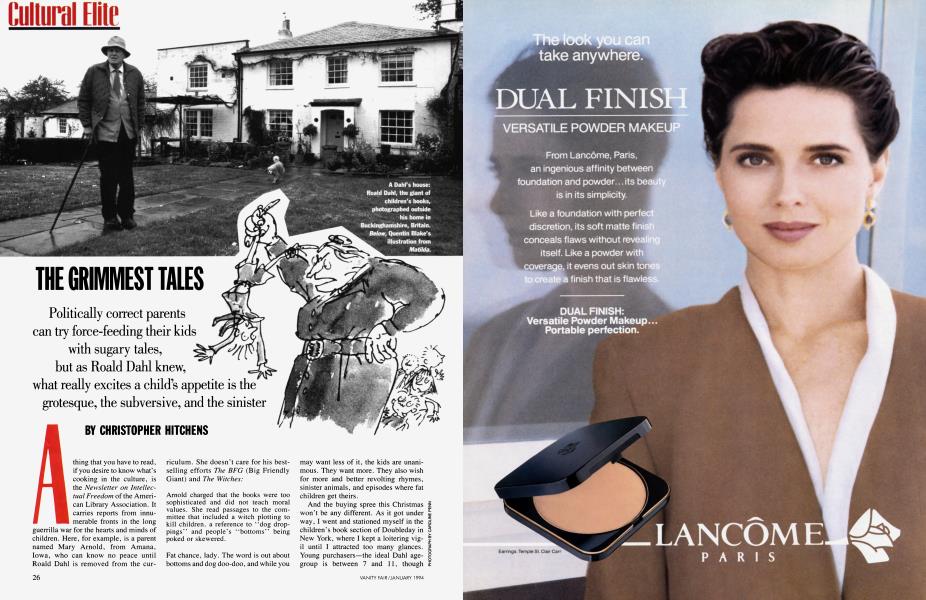
A thing that you have to read, if you desire to know what's cooking in the culture, is the Newsletter on Intellectual Freedom of the American Library Association. It carries reports from innumerable fronts in the long guerrilla war for the hearts and minds of children. Here, for example, is a parent named Mary Arnold, from Amana, Iowa, who can know no peace until Roald Dahl is removed from the curriculum. She doesn't care for his bestselling efforts The BFG (Big Friendly Giant) and The Witches:
Arnold charged that the books were too sophisticated and did not teach moral values. She read passages to the committee that included a witch plotting to kill children, a reference to "dog droppings" and people's "bottoms" being poked or skewered.
Fat chance, lady. The word is out about bottoms and dog doo-doo, and while you may want less of it, the kids are unanimous. They want more. They also wish for more and better revolting rhymes, sinister animals, and episodes where fat children get theirs.
And the buying spree this Christmas won't be any different. As it got under way, I went and stationed myself in the children's book section of Doubleday in New York, where I kept a loitering vigil until I attracted too many glances. Young purchasers—the ideal Dahl age-group is between 7 and 11, though books such as The Enormous Crocodile and Fantastic Mr. Fox are for first-graders—made straight for the Dahl shelf. It was pointless, for the most part, to try to interest them in anything else. And this was not just because of the dismal worthy competition, which did include (I swear to God) prominent display of an enticing volume called Carl Goes to Daycare.
It was a few Christmases ago that I gave a Roald Dahl to the bright nine-year-old daughter of some friends. She actually got up and left the heaped Christmas lunch table to lie down and—this really is the mot juste—devour the book. I was impressed enough to start reading the stuff myself. Apart from anything else, why did this appetite so upset her parents?
Dahl, I discovered, is more than a Pied Piper. He is a genuine subversive. In his world, kids are fit to rule. They understand cruelty and unfairness and, I'm very sorry to say, are capable of relishing it. They also have a rather raunchy idea of what's funny:
And then, a little further down A mass of others gather round: A bacon rind, some rancid lard, A loaf of bread gone stale and hard, A steak that nobody could chew, An oyster from an oyster stew, Some liverwurst so old and gray, One smelled it from a mile away, A rotten nut, a reeky pear, A thing the cat left on the stair.
Ah, the joys of the gross and yucky! The above is the fate of little Veruca Salt on her way down the garbage chute at Willy Wonka's chocolate factory.
Children need their own world, with secret rooms and eerie happenings. That Dahl furnishes these rooms cannot be doubted. It was well put by Teresa Root of Altoona, Wisconsin, who tried to pull James and the Giant Peach from a local reading list. To quote the A.L.A. report:
The book is about a boy's adventures when he spills magic crystals onto a peach tree and is taken into another world. Root objected to the use of the word "ass" and to parts of the book that dealt with wine, tobacco, snuff and to certain other words, including a reference to a female spider that she said "can be taken two ways."
You couldn't put it much better than that if you were Dahl's own publicists. The same proof is offered in a different form by Bruno Bettelheim in his classic The Uses of Enchantment. Anyway, he phrased it well, if rather doggedly:
There is a widespread refusal to let children know that the source of much that goes wrong in life is due to our very own natures—the propensity of all men for acting aggressively, socially, selfishly, out of anger and anxiety. Instead, we want our children to believe that, inherently, all men are good. But children know that they are not always good; and often, even when they are, they would prefer not to be. [Italics mine.]
He is a genuine subversive. In his world, kids are fit to rule. They understand cruelty and unfairness and are capable of relishing it.
In his pedantic way, Bettelheim went on to make several other good points about children's relative closeness to nature and animals, and about the guilty thrill that accompanies the loss of a parent or parents. But expert as he was, he could no more have written Danny the Champion of the World than he could have flown to the moon. In Danny, Dahl introduces us to a seven-year-old boy whose mother is dead and whose father illegally keeps him out of school so that he can help in the auto-mechanic business. No wonder the child is devoted to Dad, who also shows him around some scary woodland in order to teach him how to poach pheasants. A fine example to our budding youth! By the way, when the boy does get to school he finds that the headmaster has been driven to the gin bottle by his wife, and that the most prominent of the teachers is a twitching and irrepressible sadist.
Charles Dickens, who understood something about children and who, what is more, understood something about the durability of an unhappy childhood, once wrote: "Little Red Riding Hood was my first love. I felt that if I could have married Little Red Riding Hood, I should have know perfect bliss." Not after the wolf had finished with her, he wouldn't. But one sees the potency of a good yucky tale nonetheless. Roald Dahl also grasped the point of Charles Dickens, who is often thought by children to be an adult's idea of a good read, and it's suggestive that in The BFG the child is advised to get hold of Nicholas Nickleby, by an author named "Dahl's Chickens."
Roald Dahl's life, which has been read by millions of children in his two memoirs, Boy and Going Solo, was full of ripe stuff. His father and an older sister both died when he was three. At school he was bullied and thrashed in fairly spectacular ways, and quite obviously never forgot the fact. (The vile teacher in Danny is a straight lift from Boy.) Having been sent to the colonies to earn a living, and having been badly injured as a wartime flier, he married and had several children of his own, with the actress Patricia Neal, to whom he famously wasn't very nice. One of these, his daughter Olivia, died of measles when she was seven. Another, her younger brother, Theo, suffered brain damage when his stroller was hit by a taxi. So Dahl knew from the outset that God and nature are not just, that parents and teachers are not to be counted on to stick by you, that Providence doesn't protect the innocent, and that not all animals are furry friends. Perfect.
I'm only guessing, but I believe that Dahl must have read the stories of "Saki" in his youth. H. H. Munro, who took this pen name from the cupbearer in The Rubaiyat of Omar Khayyam, was a natural genius at making up absurd and sinister names. He was a snob and a bit of a Jew-hater and died heroically on the Western Front in 1916. His best-known short story, "Sredni Vashtar," is still read with shudders by parents and guardians with bad consciences. It concerns a beautiful and vicious polecat of that name, kept as a pet by an affection-starved boy named Conradin, who is only 10 years old:
Mrs. De Ropp was Conradin's cousin and guardian, and in his eyes she represented those three-fifths of the world that are necessary and disagreeable and real: the other two-fifths, in perpetual antagonism to the foregoing, were summed up in himself and his imagination. [Italics mine.]
In the end, after various propitiations and incantations, "Sredni Vashtar the Beautiful" tears out the bad woman's throat and runs off to freedom. It's one of the most moral stories I have ever read.
There's nothing very mysterious about Roald Dahl's formula. It consisted, as he proudly confessed in one of the last interviews before his death in 1990, of "conspiring with children against adults." He described it with some satisfaction as "the path to their affections." One of the reasons for adult dislike of Dahl's work is undoubtedly that of jealousy. In the mega-selling Matilda, for example, the parents and sibling of this precocious and put-upon pint-size heroine are coldly set down as "the father," "the mother," and "the brother." An enchanted privacy is woven by Matilda to escape these horrors, and the stuff of enchantment is great literature.
And then, of course, because it has to happen, come the forces of P.C. Having spent years decrying and deconstructing the very idea of authorship, and saying that as an individual enterprise it hardly counts at all, the same forces are now concentrating entirely on the private life of the writer. Dahl, it appears, was mean to his wife. He was explicitly anti-Semitic. He's been accused of giving dope and booze to his own kids to keep them quiet. So, is it true? Of course it's bloody well true. How else could Dahl have kept children enthralled and agreeably disgusted and pleasurably afraid? By being Enid Blyton?
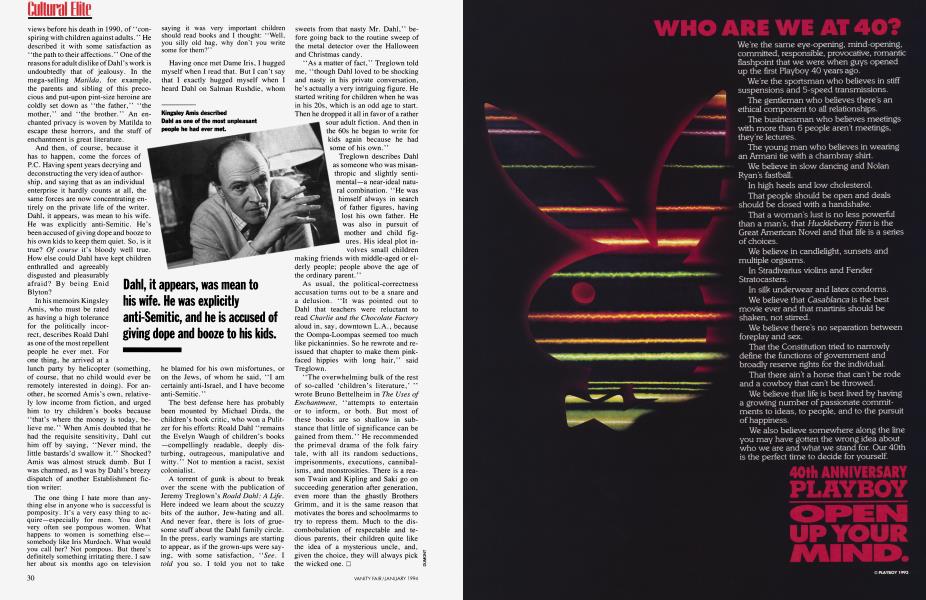
In his memoirs Kingsley Amis, who must be rated as having a high tolerance for the politically incorrect, describes Roald Dahl as one of the most repellent people he ever met. For one thing, he arrived at a lunch party by helicopter (something, of course, that no child would ever be remotely interested in doing). For another, he scorned Amis's own, relatively low income from fiction, and urged him to try children's books because "that's where the money is today, believe me." When Amis doubted that he had the requisite sensitivity, Dahl cut him off by saying, "Never mind, the little bastards'd swallow it." Shocked? Amis was almost struck dumb. But I was charmed, as I was by Dahl's breezy dispatch of another Establishment fiction writer:
The one thing I hate more than anything else in anyone who is successful is pomposity. It's a very easy thing to acquire—especially for men. You don't very often see pompous women. What happens to women is something else—somebody like Iris Murdoch. What would you call her? Not pompous. But there's definitely something irritating there. I saw her about six months ago on television saying it was very important children should read books and I thought: "Well, you silly old hag, why don't you write some for them?"
Having once met Dame Iris, I hugged myself when I read that. But I can't say that I exactly hugged myself when I heard Dahl on Salman Rushdie, whom he blamed for his own misfortunes, or on the Jews, of whom he said, "I am certainly anti-Israel, and I have become anti-Semitic."
Dahl, it appears, was mean to his wife. He was explicitly anti-Semitic, and he is accused of giving dope and booze to his kids.
The best defense here has probably been mounted by Michael Dirda, the children's book critic, who won a Pulitzer for his efforts: Roald Dahl "remains the Evelyn Waugh of children's books—compellingly readable, deeply disturbing, outrageous, manipulative and witty." Not to mention a racist, sexist colonialist.
A torrent of gunk is about to break over the scene with the publication of Jeremy Treglown's Roald Dahl: A Life. Here indeed we learn about the scuzzy bits of the author, Jew-hating and all. And never fear, there is lots of gruesome stuff about the Dahl family circle. In the press, early warnings are starting to appear, as if the grown-ups were saying, with some satisfaction, "See. I told you so. I told you not to take sweets from that nasty Mr. Dahl," before going back to the routine sweep of the metal detector over the Halloween and Christmas candy.
"As a matter of fact," Treglown told me, "though Dahl loved to be shocking and nasty in his private conversation, he's actually a very intriguing figure. He started writing for children when he was in his 20s, which is an odd age to start. Then he dropped it all in favor of a rather sour adult fiction. And then in the 60s he began to write for kids again because he had some of his own."
Treglown describes Dahl as someone who was misanthropic and slightly sentimental—a near-ideal natural combination. "He was himself always in search of father figures, having lost his own father. He was also in pursuit of mother and child figures. His ideal plot involves small children making friends with middle-aged or elderly people; people above the age of the ordinary parent."
As usual, the political-correctness accusation turns out to be a snare and a delusion. "It was pointed out to Dahl that teachers were reluctant to read Charlie and the Chocolate Factory aloud in, say, downtown L.A., because the Oompa-Loompas seemed too much like pickaninnies. So he rewrote and reissued that chapter to make them pink-faced hippies with long hair," said Treglown.
"The overwhelming bulk of the rest of so-called 'children's literature,' wrote Bruno Bettelheim in The Uses of Enchantment, "attempts to entertain or to inform, or both. But most of these books are so shallow in substance that little of significance can be gained from them." He recommended the primeval drama of the folk fairy tale, with all its random seductions, imprisonments, executions, cannibalisms, and monstrosities. There is a reason Twain and Kipling and Saki go on succeeding generation after generation, even more than the ghastly Brothers Grimm, and it is the same reason that motivates the bores and schoolmarms to try to repress them. Much to the discombobulation of respectable and tedious parents, their children quite like the idea of a mysterious uncle, and, given the choice, they will always pick the wicked one.
Subscribers have complete access to the archive.
Sign In Not a Subscriber?Join Now

