



Sign In to Your Account
Subscribers have complete access to the archive.
Sign In Not a Subscriber?Join NowLicensed to Kill
Hopalong Cassidy and how the West was marketed
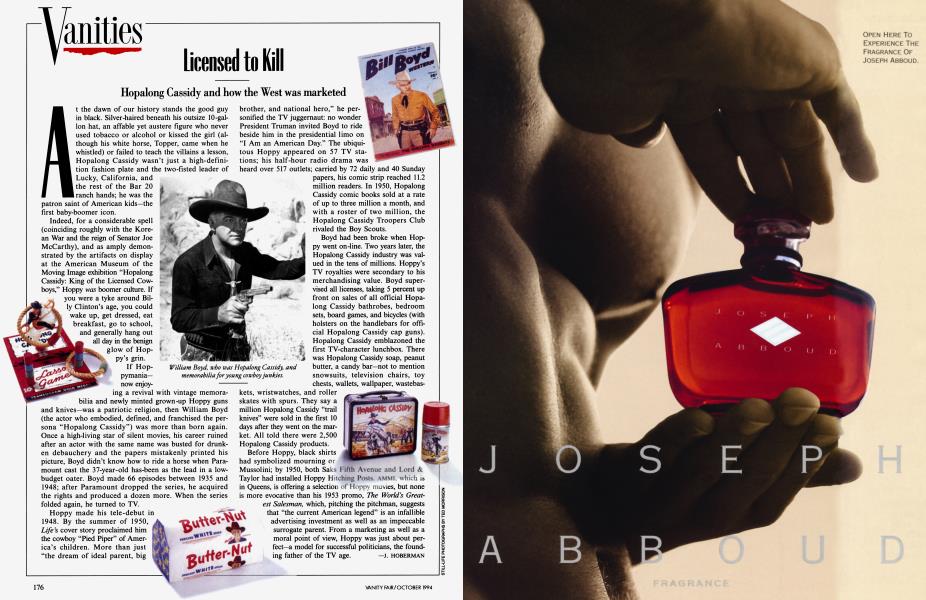
At the dawn of our history stands the good guy in black. Silver-haired beneath his outsize 10-galion hat, an affable yet austere figure who never used tobacco or alcohol or kissed the girl (al though his white horse, Topper, came when he whistled) or failed to teach the villains a lesson, Hopalong Cassidy wasn't just a high-defini tion fashion plate and the two-fisted leader of Lucky, California, and the rest of the Bar 20 ranch hands; he was the patron saint of American kids—the first baby-boomer icon.
Indeed, for a considerable spell (coinciding roughly with the Korean War and the reign of Senator Joe McCarthy), and as amply demonstrated by the artifacts on display at the American Museum of the Moving Image exhibition "Hopalong Cassidy: King of the Licensed Cowboys," Hoppy was boomer culture. If you were a tyke around Billy Clinton's age, you could wake up, get dressed, eat breakfast, go to school, and generally hang out all day in the benign glow of Hoppy's grin.
If Hop pymanianow enjoying a revival with vintage memorabilia and newly minted grown-up Hoppy guns and knives—was a patriotic religion, then William Boyd (the actor who embodied, defined, and franchised the persona "Hopalong Cassidy") was more than born again. Once a high-living star of silent movies, his career ruined after an actor with the same name was busted for drunken debauchery and the papers mistakenly printed his picture, Boyd didn't know how to ride a horse when Paramount cast the 37-year-old has-been as the lead in a lowbudget oater. Boyd made 66 episodes between 1935 and 1948; after Paramount dropped the series, he acquired the rights and produced a dozen more. When the series folded again, he turned to TV.
Hoppy made his tele-debut in 1948. By the summer of 1950, Life's cover story proclaimed him the cowboy "Pied Piper" of America's children. More than just "the dream of ideal parent, big brother, and national hero," he personified the TV juggernaut: no wonder President Truman invited Boyd to ride beside him in the presidential limo on "I Am an American Day." The ubiquitous Hoppy appeared on 57 TV stations; his half-hour radio drama was heard over 517 outlets; carried by 72 daily and 40 Sunday papers, his comic strip reached 11.2 million readers. In 1950, Hopalong Cassidy comic books sold at a rate of up to three million a month, and with a roster of two million, the Hopalong Cassidy Troopers Club rivaled the Boy Scouts.
Boyd had been broke when Hoppy went on-line. Two years later, the Hopalong Cassidy industry was valued in the tens of millions. Hoppy's TV royalties were secondary to his merchandising value. Boyd supervised all licenses, taking 5 percent up front on sales of all official Hopalong Cassidy bathrobes, bedroom sets, board games, and bicycles (with holsters on the handlebars for official Hopalong Cassidy cap guns). Hopalong Cassidy emblazoned the first TV-character lunchbox. There was Hopalong Cassidy soap, peanut butter, a candy bar—not to mention snowsuits, television chairs, toy chests, wallets, wallpaper, wastebaskets, wristwatches, and roller skates with spurs. They say a million Hopalong Cassidy "trail knives" were sold in the first 10 days after they went on the market. All told there were 2,500 Hopalong Cassidy products.
Before Hoppy, black shirts had symbolized mourning or Mussolini; by 1950, both Saks Fifth Avenue and Lord & Taylor had installed Hoppy Hitching Posts, AMMI. which is in Queens, is offering a selection of Hoppy movies, but none is more evocative than his 1953 promo, The World's Greatest Salesman, which, pitching the pitchman, suggests that "the current American legend" is an infallible advertising investment as well as an impeccable surrogate parent. From a marketing as well as a moral point of view, Hoppy was just about perfect—a model for successful politicians, the founding father of the TV age.
J. HOBERMAN
Subscribers have complete access to the archive.
Sign In Not a Subscriber?Join Now