Sign In to Your Account
Subscribers have complete access to the archive.
Sign In Not a Subscriber?Join NowLUCKY STARS
Letters
The Warren Report
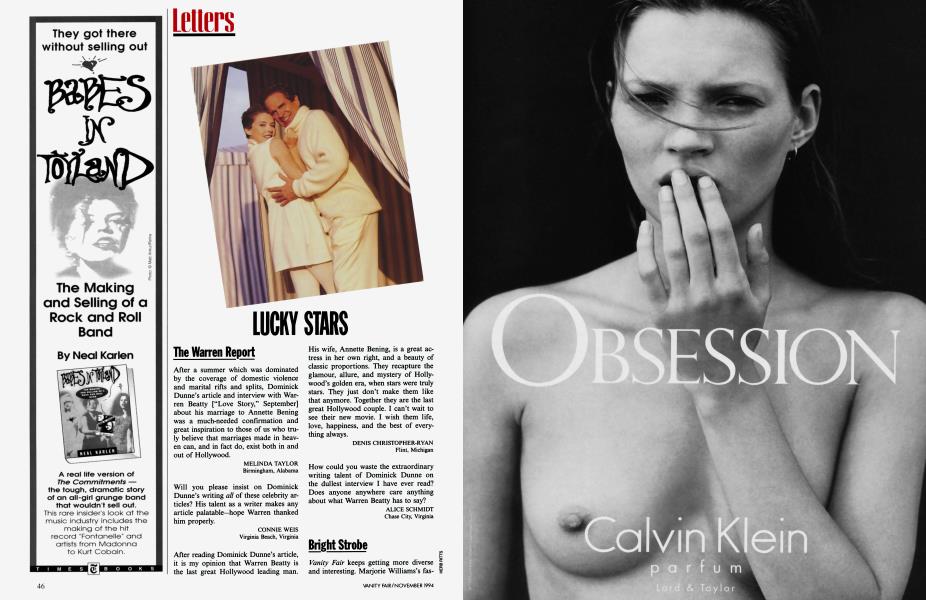
After a summer which was dominated by the coverage of domestic violence and marital rifts and splits, Dominick Dunne's article and interview with Warren Beatty ["Love Story," September] about his marriage to Annette Bening was a much-needed confirmation and great inspiration to those of us who truly believe that marriages made in heaven can, and in fact do, exist both in and out of Hollywood.
MELINDA TAYLOR Birmingham, Alabama
Will you please insist on Dominick Dunne's writing all of these celebrity articles? His talent as a writer makes any article palatable—hope Warren thanked him properly.
CONNIE WEIS Virginia Beach, Virginia
After reading Dominick Dunne's article, it is my opinion that Warren Beatty is the last great Hollywood leading man. His wife, Annette Bening, is a great actress in her own right, and a beauty of classic proportions. They recapture the glamour, allure, and mystery of Hollywood's golden era, when stars were truly stars. They just don't make them like that anymore. Together they are the last great Hollywood couple. I can't wait to see their new movie. I wish them life, love, happiness, and the best of everything always.
DENIS CHRISTOPHER-RYAN Flint, Michigan
How could you waste the extraordinary writing talent of Dominick Dunne on the dullest interview I have ever read? Does anyone anywhere care anything about what Warren Beatty has to say?
ALICE SCHMIDT Chase City, Virginia
Bright Strobe
Vanity Fair keeps getting more diverse and interesting. Marjorie Williams's fascinating and insightful portrait of Strobe Talbott ["Clinton's Rhodes Warrior," September] was so impeccably researched and written that I find myself mulling over its nuggets days after having read them. Please bring Ms. Williams back soon and keep writers of her caliber coming.
CYNTHIA HIBBARD Woodinville, Washington
In Like Quindlen
Marjorie Williams berates Anna Quindlen for bringing the truths of women's daily lives to social-policy issues, blatantly missing the goal of Quindlen's "Public & Private" column ["All About Anna," September]. Quindlen's intention is to bring the values we associate with private life and apply them to public issues. Judging by the column's popularity, Quindlen's approach resonates with millions of readers.
Ms. Williams got it right when she said Quindlen has a devoted following, especially among women, but it's not because of her "unorthodox career path" or the Times's accommodations to her family life. If anything, that elicits envy. What elicits devotion from women and men alike is her honesty about how complicated the issues are, her recognition that they don't always lend themselves to easy blood-drawing opinions, and her validation of the ambivalence that we feel about dealing with issues from welfare, adoption, and day care to policies on Haiti, Cuba, and Rwanda.
As for Ms. Williams's assertion that Quindlen's voice is "pitched to tell others what they want to hear," this is just not so. Talk to her secretary, who opens boxes of live roaches and frightening caricatures. I'd be surprised if William Safire (whom Williams holds up as exemplar) draws such hate.
Vanity Fair would have done better to have waited to interview Quindlen before they printed such a shabby piece. If Warren Beatty had refused to be interviewed for a few months because of family priorities, I'll bet you'd have held the article and made him into a family hero.
In closing, I was sad to learn that Anna Quindlen is leaving The New York Times. For all the reasons stated above, many readers now turn to the back page before reading the headlines. Therefore, I hope the Times will search for a voice of equal brilliance and resonance. For sure, her presence on my Wednesday and Saturday mornings will sorely be missed.
MARIE C. WILSON President, Ms. Foundation for Women New York, New York
Anna Quindlen wishy-washy and timid? Well, for starters, she was solidly and gutsily behind the gay and lesbian community at a time when most publications (including V.F.) wouldn't touch us.
I'm even more baffled by Maijorie Williams's alternate dissing of Quindlen as an ambitious newspaperwoman and a mom who wants to stay home with her kids. As it happens, I'm the mother of the "tykes whose parents happened to be influential journalists" whom Quindlen sought out for baby-sitting at Barnard, and I did indeed recommend her for her first job, at the old New York Post. Williams implies that seeking me out was some sort of unsavory, Sammy Glickish sucking-up on Quindlen's part. In fact, it's what we in the journalism biz call "enterprise" or "good instincts" or "brains."
I'm not surprised that Quindlen turned out to be a devoted mother (she was the best baby-sitter I ever had), and she's also a damned good reporter (as Williams herself grudgingly admits at the end of her profile). If even someone as talented and focused as Anna Quindlen finds motherhood and a high-powered career in conflict and still manages to carve out a successful niche that accommodates both, why isn't this cause for admiration instead of snarky, snotty sour grapes?
LINDSY VAN GELDER Miami Beach, Florida
To make her case that Anna Quindlen is just too domestic, not political enough, Marjorie Williams conveniently overlooks the many columns Ms. Quindlen has written defending abortion rights and the rights of battered women—subjects the more "political" boys at the Times never quite get around to covering. In some aspects of her life and work, Ms. Quindlen may be a good girl, but she's not nearly as good as Marjorie Williams. After all, there's nothing the big boys like better than watching one woman try to take another down.
THERESA REBECK Brooklyn, New York
I thought "moral high ground" and "appreciation of children and domestic life" (family values?) were exclusive territories enjoyed only by the conservative right. Anna Quindlen is a refreshing counterpoint to the morass of know-it-all columns.
JACK KAPLAN San Diego, California Anna Quindlen has much in common with men said to be tied to their mothers' apron strings. Her Times column reflects little interest in anybody whose life does not resemble the shapes and forms of her own mother's real or could-have-been existence. Curiously, men in her column appear mostly as threats to the well-being of womenfolk the world over. Indeed, her husband ought to ask himself why, as Marjorie Williams informs us, she is feeding him eggs Benedict and fried ham. (Just kiddin', folks.)
NICK SIVULICH Mount Carmel, Pennsylvania
Evans in Lotusland
Robert Evans ["Evans Gate," by Matthew Tymauer, September] looks as if he's been eating a good deal of whipped cream while sunning, heavily layered with baby oil. Evans is Norma Desmond in men's underwear. He should rethink the close-up. Quite a spectacle, eyeglass frames notwithstanding.
JOHN CRANDALL Seattle, Washington I remember Bobby Evans from the late 40s as a joyful and caring person in our group of friends. What fun we all had— with our dreams and aspirations. He contributed so much to all of us.
I wish him well and hopefully through his adversity he will realize some semblance of peace of mind.
JEAN GOLDEN BOOCHEVER Wilmette, Illinois
It's hard to believe Ali MacGraw, whom I knew in high school (Rosemary Hall, Greenwich, Connecticut), left the yummy setting of the Evans house to go off to Trancas Beach on Steve McQueen's motorcycle. I always thought she and Evans seemed to have finally found the right mate in each other, though it seems now that marriage isn't for either.
GEORGIA B. MAKIVER Lansdowne, Pennsylvania
Mr. Evans comes across as a onedimensional, highly narcissistic individual, not worthy of the space his article received in your magazine. Despite all of the surely fascinating people he has had relationships with, his identity seems rooted in his house. He comments that "Jack [Nicholson] saw me shrivel in front of him." Mr. Evans, couldn't this have been the result of cocaine use rather than the consequence of no longer having your name on the deed to your wonderful home? Get a life!
DAIN ADELMANN Scottsdale, Arizona
Less than Faithfull?
If Marianne Faithfull ["Ever Faithfull," by Cathy Horyn, September] finds the man who provided a cottage for her own mother during the last 20 years of her life so objectionable (while Marianne herself was a strungout junkie who could not even provide for herself, let alone anyone else, including her only child), why then does she feel the need to advertise her longago sexual relationship with him via a crudely self-indulgent T-shirt declaration?
Please, Marianne, a little more gratitude and spiritual generosity, or, in the words of Mick Jagger, 1968: Have some courtesy, have some sympathy and some taste.
LINDA S. COLLINS Merriam, Kansas
Good Amigas
I would like to take this opportunity to sincerely congratulate you for your gratifying report on "The Four Amigas" [by Michael Shnayerson, September]. It is really promising to see how a great magazine such as Vanity Fair is interested in covering less traditional subjects, such as Latin culture. However, it is important to point out that Ms. Julia Alvarez is probably the first Dominican woman to have been taken into consideration by V.F. Sometimes it seems that Oscar de la Renta and Porfirio Rubirosa are the only Dominicans who occupy the pages of your magazine.
JIMMY ARIZA Staten Island, New York
That "small Houston press" that first published Sandra Cisneros's The House on Mango Street (1984) is Arte Publico Press at the University of Houston. Arte Publico is the largest publisher of U.S. Latinos and has launched more Latina writers than any other press. Ana Castillo's early book of poetry, Women Are Not Roses, was also published by Arte Publico, and Denise Chavez's first work, The Last of the Menu Girls (1986), was published by Arte Publico.
JULIAN OLIVARES Houston, Texas
Jackie Ode
I always like to read a magazine's "Letters to the Editor." I was particularly interested in seeing the reactions various people had to Dominick Dunne's elegant remembrance of Jacqueline Kennedy Onassis ["Forever Jackie," July]. I wasn't disappointed!
My favorite was the letter you published from Ms. Belinda Battistelli ["Maybe Jackie O did hold a unique place in American society, but she was never part of the fabric of American culture ... "]. I believe she has a grand case of sour grapes. Mrs. Onassis was an incredible person the likes of whom we will probably never see again in our lifetime. She was a woman with great style, and she survived with quiet dignity where many would have folded. Who are any of us to judge her choices in life? We weren't standing in her shoes. Ms. Battistelli, you missed the point of Mr. Dunne's article.
CARLA JOY ZAMBELLI Haverford, Pennsylvania
Letters to the editor should be sent with the writer's name, address, and daytime phone number to: The Editor, Vanity Fair, 350 Madison Avenue, New York, New York 10017. Address electronic mail to vfmail@vf.com. The letters chosen for publication may be edited for length and clarity.
Subscribers have complete access to the archive.
Sign In Not a Subscriber?Join Now


