









Sign In to Your Account
Subscribers have complete access to the archive.
Sign In Not a Subscriber?Join NowEditor's Letter
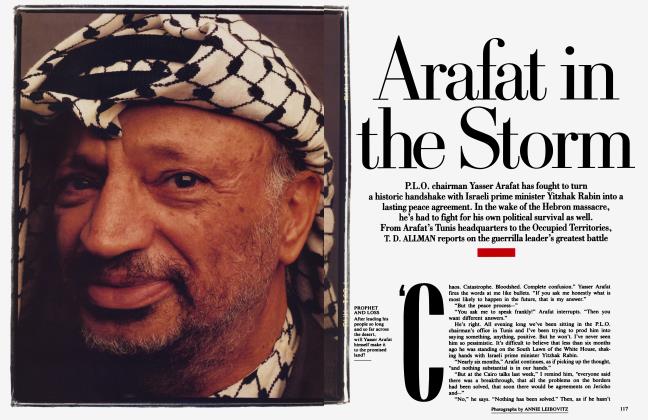
Arafat in Crisis
When T. D. Allman first met Yasser Arafat, in November 1988, the P.L.O. leader was still formally designated as a terrorist who could not set foot on American soil. Since then, Arafat has been welcomed at the White House for the handshake with Israeli prime minister Yitzhak Rabin seen round the world; he has begun the agonizingly slow process of making the handshake more than just a metaphor; and he has seen long months of negotiation evaporate in one bloody dawn, when a radical Jewish settler from Brooklyn mowed down dozens of Palestinians as they knelt in prayer.
Even the day before the Hebron massacre, in the first of three recent meetings with the P.L.O. chairman, Allman sensed a new pessimism in Yasser Arafat. After spending the last three months in the Middle East for his story on page 116, Allman understands that pessimism. "The hardest part of this story was being caught up in the delay," he says, because the delay is damaging the chances for peace. "Statesmen must do the right thing and have the right timing. Both Palestinians and Israelis have CNN—they all saw Rabin and Arafat shake hands that day. They all thought, This is it." Allman began his reporting in Cairo, where he saw
the negotiating teams, then traveled to Israel. Everywhere—in the Gaza Strip, in the occupied West Bank, in Bethlehem and Taba—he found that "the incredible gap between dream and reality" was proving hard to bridge.
The gap is reflected in the changing perceptions of Arafat himself. Finally accepted by the West as a statesman, the Palestinian leader is now being vilified by his own people—as an Israeli dupe who sold them out for two tiny patches of land. And yet, as Allman writes, "in the bloody melee following the Hebron massacre, even the survivors did what, over the decades, has become second nature to Palestinians: they telephoned Arafat, to seek his advice. For days they've been converging on Tunis, on this office, on this man."
Allman has provided an extraordinary portrait of Arafat at the center of the maelstrom, but he says his story is missing one thing: an ending. "No one knows what the ending will be. Is Arafat, like Abraham, the prophet? Will he get to his promised land?"
Editor in chief
Subscribers have complete access to the archive.
Sign In Not a Subscriber?Join Now