


Sign In to Your Account
Subscribers have complete access to the archive.
Sign In Not a Subscriber?Join NowHIGH SCHIAPARELLI
Arts
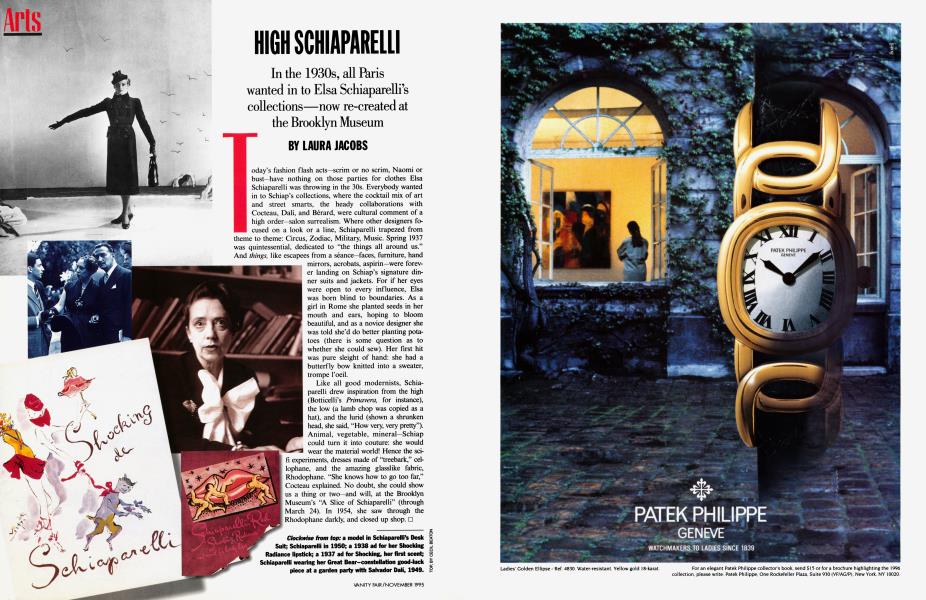
In the 1930s, all Paris wanted in to Elsa Schiaparelli's collections—now re-created at the Brooklyn Museum
LAURA JACOBS
Today's fashion flash acts—scrim or no scrim, Naomi or bust—have nothing on those parties for clothes Elsa Schiaparelli was throwing in the 30s. Everybody wanted in to Schiap's collections, where the cocktail mix of art and street smarts, the heady collaborations with Cocteau, Dali, and Berard, were cultural comment of a high order—salon surrealism. Where other designers focused on a look or a line, Schiaparelli trapezed from theme to theme: Circus, Zodiac, Military, Music. Spring 1937 was quintessential, dedicated to "the things all around us." And things, like escapees from a seance—faces, furniture, hand mirrors, acrobats, aspirin—were forever landing on Schiap's signature dinner suits and jackets. For if her eyes were open to every influence, Elsa was born blind to boundaries. As a girl in Rome she planted seeds in her mouth and ears, hoping to bloom beautiful, and as a novice designer she was told she'd do better planting potatoes (there is some question as to whether she could sew). Her first hit was pure sleight of hand: she had a butterfly bow knitted into a sweater, trompe l'oeil.
Like all good modernists, Schiaparelli drew inspiration from the high (Botticelli's Primavera, for instance), the low (a lamb chop was copied as a hat), and the lurid (shown a shrunken head, she said, "How very, very pretty"). Animal, vegetable, mineral—Schiap could turn it into couture: she would wear the material world! Hence the scifi experiments, dresses made of "treebark," cellophane, and the amazing glasslike fabric, Rhodophane. "She knows how to go too far," Cocteau explained. No doubt, she could show us a thing or two—and will, at the Brooklyn Museum's "A Slice of Schiaparelli" (through March 24). In 1954, she saw through the Rhodophane darkly, and closed up shop.
Subscribers have complete access to the archive.
Sign In Not a Subscriber?Join Now