

Sign In to Your Account
Subscribers have complete access to the archive.
Sign In Not a Subscriber?Join NowTHE UNFORGIVEN
Spotlight
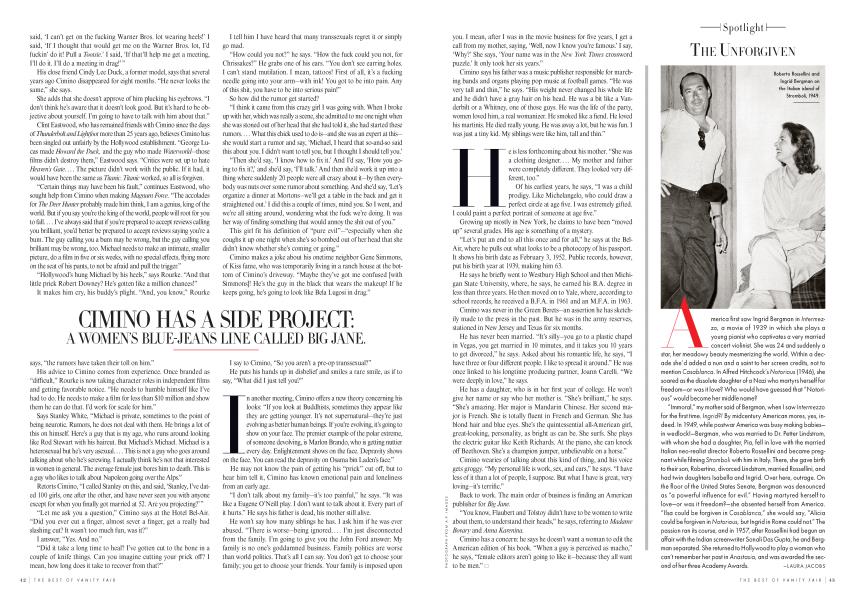
America first saw Ingrid Bergman in Intermezzo, a movie of 1939 in which she plays a young pianist who captivates a very married concert violinist. She was 24 and suddenly a star, her meadowy beauty mesmerizing the world. Within a decade she'd added a nun and a saint to her screen credits, not to mention Casablanca. In Alfred Hitchcock's Notorious (1946), she soared as the dissolute daughter of a Nazi who martyrs herself for freedom-or was it love? Who would have guessed that "Notorious" would become her middle name?
"Immoral," my mother said of Bergman, when I saw Intermezzo for the first time. Ingrid?! By midcentury American mores, yes, indeed. In 1949, while postwar America was busy making babiesin wedlockl-Bergman, who was married to Dr. Petter Lindstrom, with whom she had a daughter, Pia, fell in love with the married Italian neo-realist director Roberto Rossellini and became pregnant while filming Stromboli with him in Italy. There, she gave birth to their son, Robertino, divorced Lindstrom, married Rossellini, and had twin daughters Isabella and Ingrid. Over here, outrage. On the floor of the United States Senate, Bergman was denounced as "a powerful influence for evil." Having martyred herself to love-or was it freedom?-she absented herself from America, "lisa could be forgiven in Casablanca," she would say, "Alicia could be forgiven in Notorious, but Ingrid in Rome could not." The passion ran its course, and in 1957, after Rossellini had begun an affair with the Indian screenwriter Sonali Das Gupta, he and Bergman separated. She returned to Hollywood to play a woman who can't remember her past in Anastasia, and was awarded the second of her three Academy Awards.
LAURA JACOBS
Subscribers have complete access to the archive.
Sign In Not a Subscriber?Join Now