
Sign In to Your Account
Subscribers have complete access to the archive.
Sign In Not a Subscriber?Join NowHigh Phai
Phaidon, a great art press of the 20s, gets new life
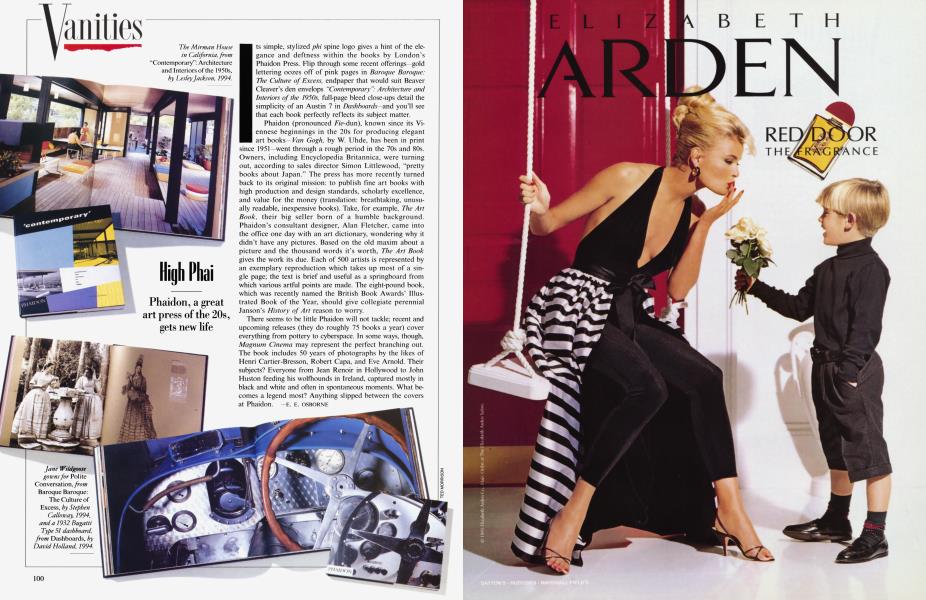
Its simple, stylized phi spine logo gives a hint of the elegance and deftness within the books by London's Phaidon Press. Flip through some recent offerings* gold lettering oozes off of pink pages in Baroque Baroque: The Culture of Excess, endpaper that would suit Beaver Cleaver's den envelops "Contemporary": Architecture and Interiors of the 1950s, full-page bleed close-ups detail the simplicity of an Austin 7 in Dashboards—and you'll see that each book perfectly reflects its subject matter.
Phaidon (pronounced Fie-dun), known since its Viennese beginnings in the 20s for producing elegant art books—Law Gogh, by W. Uhde, has been in print since 1951—went through a rough period in the 70s and 80s. Owners, including Encyclopedia Britannica, were turning out, according to sales director Simon Littlewood, "pretty books about Japan." The press has more recently turned back to its original mission: to publish fine art books with high production and design standards, scholarly excellence, and value for the money (translation: breathtaking, unusually readable, inexpensive books). Take, for example. The Art Book, their big seller born of a humble background. Phaidon's consultant designer, Alan Fletcher, came into the office one day with an art dictionary, wondering why it didn't have any pictures. Based on the old maxim about a picture and the thousand words it's worth. The Art Book gives the work its due. Each of 500 artists is represented by an exemplary reproduction which takes up most of a single page; the text is brief and useful as a springboard from which various artful points are made. The eight-pound book, which was recently named the British Book Awards' Illustrated Book of the Year, should give collegiate perennial Janson's History of Art reason to worry.
There seems to be little Phaidon will not tackle; recent and upcoming releases (they do roughly 75 books a year) cover everything from pottery to cyberspace. In some ways, though. Magnum Cinema may represent the perfect branching out. The book includes 50 years of photographs by the likes of Henri Cartier-Bresson, Robert Capa, and Eve Arnold. Their subjects? Everyone from Jean Renoir in Hollywood to John Huston feeding his wolfhounds in Ireland, captured mostly in black and white and often in spontaneous moments. What becomes a legend most? Anything slipped between the covers at Phaidon.
E. E. OSBORNE
Subscribers have complete access to the archive.
Sign In Not a Subscriber?Join Now