Sign In to Your Account
Subscribers have complete access to the archive.
Sign In Not a Subscriber?Join NowEditor's Letter
Nixon and Kennedy
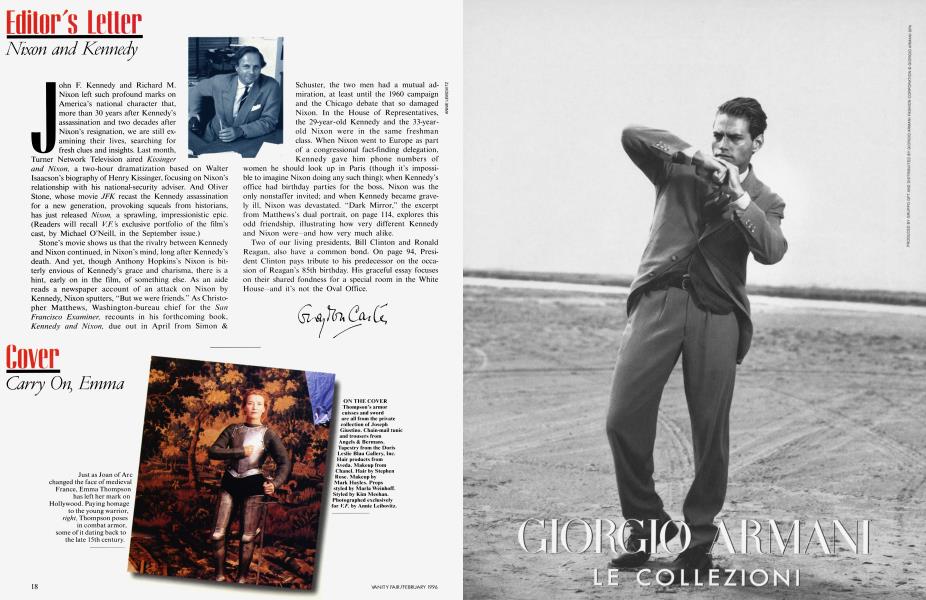
John F. Kennedy and Richard M. Nixon left such profound marks on America's national character that, more than 30 years after Kennedy's assassination and two decades after Nixon's resignation, we are still examining their lives, searching for fresh clues and insights. Last month, Turner Network Television aired Kissinger and Nixon, a two-hour dramatization based on Walter Isaacson's biography of Henry Kissinger, focusing on Nixon's relationship with his national-security adviser. And Oliver Stone, whose movie JFK recast the Kennedy assassination for a new generation, provoking squeals from historians, has just released Nixon, a sprawling, impressionistic epic. (Readers will recall VF's exclusive portfolio of the film's cast, by Michael O'Neill, in the September issue.)
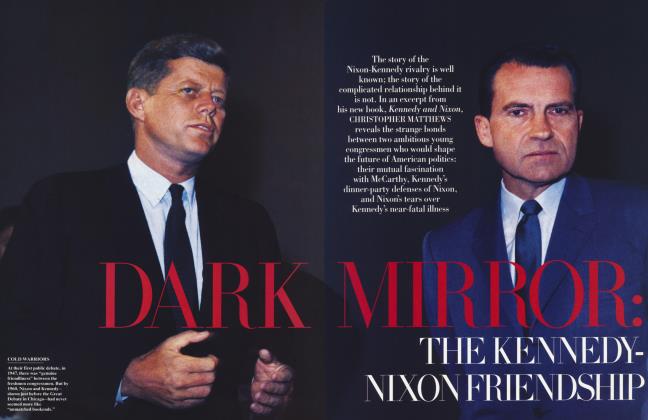
Stone's movie shows us that the rivalry between Kennedy and Nixon continued, in Nixon's mind, long after Kennedy's death. And yet, though Anthony Hopkins's Nixon is bitterly envious of Kennedy's grace and charisma, there is a hint, early on in the film, of something else. As an aide reads a newspaper account of an attack on Nixon by Kennedy, Nixon sputters, "But we were friends." As Christopher Matthews, Washington-bureau chief for the San Francisco Examiner, recounts in his forthcoming book, Kennedy and Nixon, due out in April from Simon & Schuster, the two men had a mutual admiration, at least until the 1960 campaign and the Chicago debate that so damaged Nixon. In the House of Representatives, the 29-year-old Kennedy and the 33-yearold Nixon were in the same freshman class. When Nixon went to Europe as part of a congressional fact-finding delegation, Kennedy gave him phone numbers of women he should look up in Paris (though it's impossible to imagine Nixon doing any such thing); when Kennedy's office had birthday parties for the boss, Nixon was the only nonstaffer invited; and when Kennedy became gravely ill, Nixon was devastated. "Dark Mirror," the excerpt from Matthews's dual portrait, on page 114, explores this odd friendship, illustrating how very different Kennedy and Nixon were and how very much alike.
Two of our living presidents, Bill Clinton and Ronald Reagan, also have a common bond. On page 94, President Clinton pays tribute to his predecessor on the occasion of Reagan's 85th birthday. His graceful essay focuses on their shared fondness for a special room in the White House—and it's not the Oval Office.
Subscribers have complete access to the archive.
Sign In Not a Subscriber?Join Now