



Sign In to Your Account
Subscribers have complete access to the archive.
Sign In Not a Subscriber?Join NowWOLCOTT VARIATIONS
Letters
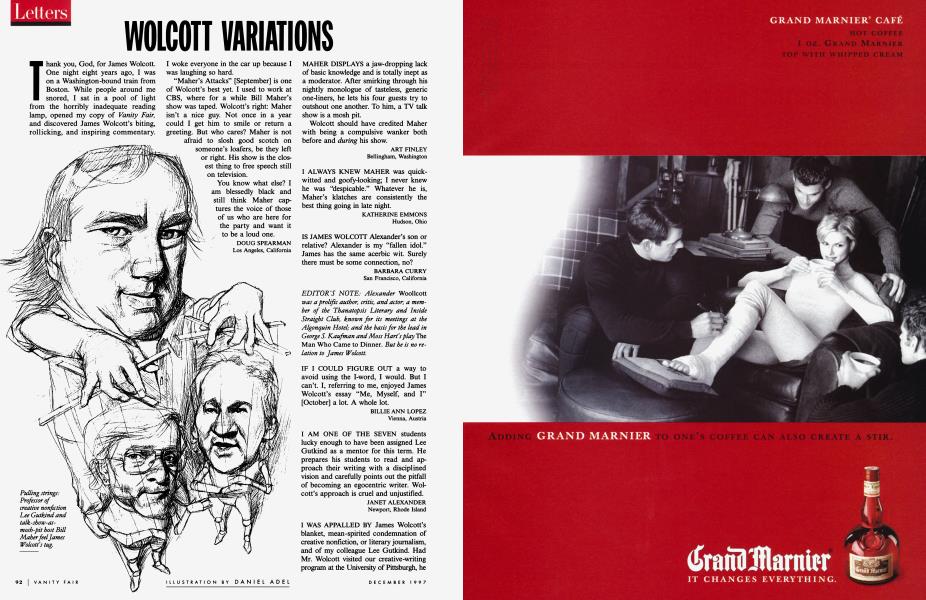
Thank you, God, for James Wolcott. One night eight years ago, I was on a Washington-bound train from Boston. While people around me snored, I sat in a pool of light from the horribly inadequate reading lamp, opened my copy of Vanity Fair, and discovered James Wolcott's biting, rollicking, and inspiring commentary. I woke everyone in the car up because I was laughing so hard.
"Maher's Attacks" [September] is one of Wolcott's best yet. I used to work at CBS, where for a while Bill Maher's show was taped. Wolcott's right: Maher isn't a nice guy. Not once in a year could I get him to smile or return a greeting. But who cares? Maher is not afraid to slosh good scotch on someone's loafers, be they left or right. His show is the closest thing to free speech still on television.
You know what else? I am blessedly black and still think Maher captures the voice of those of us who are here for the party and want it to be a loud one.
DOUG SPEARMAN Los Angeles, California
MAHER DISPLAYS a jaw-dropping lack of basic knowledge and is totally inept as a moderator. After smirking through his nightly monologue of tasteless, generic one-liners, he lets his four guests try to outshout one another. To him, a TV talk show is a mosh pit.
Wolcott should have credited Maher with being a compulsive wanker both before and during his show.
ART FINLEY Bellingham, Washington
I ALWAYS KNEW MAHER was quickwitted and goofy-looking; I never knew he was "despicable." Whatever he is, Maher's klatches are consistently the best thing going in late night.
KATHERINE EMMONS Hudson, Ohio
IS JAMES WOLCOTT Alexander's son or relative? Alexander is my "fallen idol." James has the same acerbic wit. Surely there must be some connection, no?
BARBARA CURRY San Francisco, California
EDITOR'S NOTE: Alexander Woollcott was a prolific author, critic, and actor; a member of the Thanatopsis Literary and Inside Straight Club, known for its meetings at the Algonquin Hotel; and the basis for the lead in George S. Kaufman and Moss Hart's play The Man Who Came to Dinner. But he is no relation to James Wolcott.
IF I COULD FIGURE OUT a way to avoid using the I-word, I would. But I can't. I, referring to me, enjoyed James Wolcott's essay "Me, Myself, and I" [October] a lot. A whole lot.
BILLIE ANN LOPEZ Vienna, Austria
I AM ONE OF THE SEVEN students lucky enough to have been assigned Lee Gutkind as a mentor for this term. He prepares his students to read and approach their writing with a disciplined vision and carefully points out the pitfall of becoming an egocentric writer. Wolcott's approach is cruel and unjustified.
JANET ALEXANDER Newport, Rhode Island
I WAS APPALLED BY James Wolcott's blanket, mean-spirited condemnation of creative nonfiction, or literary journalism, and of my colleague Lee Gutkind. Had Mr. Wolcott visited our creative-writing program at the University of Pittsburgh, he would know that we have students working on manuscripts about cross-country truckdrivers, the Gulf War, and female smoke jumpers, to name just a few. One of this year's graduates has published a book on Elvis Presley impersonators. And I scarcely consider my own research on life inside a Texas prison "navel gazing."
PATSY SIMS Pittsburgh, Pennsylvania
TO WANT TO WRITE WELL about one's life is no bad thing and doesn't deserve Wolcott's jeers.
STEPHEN LEWIS Santa Fe, New Mexico
Top 10 Reasons Not to Be a Mogul
YOU WOULD THINK it would be a mighty cold day in "the North" when I would stop reading at No. 14 in "The New Establishment 1997" [October] to congratulate myself for not:
10. Having to worry about a great magazine's ranking my life and my destiny.
9. Wondering which charity to give $100 million to, just to outperform my No. 1 nemesis with the squeaky voice.
8. Working in a powerful but paranoid environment where the boss breathes down my neck—or sleeps with me, for that matter.
7. Having all of the opposite sex of North America sending me videos in hopes of a date.
6. Duking out my business problems in a public forum.
5. Having to dump 80,000 employees. (Ouch, mister, hope you are enjoying your $20 million bonus and free airfare to anywhere in the world.)
4. Having my picture blown up to the point where anyone can count my nose hairs.
3. Being in the upper echelon of society, where the only critical comment that anyone dares make about me is about my questionable hygiene.
2. Worry that my gazillion-dollar mansion restoration is taking just too darn long!
And the No. 1 reason why I thank my lucky stars that I have a normal life and a mortgage is: I don't have to even consider a pre-nup worth $22 million.
STACI BARRON Kitchener, Ontario
NEW ESTABLISHMENT? Why, it looks just like the old one, white and male.
MARY SHELTON Riverside, California
Slaughter of the Innocent
THE JONBENET RAMSEY murder case is an American tragedy. "Missing Innocence," by Ann Louise Bardach [October], is telling in what it reveals. A prosecution chummy with the family defense team; a district attorney who, like a modern Hamlet, muses about prosecuting or not prosecuting as he blocks others from acting; a lead D.A. investigator who believes good Christians don't commit such crimes; a D.A. staffer who lunches with the attorneys for the main suspects.
Thank you for an excellent article which reminds us that American justice can be held captive to power and influence at the expense of the innocent.
LAURA PIETRO Clearfield, Pennsylvania
NEW PLAYERS, same old game. The story of the investigation of JonBenet Ramsey's murder was predictable yet sickening. Those who take a conscious leave of moral duty and whore themselves for power and position surely have warm, sticky blood on their hands. Listen up, Hunter, Haddon, Cochran, Abramson, et al. The world is watching. You can spin yourselves silly and confuse the issues till the cows come home, but it will not stop logical, levelheaded people from remembering the facts. Perhaps only if a child or lover of your own were murdered would the legal process interest you as a method of actually finding truth rather than as the farcical game it has become.
KIM REMPEL Virgil, Ontario
Truth in Black and White
READING "Fran Lebowitz on Race" [October], I had no way of knowing if Lebowitz was black or white. Then I realized it didn't matter.
BEVERLY A. WRIGHT Washington, D.C.
LEBOWITZ'S UNDERSTANDING of the issues that face black Americans was breathtaking. It filled me with hope to have a white person articulate what I have been trying to express to my white friends and partners for years.
ELLYN G. LEWIS Los Angeles, California
FRAN LEBOWITZ DOES the gay and lesbian community CONTINUED FROM PAGE 94 a gross disservice by suggesting that it has wrongfully appropriated symbols of oppression suffered by other minority and ethnic groups. Surely Lebowitz realizes that the pink triangle symbol adopted by gay activists was originated by the Nazis, who persecuted gays solely for being gays, just as they persecuted Jews solely for being Jews. To ridicule homosexuals' ongoing struggle for equality on the historically dubious basis that other minorities have been subject to quantifiably greater oppression is an odious lapse into bigotry in the guise of urbanity.
CONTINUED ON PAGE 104
CONTINUED FROM PAGE 94
JEFFREY GREEN San Francisco, California
MS. LEBOWITZ WAS ACCURATE in all of her observations and was astute in highlighting that the innate privilege of being white in our society is the power center at birth. As a black man working in the white world I'm always surprised when a white colleague ruminates on how hard his road to success has been. In these instances and many others I choose silence. Thank you for giving us a voice.
LIONEL RAY JOHNSON New York, New York
THIS WAS SUPPOSED to be a cancellation notice. Despite an addiction to the damned fine writing in Vanity Fair, I find the inattention to African-American actors galling. Fran Lebowitz changed my mind.
CHERYL EDWARDS Los Angeles, California
LEBOWITZ WAS ASKED, "Why are there so few black writers?" There are enough who are qualified to write for and edit mainstream magazines. Yet for some strange reason rarely do we get signed to the type of lucrative magazine contracts that our Caucasian counterparts receive after demonstrating half as much talent.
HUGH PEARSON Brooklyn, New York
I DON'T SUPPOSE Vanity Fair has much of a black readership, and as one of few I would hate to have to give up the magazine for the nitwitted way its contributors seem to keep asking one another about us. That in itself is one 104 of the primary problems with the discussion of race—the oranges talk only to themselves.
CONTINUED FROM PAGE 108
CONTINUED FROM PAGE 104
Lebowitz is right about a number of things, but she is wrong about one of our fundamental feelings. White people do not belong to a club that we're desperate to get into. Most of us, that is black Americans with a "cool sensibility," don't want to be white or in white clubs. We just want to play ball on nice courts wearing our own stylish knickers.
J. D. VAILES Washington, D.C.
I LOVE FRAN LEBOWITZ. What a mensch!
JOAN H. AGIN Chicago, Illinois
Big Trouble
ON JULY 19, 1949, for my first job, at KDSH Radio, in Boise, Idaho, I was sent to the Idaho State Penitentiary to interview Harry Orchard, the assassin of former Idaho governor Frank Steunenberg in 1905 ["Bad Trouble in the Big West," by J. Anthony Lukas, October]. Pinkerton detective James McParland said that the 40-year-old Orchard had "the most cold, cruel eyes I remember having seen." Forty-four years later I found the old killer to be the epitome of piety. While still living with acute regret for the 18 lives he had taken, he had long before made peace with his God, and was looking forward to a better life beyond this world.
This .reversal of attitude came from two sources: his early ethical home life and the amazing forgiveness of the wife of Governor Steunenberg. Shortly after the assassination Belle Steunenberg sent one of her sons to visit the imprisoned Orchard with a peace offering of several religious tracts. To Orchard this was an incomprehensible gesture. However, over the years the relationship grew. Orchard returned to religion. Mrs. Steunenberg wrote him many times, and visited him in prison on three occasions.
ROSS WOODWARD
Spokane, Washington
House Cleaning
I SPENT SEVEN very good years at The Wall Street Journal ["In the Company of Sharks," by Robert Sam Anson, August] as bureau chief in Rome and then Rio de Janeiro. For several of those years, Karen Elliott House was my editor. She was tough, she was demanding, and she was extremely good. Karen is blunt, and patience is not her preferred virtue. She is also restlessly interested in stories that break ground, for their originality, their range, or their thoughtfulness. I found her to be an inspiring editor, one who was always true to her word. She made some enemies, and she cannot peel bananas with her toes, but I do not think that makes her a lesser journalist.
ROGER COHEN Paris, France
I CONSIDER IT OUTRAGEOUS that I was not asked to comment on the item concerning Karen House which you attributed to Pamela Harriman and which has been linked to me. I did not live in the Harriman residence after May 1977. I first met House after her assignment as diplomatic correspondent sometime early in 1978.
ZBIGNIEW BRZEZINSKI
Washington, D.C.
EDITOR'S NOTE: The item to which Mr. Brzezinski refers ran as follows: "The late ambassador Pamela Harriman, no slouch at bedding powerful men, told a leading State Department official of the late night when she'd allegedly spied Karen creeping across her Georgetown garden to visit a senior foreignpolicy adviser to President Jimmy Carter. House denied any impropriety." No mention was made of a name or date.
Nobody but Norell
"NO ONE BUT NORELL" [by Laura Jacobs, October] brought back a wonderful memory: my first "sighting" of a Norell coat at one of the two stores in my hometown of Buffalo that carried his designs. I became mesmerized by the fact that the buttons appeared to float on the surface. Norell's meticulous discipline included color-matching the thread exactly to the button.
JAMES SIEWERT New York, New York
ALTHOUGH I WAS ALWAYS a tremendous fan of Norman Norell's, I could never afford his clothes. But, oh, his perfume! I've worn it almost every day of my life since 1971. People would walk into my office and claim they just wanted a sniff.
Once I was in Grand Central when I heard the man who was using the phone next to me say, "Hey, wait a minute, dear, there's a woman next to me wearing the greatest perfume I ever smelled. Hang on till I find out what it is." Another time, a woman tapped me on the shoulder and said in a desperate voice, "My God, I've just spent an hour in Saks trying to find a new perfume and now I find it on a complete stranger. What is that wonderful stuff?"
MARY H. WHALEN Bronxville, New York
lily Dietrich
MY FAMILY AND I lived in Apartment 12D, across the hall from Ms. Dietrich, during the late 50s ["Dietrich Lived Here," by Matt Tymauer, September], In my high-school years, I would do my homework to the sounds of a gorgeous young pianist—who turned out to be Burt Bacharach. I also saw Ms. Dietrich dress up in a nurse's uniform to walk her grandchild so that she would go unrecognized by her legion of fans. On one very memorable occasion, she knocked on my door, slunk in wearing nothing but a tiny dress, and asked to be zipped up.
JUDY FELDMAN WENIG Beverly Hills, California
CORRECTIONS: In "The New Establishment 1997" (October), the annual revenue for ABC, given in the entry for Robert Iger, was inaccurate. The correct figure is S8.5 to $9 billion for its most recentfiscal year.
In October's "Washington Universe," Tom Foley, a partner in Akin, Gump, Strauss, Hauer & Feld, was mistakenly included in the list of another firm.
Because of incorrect information provided by Larry King "He's Just a Guy Who Can't Say No," by Marjorie Williams (September), contained errors about King's marriage to Mickey Sutphin. They were married three and a half years. Their daughter, bom two and a half years before their divorce, was adopted by her stepfather at the age of nine.
Letters to the editor should be sent with the writer's name, address, and daytime phone number to: Vanity Fair, 350 Madison Avenue, New York, New York 10017. Address electronic mail to vfmail@vf.com. The magazine reserves the right to edit submissions, which may be published or otherwise used in any medium. All submissions become the property of Vanity Fair.
Those submitting manuscripts, photographs, artwork, or other material to Vanity Fair for consideration should not send originals unless requested in writing to do so by Vanity Fair. All unsolicited materials must be accompanied by a self-addressed overnight-delivery envelope, postage paid. However, Vanity Fair is not responsible for unsolicited submissions.
Subscribers have complete access to the archive.
Sign In Not a Subscriber?Join Now


