









Sign In to Your Account
Subscribers have complete access to the archive.
Sign In Not a Subscriber?Join NowDown for the Count
Vanities
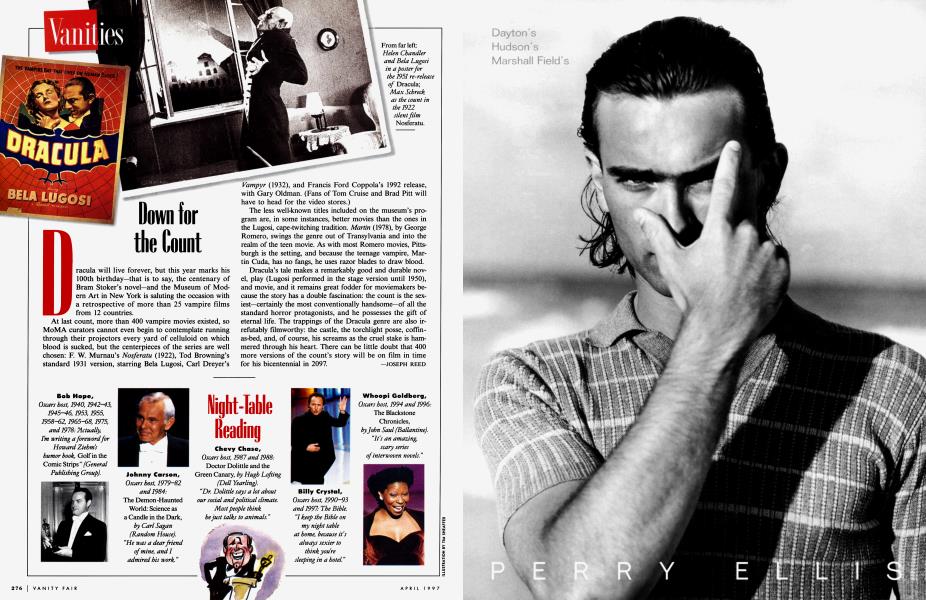
Dracula will live forever, but this year marks his 100th birthday—that is to say, the centenary of Bram Stoker’s novel—and the Museum of Modem Art in New York is saluting the occasion with a retrospective of more than 25 vampire films from 12 countries.
At last count, more than 400 vampire movies existed, so MoMA curators cannot even begin to contemplate running through their projectors every yard of celluloid on which blood is sucked, but the centerpieces of the series are well chosen: F. W. Murnau’s Nosferatu (1922), Tod Browning’s standard 1931 version, starring Bela Lugosi, Carl Dreyer’s Vampyr (1932), and Francis Ford Coppola’s 1992 release, with Gary Oldman. (Fans of Tom Cruise and Brad Pitt will have to head for the video stores.)
The less well-known titles included on the museum’s program are, in some instances, better movies than the ones in the Lugosi, cape-twitching tradition. Martin (1978), by George Romero, swings the genre out of Transylvania and into the realm of the teen movie. As with most Romero movies, Pittsburgh is the setting, and because the teenage vampire, Martin Cuda, has no fangs, he uses razor blades to draw blood.
Dracula’s tale makes a remarkably good and durable novel, play (Lugosi performed in the stage version until 1950), and movie, and it remains great fodder for moviemakers because the story has a double fascination: the count is the sexiest—certainly the most conventionally handsome—of all the standard horror protagonists, and he possesses the gift of eternal life. The trappings of the Dracula genre are also irrefutably filmworthy: the castle, the torchlight posse, coffinas-bed, and, of course, his screams as the cruel stake is hammered through his heart. There can be little doubt that 400 more versions of the count’s story will be on film in time for his bicentennial in 2097.
JOSEPH REED
Subscribers have complete access to the archive.
Sign In Not a Subscriber?Join Now