






Sign In to Your Account
Subscribers have complete access to the archive.
Sign In Not a Subscriber?Join NowWhale of Fortune
A master of horror returns
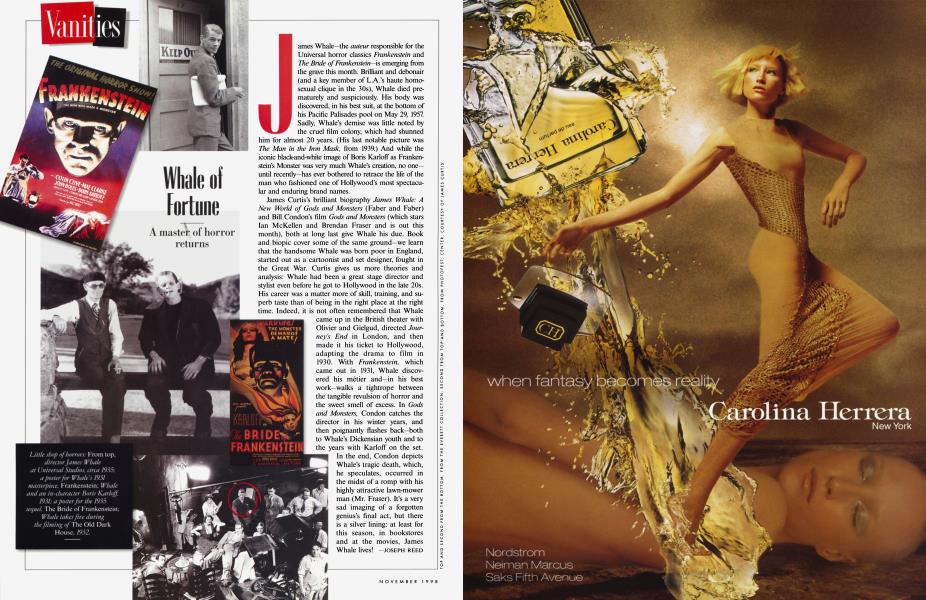
James Whale—the auteur responsible for the Universal horror classics Frankenstein and The Bride of Frankenstein—is emerging from the grave this month. Brilliant and debonair (and a key member of L.A.'s haute homosexual clique in the 30s), Whale died prematurely and suspiciously. His body was discovered, in his best suit, at the bottom of his Pacific Palisades pool on May 29, 1957. Sadly, Whale's demise was little noted by the cruel film colony, which had shunned him for almost 20 years. (His last notable picture was The Man in the Iron Mask, from 1939.) And while the iconic black-and-white image of Boris Karloff as Frankenstein's Monster was very much Whale's creation, no one— until recently—has ever bothered to retrace the life of the man who fashioned one of Hollywood's most spectacular and enduring brand names.
James Curtis's brilliant biography James Whale: A New World of Gods and Monsters (Faber and Faber) and Bill Condon's film Gods and Monsters (which stars Ian McKellen and Brendan Fraser and is out this month), both at long last give Whale his due. Book and biopic cover some of the same ground—we learn that the handsome Whale was born poor in England, started out as a cartoonist and set designer, fought in the Great War. Curtis gives us more theories and analysis: Whale had been a great stage director and stylist even before he got to Hollywood in the late 20s. His career was a matter more of skill, training, and superb taste than of being in the right place at the right time. Indeed, it is not often remembered that Whale came up in the British theater with Olivier and Gielgud, directed Journey's End in London, and then made it his ticket to Hollywood, adapting the drama to film in 1930. With Frankenstein, which came out in 1931, Whale discovered his metier and—in his best work—walks a tightrope between the tangible revulsion of horror and the sweet smell of excess. In Gods and Monsters, Condon catches the director in his winter years, and then poignantly flashes back—both to Whale's Dickensian youth and to the years with Karloff on the set. In the end, Condon depicts Whale's tragic death, which, he speculates, occurred in the midst of a romp with his highly attractive lawn-mower man (Mr. Fraser). It's a very sad imaging of a forgotten genius's final act, but there is a silver lining: at least for this season, in bookstores and at the movies, James Whale lives!
JOSEPH REED
Subscribers have complete access to the archive.
Sign In Not a Subscriber?Join Now