
Sign In to Your Account
Subscribers have complete access to the archive.
Sign In Not a Subscriber?Join NowCONTRIBUTORS
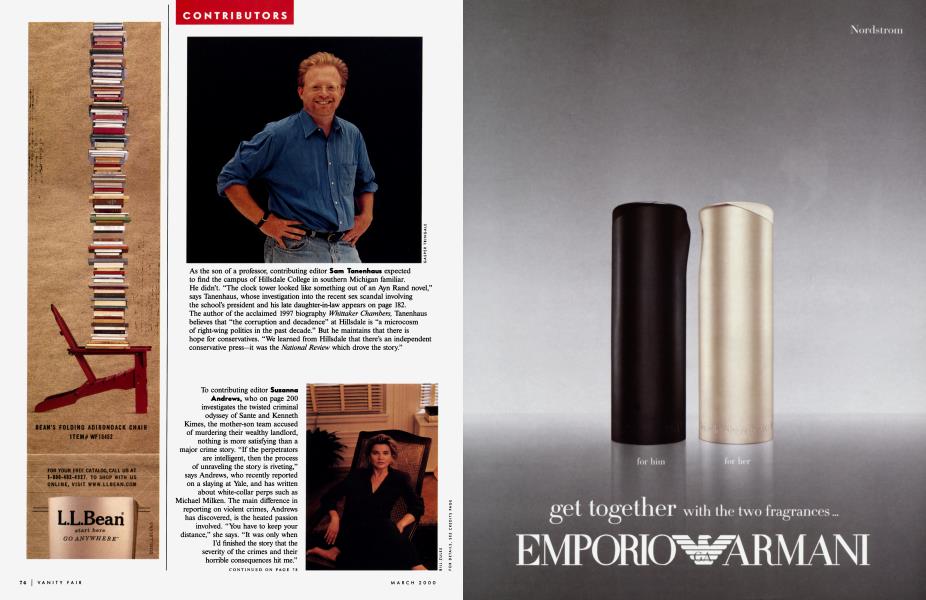
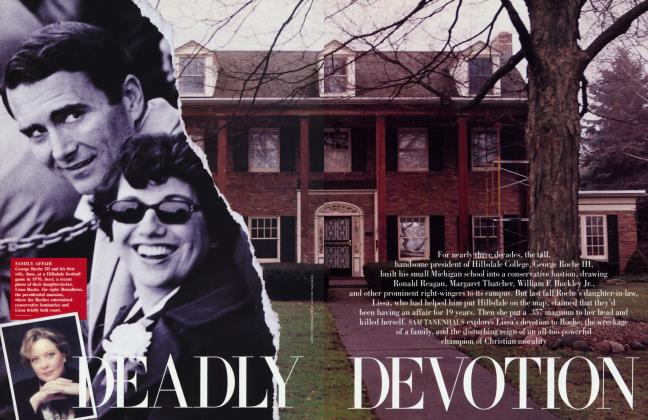
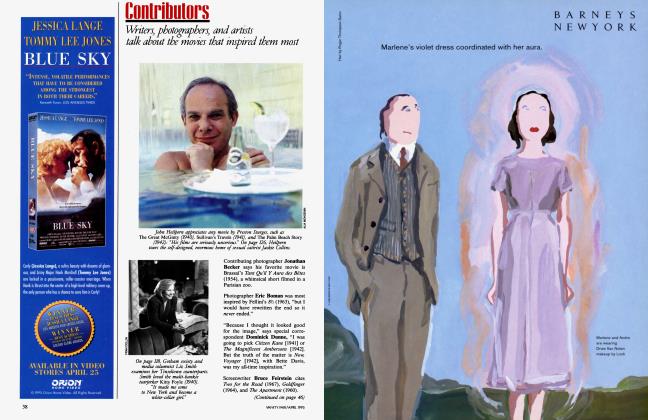
As the son of a professor, contributing editor Sam Tanenhaus expected to find the campus of Hillsdale College in southern Michigan familiar.
He didn't. "The clock tower looked like something out of an Ayn Rand novel," says Tanenhaus, whose investigation into the recent sex scandal involving the school's president and his late daughter-in-law appears on page 182.
The author of the acclaimed 1997 biography Whittaker Chambers, Tanenhaus believes that "the corruption and decadence" at Hillsdale is "a microcosm of right-wing politics in the past decade." But he maintains that there is hope for conservatives. "We learned from Hillsdale that there's an independent conservative press—it was the National Review which drove the story."
FOR DETAILS, SEE CREDITS PAGE
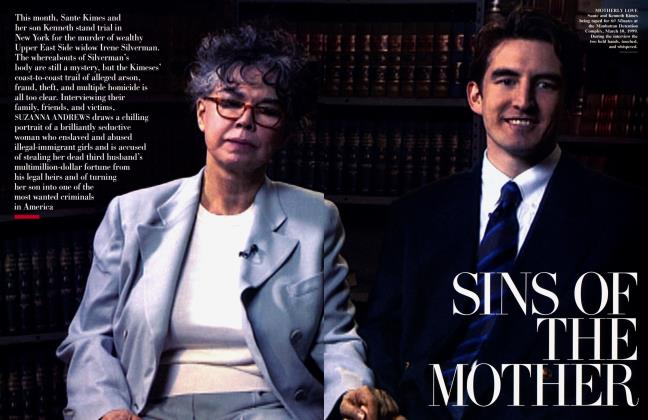
To contributing editor Suzanna Andrews, who on page 200 investigates the twisted criminal odyssey of Sante and Kenneth Kimes, the mother-son team accused of murdering their wealthy landlord, nothing is more satisfying than a major crime story. "If the perpetrators are intelligent, then the process of unraveling the story is riveting," says Andrews, who recently reported on a slaying at Yale, and has written about white-collar perps such as Michael Milken. The main difference in reporting on violent crimes, Andrews has discovered, is the heated passion involved. "You have to keep your distance," she says. "It was only when I'd finished the story that the severity of the crimes and their horrible consequences hit me."
CONTINUED ON PAGE 78
CONTINUED FROM PAGE 74
Sometimes hard to please, Christopher Hitchens, who interviewed Susan Sontag before the publication of her new novel, In America, was captivated by both book and author. In fact, he admits that his profile, which appears on page 188, is "almost a love letter." Hitchens says, "I admire her more as the years go by. She improves with time, which I can't say for myself." Reverting more to type in his column, which is from Cuba this month, our man in Havana (photographed here in the Pinar del Rio province) found that the revolution and its leader have gone stale over the decades, even while preserving "a distraught place in the American imagination."
When Selwyn Seyfu Hinds met with film and rap-video director Hype Williams for this month's "Speed Dial," Williams informed him that his crowd had already moved on from cell phones to, well, find out on page 166. Hinds probably should have known this. As former editor in chief of The Source and now editorial director of Russell Simmons's new music and lifestyle Web site (RSlW.com),
Hinds has been covering the fast-changing worlds of hip-hop and gadgetry for years. "Among hip-hoppers, it's always about the new and next thing," says Hinds.
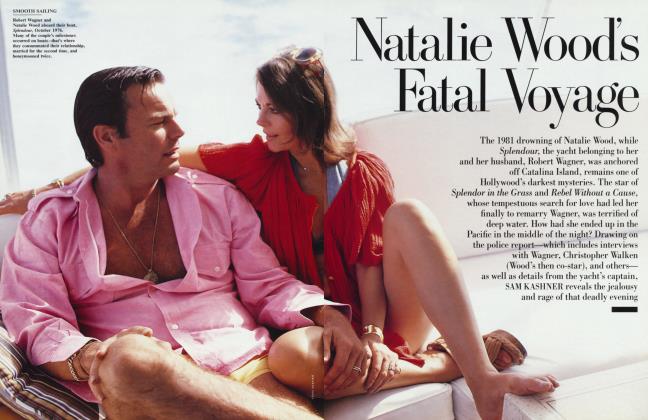
Sam Kashner's fascination with the secret lives of Hollywood stars began at a young age, in his mother's Fifth Avenue handbag store, where the clientele included Lucille Ball, Marlene Dietrich, and Gene Tierney. "I grew up hearing about the kind of odd, private behavior of movie stars through my mother's shop," says Kashner, who on page 214 uncovers new details about Natalie Wood's 1981 death. "Their specialized orders, their tastes, when they didn't pay their bills. I knew their peccadilloes even before I knew much about them as movie stars."
FOR DETAILS, SEE CREDITS PAGE
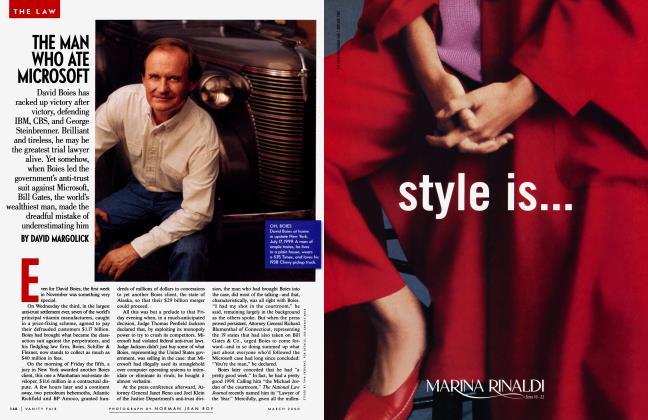
A legal reporter for The New York Times for more than 12 years, David Margolick joined V.F. in 1996, eager to "write about the rest of the universe." But after tackling subjects as diverse as publishing takeovers and Billie Holiday—a story he has since expanded into a book, Strange Fruit, due out this April (Running Press)—he found he missed his old beat.
In his first law-related story for V.F., he profiles the government's lead attorney in the Microsoft trial, the legendary New York litigator David Boies. "Lawyers are, by definition, working on the most important issues a society faces," says Margolick.
"No one exemplifies that more than David Boies."
CONTINUED ON PAGE 84
CONTINUED FROM PAGE 78
FOR DETAILS, SEE CREDITS PAGE
Meet Bernice Ellis, Vanity Fair's "keeper of the gates," who for more than 13 years has manned the switchboard, handled the index, responded to queries, and expertly weeded out a majority of the crackpots who call in each week. She's also met more than a few famous faces who have drifted through the offices, including Diana Ross, Robert Redford, and Sarah Ferguson, Duchess of York. "Fergie was the most memorable, because of her status," says Ellis. "She was absolutely charming. I kept asking myself, Should I curtsy?" As for V.F.'s staff members, whom she greets every day and watches over with motherly care, "they're very special people." The feeling is mutual.
To find out what kind of madness he was in for at the 100th Army-Navy football game, photographer Larry Fink traveled to West Point to observe Army's pre-game revelry. Navy, however, was not as welcoming. Perhaps that accounts for Fink's bias. "My sympathies were for the funky underdog," he admits. "Army was the more emotional unit, and in this case the emotional unit lost." Fink, who has taught photography at Bard College for the past 14 years, explains, "I'm a pretty emotional unit myself, even though I was never in the army and didn't go to Vietnam or anything like that." Fink's third book, Runway, will be published this spring by Powerhouse Books.
Hipster magician David Blaine may have survived being buried alive for a week, but did he survive George Wayne? Find out on page 168. V.F.'s resident master of the shockingly frank Q&A, the Jamaican-born G.W. founded the style and gossip magazine R.O.M.E. in 1986. A new issue of R.O.M.E., which hasn't appeared since 1997, is due out this spring. Why the delay? "Well, as Paul Masson would say, 'We will sell no wine before its time,"' explains G.W., who will make his screen debut in Black and White, James Toback's film about race and hip-hop, to be released in April.
Senior articles editor Bruce Handy has been a science-fiction fan ever since seeing the film 2001: A Space Odyssey as a fifth-grader. "That giant fetus and the pounding music gave me an anxiety attack—but in a good way," says Handy, who on page 114 examines a future being redefined by nostalgia for the past. "The future seems less awe-inspiring now. When I was a kid I really thought that I would make it to outer space eventually." He also failed to predict the changes that have come to Palo Alto, his hometown.
"Steve Jobs was around the comer inventing the real future and all I could think about was moving to New York and working in old media."
Subscribers have complete access to the archive.
Sign In Not a Subscriber?Join Now

