
Sign In to Your Account
Subscribers have complete access to the archive.
Sign In Not a Subscriber?Join NowEDITOR'S LETTER
Two for the Road
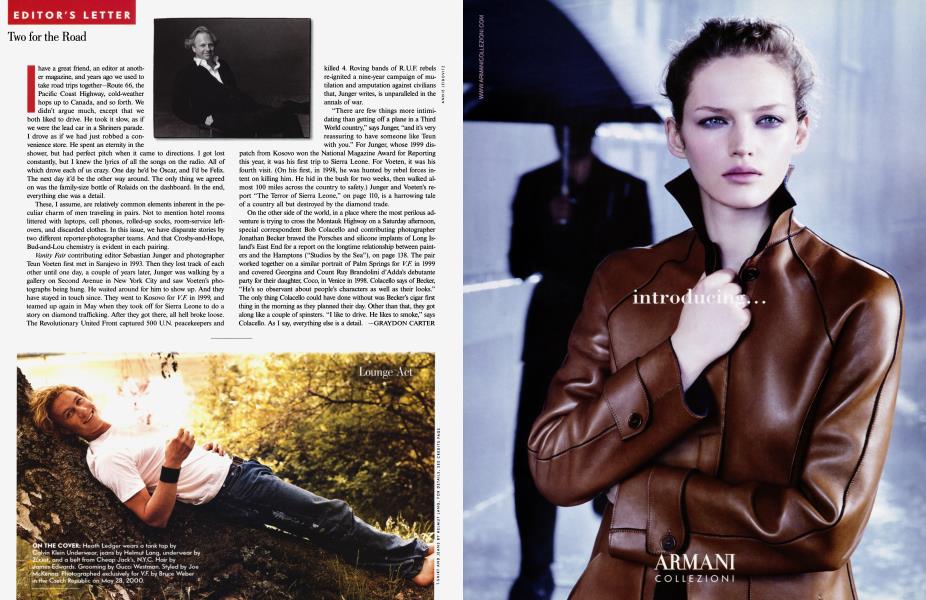
I have a great friend, an editor at another magazine, and years ago we used to take road trips together—Route 66, the Pacific Coast Highway, cold-weather hops up to Canada, and so forth. We didn’t argue much, except that we both liked to drive. He took it slow, as if we were the lead car in a Shriners parade. I drove as if we had just robbed a convenience store. He spent an eternity in the shower, but had perfect pitch when it came to directions. I got lost constantly, but I knew the lyrics of all the songs on the radio. All of which drove each of us crazy. One day he’d be Oscar, and I’d be Felix. The next day it’d be the other way around. The only thing we agreed on was the family-size bottle of Rolaids on the dashboard. In the end, everything else was a detail.
These, I assume, are relatively common elements inherent in the peculiar charm of men traveling in pairs. Not to mention hotel rooms littered with laptops, cell phones, rolled-up socks, room-service leftovers, and discarded clothes. In this issue, we have disparate stories by two different reporter-photographer teams. And that Crosby-and-Hope, Bud-and-Lou chemistry is evident in each pairing.
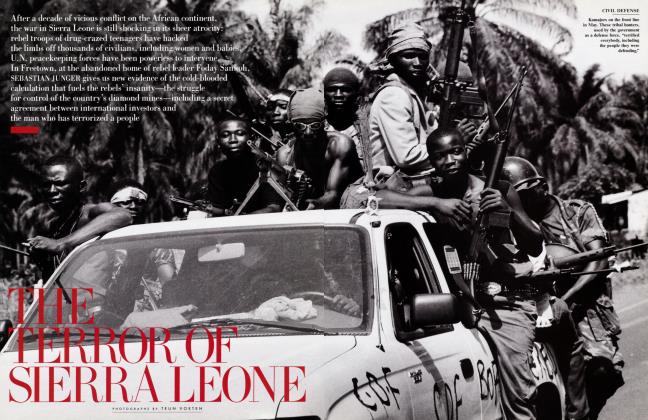
Vanity Fair contributing editor Sebastian Junger and photographer Teun Voeten first met in Sarajevo in 1993. Then they lost track of each other until one day, a couple of years later, Junger was walking by a gallery on Second Avenue in New York City and saw Voeten’s photographs being hung. He waited around for him to show up. And they have stayed in touch since. They went to Kosovo for V.F. in 1999, and teamed up again in May when they took off for Sierra Leone to do a story on diamond trafficking. After they got there, all hell broke loose. The Revolutionary United Front captured 500 U.N. peacekeepers and killed 4. Roving bands of R.U.F. rebels re-ignited a nine-year campaign of mutilation and amputation against civilians that, Junger writes, is unparalleled in the annals of war.
“There are few things more intimidating than getting off a plane in a Third World country,” says Junger, “and it’s very reassuring to have someone like Teun with you.” For Junger, whose 1999 dispatch from Kosovo won the National Magazine Award for Reporting this year, it was his first trip to Sierra Leone. For Voeten, it was his fourth visit. (On his first, in 1998, he was hunted by rebel forces intent on killing him. He hid in the bush for two weeks, then walked almost 100 miles across the country to safety.) Junger and Voeten’s report “The Terror of Sierra Leone,” on page 110, is a harrowing tale of a country all but destroyed by the diamond trade.
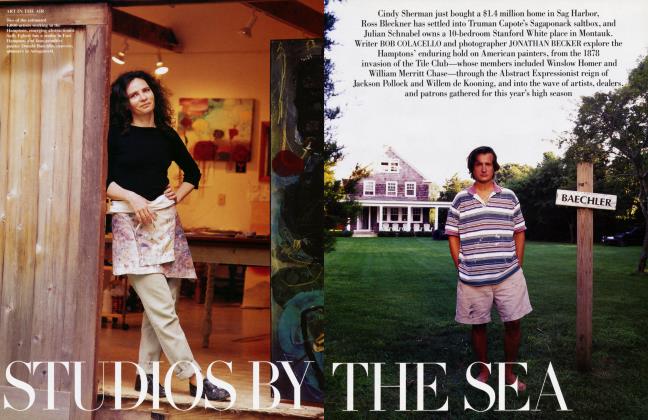
On the other side of the world, in a place where the most perilous adventure is trying to cross the Montauk Highway on a Saturday afternoon, special correspondent Bob Colacello and contributing photographer Jonathan Becker braved the Porsches and silicone implants of Long Island’s East End for a report on the longtime relationship between painters and the Hamptons (“Studios by the Sea”), on page 138. The pair worked together on a similar portrait of Palm Springs for V.F. in 1999 and covered Georgina and Count Ruy Brandolini d’Adda’s debutante party for their daughter, Coco, in Venice in 1998. Colacello says of Becker, “He’s so observant about people’s characters as well as their looks.” The only thing Colacello could have done without was Becker’s cigar first thing in the morning as they planned their day. Other than that, they got along like a couple of spinsters. “I like to drive. He likes to smoke,” says Colacello. As I say, everything else is a detail.
GRAYDON CARTER
Subscribers have complete access to the archive.
Sign In Not a Subscriber?Join Now