

Sign In to Your Account
Subscribers have complete access to the archive.
Sign In Not a Subscriber?Join NowEDITOR'S LETTER
The Black and White of It
There comes a time in the course of a book tour when you think the people interviewing you are beginning to find you incredibly boring. In my case, I was one step ahead of them—I found myself incredibly boring. In late September and early October I made a lap around the radio-TV circuit to publicize a book I've written about the Bush administration called What We've Lost. Media-training shamans tell you to boil what you want to say down to a few choice morsels, and then spit them out in a roughly pre-arranged order regardless of the question being asked. Which I tried to do. But responses designed to have a Churchillian flare about them came out sounding more, um ... Dukakisian, to coin a really clumsy word.
Before 1987, F.C.C. policy mandated that political coverage on TV and radio be balanced. (Eric Sevareid, the legendary CBS reporter turned commentator, was so evenhanded he earned the nickname Eric "Severalsides.") But the Fairness Doctrine was dropped during the Reagan administration, and it can be reasonably argued that this one decision is a factor in why Americans have become so rigidly polarized during this presidential election. Age and common sense teach you that things are rarely black or white, that life is a canvas dappled with grays. But not on TV, where the evening political shoutfests address issues in increasingly extremist terms. Bookers for the shows haul in nutcases from the right and nutcases from the left and let them go at it. This is what programmers think makes "good TV." Speaking for myself, I just can't watch them anymore. do, polarizing form of debate has infected voters as well. In an election virtually free of tangible domestic issues, it has come down to do you love this candidate, or do you detest this candidate.
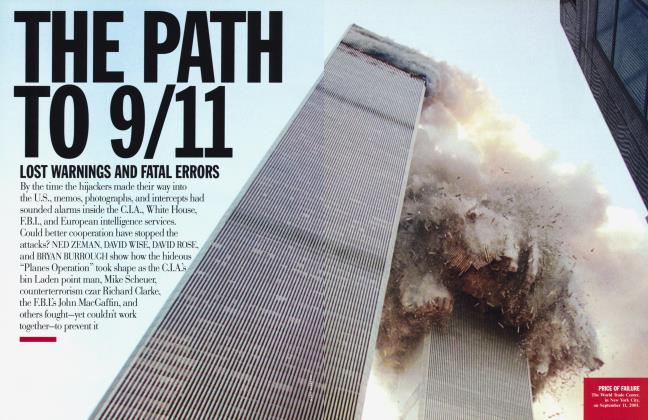
The overriding theme of the election is security. Which candidate will make the country safer. Which candidate will best protect the nation against another terrorist attack. In this issue, we have a special report on terrorism that is both disheartening and encouraging. On page 326, "The Path to 9/11," written by Bryan Burrough, David Rose, David Wise, and Ned Zeman, traces in intricate detail the multiple intelligence failures that led to the attacks. (This is the third in a trilogy of sweeping stories that attempt to illustrate how we got to this point in our recent history. The other two were "The Path to War," which chronicled the events leading up to the invasion of Iraq, and "The Path to Florida," a narrative telling of the recount scandals of the 2000 election.) As Vanity Fair's enterprise team illustrates in this issue, the C.I.A., the F.B.I., as well as intelligence agencies in Britain, Germany, and Spain, had gathered remarkable information on al-Qaeda cells in the years, months, and days leading up to September 11. Where the American and European agencies failed was in the sharing of that information. As this story and the report of the 9/11 commission point out, had there been more cooperation, there is a strong possibility that the attacks of September 11—which set in motion so many damaging and nation-changing reactions—could have been intercepted.
GRAYDON CARTER


Subscribers have complete access to the archive.
Sign In Not a Subscriber?Join Now