





Sign In to Your Account
Subscribers have complete access to the archive.
Sign In Not a Subscriber?Join NowSafe Flavin
Dan Flavin lights up Texas
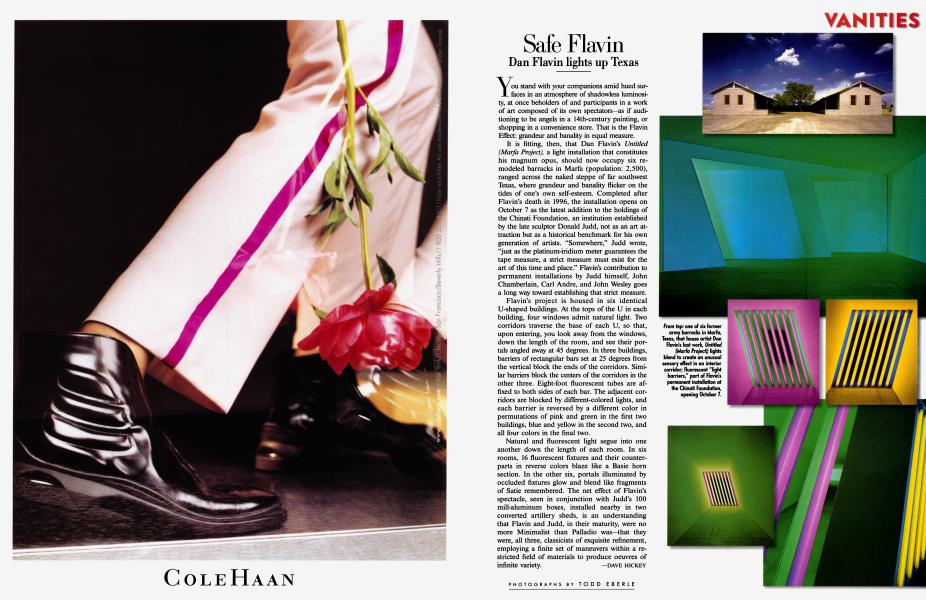
You stand with your companions amid hued surfaces in an atmosphere of shadowless luminosity, at once beholders of and participants in a work of art composed of its own spectators—as if auditioning to be angels in a 14th-century painting, or shopping in a convenience store. That is the Flavin Effect: grandeur and banality in equal measure.
It is fitting, then, that Dan Flavin’s Untitled (Marfa Project), a light installation that constitutes his magnum opus, should now occupy six remodeled barracks in Marfa (population: 2,500), ranged across the naked steppe of far southwest Texas, where grandeur and banality flicker on the tides of one’s own self-esteem. Completed after Flavin’s death in 1996, the installation opens on October 7 as the latest addition to the holdings of the Chinati Foundation, an institution established by the late sculptor Donald Judd, not as an art attraction but as a historical benchmark for his own generation of artists. “Somewhere,” Judd wrote, “just as the platinum-iridium meter guarantees the tape measure, a strict measure must exist for the art of this time and place.” Flavin’s contribution to permanent installations by Judd himself, John Chamberlain, Carl Andre, and John Wesley goes a long way toward establishing that strict measure.
Flavin’s project is housed in six identical U-shaped buildings. At the tops of the U in each building, four windows admit natural light. Two corridors traverse the base of each U, so that, upon entering, you look away from the windows, down the length of the room, and see their portals angled away at 45 degrees. In three buildings, barriers of rectangular bars set at 25 degrees from the vertical block the ends of the corridors. Similar barriers block the centers of the corridors in the other three. Eight-foot fluorescent tubes are affixed to both sides of each bar. The adjacent corridors are blocked by different-colored lights, and each barrier is reversed by a different color in permutations of pink and green in the first two buildings, blue and yellow in the second two, and all four colors in the final two.
Natural and fluorescent light segue into one another down the length of each room. In six rooms, 16 fluorescent fixtures and their counterparts in reverse colors blaze like a Basie horn section. In the other six, portals illuminated by occluded fixtures glow and blend like fragments of Satie remembered. The net effect of Flavin’s spectacle, seen in conjunction with Judd’s 100 mill-aluminum boxes, installed nearby in two converted artillery sheds, is an understanding that Flavin and Judd, in their maturity, were no more Minimalist than Palladio was—that they were, all three, classicists of exquisite refinement, employing a finite set of maneuvers within a restricted field of materials to produce oeuvres of infinite variety.
DAVE HICKEY
Subscribers have complete access to the archive.
Sign In Not a Subscriber?Join Now