


Sign In to Your Account
Subscribers have complete access to the archive.
Sign In Not a Subscriber?Join NowEDITOR'S LETTER
This Was New York
'The city, for the first time in its long history, is destructible. A single flight of planes no bigger than a wedge of geese can quickly end this island fantasy, burn the towers, crumble the bridges, turn the underground passages into lethal chambers, cremate the millions. The intimation of mortality is part of New York now: in the sound of jets overhead, in the black headlines of the latest edition.
“All dwellers in cities must live with the stubborn fact of annihilation; in New York the fact is somewhat more concentrated because of the concentration of the city itself, and because, of all targets, New York has a certain clear priority. In the mind of whatever perverted dreamer might loose the lightning, New York must hold a steady, irresistible charm.”
These, the words of E. B. White, de facto poet laureate of New York City, were written in 1948. It couldn’t have been easy back then for minds to absorb the epic events of the previous decade. But following the attacks against New York and Washington on the morning of September 11, 2001, it may be impossible to expect comprehension from any mind.
I live in the West Village, 34 blocks north of the World Trade Center. On a picture-postcard morning, with the sky the color of the vault of heaven, I was sitting on my brownstone’s stoop reading the papers when a neighbor ran by saying that a plane had just crashed into one of the World Trade Center towers. As that tower burned, the crowd that had gathered on Seventh Avenue watched as a passenger jet banked over the waters at the tip of Manhattan and hit the other. One of the 110-story towers imploded; then its twin. It was as if the explosion of the Hinden- burg, the sinking of the Titanic, and the bombing of Pearl Harbor had all been booked for an hour and 40 minutes of pure, unremitting horror. As far as the ability to shock New Yorkers goes, the bar has seriously been raised.
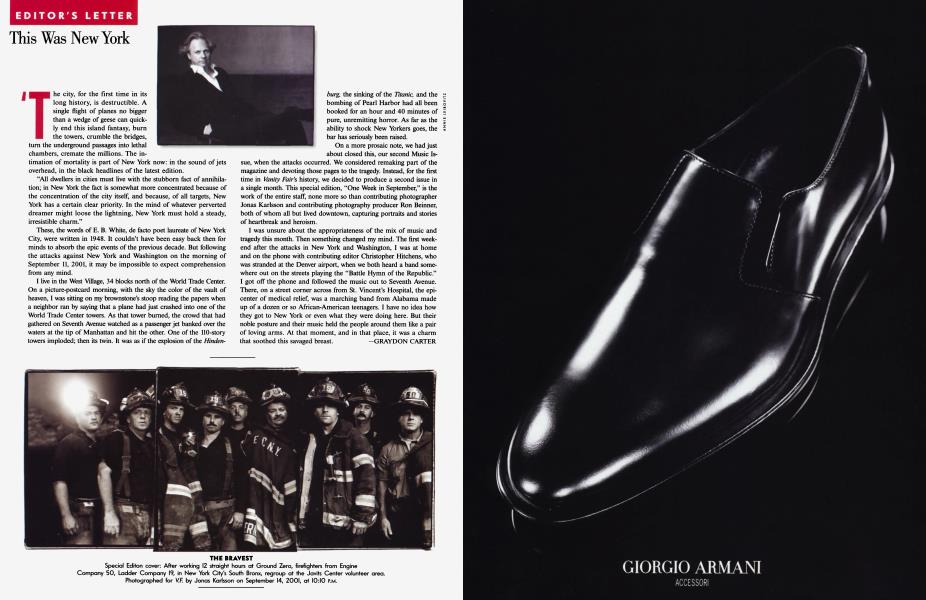
On a more prosaic note, we had just about closed this, our second Music Issue, when the attacks occurred. We considered remaking part of the magazine and devoting those pages to the tragedy. Instead, for the first time in Vanity Fair’s history, we decided to produce a second issue in a single month. This special edition, “One Week in September,” is the work of the entire staff, none more so than contributing photographer Jonas Karlsson and contributing photography producer Ron Beinner, both of whom all but lived downtown, capturing portraits and stories of heartbreak and heroism.
I was unsure about the appropriateness of the mix of music and tragedy this month. Then something changed my mind. The first weekend after the attacks in New York and Washington, I was at home and on the phone with contributing editor Christopher Hitchens, who was stranded at the Denver airport, when we both heard a band somewhere out on the streets playing the “Battle Hymn of the Republic.” I got off the phone and followed the music out to Seventh Avenue. There, on a street corner across from St. Vincent’s Hospital, the epicenter of medical relief, was a marching band from Alabama made up of a dozen or so African-American teenagers. I have no idea how they got to New York or even what they were doing here. But their noble posture and their music held the people around them like a pair of loving arms. At that moment, and in that place, it was a charm that soothed this savaged breast. —GRAYDON CARTER
GRAYDON CARTER
Subscribers have complete access to the archive.
Sign In Not a Subscriber?Join Now