Sign In to Your Account
Subscribers have complete access to the archive.
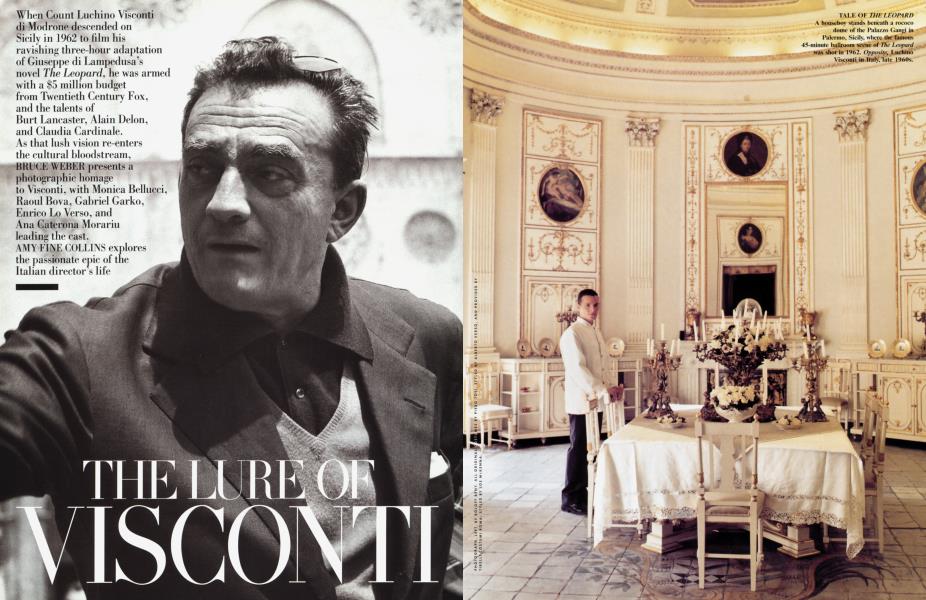
Sign In Not a Subscriber?Join NowWhen Count Luchino Visconti di Modrone descended on Sicily in 1962 to film his ravishing three-hour adaptation of Giuseppe di Lampedusa’s novel The Leopard, he was armed with a $5 million budget from Twentieth Century Fox, and the talents of Burt Lancaster, Alain Delon, and Claudia Cardinale. As that lush vision re-enters the cultural bloodstream, BRUCE WEBER presents a photographic homage to Visconti, with Monica Bellucci, Raoul Bova, Gabriel Garko, Enrico Lo Verso, and Ana Caterona Morariu leading the cast. AMY FINE COLLINS explores the passionate epic of the Italian director’s life
When Count Luchino Visconti di Modrone descended on Sicily in 1962 to film his ravishing three-hour adaptation of Giuseppe di Lampedusa’s novel The Leopard, he was armed with a $5 million budget from Twentieth Century Fox, and the talents of Burt Lancaster, Alain Delon, and Claudia Cardinale. As that lush vision re-enters the cultural bloodstream, BRUCE WEBER presents a photographic homage to Visconti, with Monica Bellucci, Raoul Bova, Gabriel Garko, Enrico Lo Verso, and Ana Caterona Morariu leading the cast. AMY FINE COLLINS explores the passionate epic of the Italian director’s life
In recent years cultural mood shifts seem to be accompanied by revivals of movies by Luchino Visconti. About a decade ago, at the height of the AIDS scare, Death in Venice (1971)—the Italian director’s elegiac adaptation of Thomas Mann’s tale of a middle-aged man’s homosexual awakening and subsequent collapse from plague—was generating video rentals and inspiring fashion shoots. Right now, attention is turning to The Leopard (1963), Visconti’s lush, rapturous evocation of Giuseppe di Lampedusa’s 1958 novel, which chronicles the deterioration of the Sicilian aristocracy during the chaotic 19th-century Italian Risorgimento. Like Visconti’s torpid, insular Palermo nobility, we too are bearing witness to confusing events which could be precipitating the end of a historical cycle.
Adding to the mystique of The Leopard and its galvanic creator is the fact that the nearly three-hour epic doesn’t exist, at least not legally, on videotape. But the cult of Count Luchino Visconti di Modrone (who died in 1976) is based not just on the work that can be seen but also on the projects that never materialized— Remembrance of Things Past, for instance. There are vanished stage productions, too—plays from the 40s and 50s by Arthur Miller and Tennessee Williams, whom he introduced to Italian audiences. And even more prized are the ephemeral operas with Maria Callas—La Vestale (1954), La Sonnambula (1955)—who credited Visconti, briefly her lover as well as her mentor, with teaching her to act. Like many insecure stars, Callas (he called her “a monstrous phenomenon ... almost a sickness”) flourished under the charismatic director’s tyranny. “Shut up, cunt!” he would shout at her if she dared ask a question. “Sing— which is the only thing you are able to do.”
Both his supercilious despotism—Italian leading lady Clara Calamai called him “a medieval lord with a whip”—and his perfect mastery of theatrical, musical, and decorative effects came to Visconti almost as a birthright. Claiming descent from a Renaissance Duke of Milan, the Visconti clan, at the moment of Luchino’s 1906 arrival, were social, industrial, and cultural beacons of their city. Luchino’s grandfather helped finance La Scala—an extravagance which allowed him to indulge his predilection for cross-dressing as a ballerina and dancing with the opera house’s corps de ballet. In the private theater of the Palazzo Visconti, Luchino’s parents, Giuseppe and Carla, put on plays, often written by one and starring the other. The Palazzo Visconti’s teatrino, however, was not quite grand enough to contain Giuseppe’s expansive, flamboyant vision. In a sustained act of omnipotence that could not have failed to impress his son, he transformed one of the family’s country seats, Grazzano, into a real-life stage set. Rounding up peasants from the land around Piacenza, he installed them in a picturesque medieval-revival hamlet of his own creation, put them to work as ironmongers and embroiderers in shops of his own invention, and dressed them up in folkloric costumes of his own design.
Visconti was at heart a progressive and a humanist.
At home in Grazzano, Milan, or Cernobbio, where his mother—greatly admired for her musical gifts and formidable chicowned a lakeside villa, Luchino regularly encountered such luminaries as conductor Arturo Toscanini, composer Giacomo Puccini, and novelist Gabriele D’Annunzio. (Though he impregnated his wife with seven children, Luchino’s dashing father had lovers of both sexes—most notably, the Queen of Italy.) Under his mother’s strict supervision, Luchino mastered the cello and, after attending a cavalry academy, dedicated himself to breeding and racing thoroughbreds. “For eight years I was totally absorbed in horses,” he said. “It was my great passion and I thought of nothing else.”
By the 30s, his stables began to bore him and, in search of a new vocation, he gravitated to France. “When I was in Paris,” he recalled, “I was a kind of imbecile.” At one point the proud count even set himself up as a designer of chintz fabric. Eventually, intoxicated by friendships with some of Paris’s most notorious sacred monsters—Jean Cocteau, Princess Natalie Paley, Christian Berard, and Coco Chanel, with whom he had an affair—Visconti, at age 30, underwent a trifold conversion. Smitten at first sight with the virile Teutonic photographer Horst, whom he met at the home of art patron Marie-Laure de Noailles, Visconti broke off his engagement to a titled Austrian. Then Chanel presented her Italian protege to filmmaker Jean Renoir, who immediately hired him as an unpaid third assistant director (Henri CartierBresson was the second assistant). And, stimulated by the ideas of his new cinematic colleagues, who supported the Popular Front, Visconti, previously a Fascist, switched to Communism.
During the war Visconti stayed in Rome, in the palace on the Via Salaria that he had inherited from his father. He sold some family jewels to bankroll his first movie, Ossessione (1942), a subversive reworking of James M. Cain’s The Postman Always Rings Twice. And simultaneously, Visconti allowed his stately palazzo to be used as a clandestine headquarters for members of the Communist Resistance (one worked incognito as his gardener). In April 1944, on the day the count was to participate in an armed action against the German occupiers, he was arrested and thrown into the squalid Pensione Jaccarino prison, where for 12 days he was locked in a fetid, three-footsquare latrine used by his persecutors. But after the liberation of Rome, Visconti got his revenge. Called upon to contribute to the documentary Days of Glory (1945), he filmed the execution by firing squad of Pietro Koch, head of the Jaccarino jail.
For the rest of his life, Visconti was ridiculed for “voting left and living right”— Vogue, for example, noted dryly that at his Roman house the count kept five cars and four butlers. “He ate off gold plates,” sneered Salvador Dali, who made sets and costumes for Visconti’s 1948 As You Like It. “He was a Communist who only liked luxury.” But the seditious content of Visconti’s plays and films posed a real enough threat to Italy’s postwar right-wing establishment, which disparaged the count as “the director of the soiled beds.” La Term Trema (1948, adapted from a novel by Giuseppe Verga) and Rocco and His Brothers (1960), both of which portray the plight of the lower classes, were routinely boycotted, denounced, or censored. And, Visconti biographer Gaia Servadio reports, in 1953 the Christian Democratic Ministry of the Arts bribed the Venice Film Festival’s jury to stop Senso, which maligned the Italian military, from winning an award. Visconti could not understand why anyone expected him to prove himself by wearing sackcloth. “If you are a man, you must have an opinion,” he reasoned. “u must have a belief.... Art must be useful.”
In The Leopardl Visconti lilted imagery not only from Lampedusas sensual, contemplative novel, but also from his vivid memories of his childhood.
In the 1960s—maybe as a result of psychoanalytic sessions in Paris with Jacques Lacan—Visconti’s films began to take a more inward, private turn, often exploring the theme of the tortured family. “All our way of being, of living, derives from ... the happiness or unhappiness of our childhood. So the family represents a kind of fate, of destiny,” Visconti reflected. “I try to explain, in the development of the family, the parallel” of public events.
And so in The Leopard, the director lifted imagery not only from Lampedusa’s sensual, contemplative novel, but also from his vivid memories of his childhood—his mother swathed in ethereal silken veils, elaborate picnics unpacked during the Visconti family’s seasonal migrations to the countryside, stultifying services in private chapels. Fortified with a budget of $5 million from Twentieth Century Fox, the imperious director descended on Sicily, commanding an army nearly as vast as the one with which Garibaldi had invaded the island a century earlier. Filling out the ranks were 150 builders; 120 makeup men, hairdressers, and seamstresses; 20 electricians; 15 florists; and 10 cooks. Scores of natives were recruited to impersonate soldiers, and Palermo patricians were conscripted to masquerade as their own ancestors. The jeweler Fulco di Verdura—Visconti’s friend from his Chanel days, and a cousin of Lampedusa’s—advised him on Sicilian etiquette and servants’ liveries, as well as on the regional aristocracy’s manner of dancing the quadrille. To give Visconti’s authentic locations even more verisimilitude, Verdura scoured his ducal storerooms for furniture, paintings, and bric-a-brac. Much like his megalomaniacal father, who had fashioned a feudal village out of the contemporary landscape, Visconti ordered telephone poles to be uprooted, asphalt roads to be restored to cobblestone, and an entire section of Palermo to be demolished. Piero Tosi, Visconti’s beleaguered costume designer, had to oversee 20 redyeings of his soldiers’ uniforms before the director approved the proper shade of Garibaldi red.
Burt Lancaster—who modeled his Prince of Salina, the title role, on Visconti himself—recalled that the count, in his fanatical quest for accuracy, spent two hours stuffing a mattress with his own elegant fingers. This bed, on which the Prince was to sleep, “was never even on camera,” Lancaster said. “But Luchino felt its lumpy reality would help the scene. It did.” Lancaster, Visconti’s third choice (after Brando and Olivier) to play the Prince, stood around for hours on location while Alain Delon (cast as Tancredi, the Prince’s rogue, opportunistic nephew) reposed in a Hollywood-style trailer—an amenity arising from the director’s infatuation with the Frenchman. Still, Lancaster extolled Visconti as “the best director I’ve ever worked with ... an actor’s dream.”
FOR DETAILS, SEE CREDITS PAGE
ii you are# man, you niustnave an opinion’ ViscoiM reasoned. “Art must be
Unquestionably, The Leopard’s tour de force is the languid, climactic 45-minute ballroom sequence, which describes in intimate, sumptuous detail the party at which Tancredi’s vulgar fiancee, the beautiful Angelica (Claudia Cardinale), makes her entrance into society. For this opulent spectacle, Visconti took over the vast mirrored gallery of Palermo’s Palazzo Gangi—a miracle of rococo mise en scene, with lacy Venetian chandeliers illuminated by a thousand candles, trompe l’oeil ceiling frescoes of cloud-borne Olympian gods, and glistening tiled floors depicting a leopard hunt in a wood. Bedecked in billowy, gossamer ball gowns—underpinned by the right number of petticoats—and fluttering their fans nervously like swarming hummingbirds, pale, prattling girls await their turn to dance. The orchestra plays a Verdi waltz, a lost composition discovered shortly before filming began. “A piece of music may never have been showcased more lavishly,” Pauline Kael exulted in The New Yorker. Visconti even went so far as to equip the Palazzo Gangi with a colossal refrigerator and oven in order to ensure that the banquet tables’ “cruel, colored delicacies” (Lampedusa’s words) were dished out to the 200 extras at the gastronomically correct temperatures.
When it was released, The Leopard was denounced for decadence. “Visconti,” one journalist declared, “is not an artist but an antiquarian.” But of course the ravishing settings, costumes, and cinematography are just what establish the Prince of Salina’s intellectual, moral, and social stature, precisely what conjure up the palpable atmosphere of “voluptuous immobility”—the condition that, in Salina’s opinion, dooms his moribund Sicily. “[I am] telling stories of live men,” Visconti said, “of men who live among the things, not of the things themselves.”
Visconti made seven more movies after The Leopard, two of them, The Damned (1969) and Ludwig (1972), vehicles for his Austrian lover, Helmut Berger. King Ludwig of Bavaria fascinated the aging filmmaker because the weak, Wagnerloving monarch, incapable of inhabiting the real world, retreated into an idiosyncratic cosmos of his own devising. This withdrawal was analogous to Visconti’s own, effected partly by circumstance and partly by choice. Felled by a stroke in 1972—smoking up to 120 cigarettes a day had not helped his health—the director moved into a tiny apartment, and, surrounded by a dubious new entourage, he was robbed of many of his possessions, and much of his dignity. Helmut Berger mocked his invalid benefactor mercilessly, a form of sadism the older man may have enjoyed. An American producer hoping to sign Berger for his next movie visited the couple in Rome in 1973. Pontificating to his guest about “how hard stars had to work under the old studio system,” Visconti reproached the actors of Berger’s generation for “having everything handed to them.” Berger retorted, “You don’t think it’s hard work having to fuck you every night?”
Visconti rallied long enough to shoot one last film, The Innocent, before dying in March 1976, at 69. Like the Prince of Salina, in the end he had become morbidly preoccupied with the demise of the world of his youth. Still, Visconti was at heart a progressive and a humanist. “I believe in life, that is the central point,” he told an American reporter in 1961. “I believe in
Subscribers have complete access to the archive.
Sign In Not a Subscriber?Join Now


