Sign In to Your Account
Subscribers have complete access to the archive.
Sign In Not a Subscriber?Join NowEDITOR'S LETTER
The War Room
In earlier conflicts when Americans were in harm’s way, Vanity Fair’s legendary stable of photographers produced memorable images of men and women at war. As World War I raged in Europe, Vanity Fair published strong black-and-white photographs of Brigadier General John J. Pershing, Theodore Roosevelt’s son Archie, then a soldier at the front, and Major General Leonard Wood, who had helped Teddy organize his Rough Riders regiment during the Spanish-American War. (In our April 1918 issue, we even ran a double-page spread showing two dozen V.F. staff members in uniform, taking leave from Conde Nast to serve their country.) For the December 1991 issue, contributing photographer Annie Leibovitz shot a 21-page portfolio depicting the key figures of the Gulf War. She created a series of bold, magnetic studies of the 41st president’s war council, including two men who have played critical roles in the current campaign: Vice President Dick Cheney (then secretary of defense) and Secretary of State Colin Powell (then chairman of the Joint Chiefs of Staff).
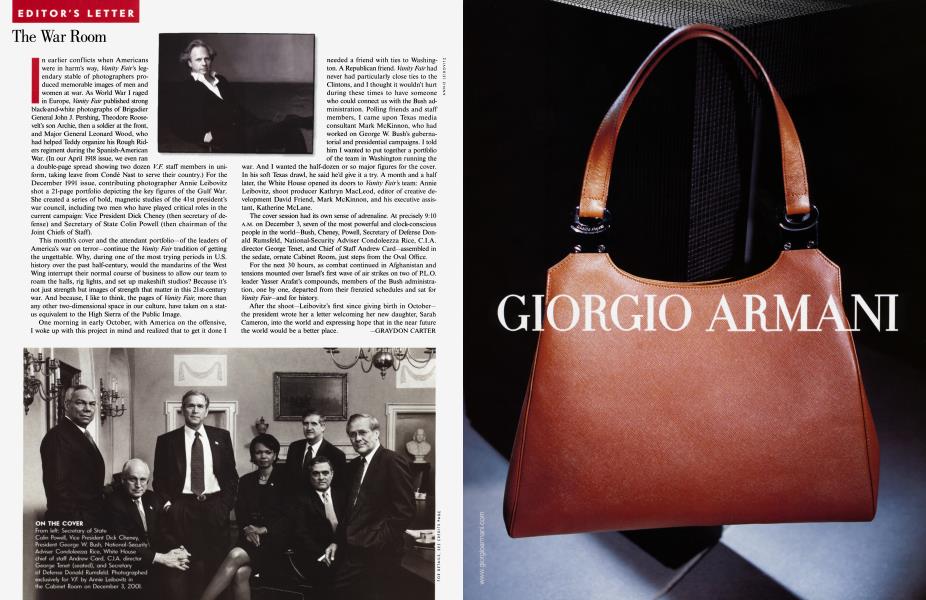
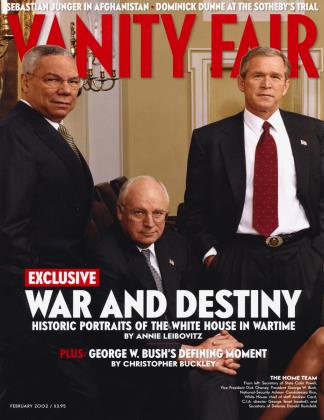
This month’s cover and the attendant portfolio—of the leaders of America’s war on terror—continue the Vanity Fair tradition of getting the ungettable. Why, during one of the most trying periods in U.S. history over the past half-century, would the mandarins of the West Wing interrupt their normal course of business to allow our team to roam the halls, rig lights, and set up makeshift studios? Because it’s not just strength but images of strength that matter in this 21st-century war. And because, I like to think, the pages of Vanity Fair, more than any other two-dimensional space in our culture, have taken on a status equivalent to the High Sierra of the Public Image.
One morning in early October, with America on the offensive, I woke up with this project in mind and realized that to get it done I needed a friend with ties to Washington. A Republican friend. Vanity Fair had never had particularly close ties to the Clintons, and I thought it wouldn’t hurt during these times to have someone who could connect us with the Bush administration. Polling friends and staff members, I came upon Texas media consultant Mark McKinnon, who had worked on George W. Bush’s gubernatorial and presidential campaigns. I told him I wanted to put together a portfolio of the team in Washington running the war. And I wanted the half-dozen or so major figures for the cover. In his soft Texas drawl, he said he’d give it a try. A month and a half later, the White House opened its doors to Vanity Fair’s team: Annie Leibovitz, shoot producer Kathryn MacLeod, editor of creative development David Friend, Mark McKinnon, and his executive assistant, Katherine McLane.
The cover session had its own sense of adrenaline. At precisely 9:10 A.M. on December 3, seven of the most powerful and clock-conscious people in the world—Bush, Cheney, Powell, Secretary of Defense Donald Rumsfeld, National-Security Adviser Condoleezza Rice, C.I.A. director George Tenet, and Chief of Staff Andrew Card—assembled in the sedate, ornate Cabinet Room, just steps from the Oval Office.
For the next 30 hours, as combat continued in Afghanistan and tensions mounted over Israel’s first wave of air strikes on two of RL.O. leader Yasser Arafat’s compounds, members of the Bush administration, one by one, departed from their frenzied schedules and sat for Vanity Fair—and for history.
After the shoot—Leibovitz’s first since giving birth in October— the president wrote her a letter welcoming her new daughter, Sarah Cameron, into the world and expressing hope that in the near future the world would be a better place.
GRAYDON CARTER
Subscribers have complete access to the archive.
Sign In Not a Subscriber?Join Now