

Sign In to Your Account
Subscribers have complete access to the archive.
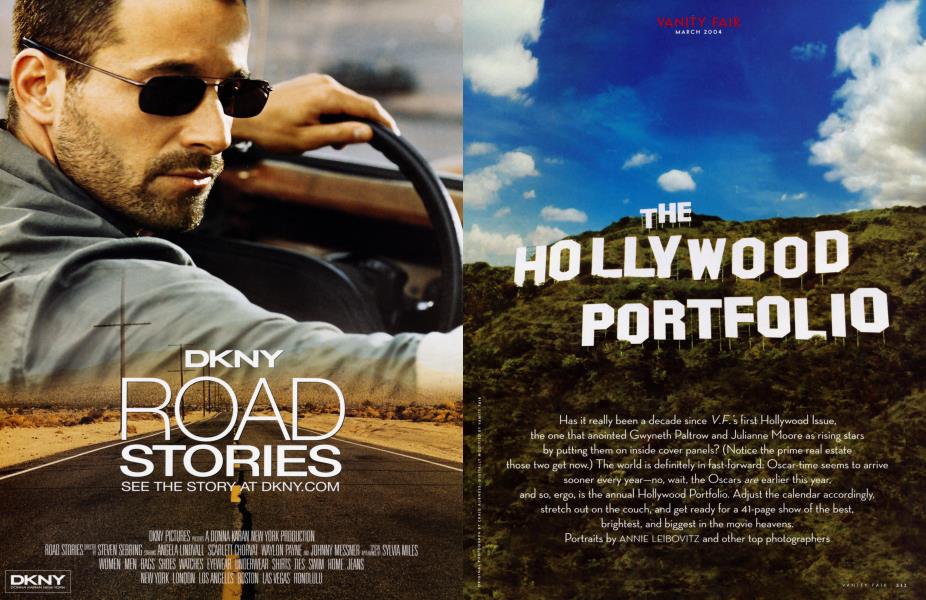
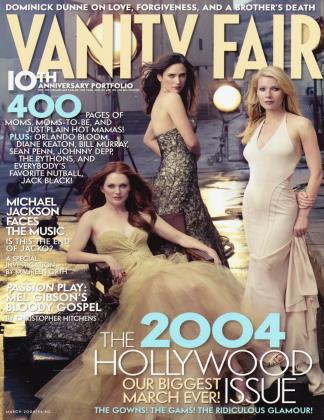
Sign In Not a Subscriber?Join NowHas it really been a decade since V.F.'s first Hollywood Issue, the one that anointed Gwyneth Paltrow and Julianne Moore as rising stars by putting them on inside cover panels? (Notice the prime real estate those two get now.) The world is definitely in fast-forward: Oscar-time seems to arrive sooner every year—no, wait, the Oscars are earlier this year, and so, ergo, is the annual Hollywood Portfolio. Adjust the calendar accordingly, stretch out on the couch, and get ready for a 41-page show of the best, brightest, and biggest in the movie heavens. Portraits by ANNIE LEIBOVITZ and other top photographers
Has it really been a decade since V.F.'s first Hollywood Issue, the one that anointed Gwyneth Paltrow and Julianne Moore as rising stars by putting them on inside cover panels? (Notice the prime real estate those two get now.) The world is definitely in fast-forward: Oscar-time seems to arrive sooner every year—no, wait, the Oscars are earlier this year, and so, ergo, is the annual Hollywood Portfolio. Adjust the calendar accordingly, stretch out on the couch, and get ready for a 41-page show of the best, brightest, and biggest in the movie heavens. Portraits by ANNIE LEIBOVITZ and other top photographers
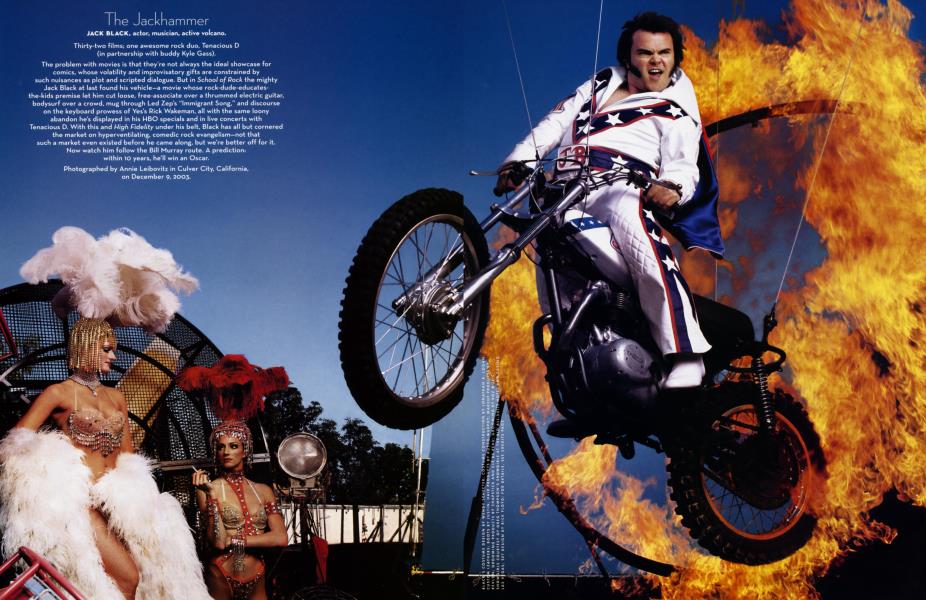
The problem with movies is that they’re not always the ideal showcase for comics, whose volatility and improvisatory gifts are constrained by such nuisances as plot and scripted dialogue. But in School of Rock the mighty Jack Black at last found his vehicle—a movie whose rock-dude-educates-the-kids premise let him cut loose, free-associate over a thrummed electric guitar, bodysurf over a crowd, mug through Led Zep’s “Immigrant Song,” and discourse on the keyboard prowess of Yes’s Rick Wakeman, all with the same loony abandon he’s displayed in his HBO specials and in live concerts with Tenacious D. With this and High Fidelity under his belt, Black has all but cornered the market on hyperventilating, comedic rock evangelism—not that such a market even existed before he came along, but we’re better off for it. Now watch him follow the Bill Murray route. A prediction: within 10 years he’ll win an Oscar.
Photographed by Annie Leibovitz in Culver City, California, on December 9, 2003.
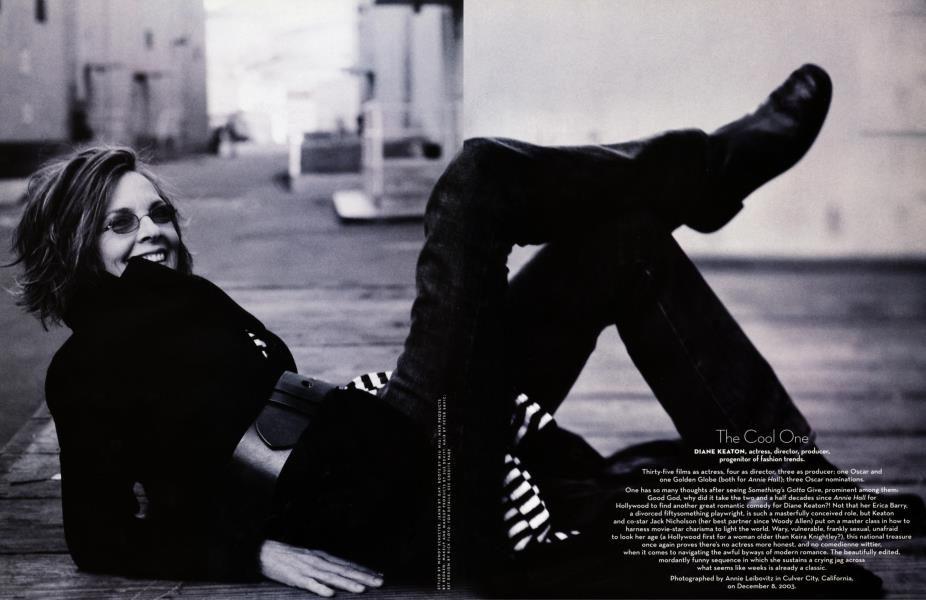
One has so many thoughts after seeing Something's Gotta Give, prominent among them: Good God, why did it take the two and a half decades since Annie Hall for Hollywood to find another great romantic comedy for Diane Keaton?! Not that her Erica Barry, a divorced fifty-something playwright, is such a masterfully conceived role, but Keaton and co-star Jack Nicholson (her best partner since Woody Allen) put on a master class in how to harness movie-star charisma to light the world. Wary, vulnerable, frankly sexual, unafraid to look her age (a Hollywood first for a woman older than Keira Knightley?), this national treasure once again proves there's no actress more honest, and no comedienne wittier, when it comes to navigating the awful byways of modern romance. The beautifully edited, mordantly funny sequence in which she sustains a crying jag across what seems like weeks is already a classic.
Photographed by Annie Leibovitz in Culver City, California, on December 8, 2003.
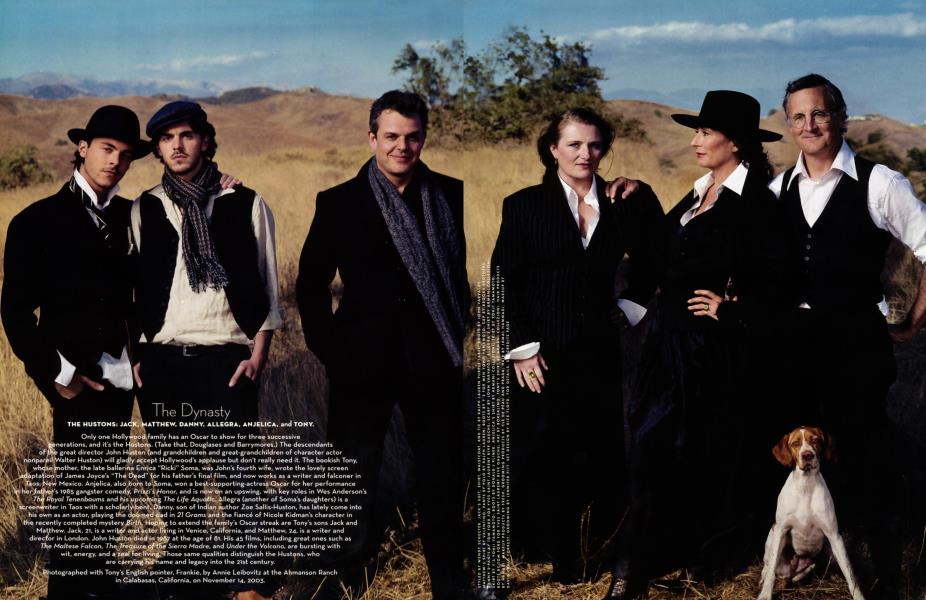
Only one Hollywood family has an Oscar to show for three successive generations, and it’s the Hustons. (Take that, Douglases and Barrymores.) The descendants of the great director John Huston (and grandchildren and great-grandchildren of character actor nonpareil Walter Huston) will gladly accept Hollywood’s applause but don’t really need it. The bookish Tony, whose mother, the late ballerina Enrica “Ricki” Soma, was John’s fourth wife, wrote the lovely screen adaptation of James Joyce’s "The Dead” for his father’s final film, and now works as a writer and falconer in Taos, New Mexico. Anjelica, also born to Soma, won a best-supporting-actress Oscar for her performance in her father's 1985 gangster comedy, Prizzi’s Honor, and is now on an upswing, with key roles in Wes Anderson’s The Royal Tenenbaums and his upcoming The Life Aquatic. Allegra (another of Soma’s daughters) is a screenwriter in Taos with a scholarly bent. Danny, son of Indian author Zoe Sallis-Huston, has lately come into his own as an actor, playing the doomed dad in 21 Grams and the fiancé of Nicole Kidman’s character in the recently completed mystery Birth. Hoping to extend the family's Oscar streak are Tony’s sons Jack and Matthew. Jack, 21, is a writer and actor lining in Venice, California, and Matthew, 24, is a writer and director in London. John Huston died in 1987 at the age of 81. His 45 films, including great ones such as The Maltese Falcon, The Treasure of the Sierra Madre, and Under the Volcano, are bursting with wit, energy, and a zeal for living. Those same qualities distinguish the Hustons, who are carrying his name and legacy into the 21st century.
Photographed with Tony’s English pointer, Frankie, by Annie Leibovitz at the Ahmanson Ranch in Calabasas, California, on November 14, 2003.
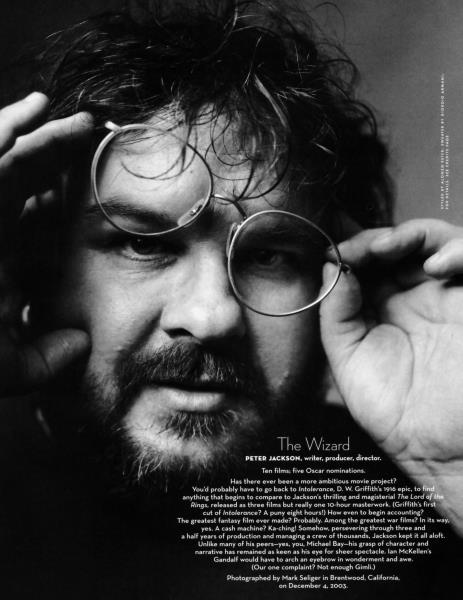
Has there ever been a more ambitious movie project? You'd probably have to go back to Intolerance, D. W. Griffith's 1916 epic, to find anything that begins to compare to Jackson's thrilling and magisterial The Lord of Rings, released as three films but really one 10-hour masterwork. (Griffith's first cut of Intolerance? A puny eight hours!) How even to begin accounting? The greatest fantasy film ever made? Probably. Among the greatest war films? In its way, yes. A cash machine? Ka-ching! Somehow, persevering through three and a half years of production and managing a crew of thousands, Jackson kept it all aloft. Unlike many of his peers—yes, you, Michael Bay—his grasp of character and narrative has remained as keen as his eye for sheer spectacle. Ian McKellen's Gandalf would have to arch an eyebrow in wonderment and awe. (Our one complaint? Not enough Gimli.)
Photographed by Mark Seliger in Brentwood, California, on December 4, 2003.
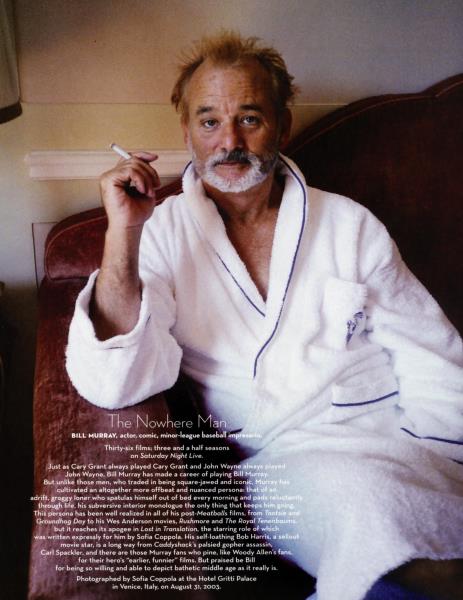
Just as Cary Grant always played Cary Grant and John Wayne always played John Wayne, Bill Murray has made a career of playing Bill Murray. But unlike those men, who traded in being square-jawed and iconic, Murray has cultivated an altogether more offbeat and nuanced persona: that of an adrift, groggy loner who spatulas himself out of bed every morning and pads reluctantly through life, his subversive interior monologue the only thing that keeps him going. This persona has been well realized in all of his post-Meatballs films, from Tootsie and Groundhog Day to his Wes Anderson movies, Rushmore and The Royal Tenenbaums, but it reaches its apogee in Lost in Translation, the starring role of which was written expressly for him by Sofia Coppola. His self-loathing Bob Harris, a sellout movie star, is a long way from Caddyshack's palsied gopher assassin, Carl Spackler, and there are those Murray fans who pine, like Woody Allen’s fans, for their hero’s “earlier, funnier" films. But praised be Bill for being so willing and able to depict bathetic middle age as it really is.
Photographed by Sofia Coppola at the Motel Gritti Palace in Venice, Italy, on August 31, 2003.
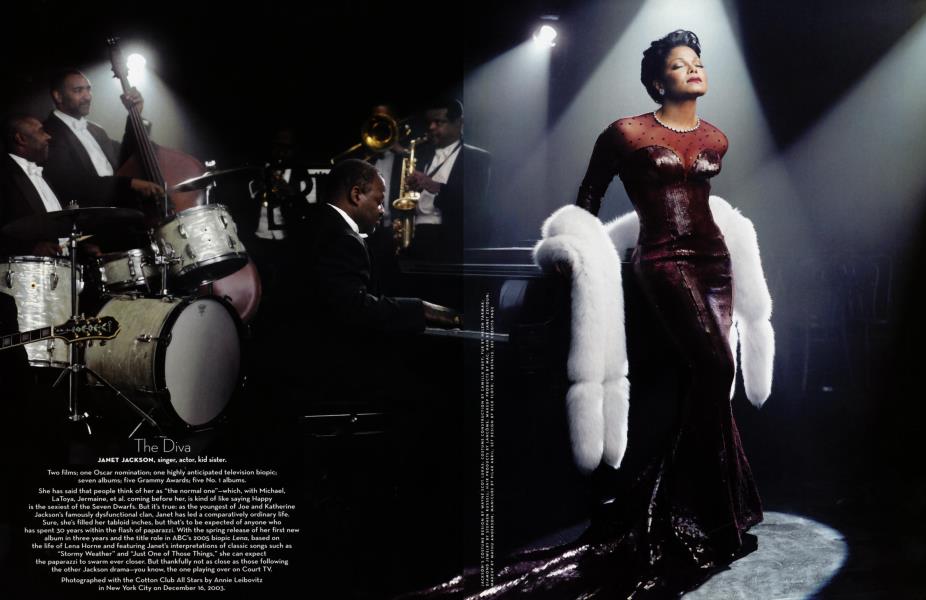
She has said that people think of her as “the normal one”—which, with Michael, LaToya, Jermaine, et al. coming before her, is kind of like saying Happy is the sexiest of the Seven Dwarfs. But it’s true: as the youngest of Joe and Katherine Jackson’s famously dysfunctional clan, Janet has led a comparatively ordinary life. Sure, she’s filled her tabloid inches, but that’s to be expected of anyone who has spent 30 years within the flash of paparazzi. With the spring release of her first new album in three years and the title role in ABC's 2005 biopic Lena, based on the life of Lena Horne and featuring Janet’s interpretations of classic songs such as "Stormy Weather" and “Just One of Those Things,” she can expect the paparazzi to swarm ever closer. But thankfully not as close as those following the other Jackson drama—you know, the one playing over on Court TV.
Photographed with the Cotton Club All Stars by Annie Leibovitz in New York City on December 16, 2003.
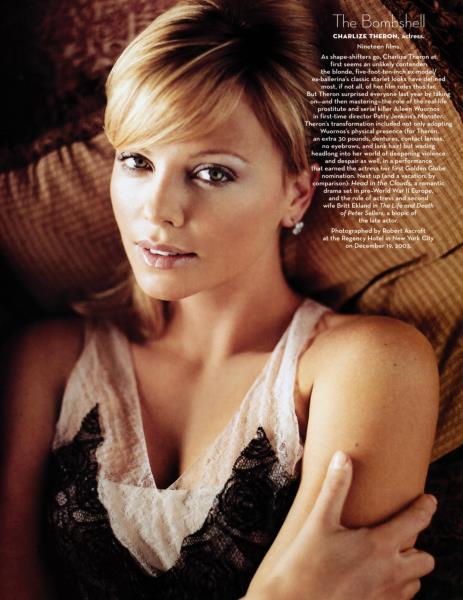
As shape-shifters go, Charlize Theron at first seems an unlikely contender: the blonde, five-foot-ten-inch ex-model/ ex-ballerina’s classic starlet looks have defined most, if not all, of her film roles thus far. But Theron surprised everyone last year by taking on—and then mastering—the role of the real-life prostitute and serial killer Aileen Wuornos in first-time director Patty Jenkins's Monster. Theron’s transformation included not only adopting Wuornos’s physical presence (for Theron, an extra 30 pounds, dentures, contact lenses, no eyebrows, and lank hair) but wading headlong into her world of deepening violence and despair as well, in a performance that earned the actress her first Golden Globe nomination. Next up (and a vacation, by comparison): Head in the Clouds, a romantic drama set in pre-World War II Europe, and the role of actress and second wife Britt Ekland in The Life and Death of Peter Sellers, a biopic of the late actor.
Photographed by Robert Ascroft at the Regency Hotel in New York City on December 19, 2003.
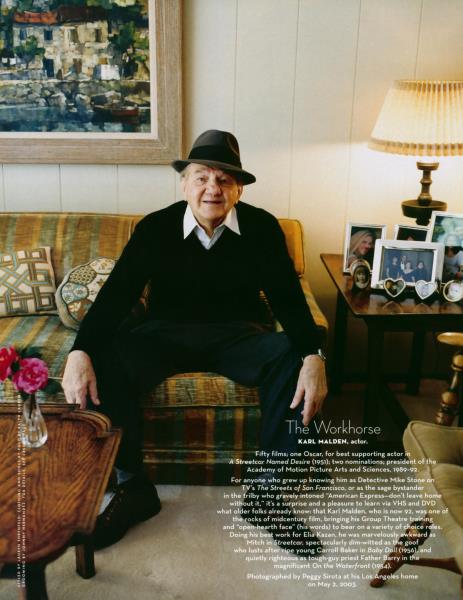
For anyone who grew up knowing him as Detective Mike Stone on TV’s The Streets of San Francisco, or as the sage bystander in the trilby who gravely intoned “American Express—don’t leave home without it,” it's a surprise and a pleasure to learn via VHS and DVD what older folks already know: that Karl Malden, who is now 92, was one of the rocks of midcentury film, bringing his Group Theatre training and “open-hearth face” (his words) to bear on a variety of choice roles. Doing his best work for Elia Kazan, he was marvelously awkward as Mitch in Streetcar, spectacularly dim-witted as the goof who lusts after ripe young Carroll Baker in Baby Doll (1956), and quietly righteous as tough-guy priest Father Barry in the magnificent On the Waterfront (1954).
Photographed by Peggy Sirota at his Los Angeles home on May 2, 2003.
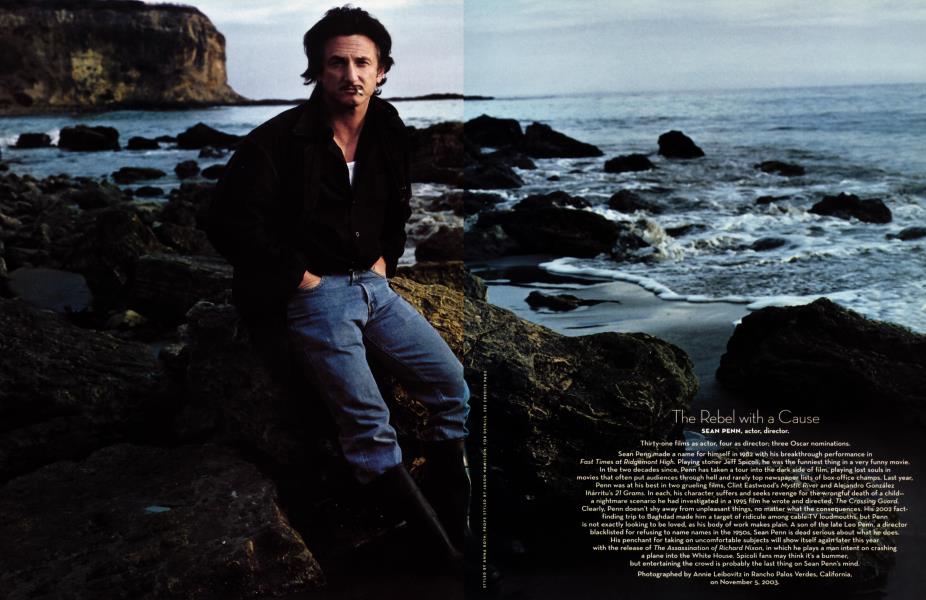
Sean Penn made a name for himself in 1982 with his breakthrough performance in Fast Times at Ridgemont High. Playing stoner Jeff Spicoli, he was the funniest thing in a very funny movie. In the two decades since, Penn has taken a tour into the dark side of film, playing lost souls in movies that often put audiences through hell and rarely top newspaper lists of box-office champs. Last year, Penn was at his best in two grueling films, Clint Eastwood's Mystic River and Alejandro Gonzalez Iñárritu's 21 Grams. In each, his character suffers and seeks revenge for the wrongful death of a child— a nightmare scenario he had investigated in a 1995 film he wrote and directed, The Crossing Guard. Clearly, Penn doesn’t shy away from unpleasant things, no matter what the consequences. His 2002 fact-finding trip to Baghdad made him a target of ridicule among cable-TV loudmouths, but Penn is not exactly looking to be loved, as his body of work makes plain. A son of the late Leo Penn, a director blacklisted for refusing to name names in the 1950s, Sean Penn is dead serious about what he does. His penchant for taking on uncomfortable subjects will show itself again later this year with the release of The Assassination of Richard Nixon, in which he plays a man intent on crashing a plane into the White House. Spicoli fans may think it’s a bummer, but entertaining the crowd is probably the last thing on Sean Penn’s mind.
Photographed by Annie Leibovitz in Rancho Palos Verdes, California, on November 5, 2003.
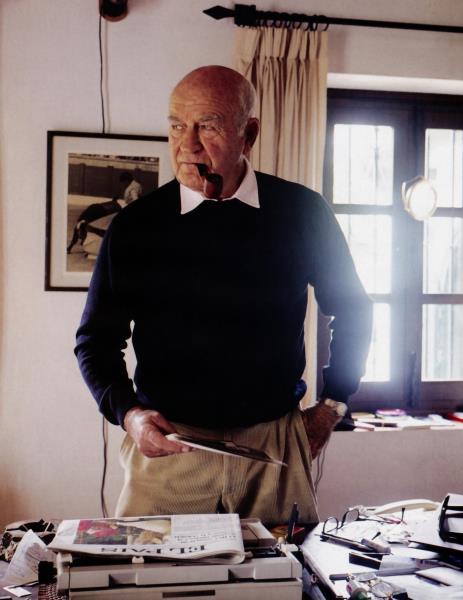
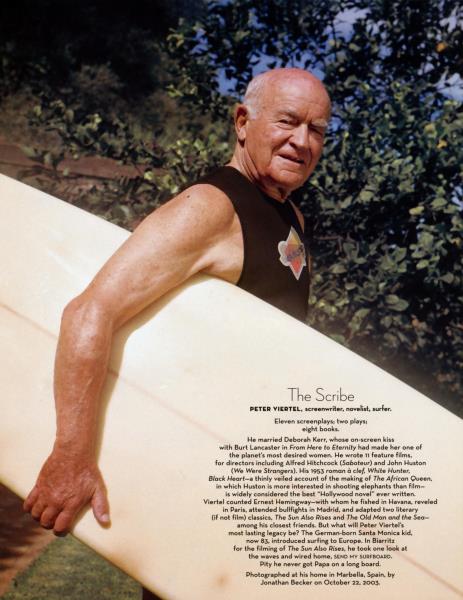
He married Deborah Kerr, whose on-screen kiss with Burt Lancaster in From Here to Eternity had made her one of the planet’s most desired women. He wrote 11 feature films, for directors including Alfred Hitchcock (Saboteur) and John Huston (We Were Strangers). His 1953 roman a clef, White Hunter, Black Heart—a thinly veiled account of the making of The African Queen, in which Huston is more interested in shooting elephants than film— is widely considered the best “Hollywood novel” ever written. Viertel counted Ernest Hemingway—with whom he fished in Havana, reveled in Paris, attended bullfights in Madrid, and adapted two literary (if not film) classics, The Sun Also Rises and The Old Man and the Sea— among his closest friends. But what will Peter Viertel’s most lasting legacy be? The German-born Santa Monica kid, now 83, introduced surfing to Europe. In Biarritz for the filming of The Sun Also Rises, he took one look at the waves and wired home, SEND MY SURFBOARD. Pity he never got Papa on a long board.
Photographed at his home in Marbella, Spain, by Jonathan Becker on October 22, 2003.
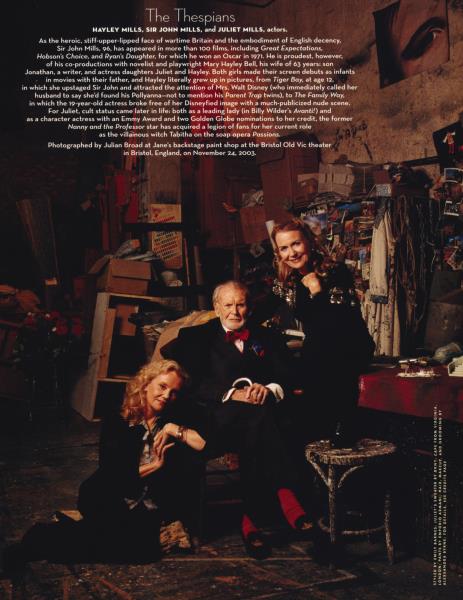
As the heroic, stiff-upper-lipped face of wartime Britain and the embodiment of English decency, Sir John Mills, 96, has appeared in more than 100 films, including Great Expectations, Hobson's Choice, and Ryan’s Daughter, for which he won an Oscar in 1971. He is proudest, however, of his co-productions with novelist and playwright Mary Hayley Bell, his wife of 63 years: son Jonathan, a writer, and actress daughters Juliet and Hayley. Both girls made their screen debuts as infants in movies with their father, and Hayley literally grew up in pictures, from Tiger Bay, at age 12, in which she upstaged Sir John and attracted the attention of Mrs. Walt Disney (who immediately called her husband to say she’d found his Pollyanna—not to mention his Parent Trap twins), to The Family Way, in which the 19-year-old actress broke free of her Disneyfied image with a much-publicized nude scene. For Juliet, cult status came later in life: both as a leading lady (in Billy Wilder’s Avanti!) and as a character actress with an Emmy Award and two Golden Globe nominations to her credit, the former Nanny and the Professor star has acquired a legion of fans for her current role as the villainous witch Tabitha on the soap opera Passions.
Photographed by Julian Broad at Jane's backstage paint shop at the Bristol Old Vic theater in Bristol, England, on November 24, 2003.
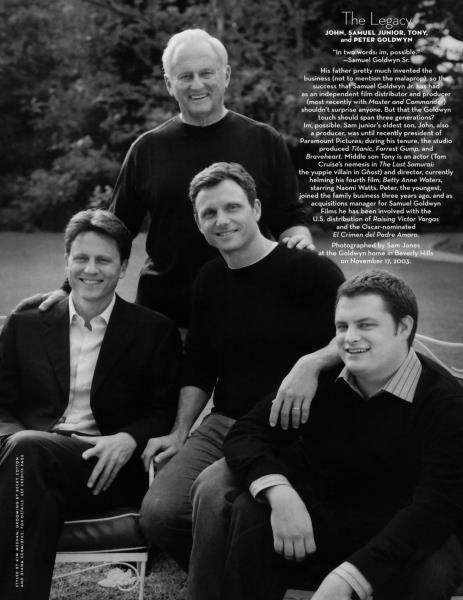
His father pretty much invented the business (not to mention the malaprop), so the success that Samuel Goldwyn Jr. has had as an independent film distributor and producer (most recently with Master and Commander) shouldn’t surprise anyone. But that the Goldwyn touch should span three generations? Im, possible. Sam junior’s eldest son, John, also a producer, was until recently president of Paramount Pictures; during his tenure, the studio produced Titanic, Forrest Gump, and Braveheart. Middle son Tony is an actor (Tom Cruise’s nemesis in The Last Samurai; the yuppie villain in Ghost) and director, currently helming his fourth film, Betty Anne Waters, starring Naomi Watts. Peter, the youngest, joined the family business three years ago, and as acquisitions manager for Samuel Goldwyn Films he has been involved with the U.S. distribution of Raising Victor Vargas and the Oscar-nominated El Crimen del Padre Amaro.
Photographed by Sam Jones at the Goldwyn home in Beverly Hills on November 17, 2003.
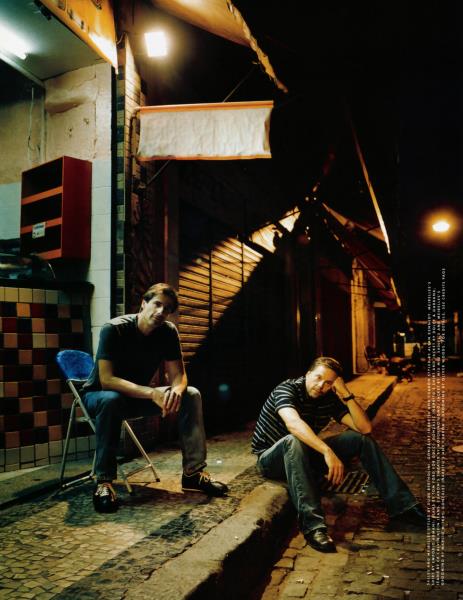
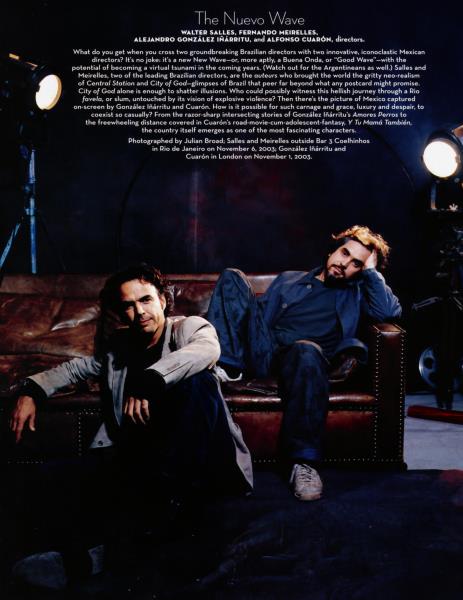
What do you get when you cross two groundbreaking Brazilian directors with two innovative, iconoclastic Mexican directors? It’s no joke: it’s a new New Wave—or, more aptly, a Buena Onda, or “Good Wave”—with the potential of becoming a virtual tsunami in the coming years. (Watch out for the Argentineans as well.) Salles and Meirelles, two of the leading Brazilian directors, are the auteurs who brought the world the gritty neo-realism of Central Station and City of God—glimpses of Brazil that peer far beyond what any postcard might promise. City of God alone is enough to shatter illusions. Who could possibly witness this hellish journey through a Rio favela, or slum, untouched by its vision of explosive violence? Then there’s the picture of Mexico captured on-screen by Gonzalez Iñárritu and Cuarón. Now is it possible for such carnage and grace, luxury and despair, to coexist so casually? From the razor-sharp intersecting stories of Gonzalez Iñárritu’s Amores Perros to the freewheeling distance covered in Cuarón’s road-movie-cum-adolescent-fantasy, Y Tu Mama Tambien, the country itself emerges as one of the most fascinating characters.
Photographed by Julian Broad; Salles and Meirelles outside Bar 3 Coelhinhos in Rio de Janeiro on November 6, 2003; Gonzalez Iñárritu and Cuarón in London on November 1, 2003.
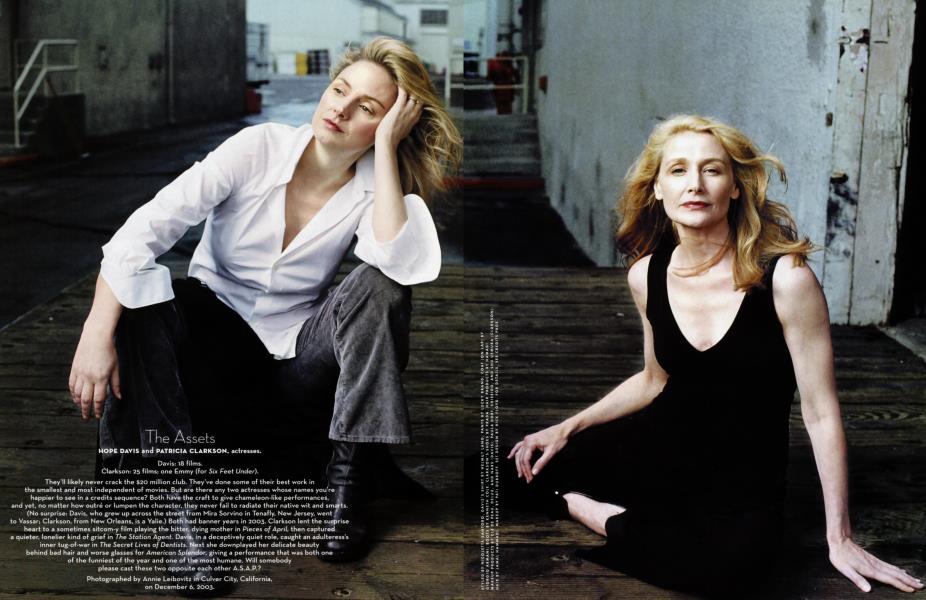
They’ll likely never crack the $20 million club. They’ve done some of their best work in the smallest and most independent of movies. But are there any two actresses whose names you’re happier to see in a credits sequence? Both have the craft to give chameleon-like performances, and yet, no matter how outre or lumpen the character, they never fail to radiate their native wit and smarts. (No surprise: Davis, who grew up across the street from Mira Sorvino in Tenafly, New Jersey, went to Vassar; Clarkson, from New Orleans, is a Yalie.) Both had banner years in 2003—Clarkson lent the surprise heart to a sometimes sitcom-y film playing the bitter, dying mother in Pieces of April, then captured a quieter, lonelier kind of grief in The Station Agent. Davis, in a deceptively quiet role, caught an adulteress's inner tug-of-war in The Secret Lives of Dentists. Next she downplayed her delicate beauty behind bad hair and worse glasses for American Splendor, giving a performance that was both one of the funniest of the year and one of the most humane. Will somebody please cast these two opposite each other A.S.A.P.?
Photographed by Annie Leibovitz in Culver City, California, on December 6, 2003.
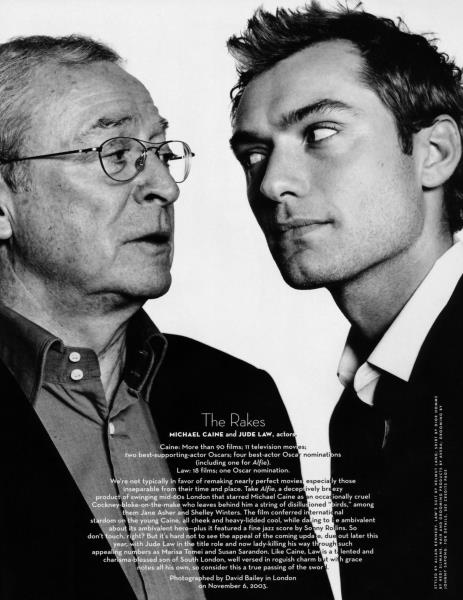
We’re not typically in favor of remaking nearly perfect movies, especially inseparable from their time and place. Take Alfie, a deceptively breezy product of swinging mid-60s London that starred Michael Caine as occasionally cruel Cockney-bloke-on-the-make who leaves behind him a string of disillusioned "birds," among them Jane Asher and Shelley Winters. The film conferred international stardom on the young Caine, all cheek and heavy-lidded cool, while daring to be ambivalent about its ambivalent hero—plus it featured a fine jazz score by Sonny Rollins. So don't touch it, right? But it's hard not to see the appeal of the coming update, due out later this year, with Jude Law in the title role and now lady-killing his way through such appealing numbers as Marisa Tomei and Susan Sarandon. Like Caine, Law is a talented and charisma-blessed son of South London, well versed in roguish charm but with grace and notes all his own, so consider this a true passing of the sword.
Photographed by David Bailey in London on November 6, 2003.
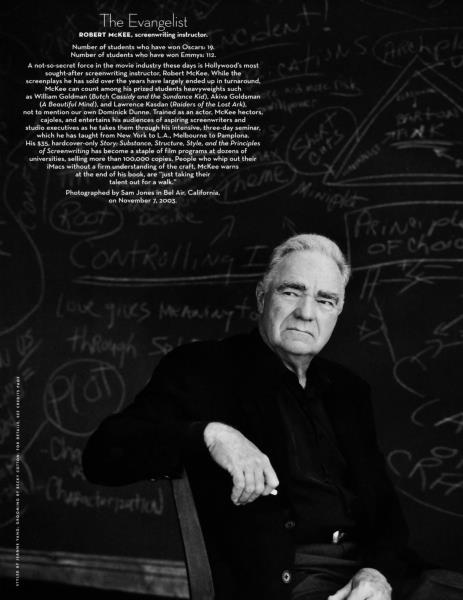
A not-so-secret force in the movie industry these days is Hollywood’s most sought-after screenwriting instructor, Robert McKee. While the screenplays he has sold over the years have largely ended up in turnaround, McKee can count among his prized students heavyweights such as William Goldman (Butch Cassidy and the Sundance Kid), Akiva Goldsman (A Beautiful Mind), and Lawrence Kasdan (Raiders of the Lost Ark), not to mention our own Dominick Dunne. Trained as an actor, McKee hectors, cajoles, and entertains his audiences of aspiring screenwriters and studio executives as he takes them through his intensive, three-day seminar, which he has taught from New York to L.A., Melbourne to Pamplona. His $35, hardcover-only Story: Substance, Structure, Style, and the Principles of Screenwriting has become a staple of film programs at dozens of universities, selling more than 100,000 copies. People who whip out their iMacs without a firm understanding of the craft, McKee warns at the end of his book, are “just taking their talent out for a walk.”
Photographed by Sam Jones in Bel Air, California, on November 7, 2003.
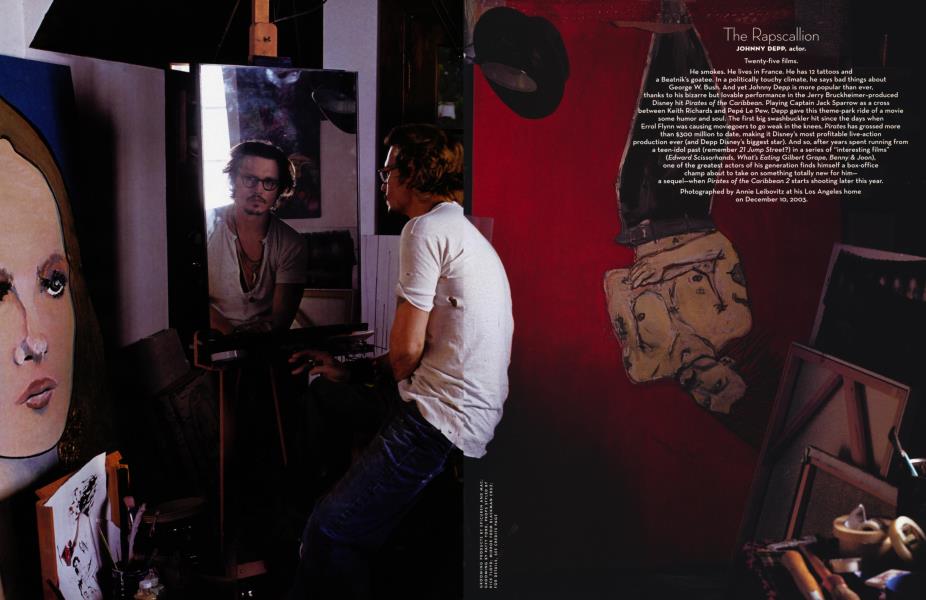
He smokes. He lives in France. He has 12 tattoos and a Beatnik’s goatee. In a politically touchy climate, he says bad things about George W. Bush. And yet Johnny Depp is more popular than ever, thanks to his bizarre but lovable performance in the Jerry Bruckheimer-produced Disney hit Pirates of the Caribbean. Playing Captain Jack Sparrow as a cross between Keith Richards and Pepe Le Pew, Depp gave this theme-park ride of a movie some humor and soul. The first big swashbuckler hit since the days when Errol Flynn was causing moviegoers to go weak in the knees, Pirates has grossed more than $300 million to date, making it Disney’s most profitable live-action production ever (and Depp Disney’s biggest star). And so, after years spent running from a teen-idol past (remember 21 Jump Street?) in a series of "interesting films” (Edward Scissorhands, What's Eating Gilbert Grape, Benny & Joon), one of the greatest actors of his generation finds himself a box-office champ about to take on something totally new for him— a sequel—when Pirates of the Caribbean 2 starts shooting later this year.
Photographed by Annie Leibovitz at his Los Angeles home on December 10, 2003.
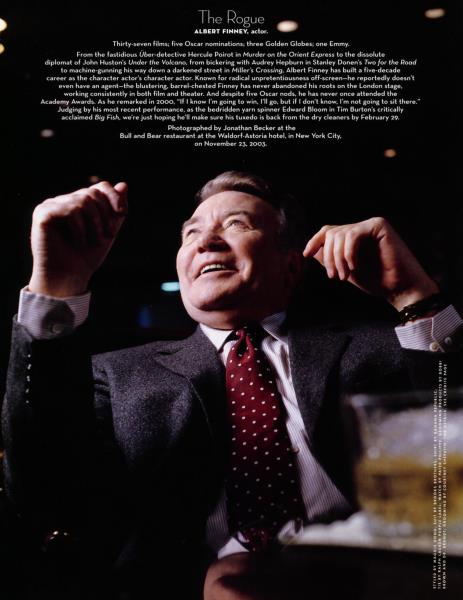
From the fastidious Über-detective Hercule Poirot in Murder on the Orient Express to the dissolute diplomat of John Huston’s Under the Volcano, from bickering with Audrey Hepburn in Stanley Donen's Two for the Road to machine-gunning his way down a darkened street in Miller's Crossing, Albert Finney has built a five-decade career as the character actor's character actor. Known for radical unpretentiousness off-screen—he reportedly doesn’t even have an agent—the blustering, barrel-chested Finney has never abandoned his roots on the London stage, working consistently in both film and theater. And despite five Oscar nods, he has never once attended the Academy Awards. As he remarked in 2000, "If I know I'm going to win, I’ll go, but if I don’t know, I’m not going to sit there.” Judging by his most recent performance, as the bedridden yarn spinner Edward Bloom in Tim Burton’s critically acclaimed Big Fish, we’re just hoping he’ll make sure his tuxedo is back from the dry cleaners by February 29.
Photographed by Jonathan Becker at the Bull and Bear restaurant at the Waldorf-Astoria hotel, in New York City, on November 23, 2003.
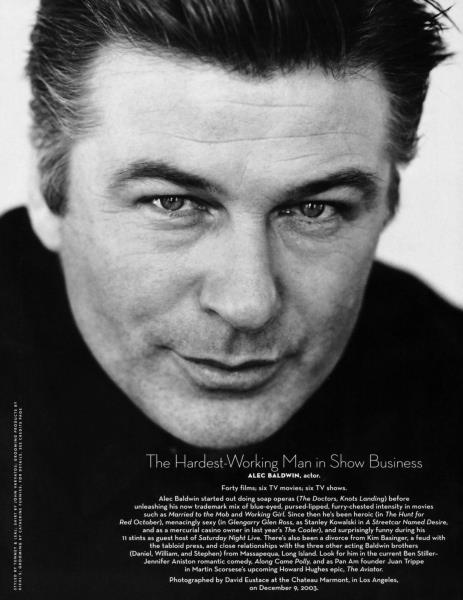
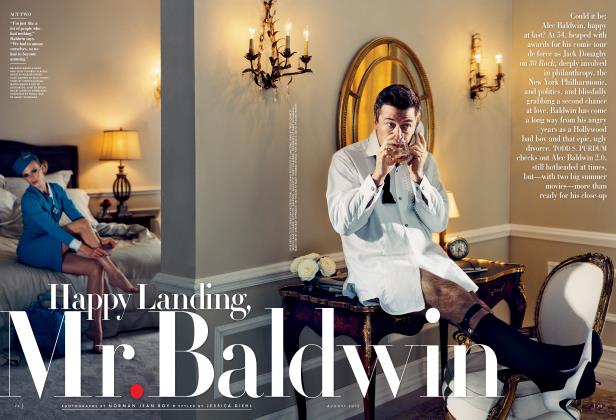
Alec Baldwin started out doing soap operas (The Doctors, Knots Landing) before unleashing his now trademark mix of blue-eyed, pursed-lipped, furry-chested intensity in movies such as Married to the Mob and Working Girl. Since then he’s been heroic (in The Hunt for Red October), menacingly sexy (in Glengarry Glen Ross, as Stanley Kowalski in A Streetcar Named Desire, and as a mercurial casino owner in last year’s The Cooler), and surprisingly funny during his 11 stints as guest host of Saturday Night Live. There’s also been a divorce from Kim Basinger, a feud with the tabloid press, and close relationships with the three other acting Baldwin brothers (Daniel, William, and Stephen) from Massapequa, Long Island. Look for him in the current Ben Stiller-Jennifer Aniston romantic comedy, Along Came Polly, and as Pan Am founder Juan Trippe in Martin Scorsese’s upcoming Howard Hughes epic, The Aviator.
Photographed by David Eustace at the Chateau Marmont, in Los Angeles, on December 9, 2003.
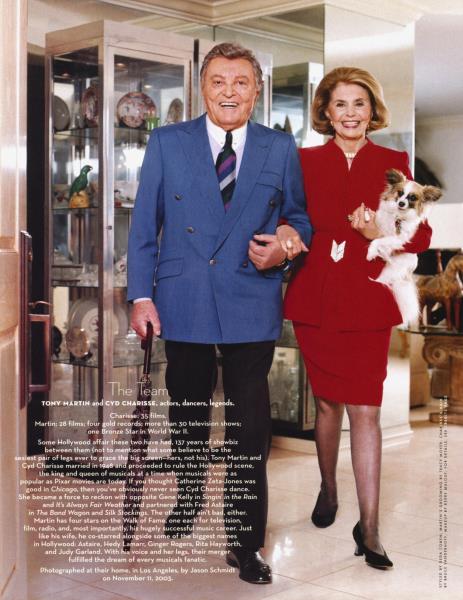
Some Hollywood affair these two have had, 137 years of showbiz between them (not to mention what some believe to be the sexiest pair of legs ever to grace the big screen—hers, not his). Tony Martin and Cyd Charisse married in 1948 and proceeded to rule the Hollywood scene the king and queen of musicals at a time when musicals were as popular as Pixar movies are today. If you thought Catherine Zeta-Jones was good in Chicago, then you’ve obviously never seen Cyd Charisse dance. She became a force to reckon with opposite Gene Kelly in Singin' in the Rain and It’s Always Fair Weather and partnered with Fred Astaire in The Band Wagon and Silk Stockings. The other half ain’t bad, either. Martin has four stars on the Walk of Fame, one each for television, film, radio, and, most importantly, his hugely successful music career. Just like his wife, he co-starred alongside some of the biggest names in Hollywood: Astaire, Hedy Lamarr, Ginger Rogers, Rita Hayworth, and Judy Garland. With his voice and her legs, their merger fulfilled the dream of every musicals fanatic.
Photographed at their home, in Los Angeles, by Jason Schmidt on November 11, 2003.
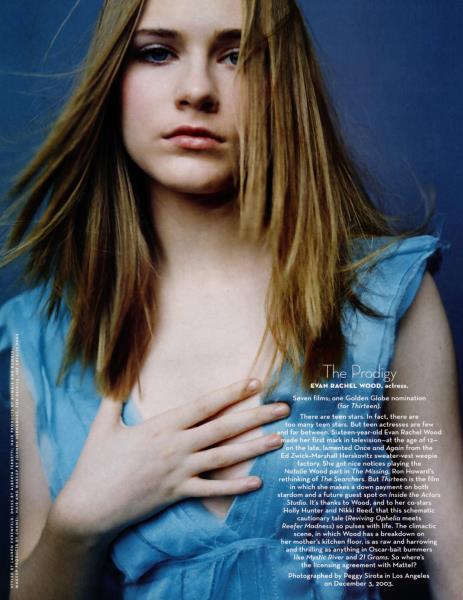
There are teen stars. In fact, there are too many teen stars. But teen actresses are few and far between. Sixteen-year-old Evan Rachel Wood made her first mark in television—at the age of 12— on the late, lamented Once and Again from the Ed Zwick-Marshall Herskovitz sweater-vest weepie factory. She got nice notices playing the Natalie Wood part in The Missing, Ron Howard’s rethinking of The Searchers. But Thirteen is the film in which she makes a down payment on both stardom and a future guest spot on Inside the Actors Studio. It’s thanks to Wood, and to her co-stars Holly Hunter and Nikki Reed, that this schematic cautionary tale (Reviving Ophelia meets Reefer Madness) so pulses with life. The climactic scene, in which Wood has a breakdown on her mother’s kitchen floor, is as raw and harrowing and thrilling as anything in Oscar-bait bummers like Mystic River and 21 Grams. So where’s the licensing agreement with Mattel?
Photographed by Peggy Sirota in Los Angeles on December 3, 2003.
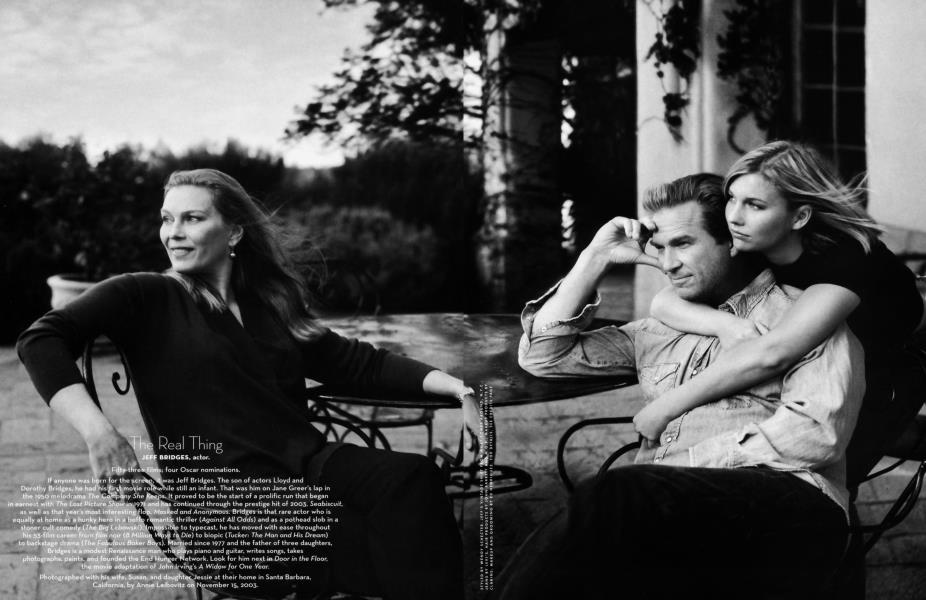
If anyone was born for the screen, it was Jeff Bridges. The son of actors Lloyd and Dorothy Bridges, he had his first movie role while still an infant. That was him on Jane Greer’s lap in the 1950 melodrama The Company She Keeps. It proved to be the start of a prolific run that began in earnest with The Last Picture Show in 1971 and has continued through the prestige hit of 2003, Seabiscuit, as well as that year’s most interesting flop, Masked and Anonymous. Bridges is that rare actor who is equally at home as a hunky hero in a boffo romantic thriller (Against All Odds) and as a pothead slob in a stoner cult comedy (The Big Lebowski). Impossible to typecast, he has moved with ease throughout his 53-film career from film noir (8 Million Ways to Die) to biopic (Tucker: The Man and His Dream) to backstage drama (The Fabulous Baker Boys). Married since 1977 and the father of three daughters, Bridges is a modest Renaissance man who plays piano and guitar, writes songs, takes photographs, paints, and founded the End Hunger Network. Look for him next in Door in the Floor, the movie adaptation of John Irving’s A Widow for One Year.
Photographed with his wife, Susan, and daughter Jessie at their home in Santa Barbara, California, by Annie Leibovitz on November 15, 2003.
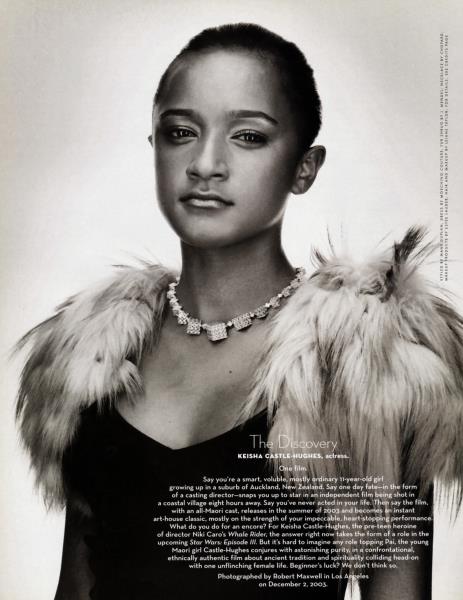
Say you’re a smart, voluble, mostly ordinary 11-year-old girl growing up in a suburb of Auckland, New Zealand. Say one day fate—in the form of a casting director—snaps you up to star in an independent film being shot in a coastal village eight hours away. Say you’ve never acted in your life. Then say the film, with an all-Maori cast, releases in the summer of 2003 and becomes an instant art-house classic, mostly on the strength of your impeccable, heart-stopping performance. What do you do for an encore? For Keisha Castle-Hughes, the pre-teen heroine of director Niki Caro’s Whale Rider, the answer right now takes the form of a role in the upcoming Star Wars: Episode III. But it’s hard to imagine any role topping Pai, the young Maori girl Castle-Hughes conjures with astonishing purity, in a confrontational, ethnically authentic film about ancient tradition and spirituality colliding head-on with one unflinching female life. Beginner’s luck? We don’t think so.
Photographed by Robert Maxwell in Los Ahgeles on December 2, 2003.
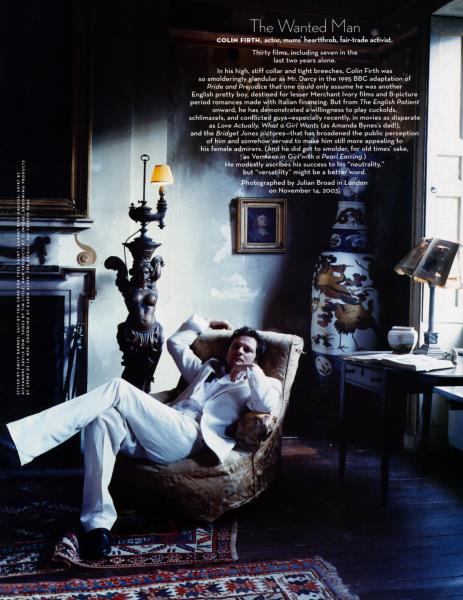
In his high, stiff collar and tight breeches, Colin Firth was so smolderingly glandular as Mr. Darcy in the 1995 BBC adaptation of Pride and Prejudice that one could only assume he was another English pretty boy, destined for lesser Merchant Ivory films and B-picture period romances made with Italian financing. But from The English Patient onward, he has demonstrated a willingness to play cuckolds, schlimazels, and conflicted guys—especially recently, in movies as disparate as Love Actually, What a Girl Wants (as Amanda Bynes’s dad!), and the Bridget Jones pictures—that has broadened the public perception of him and somehow served to make him still more appealing to his female admirers. (And he did get to smolder, for old times’ sake, as Vermeer in Girl with a Pearl Earring.) He modestly ascribes his success to his "neutrality," versatility” might be a better word.
Photographed by Julian Broad in London on November 14, 2003.
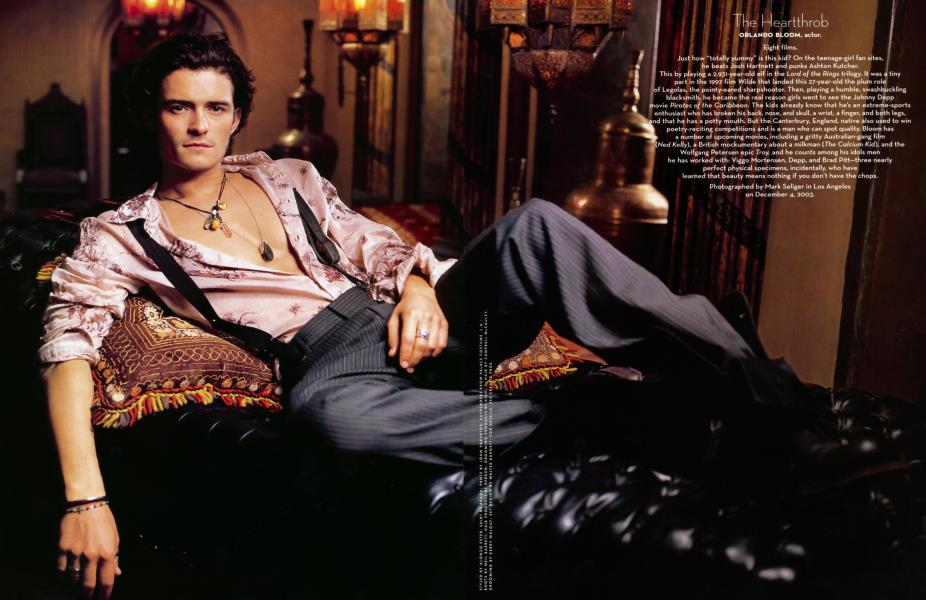
Just how “totally yummy" is this kid? On the teenage-girl fan sites, he beats Josh Hartnett and punks Ashton Kutcher. This by playing a 2,931-year-old elf in the Lord of the Rings trilogy. It was a tiny part in the 1997 film Wilde that landed this 27-year-old the plum role of Legolas, the pointy-eared sharpshooter. Then, playing a humble, swashbuckling blacksmith, he became the real reason girls went to see the Johnny Depp movie Pirates of the Caribbean. The kids already know that he’s an extreme-sports enthusiast who has broken his back, nose, and skull, a wrist, a finger, and both legs, and that he has a potty mouth. But the Canterbury, England, native also used to win poetry-reciting competitions and is a man who can spot quality. Bloom has a number of upcoming movies, including a gritty Australian-gang film Ned Kelly, a British mockumentary about a milkman (The Calcium Kid), and the Wolfgang Petersen epic Troy, and he counts among his idols men he has worked with: Viggo Mortensen, Depp, and Brad Pitt—three nearly perfect physical specimens, incidentally, who have learned that beauty means nothing if you don’t have the chops.
Photographed by Mark Seliger in Los Angeles on December 4, 2003.
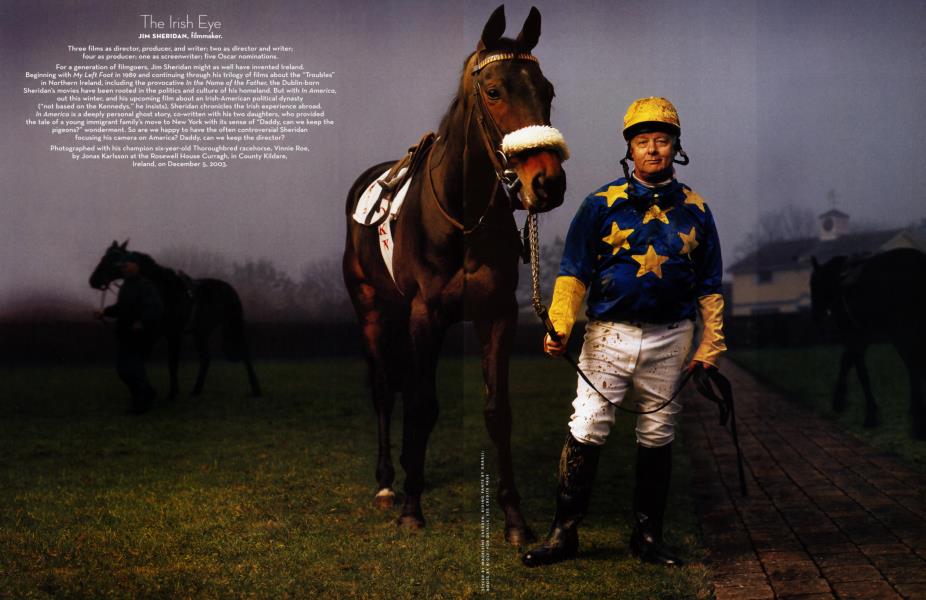
For a generation of filmgoers, Jim Sheridan might as well have invented Ireland. Beginning with My Left Foot in 1989 and continuing through his trilogy of films about the "Troubles” in Northern Ireland, including the provocative In the Name of the Father, the Dublin-born Sheridan’s movies have been rooted in the politics and culture of his homeland. But with In America, out this winter, and his upcoming film about an Irish-American political dynasty ("not based on the Kennedys,” he insists), Sheridan chronicles the Irish experience abroad. In America is a deeply personal ghost story, co-written with his two daughters, who provided the tale of a young immigrant family’s move to New York with its sense of "Daddy, can we keep the pigeons?” wonderment. So are we happy to have the often controversial Sheridan focusing his camera on America? Daddy, can we keep the director?
Photographed with his champion six-year-old Thoroughbred racehorse, Vinnie Roe, by Jonas Karlsson at the Rosewell Mouse Curragh, in County Kildare, Ireland, on December 5, 2003.
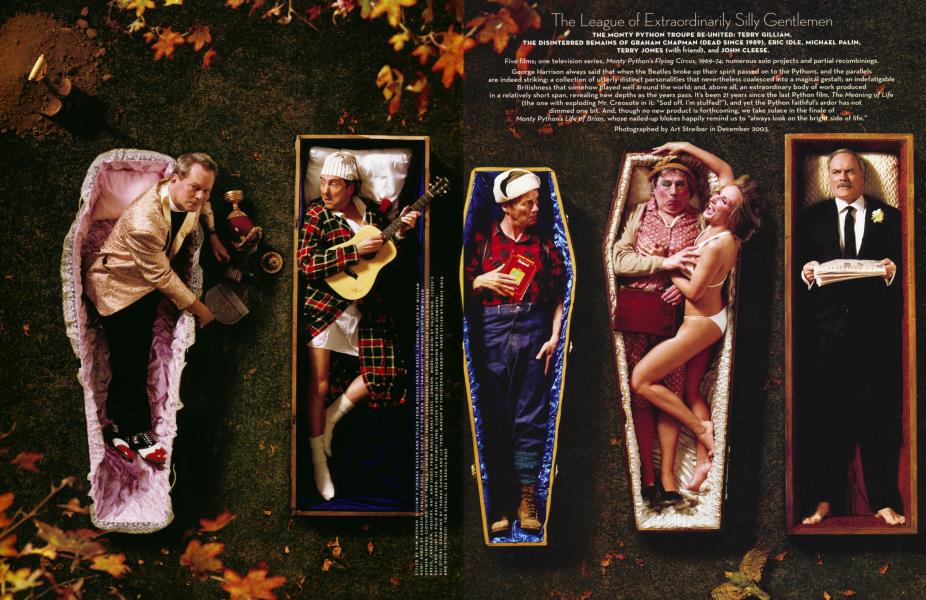
George Harrison always said that when the Beatles broke up their spirit passed on to the Pythons, and the parallels are indeed striking: a collection of utterly distinct personalities that nevertheless coalesced into a magical gestalt; an indefatigable Britishness that somehow played well around the world; and, above all, an extraordinary body of work produced in a relatively short span, revealing new depths as the years pass. It’s been 21 years since the last Python film, The Meaning of Life (the one with exploding Mr. Creosote in it: “Sod off, I’m stuffed!”), and yet the Python faithful’s ardor has not dimmed one bit. And, though no new product is forthcoming, we take solace in the finale of Monty Pythons Life of Brian, whose nailed-up blokes happily remind us to “always look on the bright side of life.”
Photographed by Art Streiber in December 2003.
Subscribers have complete access to the archive.
Sign In Not a Subscriber?Join Now


