Sign In to Your Account
Subscribers have complete access to the archive.
Sign In Not a Subscriber?Join NowHOT TYPE ELISSA SCHAPPELL
Rats! Robert Sullivan's histoire du rodent, Rats M (Bloomsbury), is a fascinating look at the lowly beasts that wreak havoc, spread pestilence, and (in this way they differ from compassionate conservatives) have sex 20 times a day. Seasoned investigative reporter (and sometime V.F. contributor) Craig Unger tears the veil off the secret relationship between two of the world's most powerful dynasties in House of Bush, House of Saud (Scribner). Things Worth Fighting For (Penguin) collects the essays of the late Michael Kelly, syndicated columnist, editor, and war correspondent for The Washington Post until he was killed in Iraq. Empire: NozoneIX(Princeton Architectural Press), edited by Nicholas Blechman, rallies artists and writers to rage against the imperial forces, such as the U.S.A. and the I.M.F., who aim to steamroll all who dare resist their diabolical plans. The melancholy cartoons of Bruce Eric Kaplan declare This Is a Bad Time (Simon & Schuster).
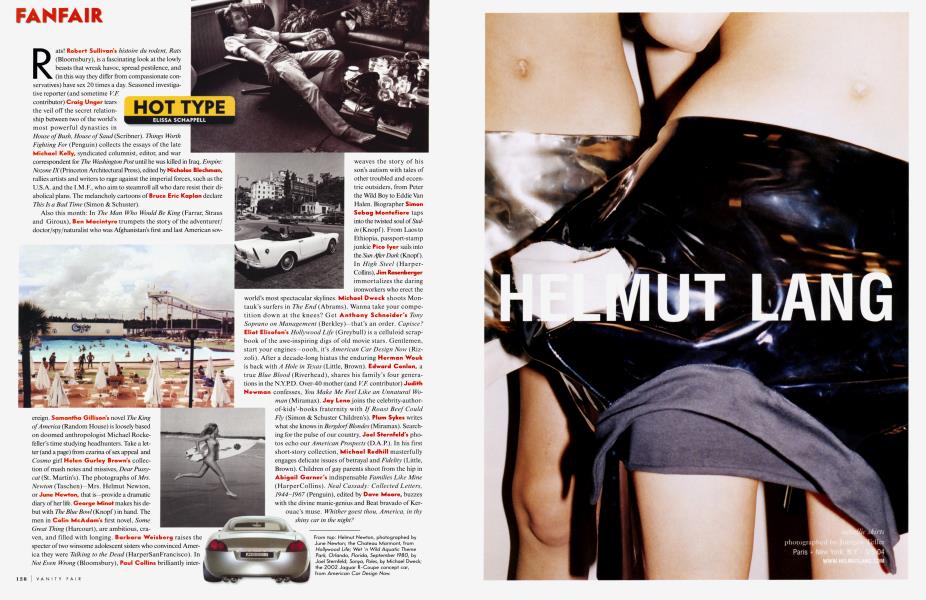
Also this month: In The Man Who Would Be King (Farrar, Straus and Giroux), Ben Macintyre trumpets the story of the adventurer/ doctor/spy/naturalist who was Afghanistan's first and last American sovereign. Samantha Gillison's novel The King of America (Random House) is loosely based on doomed anthropologist Michael Rockefeller's time studying headhunters. Take a letter (and a page) from czarina of sex appeal and Cosmo girl Helen Gurley Brown's collection of mash notes and missives, Dear Pussycat (St. Martin's). The photographs of Mrs. Newton (Taschen)—Mrs. Helmut Newton, or June Newton, that is—provide a dramatic diary of her life. George Minot makes his debut with The Blue Bowl (Knopf) in hand. The men in Colin McAdam's first novel, Some Great Thing (Harcourt), are ambitious, craven, and filled with longing. Barbara Weisberg raises the specter of two winsome adolescent sisters who convinced America they were Talking to the Dead (HarperSanFrancisco). In Not Even Wrong (Bloomsbury), Paul Collins brilliantly interweaves the story of his son's autism with tales of other troubled and eccentric outsiders, from Peter the Wild Boy to Eddie Van Halen. Biographer Simon Sebag Montefiore taps into the twisted soul of Stalin (Knopf). From Laos to Ethiopia, passport-stamp junkie Pico Iyer sails into the Sun After Dark (Knopf). In High Steel (HarperCollins), Jim Rasenberger immortalizes the daring ironworkers who erect the world's most spectacular skylines. Michael Dweck shoots Montauk's surfers in The End (Abrams). Wanna take your competition down at the knees? Get Anthony Schneider's Tony Soprano on Management (Berkley)—that's an order. Capisce? Eliot Elisofon's Hollywood Life (Greybull) is a celluloid scrapbook of the awe-inspiring digs of old movie stars. Gentlemen, start your engines—oooh, it's American Car Design Now (Rizzoli). After a decade-long hiatus the enduring Herman Wouk is back with A Hole in Texas (Little, Brown). Edward Conlon, a true Blue Blood (Riverhead), shares his family's four generations in the N.Y.P.D. Over-40 mother (and V.F. contributor) Judith Newman confesses, You Make Me Feel Like an Unnatural Woman (Miramax). Jay Leno joins the celebrity-authorof-kids'-books fraternity with If Roast Beef Could Fly (Simon & Schuster Children's). Plum Sykes writes what she knows in Bergdorf Blondes (Miramax). Searching for the pulse of our country, Joel Sternfeld's photos echo our American Prospects (D.A.P.). In his first short-story collection, Michael Redhill masterfully engages delicate issues of betrayal and Fidelity (Little, Brown). Children of gay parents shoot from the hip in Abigail Garner's indispensable Families Like Mine (HarperCollins). Neal Cassady: Collected Letters, 1944-1967 (Penguin), edited by Dave Moore, buzzes with the divine manic-genius and Beat bravado of Kerouac's muse. Whither goest thou, America, in thy shiny car in the night?
Subscribers have complete access to the archive.
Sign In Not a Subscriber?Join Now