


Sign In to Your Account
Subscribers have complete access to the archive.
Sign In Not a Subscriber?Join NowEDITOR'S LETTER
Unsolved Mysteries
Me, I'm in a kind of move-on, let's-wait-and-see sort of mood with regard to the events of the past year. Perhaps President Bush will become the "compassionate conservative" he once promised. Perhaps the Democrats can rebuild their party from the ground up, as they need to do. Perhaps they will refine their pitch, learn to talk to Americans' hearts and not just their heads. Perhaps they will look outside the obvious political arenas for someone to lead them in 2008.
In the meantime, there's no shortage of unfinished business and unresolved questions. Why, for instance, has Washington, if not the country as a whole, not made a bigger stink over the scandalous shortage of flu shots? It's not like flu is some freak disease that pops up when you least expect it. It comes every year. That the administration did not plan for supplies sufficient to cover even elderly Americans or young children is nothing short of a national scandal. Flu is not an inconvenience, remember; it's a serious killer. An estimated 10 times the number of people who lost their lives in the attacks of September 11 will die from flu this winter.
Why was Defense Secretary Donald Rumsfeld caught off-guard during that question-and-answer period in Kuwait when army specialist Thomas Wilson asked—to rousing applause from his fellow grunts—why they were still not equipped with fully armored Humvees? The Pentagon went into the war without enough up-armored vehicles, and more than a year and a half after "major combat operations" were completed, two-thirds of the Humvees traversing Iraq's dangerous terrain are still not fully armored. (Rumsfeld's tart reply that "you go to war with the army you have, not the army you might want"—a flippant, "If you can't be with the one you love, love the one you're with" sort of comment—was certainly not appreciated among those who are risking their lives in Iraq.)
How brazen was it for President Bush, in his Oval Office chat with Italian prime minister Silvio Berlusconi in December, to warn nations like Iran and Syria to keep their noses out of Iraq's business? Similarly, how daring was it for members of the Bush administration to comment about the legitimacy of the Ukrainian elections last November? Their remarks were certainly on the money. But why the world didn't collectively laugh out loud, given our own shoddy record on election legitimacy, is a mystery. And why, with Iraqi civilians fighting to repel the American occupying force, do the U.S. media unilaterally call them "insurgents" when it's their country they're fighting in? Were American civilians to take up arms against an invading nation, the U.S. press would refer to them as "patriots."
And how could a button-down organization like the Bush administration have allowed the nomination of Bernard Kerik as homeland-security chief to get as far as it did, given his background?
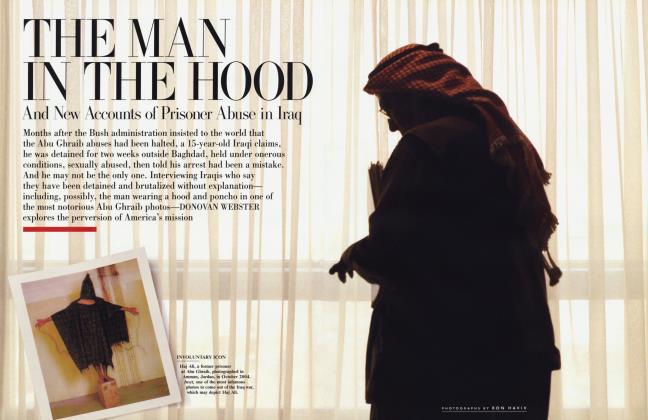
His widely known record wasn't multicheckered, it was omni-checkered. Handling the vetting chores was another nominee, White House counsel Alberto R. Gonzales, who is up for the attorney-general spot vacated by John Ashcroft. Gonzales is a curious choice for the job—or, if you're of a certain mind, the perfect choice, given that he was the legal scholar who supervised the memorandums that directly sanctioned the brutal treatment and torture of detainees at Guantanamo Bay and indirectly led to the Abu Ghraib prison horrors in Iraq. The most famous of the photos from that scandal, the one of a hooded prisoner standing on a box with electrodes connected to his hands—possibly the most iconic image of the entire Iraq war up to this point—is the focus of Donovan Webster's report "The Man in the Hood," on page 122. A former prisoner known as Haj Ali, who believes he is the one depicted, talks about the incident for the first time. Webster furthermore digs up fresh incidents of humiliation and torture that occurred after the Abu Ghraib abuse nightmare came to light.
There's one thing in Iraq that seems to be working: deliveries. Friends in England have a son working in Baghdad—a young lawyer turned entrepreneur who had gone there at war's end to start a business involved in the rebuilding effort. With the war's end never fully realized, he has been confined to his hotel room within the "safe" Green Zone, day in, day out. His parents were worried that he wasn't getting enough exercise, and bought him a stationary bike. They shipped it by DHL on a Thursday from their small town, outside Oxford, and it arrived in Baghdad that Saturday. If only the Pentagon could do that with up-armored Humvees. GRAYDON CARTER

Subscribers have complete access to the archive.
Sign In Not a Subscriber?Join Now