
Sign In to Your Account
Subscribers have complete access to the archive.
Sign In Not a Subscriber?Join NowIn the wake of the Miami airport shooting in December, the Federal Air Marshal Service is under harsher scrutiny than ever. Are "sky cops" making flying safer—or can any terrorist spot an air marshal from 20 rows away? And some critics say the program has serious leadership problems, which is contributing to its agents' dangerously low morale
In the wake of the Miami airport shooting in December, the Federal Air Marshal Service is under harsher scrutiny than ever. Are "sky cops" making flying safer—or can any terrorist spot an air marshal from 20 rows away? And some critics say the program has serious leadership problems, which is contributing to its agents' dangerously low morale
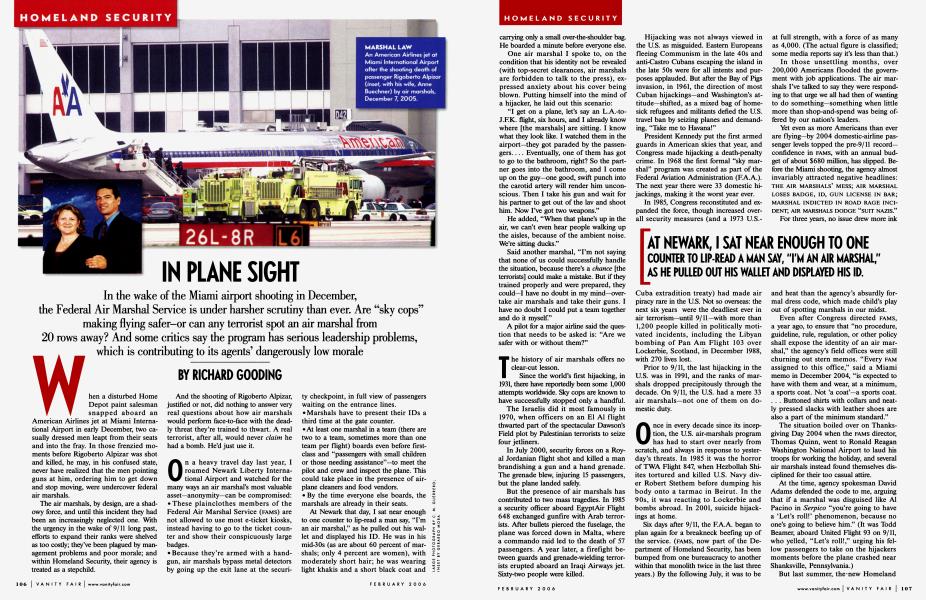
When a disturbed Home Depot paint salesman snapped aboard an American Airlines jet at Miami International Airport in early December, two casually dressed men leapt from their seats and into the fray. In those frenzied moments before Rigoberto Alpizar was shot and killed, he may, in his confused state, never have realized that the men pointing guns at him, ordering him to get down and stop moving, were undercover federal air marshals.
The air marshals, by design, are a shadowy force, and until this incident they had been an increasingly neglected one. With the urgency in the wake of 9/11 long past, efforts to expand their ranks were shelved as too costly; they've been plagued by management problems and poor morale; and within Homeland Security, their agency is treated as a stepchild.
And the shooting of Rigoberto Alpizar, justified or not, did nothing to answer very real questions about how air marshals would perform face-to-face with the deadly threat they're trained to thwart. A real terrorist, after all, would never claim he had a bomb. He'd just use it.
On a heavy travel day last year, I roamed Newark Liberty International Airport and watched for the many ways an air marshal's most valuable asset—anonymity—can be compromised:
• These plainclothes members of the Federal Air Marshal Service (FAMS) are not allowed to use most e-ticket kiosks, instead having to go to the ticket counter and show their conspicuously large badges.
• Because they're armed with a handgun, air marshals bypass metal detectors by going up the exit lane at the security checkpoint, in full view of passengers waiting on the entrance lines.
• Marshals have to present their IDs a third time at the gate counter.
• At least one marshal in a team (there are two to a team, sometimes more than one team per flight) boards even before first-class and "passengers with small children or those needing assistance"—to meet the pilot and crew and inspect the plane. This could take place in the presence of airplane cleaners and food vendors.
• By the time everyone else boards, the marshals are already in their seats.
At Newark that day, I sat near enough to one counter to lip-read a man say, "I'm an air marshal," as he pulled out his wallet and displayed his ID. He was in his mid-30s (as are about 60 percent of marshals; only 4 percent are women), with moderately short hair; he was wearing light khakis and a short black coat and carrying only a small over-the-shoulder bag. He boarded a minute before everyone else.
One air marshal I spoke to, on the condition that his identity not be revealed (with top-secret clearances, air marshals are forbidden to talk to the press), expressed anxiety about his cover being blown. Putting himself into the mind of a hijacker, he laid out this scenario:
"I get on a plane, let's say an L.A.-toJ.F.K. flight, six hours, and I already know where [the marshals] are sitting. I know what they look like. I watched them in the airport—they got paraded by the passengers. ... Eventually, one of them has got to go to the bathroom, right? So the partner goes into the bathroom, and I come up on the guy—one good, swift punch into the carotid artery will render him unconscious. Then I take his gun and wait for his partner to get out of the lav and shoot him. Now I've got two weapons."
He added, "When that plane's up in the air, we can't even hear people walking up the aisles, because of the ambient noise. We're sitting ducks."
Said another marshal, "I'm not saying that none of us could successfully handle the situation, because there's a chance [the terrorists] could make a mistake. But if they trained properly and were prepared, they could—I have no doubt in my mind—overtake air marshals and take their guns. I have no doubt I could put a team together and do it myself."
A pilot for a major airline said the question that needs to be asked is: "Are we safer with or without them?"
The history of air marshals offers no clear-cut lesson.
Since the world's first hijacking, in 1931, there have reportedly been some 1,000 attempts worldwide. Sky cops are known to have successfully stopped only a handful.
The Israelis did it most famously in 1970, when officers on an El Al flight thwarted part of the spectacular Dawson's Field plot by Palestinian terrorists to seize four jetliners.
In July 2000, security forces on a Royal Jordanian flight shot and killed a man brandishing a gun and a hand grenade. The grenade blew, injuring 15 passengers, but the plane landed safely.
But the presence of air marshals has contributed to two mass tragedies. In 1985 a security officer aboard EgyptAir Flight 648 exchanged gunfire with Arab terrorists. After bullets pierced the fuselage, the plane was forced down in Malta, where a commando raid led to the death of 57 passengers. A year later, a firefight between guards and grenade-wielding terrorists erupted aboard an Iraqi Airways jet. Sixty-two people were killed.
Hijacking was not always viewed in the U.S. as misguided. Eastern Europeans fleeing Communism in the late 40s and anti-Castro Cubans escaping the island in the late 50s were for all intents and purposes applauded. But after the Bay of Pigs invasion, in 1961, the direction of most Cuban hijackings—and Washington's attitude-shifted, as a mixed bag of homesick refugees and militants defied the U.S. travel ban by seizing planes and demanding, "Take me to Havana!"
President Kennedy put the first armed guards in American skies that year, and Congress made hijacking a death-penalty crime. In 1968 the first formal "sky marshal" program was created as part of the Federal Aviation Administration (F.A.A.). The next year there were 33 domestic hijackings, making it the worst year ever.
In 1985, Congress reconstituted and expanded the force, though increased overall security measures (and a 1973 U.S.Cuba extradition treaty) had made air piracy rare in the U.S. Not so overseas: the next six years were the deadliest ever in air terrorism—until 9/11—with more than 1,200 people killed in politically motivated incidents, including the Libyan bombing of Pan Am Flight 103 over Lockerbie, Scotland, in December 1988, with 270 lives lost.
AT NEWARK, I SAT NEAR ENOUGH TO ONE COUNTER TO LIP-READ A MAN SAY, "I'M AN AIR MARSHAL," AS HE PULLED OUT HIS WALLET AND DISPLAYED HIS ID.
Prior to 9/11, the last hijacking in the U.S. was in 1991, and the ranks of marshals dropped precipitously through the decade. On 9/11, the U.S. had a mere 33 air marshals—not one of them on domestic duty.
Once in every decade since its inception, the U.S. air-marshals program has had to start over nearly from scratch, and always in response to yesterday's threats. In 1985 it was the horror of TWA Flight 847, when Hezbollah Shiites tortured and killed U.S. Navy diver Robert Stethem before dumping his body onto a tarmac in Beirut. In the 90s, it was reacting to Lockerbie and bombs abroad. In 2001, suicide hijackings at home.
Six days after 9/11, the F.A.A. began to plan again for a breakneck beefing up of the service, (FAMS, now part of the Department of Homeland Security, has been bumped from one bureaucracy to another within that monolith twice in the last three years.) By the following July, it was to be at full strength, with a force of as many as 4,000. (The actual figure is classified; some media reports say it's less than that.)
In those unsettling months, over 200,000 Americans flooded the government with job applications. The air marshals I've talked to say they were responding to that urge we all had then of wanting to do something—something when little more than shop-and-spend was being offered by our nation's leaders.
Yet even as more Americans than ever are flying—by 2004 domestic-airline passenger levels topped the pre-9/11 record—confidence in FAMS, with an annual budget of about $680 million, has slipped. Before the Miami shooting, the agency almost invariably attracted negative headlines: THE AIR MARSHALS' MESS; AIR MARSHAL LOSES BADGE, ID, GUN LICENSE IN BAR; MARSHAL INDICTED IN ROAD RAGE INCIDENT, AIR MARSHALS DODGE "SUIT NAZIS."
For three years, no issue drew more ink and heat than the agency's absurdly formal dress code, which made child's play out of spotting marshals in our midst.
Even after Congress directed FAMS, a year ago, to ensure that "no procedure, guideline, rule, regulation, or other policy shall expose the identity of an air marshal," the agency's field offices were still churning out stern memos. "Every FAM assigned to this office," said a Miami memo in December 2004, "is expected to have with them and wear, at a minimum, a sports coat. Not 'a coat'—a sports coat. . . . Buttoned shirts with collars and neatly pressed slacks with leather shoes are also a part of the minimum standard."
The situation boiled over on Thanksgiving Day 2004 when the FAMS director, Thomas Quinn, went to Ronald Reagan Washington National Airport to laud his troops for working the holiday, and several air marshals instead found themselves disciplined for their too casual attire.
At the time, agency spokesman David Adams defended the code to me, arguing that if a marshal was disguised like A1 Pacino in Serpico "you're going to have a 'Let's roll!' phenomenon, because no one's going to believe him." (It was Todd Beamer, aboard United Flight 93 on 9/11, who yelled, "Let's roll!," urging his fellow passengers to take on the hijackers moments before the plane crashed near Shanksville, Pennsylvania.)
But last summer, the-new Homeland Security secretary, Michael Chertoff, intervened and Quinn finally relaxed the code, dropping the sport-coat edict and for the first time allowing air marshals to grow mustaches and beards. Before then, the Hawaiian shirt worn by one of the marshals in the Alpizar confrontation would have earned him desk duty.
Thomas Quinn has labeled air marshals who've complained to the press about policies as "a small number of disgruntled individuals who are total amateurs." At least one marshal caught talking to a reporter was fired.
Yet the marshals I was able to interview say the agency does have a morale problem. Many on the force are in their mid-30s, with years of prior experience, often as undercover agents with a good deal of on-the-job autonomy, and they've chafed in the more controlled environment of FAMS. "It doesn't help when they treat us like kindergartners," one marshal told me. "Guys are getting really pissed off."
Several aviation-security experts who keep a close watch on the agency agree that all's not well there. One, who asked that his name not be used because he has known Quinn for years, told me FAMS has "some good people, no doubt about it. But at the very top there are problems. The leadership, in my opinion, is outdated."
The "malcontent" put-down is "a typical Tom Quinn response," he said. "That's not how you manage people— everybody that has a problem is not a malcontent."
According to the former Homeland Security inspector general, Clark Kent Ervin, that posture of disparaging critics permeates the whole department. As the agency's internal watchdog, he turned out a series of tough reports—only to be effectively dismissed by the White House after just a year on the job.
"The attitude I got at the department time and again," Ervin told me, "was 'We don't want to hear bad news.... Either ignore the problem or deny it exists, or minimize it, or ridicule it, or claim it has already been fixed and our reports are old news.'"
When I asked Adams about Ervin's August 2004 report criticizing the FAMS background-checking process (he cited 753 documented instances, including marshals' lying, losing their guns, drinking, using drugs, and sleeping on duty), the spokesman, as if on cue, called it inaccurate, outdated, "grandstanding," and "one big package of sensationalism."
The 59-year-old Quinn, who bears a resemblance to Clint Eastwood, is a 20-year veteran of the Secret Service, whose career included heading up Senator Ted Kennedy's protection detail when he ran for president, in 1980.
But his more recent past reveals a twist worthy of a new scene in Michael Moore's Fahrenheit 9/11: the man in charge of one of America's key countermeasures to attacks carried out largely by Saudi nationals worked for Saudi Arabian royalty before taking the FAMS job, in January 2002.
THE MARSHALS I WAS ABLE TO INTERVIEW SAY THE AGENCY DOES HAVE A MORALE PROBLEM. SEVERAL AVIATION-SECURITY EXPERTS AGREE: ALL'S NOT WELL THERE.
His FAMS biography doesn't mention it, recording only that three years after retiring from the Secret Service, in 1989, he started his own security-and-investigation firm in New York, with clients ranging "from corporations to the United States and allied governments." But Adams confirmed it to me. "He worked for the Saudis," he said. "Did security for them . . . one of the princes."
(Through Adams, V.F. twice requested an interview with Quinn, who rarely talks to the press. Both times he declined.)
Quinn took a slew of Secret Service buddies with little experience in aviation security with him to the air marshals, according to one knowledgeable source.
There was more to it than the appeal of working for a former colleague. Under a little-known legal loophole, Secret Service retirees were once allowed to take a new federal job and collect both their salary and their full pension. Congress put an end to the "double dip" loophole in 1984, but grandfathered in those already on the job, so the perk remained in effect as late as 2004 for anyone retiring after 20 years of service.
As of March 2003, according to government figures, 81 former Secret Service agents (Adams included) had been hired by FAMS, many in supervisory positions.
Quinn is now making $162,100; one expert estimates his Secret Service pension to be around $60,000. Together, that's more than a Supreme Court justice earns. (The average air-marshal salary is about $72,000, but pay can top $80,000—generally more than the compensation for other federal law-enforcement agents.)
"It's totally legal, and there's nothing wrong with it," said Adams. "We retired, and because of the law, there was an opportunity for us to serve the government in another agency." He added, "We feel we are here to mentor the troops and to make them the future leaders" of the service. "We're not going to be here forever."
At least some air marshals aren't inclined to wait. A public (but unauthorized) Internet forum is full of postings by anonymous marshals calling for Quinn's ouster and blasting the Secret Service Men in Black mentality for the agency's ills.
A former head of security at the F.A.A., Billie Vincent, agreed, saying that the agency "is a blooming, flaming mess at the moment, and it's due solely to the leadership." He told me the first step forward "is to fire Tom Quinn."
In Herndon, Virginia, a few miles east of Washington Dulles International Airport, workers inside a nondescript building that doesn't bear the FAMS nameplate communicate with the agency's sky cops, analyze their airport-surveillance reports, and schedule their flights. Air marshals ride shotgun on a little bit of everything but focus on "targeted critical flights"— fuel-heavy planes like the ones used on 9/11, those on certain overseas routes, and a wide range of flights into Washington and New York.
According to some estimates, air marshals fly on as many as half of those critical flights. For the some 30,000 flights a day, Quinn has put the figure at "more than 5 percent"; some experts believe it's less.
Air marshals' schedules are prepared 28 days in advance (they fly 5 days a week; a workday can run 10 hours or longer, depending on delays), but the service claims to be able to make last-minute changes based on "actionable information" from its Intelligence Branch. Just how much actionable intelligence is ever produced in Washington, however, is debatable.
John MacGaffin, a 31-year C.I.A. veteran who became that agency's number-two clandestine-operations officer and later a senior adviser to the F.B.I., told the 9/11 commission that, owing to the inability to infiltrate al-Qaeda within the U.S., even two years after 9/11, domestic intelligence was still alarmingly scarce.
In an interview, MacGaffin, now an independent security consultant, said the ideal type of intelligence is a specific tip from a recruited source in the innermost councils of al-Qaeda: "Tomorrow. Flight 337. Five guys with beards and Iranian passports with the following numbers are gonna ..." The other extreme, he said, goes like this: "Something bad's going to happen someday, someplace." But the former scenario almost never happens, he said, and in the latter, the tip is "of no use at all.... You say, 'Oh, shit,' and go back to sleep."
It's all the rest of the intelligence that causes headaches. "It's somebody the F.B.I. caught on a drug sting—true story—in England or in Europe," recalled MacGaffin, "who, not wanting to go to jail, said, 'I know something really important,'" that "some Iranians, or some Middle Easterners, are doing something on a flight from Boston to San Francisco to Manila tomorrow or the next day, or maybe it's Boston-Chicago-Malaysia."
That warning sent officials scrambling. "I know [the information] is wacko," MacGaffin said, "but just what if it's true? So you pass it on. Intelligence, like shit, runs downhill."
Larry Johnson, ex-C.I.A. analyst, former deputy director of the State Department's counterterrorism office, and now managing director of BERG Associates L.L.C., an international business-consulting firm, said, "The odds that you're ever going to get any kind of useful, actionable intelligence, I think, are between slim and none."
So far, American air marshals have never had to prove themselves against any real hijackers or terrorists.
There were no marshals aboard American Airlines Flight 63 from Paris to Miami in December 2001 when Richard Reid tried to ignite his "shoe bomb"; he was subdued by flight attendants and passengers. And of some 40 arrests made by air marshals since 9/11, none had any link to terrorism.
Far from it. One was an Illinois businessman who was busted on a federal assault charge for hassling a flight attendant after he stood up during a United Airlines flight and pointed out which passengers he thought were marshals. (He faced six months in prison but got off with a year's probation.) A Pittsburgh woman was carried off a Northwest Airlines flight after talking about the plane blowing up, and attempting to choke an air marshal who tried to calm her. In court, she blamed booze: "My memory is not that clear of that day." (Facing 20 years, she got eight months.)
Wise guys, abusive drunks, air-ragers: air marshals are trained to stay out of the fray if at all possible; it might be a ruse—terrorists trying to smoke out the marshals as a prelude to an attack. If Rigoberto Alpizar hadn't allegedly uttered the word "bomb," he might have been allowed to run off the plane unharmed.
The only other time marshals are known to have even drawn a weapon was in August 2002, when two agents went all out in restraining an unruly passenger on a Delta flight to Philadelphia. For the last 30 or 40 minutes of the flight, one held the entire coach section at gunpoint. "A little bit of Rambo in the air," one terrified passenger remarked.
"IF THE TERRORISTS TRAINED PROPERLY, THEY COULD—I HAVE NO DOUBT IN MY MIND—OVERTAKE AIR MARSHALS AND TAKE THEIR GUNS," ONE MARSHAL TOLD ME.
But for most of an air marshal's time—hundreds of flights, thousands of hours in the air—nothing happens. As George Novak, a former F.A.A. attorney who once taught legal courses for air marshals and now works as a consultant on airline safety, put it, an air marshal's daily grind is lonelier "than a beat cop's," and "not as glamorous, not as exciting.... You don't get any accolades for being a deterrent."
One of the most courageous things I know of," Cathal "Irish" Flynn, who oversaw the F.A.A.'s air-marshal program from 1993 to 2000, told me, "is that the president, the secretary of transportation, and the administrator of the F.A.A. put the planes back in the air three days after 9/11.
"How the hell could they know [it was safe]? Because I bet that the F.B.I. and the C.I.A. were being wishy-washy as hell_ They put the planes back. And people flew."
But the threat to air travel remains, despite all the post-9/11 security measures— from reinforced (but not impregnable) cockpit doors and tighter (yet anything but foolproof) passenger and baggage screening to air marshals and some armed pilots. Spending billions more to try to close the significant gaps that remain—most egregiously, the inability to consistently spot plastic explosives in carry-on luggage—won't necessarily eliminate it.
There are wild cards working against a terrorist. There could be more air marshals on a plane than he can identify. And there could be one or more of the hundreds of federal law-enforcement officers—F.B.I., Secret Service, drug agents, or even a state taxicab investigator—who are permitted to fly armed on government business every day. Plus, there is the remarkable phenomenon, born of Todd Beamer, of the post-9/11 vigilance of passengers.
But, said Flynn's predecessor, General O. K. Steele, "anybody who wants to create a sensational thing" is still going to go after a jetliner, if for no other reason than the dramatic difference between "falling out of the air at 35,000 feet... and, say, a train wreck."
And provocative new targets—such as the Airbus A380, with its 800-passenger capacity—are always in the wings. Steele, 73, who until recently did consulting work on aviation security, also argued that airlines are an attractive target because they at least attempt to fly on precise schedules. "That plane that was late on 9/11," he said, referring to United Flight 93. "Remember, it was delayed about 40 minutes. That's what probably saved Washington."
Predictability works in the terrorists' favor, he said. The air marshals' challenge is to be as unpredictable as possible.
"The deterrent," said Steele, "is that your adversary never knows when he may have to contend with this.... He's going to have to increase the number of people he may need to take over that airplane, and thereby increase our chances of picking up at least one or two of those guys beforehand—before they get on."
That, he said, should be the ultimate goal: to nab terrorists on the ground—not to have to fight them in the air.
Subscribers have complete access to the archive.
Sign In Not a Subscriber?Join Now


