




Sign In to Your Account
Subscribers have complete access to the archive.
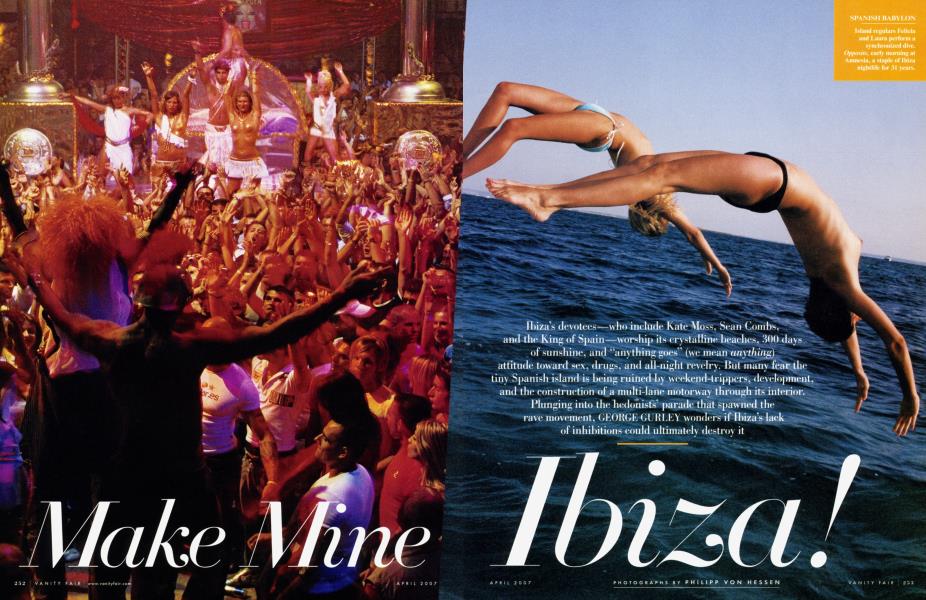
Sign In Not a Subscriber?Join NowIbiza’s devotees—who include Kate Moss, Sean Combs, and the King of Spain—worship its crystalline beaches, 300 days of sunshine, and “anything goes” (we mean anything) attitude toward sex, drugs, and all-night revelry. But many fear the tiny Spanish island is being ruined by weekend-trippers, development, and the construction of a multi-lane motorway through its interior. Plunging into the hedonists' parade that spawned the rave movement, GEORGE GURLEY wonders if Ibiza’s lack of inhibitions could ultimately destroy it
Ibiza’s devotees—who include Kate Moss, Sean Combs, and the King of Spain—worship its crystalline beaches, 300 days of sunshine, and “anything goes” (we mean anything) attitude toward sex, drugs, and all-night revelry. But many fear the tiny Spanish island is being ruined by weekend-trippers, development, and the construction of a multi-lane motorway through its interior. Plunging into the hedonists' parade that spawned the rave movement, GEORGE GURLEY wonders if Ibiza’s lack of inhibitions could ultimately destroy it
On Monday afternoon, a plane flies over a nightclub called DC 10, which opens at eight A.M., and on the ground people look up, wave, and yell, “Welcome to Ibiza!”
On Wednesday morning at five o’clock, 8,000 revelers are dancing and shouting “We are one!” at Privilege, the biggest nightclub in the world. At noon it’s time for a nap on the beach or maybe a magic mushroom-omelet breakfast. And when the sun sets over the sparkling-clean turquoise water, everyone applauds. Some cry, it’s so breathtaking.
On another afternoon, a boat anchors a hundred yards from a popular beach, in full view of the sunbathing families. On deck an attractive woman strips, which is nothing new, but then she pulls the swimming trunks off her boyfriend and starts performing fellatio. Next she gets on top of him, and after the couple finish they dive into the sea.
More applause.
It’s the same attitude everywhere you go on this tiny, outrageously beautiful island 57 miles off the southeastern coast of Spain. A mantra here is ‘No pasa nada” (No problem), and the all-purpose adjective is “amazing.” The weather is amazing (300 days of sunshine a year), as are the scores of beaches, the coves, bays, mountains, lush green countryside, and invigorating pine-scented air.
The food, the music, and the drugs are amazing, too, not to mention the mix of great-looking people.
Here you will find a millionaire having a drink next to an Arab oil sheikh, the King of Spain, a Formula One racecar driver, Sean Combs, Kate Moss, an 18-year-old girl from Manchester, or a hippie who lives in a cave. Here you can do what you want, and no one will judge you, especially not the smiling, tolerant Ibicencos.
The spirit of freedom, laziness, and decadence has reigned on Ibiza since long before the first hippies, rock stars, models, and ravers arrived. And while there’s something for everybody, it’s the perfect place for a groovy jet-setter, with its 150-foot yachts, rentable villas and mini-islands, excellent restaurants, and happening superclubs. All this three hours from London, two hours from Paris, and 45 minutes from Barcelona.
Amazing.
At the same time, many longtime residents, rich and poor, complain that their island is in danger of losing its charm, thanks to mass tourism, overdevelopment, petty crime, and condoms on the beach. The alarm has been sounding for decades (“Ibiza’s turning into Saint-Tropez!”), but it’s gotten louder by the time I arrive, in August 2005. More and more people have been escaping by ferry to the smaller sister isle of Formentera, which has no airport, no traffic lights, and no crazy nightlife. It’s where you go to find out what Ibiza was like 40 years ago.
But, for every person who thinks the island is “over,” there’s someone else who insists that it’s still like nowhere else. Back in the 1500s, Nostradamus supposedly showed his confidence in its staying power when he predicted that only Ibiza would survive the apocalypse.
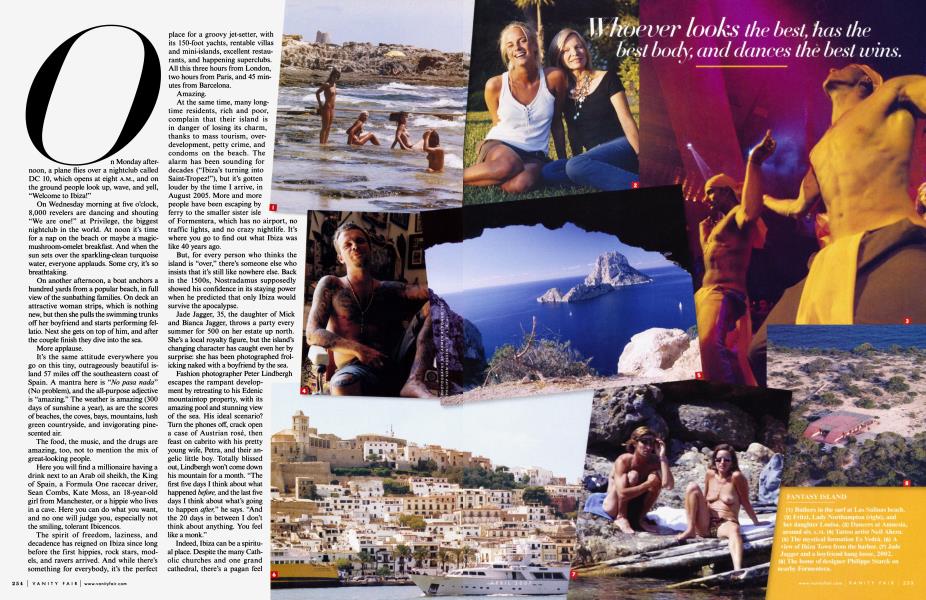
Jade Jagger, 35, the daughter of Mick and Bianca Jagger, throws a party every summer for 500 on her estate up north. She’s a local royalty figure, but the island’s changing character has caught even her by surprise: she has been photographed frolicking naked with a boyfriend by the sea.
Fashion photographer Peter Lindbergh escapes the rampant development by retreating to his Edenic mountaintop property, with its amazing pool and stunning view of the sea. His ideal scenario? Turn the phones off-, crack open a case of Austrian rose, then feast on cabrito with his pretty young wife, Petra, and their angelic little boy. Totally blissed out, Lindbergh won’t come down his mountain for a month. “The first five days I think about what happened before, and the last five days I think about what’s going to happen after," he says. “And the 20 days in between I don’t think about anything. You feel like a monk.”
Indeed, Ibiza can be a spiritual place. Despite the many Catholic churches and one grand cathedral, there’s a pagan feel to the island. After the Phoenicians discovered Ibiza by accident, in the seventh century B.C., they named it after Bes, their god of dance. But it’s Tanit, their goddess of sex, fertility, and war, whose image appears on all the souvenir T-shirts.
Whoever looks the best, has the best body, and dances the best wins.
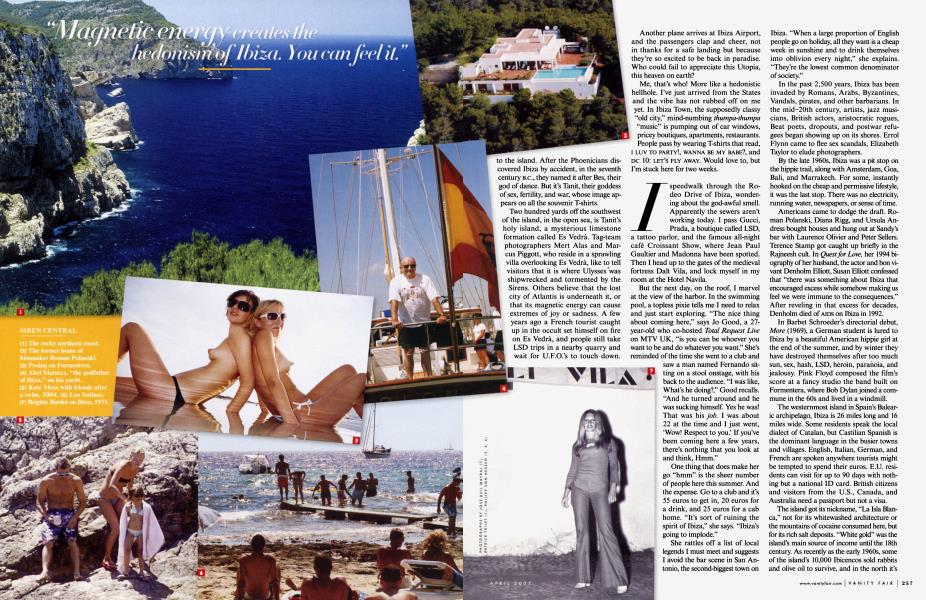
Two hundred yards off the southwest of the island, in the open sea, is Tank’s holy island, a mysterious limestone formation called Es Vedra. Tag-team photographers Mert Alas and Marcus Piggott, who reside in a sprawling villa overlooking Es Vedra, like to tell visitors that it is where Ulysses was shipwrecked and tormented by the Sirens. Others believe that the lost city of Atlantis is underneath it, or that its magnetic energy can cause extremes of joy or sadness. A few years ago a French tourist caught up in the occult set himself on fire on Es Vedra, and people still take LSD trips in a nearby quarry and wait for U.F.O.’s to touch down.
Another plane arrives at Ibiza Airport, and the passengers clap and cheer, not in thanks for a safe landing but because they’re so excited to be back in paradise. Who could fail to appreciate this Utopia, this heaven on earth?
Me, that’s who! More like a hedonistic hellhole. I’ve just arrived from the States and the vibe has not rubbed off on me yet. In Ibiza Town, the supposedly classy “old city,” mind-numbing thumpa-thumpa “music” is pumping out of car windows, pricey boutiques, apartments, restaurants. People pass by wearing T-shirts that read, I LUV TO PARTY!, WANNA BE MY BABE?, and DC 10: LET’S FLY AWAY. Would love to, but I’m stuck here for two weeks.
I speedwalk through the Rodeo Drive of Ibiza, wondering about the god-awful smell. Apparently the sewers aren’t working today. I pass Gucci, Prada, a boutique called LSD, a tattoo parlor, and the famous all-night cafe Croissant Show, where Jean Paul Gaultier and Madonna have been spotted. Then I head up to the gates of the medieval fortress Dalt Vila, and lock myself in my room at the Hotel Navila.
But the next day, on the roof, I marvel at the view of the harbor. In the swimming pool, a topless pixie tells me I need to relax and just start exploring. “The nice thing about coming here,” says Jo Good, a 27year-old who co-hosted Total Request Live on MTV UK, “is you can be whoever you want to be and do whatever you want.” She’s reminded of the time she went to a club and saw a man named Fernando sitting on a stool onstage, with his back to the audience. “I was like, What’s he doing?,” Good recalls. “And he turned around and he was sucking himself. Yes he was! That was his job. I was about 22 at the time and I just went, ‘Wow! Respect to you.’ If you’ve been coming here a few years, there’s nothing that you look at and think, Hmm.”
One thing that does make her go “hmm” is the sheer number of people here this summer. And the expense. Go to a club and it’s 55 euros to get in, 20 euros for a drink, and 25 euros for a cab home. “It’s sort of ruining the spirit of Ibiza,” she says. “Ibiza’s going to implode.”
She rattles off a list of local legends I must meet and suggests I avoid the bar scene in San Antonio, the second-biggest town on Ibiza. “When a large proportion of English people go on holiday, all they want is a cheap week in sunshine and to drink themselves into oblivion every night,” she explains. “They’re the lowest common denominator of society.”
In the past 2,500 years, Ibiza has been invaded by Romans, Arabs, Byzantines, Vandals, pirates, and other barbarians. In the mid-20th century, artists, jazz musicians, British actors, aristocratic rogues, Beat poets, dropouts, and postwar refugees began showing up on its shores. Errol Flynn came to flee sex scandals, Elizabeth Taylor to elude photographers.
By the late 1960s, Ibiza was a pit stop on the hippie trail, along with Amsterdam, Goa, Bali, and Marrakech. For some, instantly hooked on the cheap and permissive lifestyle, it was the last stop. There was no electricity, running water, newspapers, or sense of time.
Americans came to dodge the draft. Roman Polanski, Diana Rigg, and Ursula Andress bought houses and hung out at Sandy’s bar with Laurence Olivier and Peter Sellers. Terence Stamp got caught up briefly in the Rajneesh cult. In Quest for Love, her 1994 biography of her husband, the actor and bon vivant Denholm Elliott, Susan Elliott confessed that “there was something about Ibiza that encouraged excess while somehow making us feel we were immune to the consequences.” After reveling in that excess for decades, Denholm died of AIDS on Ibiza in 1992.
Magnetic energy creates the hedonism of Ibiza. You can feel it.
In Barbet Schroeder’s directorial debut, More (1969), a German student is lured to Ibiza by a beautiful American hippie girl at the end of the summer, and by winter they have destroyed themselves after too much sun, sex, hash, LSD, heroin, paranoia, and jealousy. Pink Floyd composed the Film’s score at a fancy studio the band built on Formentera, where Bob Dylan joined a commune in the 60s and lived in a windmill.
The westernmost island in Spain’s Balearic archipelago, Ibiza is 26 miles long and 16 miles wide. Some residents speak the local dialect of Catalan, but Castilian Spanish is the dominant language in the busier towns and villages. English, Italian, German, and French are spoken anywhere tourists might be tempted to spend their euros. E.U. residents can visit for up to 90 days with nothing but a national ID card. British citizens and visitors from the U.S., Canada, and Australia need a passport but not a visa.
The island got its nickname, “La Isla Blanca,” not for its whitewashed architecture or the mountains of cocaine consumed here, but for its rich salt deposits. “White gold” was the island’s main source of income until the 18th century. As recently as the early 1960s, some of the island’s 10,000 Ibicencos sold rabbits and olive oil to survive, and in the north it’s still possible to spot a farmer working his field with a horse-drawn plow. But now that 75 percent of the economy is funded by tourism, more than a few of the locals (who now number upwards of 115,000) are wealthy, such as the owner of a bait shop who drives a BMW M5.
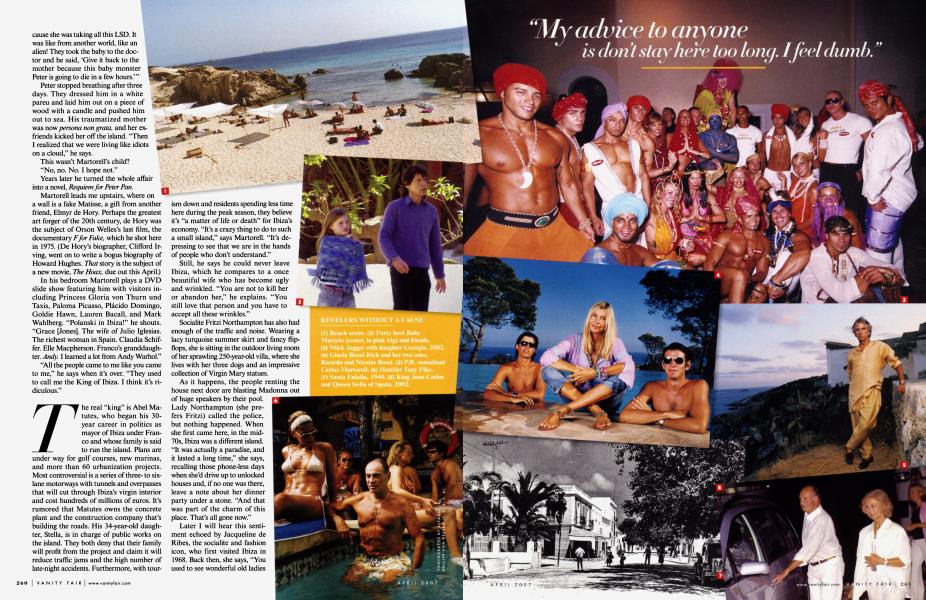
Carlos Martorell opens the door to his town house in Dalt Vila. Wearing white linen Moroccan pajamas, he’s a small, dignified man with patrician features and dramatic blue eyes that obviously have seen a lot.
A nightlife P.R. consultant, Martorell has partied at the nightclubs Space and Pacha with countless counts, duchesses, kings, princesses, and hell-raisers, as well as such luminaries as Valentino, Jean Paul Gaultier, Naomi Campbell, Mick Jagger, and onetime fugitive financier Marc Rich (whose ex-wife Gisela Rossi Rich still lives on Ibiza with her two sons). “I get to know the most important people in the world!” Martorell declares. “But they’re here on vacation, they’re relaxed.”
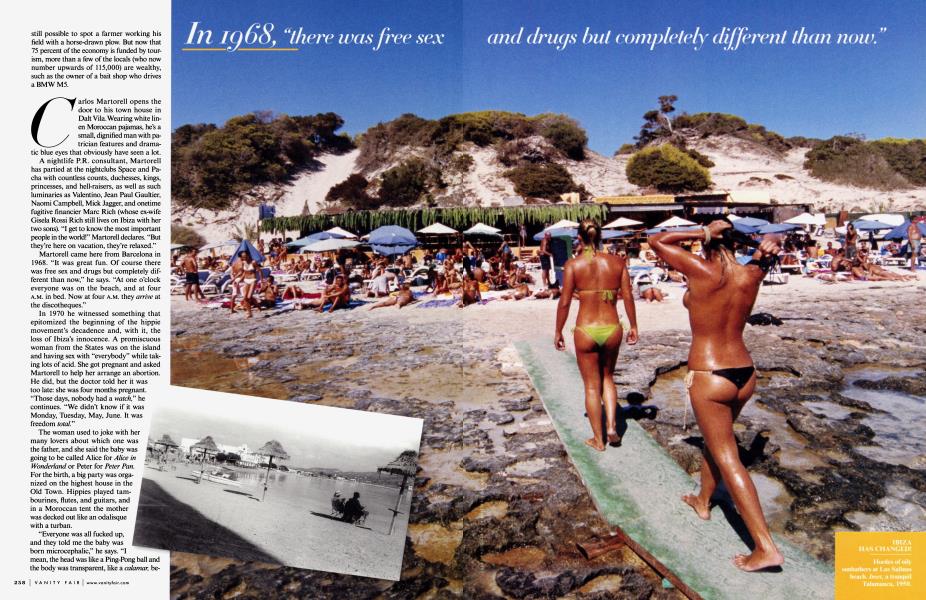
Martorell came here from Barcelona in 1968. “It was great fun. Of course there was free sex and drugs but completely different than now,” he says. “At one o’clock everyone was on the beach, and at four A.M. in bed. Now at four A.M. they arrive at the discotheques.”
In 1970 he witnessed something that epitomized the beginning of the hippie movement’s decadence and, with it, the loss of Ibiza’s innocence. A promiscuous woman from the States was on the island and having sex with “everybody” while taking lots of acid. She got pregnant and asked Martorell to help her arrange an abortion. He did, but the doctor told her it was too late: she was four months pregnant. “Those days, nobody had a watch,” he continues. “We didn’t know if it was Monday, Tuesday, May, June. It was freedom total.”
The woman used to joke with her many lovers about which one was the father, and she said the baby was going to be called Alice for Alice in Wonderland or Peter for Peter Pan. For the birth, a big party was organized on the highest house in the Old Town. Hippies played tambourines, flutes, and guitars, and in a Moroccan tent the mother was decked out like an odalisque with a turban.
“Everyone was all fucked up, and they told me the baby was born microcephalic,” he says. “I mean, the head was like a Ping-Pong ball and the body was transparent, like a calamar, because she was taking all this LSD. It was like from another world, like an alien! They took the baby to the doctor and he said, ‘Give it back to the mother because this baby monster Peter is going to die in a few hours.”’
In 1968, "there was free sex and drugs but completely different than now."
Peter stopped breathing after three days. They dressed him in a white pareu and laid him out on a piece of wood with a candle and pushed him out to sea. His traumatized mother was now persona non grata, and her ex-friends kicked her off the island. “Then I realized that we were living like idiots on a cloud,” he says.
This wasn’t Martorell’s child?
“No, no. No. I hope not.”
Years later he turned the whole affair into a novel, Requiem for Peter Pan.
Martorell leads me upstairs, where on a wall is a fake Matisse, a gift from another friend, Elmyr de Hory. Perhaps the greatest art forger of the 20th century, de Hory was the subject of Orson Welles’s last film, the documentary F for Fake, which he shot here in 1975. (De Hory’s biographer, Clifford Irving, went on to write a bogus biography of Howard Hughes. That story is the subject of a new movie, The Hoax, due out this April.)
In his bedroom Martorell plays a DVD slide show featuring him with visitors including Princess Gloria von Thurn und Taxis, Paloma Picasso, Placido Domingo, Goldie Hawn, Lauren Bacall, and Mark Wahlberg. “Polanski in Ibiza!” he shouts. “Grace [Jones]. The wife of Julio Iglesias. The richest woman in Spain. Claudia Schiffer. Elle Macpherson. Franco’s granddaughter. Andy. I learned a lot from Andy Warhol.”
“All the people came to me like you came to me,” he says when it’s over. “They used to call me the King of Ibiza. I think it’s ridiculous.”
The real “king” is Abel Matutes, who began his 30-year career in politics as mayor of Ibiza under Franco and whose family is said to run the island. Plans are under way for golf courses, new marinas, and more than 60 urbanization projects. Most controversial is a series of three- to six-lane motorways with tunnels and overpasses that will cut through Ibiza’s virgin interior and cost hundreds of millions of euros. It’s rumored that Matutes owns the concrete plant and the construction company that’s building the roads. His 34-year-old daughter, Stella, is in charge of public works on the island. They both deny that their family will profit from the project and claim it will reduce traffic jams and the high number of late-night accidents. Furthermore, with tourism down and residents spending less time here during the peak season, they believe it’s “a matter of life or death” for Ibiza’s economy. “It’s a crazy thing to do to such a small island,” says Martorell. “It’s depressing to see that we are in the hands of people who don’t understand.”
Still, he says he could never leave Ibiza, which he compares to a once beautiful wife who has become ugly and wrinkled. “You are not to kill her or abandon her,” he explains. “You still love that person and you have to accept all these wrinkles.”
Socialite Fritzi Northampton has also had enough of the traffic and noise. Wearing a lacy turquoise summer skirt and fancy flip-flops, she is sitting in the outdoor living room of her sprawling 250-year-old villa, where she lives with her three dogs and an impressive collection of Virgin Mary statues.
As it happens, the people renting the house next door are blasting Madonna out of huge speakers by their pool. Lady Northampton (she prefers Fritzi) called the police, but nothing happened. When she first came here, in the mid70s, Ibiza was a different island. “It was actually a paradise, and it lasted a long time,” she says, recalling those phone-less days when she’d drive up to unlocked houses and, if no one was there, leave a note about her dinner party under a stone. “And that was part of the charm of this place. That’s all gone now.”
Later I will hear this sentiment echoed by Jacqueline de Ribes, the socialite and fashion icon, who first visited Ibiza in 1968. Back then, she says, “You used to see wonderful old ladies in their costumes with their flocks of sheep under almond trees. No one would ever think of locking the door to their house. Now all that ambience has disappeared completely. The [Ibicencos] sold all those farms, they live in apartments now, and the children of those people probably take drugs today. So it’s one generation and the whole thing is changed completely, which is a pity.”
My advice to anyone is don't stay here too long. I feel dumb.
The daughter of a banker, Fritzi (nee Ellen Erhardt) grew up in Munich, went to school in England, worked as a model, and married two English aristocrats, Lord Cowdray and then Lord Northampton (who went by the name Spenny), before settling down with her current husband, a nice German man who does human-resources consulting. These days she runs a real-estate company, Bluestone Properties, which rents out high-end houses in the summer. For two summers she rented a house to Kate Moss.
And yet she’s been thinking lately about going back to London. “This is the big question,” she says, pausing. ‘No. I love it here very much. I have my roots here, this is my home, my children love it here. No, I can’t imagine living somewhere else.”
Later that afternoon her 21-year-old daughter, Louisa, shows up. Born in London, she spent her childhood on Ibiza. “It’s actually had a really positive effect on me,” she says, “in the sense that you haven’t done what everyone else in England has done. Gone to the same prep schools, gone to Eton and then to Newcastle.” After two months here this summer, however, she’s ready to return to civilization. “My advice to anyone is don’t stay here too long,” she says. “I feel dumb. If I have to sit at a dinner party, I don’t know what to talk about. I’m like, ‘Well, Pacha’s good lately. Amnesia’s good, too.’ ”
Her mother has changed into a black shirt and blue jeans. Cocktail hour! Louisa’s shirtless friends, Harry and Tom, get on their cell phones and make reservations at Pacha for a table that costs 1,500 euros. They, too, warn me about the “lager louts” in San Antonio.
The trouble with San Antonio, on the island’s west coast, began when English travel companies in Manchester and Birmingham started offering cheap package holidays to “weekend zombies,” who, in some cases, get flown in for £100, go wild at the clubs, then return home the next day and crash. (Every year, an estimated 500,000 Brits visit Ibiza.)
In 1989, a pack of young British thugs beat an Andalusian waiter to death here, and the ugliness peaked in the late 1990s, when documentaries such as Ibiza Uncovered seriously damaged the island’s reputation as a peaceful getaway.
Minutes after arriving in San Antonio’s West End on a Saturday night I meet Lee, a 21-year-old student from southern Wales, who has been here for 10 days. So what’s Ibiza all about? “Drugs!,” Lee wails. “I love drugs! Give me a drug!” We are in the middle of a four-block strip of bars that resembles a Disney theme park with everything a lad would need to have fun in his homeland: chips, kebabs, Guinness, fit girls—and a beach down the street.
Outside the Bulldog Inn, a young man is weaving around, then comes to an abrupt halt. Something has caught his eye: a garbage can. He charges, arcs up into the air, and dives headfirst into it. Bull’s-eye!
“That is the most revolting thing I’ve seen in my life,” says a witness.
“I see that all the time,” says a barmaid, 22-year-old Robin Taylor, from North London. “People go rolling down the hill and do somersaults, and there’s ambulances daily, police cars, fights all the time.”
So Ibiza’s not exactly a mystical, spiritual place?
“Oh, God no!” says Taylor. “You go to Ibiza to get wrecked on drugs and see all the best D.J.’s. That’s about it.”
Despite so much debauchery, the last thing you’d expect is to get shot, but that’s what happened in August 2006 to two teenagers from Northern Ireland. It was one A.M. and they had just left the Garden of Eden nightclub in San Antonio for a snack at a nearby eatery when they found themselves in the middle of a gun battle between two rival drug dealers. Of the roughly 30 rounds fired, one hit Gareth Richardson, 18, in the chest and another lodged in the jaw of his friend Niall Hamilton, 19.
While they recovered back home in Ulster, the Spanish police commenced a serious crackdown, arresting 13 Britons after a raid on a villa yielded weapons, black ski masks, Ecstasy pills, and heroin, CRIMEWAVE MAY MEAN THE PARTY IS OVER FOR IBIZA, read a headline in The Guardian.
This was the first time anything like that had happened to tourists on the island, but the nightlife crowd took it in stride. I’m told it’s an isolated incident that has been blown out of proportion. Apparently, some British drug barons based in the Costa del Sol region of southern Spain were trying to break in to the Ibiza market, a development that didn’t sit well with rival dealers. The police have arrested most of the suspects, I’m assured, and the important thing is that nobody got killed.
“Where you’ve got drugs and partying, anywhere in the world, there are corpses,” says Stephen Armstrong of BBC Radio 4 and London’s Sunday Times, whose 2004 travel book, The White Island, offers a fascinating perspective on Ibiza’s history. “What’s astonishing about Ibiza is how few bodies ever turn up. Now, I don’t think that’s because they are well hidden. I just think people don’t get killed.”
According to Armstrong, a group of powerful Ibicenco families have been able to control the island without having to resort to bloodshed: “What they do, very subtly and very discreetly, is that they make it impossible for people to get anything done if they step out of line.... You can’t even get your mail delivered.
“Now this may be different,” he continues, “but I think what will happen is the people involved will just end up leaving the island. There won’t be any reason, but it just won’t work out for them. They’ll go, and they won’t be arrested necessarily.”
Armstrong thinks it will take more than a shooting to ruin Ibiza. “Ibiza is like the S.S. Poseidon in a way. In the old Poseidon Adventure, they’re all partying on New Year’s Eve. They’re all drunk, getting off with each other, all having affairs, and there are all these stories waiting to develop—and then the tidal wave hits. Ibiza is like the Poseidon on New Year’s Eve forever, and the tidal wave is always just about to hit but it never quite hits. Somehow the ship manages to keep ahead of the tidal wave. But some people never get off.”
On a Sunday afternoon there’s a long line outside Space, which has been open since eight A.M. (The party literally never stops on Ibiza.) Most of the people waiting to pay 60 euros to enter are white Europeans, but it’s a more cosmopolitan crowd than in San Antonio.
Inside, on the dance floor, hundreds of ravers are jumping around to the infectious sounds, making shaky hand movements, touching one another, nodding and smiling knowingly. It’s safe to estimate that more than half of them are on Ecstasy. Many of these hard-core partyers will stay at the club until six A.M.
Ibiza D.J.’s such as Alfredo Fiorito helped kick-start the rave movement 20 years ago by influencing fledgling D.J.’s such as Danny Rampling, who came here from the U.K. on holiday. Clubs like Space are still laboratories for the best new beats, although a resurgence of guitar bands across Europe, and especially in the U.K., makes some D.J.’s nervous.
Over by the bar a chic blonde in Chloe sunglasses and a green-and-turquoise dress is drinking white wine. “It’s about being free,” Larah Davis, a 29-year-old “life designer” from Britain, says of the scene. “The most beautiful people in Europe coming together to celebrate life.”
I tell her where I live.
“I have to be honest,” she replies. “New York nightlife is mainstream, commercial. It’s about who you know, what your apartment is worth that week, and what you will pay for your table. You see people working their asses off in Manhattan, then going out to the Hamptons on the weekend, and they’re just disgusting ... I wonder if they would understand the magical subtlety of what this is all about.”
There is no velvet rope at Space, but there is a status hierarchy: whoever looks the best, has the best body, and dances the best wins. That person beats Sean Combs showing up with a posse (which he did in 2004) or some pretender pulling up in a Bentley and spraying champagne in the V.I.P. room, especially because there is no V.I.P. room at Space. “We are all V.I.P.’s and we feel like V.I.P.’s when we are here,” Davis explains. “So you have your Kate Mosses and your Jade Jaggers. . . . They are style icons within the U.K., and we are all style icons in Space.”
Downstairs in the bathroom, one rhythmic sniff after another can be heard from inside the stalls. Later, I’m told that drug taking by oneself is not done in Ibiza. “When people take drugs here they share,” says my source. “Part of the whole experience is the idea of going to the bathrooms together.”
Back upstairs, I meet Gail, from St. Louis, who says I’m the first American she’s met in Ibiza. “I feel like a minority,” she says. We watch as the barmaid leans over and kisses a girl hard for 10 seconds, then pulls back and pushes her away.
“Ibiza,” Gail decides, “allows you to be free and behave in a way ... I can’t say the word. Unhibited. Uninhibited, that’s the word!” She mentions how going topless on the beach made her feel vulnerable. What would make her more comfortable?
“All the men here to go home and take a shower. They smell bad, their hair looks greasy. It’s not the same standards I’m used to. Not to be negative.”
“I wish all the women here would come and take a shower with me,” says her boyfriend, Matt.
Around midnight I meet Nick, an uppercrust Brit who is on a sabbatical year after having sold his Internet start-up for a lot of money. Now he’s writing a “thought paper” on the failure of established religion to connect with modern European youth.
“I see people on the dance floor looking for connection to spirituality, and I go to church here in Ibiza and they’re empty,” he tells me at an all-night cafe across the street from the club. “I see the demand, but the supply is not meeting the demand. Why?” When Nick goes to a nightclub and witnesses 8,000 people chanting, “We are one!,” he takes it to mean “We are all one God.”
I wonder if the crowd at Space is more interested in self-indulgence than connecting with others. “There I would respectfully say you’re wrong!,” Nick insists. “When they take those drugs, what are they trying to achieve?”
“Pleasure.”
“No, they want the state of Nirvana. That’s what everyone’s chasing. Of course it’s the wrong way. The drugs can get you to a Nirvana-like state for a brief period of time. It’s a reflection of the modern age that you can get there with a pill.”
After three hours of sleep, I somehow make it to the hills behind San Antonio, where I’m to meet the owner of the rustic yet luxurious Pike’s Hotel. Outside Tony Pike’s office are pictures of Sade, Jon Bon Jovi, Anthony Quinn, Naomi Campbell, and Jean-Claude Van Damme.
Sitting by the pool, Pike could easily pass for a hard-ass Cockney gangster in a heist movie. Tanned, handsome, and fit at 72, he looks 20 years younger. So, how did he create this paradise?
“I love people who love life, and nothing disgusts me and nothing offends me,” he says. “That’s not true. I wouldn’t want someone to crap on the floor or something. I always had two rules: No children, and the other was you could do anything you wanted as long as you didn’t upset other guests. If you wanted to screw on that lounge chair right there, you could do it, but if guests complained about it I’d ask you to stop.”
He was raised working-class in East London. His father was killed fighting in World War II, his house was bombed, and young Tony grew up dreaming about killing Germans. He joined the navy, got a college scholarship, married, lived in Sydney, struck it rich, divorced, bought a yacht, sailed to New Guinea, made more money, and in 1978 landed on Ibiza, where he found a 15th-century finca that needed some fixing up. Pike’s Hotel opened in 1980 with eight rooms. (Now there are 27.) One of the first guests, a musical director for Stevie Wonder, was blown away by the ambience and the owner, and soon more luminaries showed up, including George Michael of Wham!
The video for the band’s 1983 single “Club Tropicana” was shot here. According to The White Island, Michael’s sidekick, Andrew Ridgeley, was the only person ever to have run off without paying the bill. At the time, Pike was in desperate financial circumstances and didn’t appreciate it. A few years later, while accompanying his then girlfriend, Grace Jones, when she opened for Wham! in Madrid, Pike had his chance to confront Ridgeley backstage but let it go. “If he doesn’t want to pay, then I don’t want the money,” he reasoned. Jones called him a chicken.
Over time, Pike’s gained a reputation as a nonstop party zone for the rich and famous. Robert Plant checked in for a month. Julio Iglesias got a room named after him. Freddie Mercury had his 41st-birthday party at the hotel. There were stories of orgies and of cocaine being served on mirrors by the pool.
In a 2002 profile of Pike in the London Independent, Boy George called him “the Hugh Hefner of Ibiza” and Pike said he’d had sex with more than 3,000 women—sometimes 7 in one day. Pike, who was proud to be known for his “donkey dick,” attributed his stamina to being born with two aortas, “so I was pumping seven liters of blood a minute instead of four, and I could keep an erection indefinitely.”
Pike’s prowess attracted to the hotel numerous unsatisfied young ladies and divorcees with money. He calls the arrangement “womb service.”
“It was fine when I was just coping with one,” he says, “but as time passed they were booking in too frequently.”
So he’d go room to room?
“Yes. Three or four at the same time. Plus a wife.”
Did she ever find out?
“Well, now, but not then. Divorced.”
Pike introduces me to his fifth wife, Dounia, whom he met in Casablanca, and their four-year-old boy. Just 31, she is a stunning beauty but a strict Muslim who keeps her husband in line.
“I needed her. And I still do. In fact, I worship her. She’s come and sort of saved me.”
So he doesn’t drink anymore?
“A little.”
No more coke?
“A little.”
What about women?
“A little.”
In the north of the island is a secluded jetset beach, Benirras, also home to New Age hippies who bang their drums at sunset and live in the surrounding woods for the summer. Up there you can catch glimpses of unspoiled, centuries-old Ibiza, but development projects are under way. Jade Jagger likes to hide out in the 18th-century finca she owns in the area.
On a Friday night, Jagger has come down to Ibiza Town to have dinner with friends and family at Macao, her favorite restaurant, at the far end of the port. At the adjacent table sits Federico Chiarva, 25, who tells me he’s from Milan, runs a telecommunications company in Madrid, and has a 79-foot boat in the harbor. Every time he flies here, he says, he can feel the magnetic energy from Es Vedra as soon as the plane door opens.
He says that, according to legend, fishermen avoided the mystical rock, partly because their compasses didn’t work there, same as at the North Pole and in the Bermuda Triangle. “It’s very bad luck to cross with a boat in between Es Vedra and Ibiza,” Chiarva says. “What would happen is the compass would get screwed up and the boat would crash on the rocks somewhere. This same magnetic energy creates the hedonism of Ibiza. You can feel it.”
Later, I ask Jagger, who looks amazing in a leather dress and jewelry of her own design, about Es Vedra. “There’s great mythological stories about how previously, before we were fully in the knowledge that the earth wasn’t flat," she says, “they would hear the wind going around Es Vedra and it was kind of a howling sound and that generated, like, a kind of sense that there was, like, this woman there, kind of howling.”
She goes on to say that, over in the north of the island, there’s a beautiful old medieval well on her property, and there are a few people, including herself, who feel there is something quite special about that area.
The hot topic at Macao tonight is the new highway, which most people seem to view as an unmitigated disaster, but Jagger says she’s tired from packing her suitcases and boxes for her move back to London in 10 days and doesn’t really want to talk about the motorway right now. It’s a shame, but she’s not firmly against it, and, no, Matutes isn’t a villain. Actually, come to think of it—
“I don’t give a shit about the fucking highway, O.K.?” she says. “I’ve got bigger fish to fry than the highway.”
All of a sudden, Kate Moss sits down across from me. In her gold dress, she looks like a 16-year-old vestal virgin about to be sacrificed on Es Vedra.
“I don’t give interviews,” she tells me.
Jagger suggests I meet her tattoo-artist friend, Neil Ahern, then follows Moss to the loo.
'It’s a little fantasy island, isn’t it?,” Ahern says two days later. “But this island can kick you up the ass and push you in the ground. Freedom is dangerous.”
Ahern has a calm, gracious manner, despite his wild eyes, endless chain of Marlboros, and the fact that 75 percent of his body is covered with tattoos. Dangling down his bare chest is a gold necklace he designed with Jade Jagger, whom he describes as “very beautiful, honest, sincere, and giving.” (She called Neil her “male muse” in Travel & Leisure magazine.)
His tattoo shop, Inkadelic, is located in the heart of Ibiza Town, by the open-air market and high-end boutiques.
“For me, everyone who wants to sit down here and get something is a celebrity,” he says, leaning back in his tattooing chair. “I do everyone from billionaires to artists to musicians to whores.”
Ahern, 37, grew up in England, traveled throughout the Far East in the 80s, learned the tattoo trade in Germany, then tried New York, Philadelphia, and London. When he first came here, in 1993, he hated it and left after 10 days, but he was lured back by the freedom, the “luxury of time,” and the island’s “raw, rustic feel.” He’s still got a long list of complaints, though, among them the service (“ridiculous”), the sewage system (“smells like the back of a toilet”), and the lack of culture. Then there’s the “eight-lane L.A. fricking highway” under construction and the druggy nightclub scene, which he calls “an illusion, a big lie.”
Ahern has a message for everyone who comes here to escape reality. “Come on, wake up!” he hollers, clapping his hands twice. “Sitting around here doing fucking drugs all fucking summer thinking you’re liberated and free and wild and crazy—wake up!” Clap clap! “Because there’s a fucking price you’re going to pay, man. It’s the same if you think you’re going to keep on building roads and have people coming back for the beauty. Wake up!” Clap clap!
The next day I find myself at the Matutes family headquarters, in an office tower in Ibiza Town, sitting with Abel Matutes, who’s often called “the godfather of Ibiza.” Those who blame him for ruining the island often call him much worse. “He has always been at the forefront of development on the island,” says Stephen Armstrong. “I wouldn’t say he’s Don Corleone, but he’s the richest man on the island and he still wants to build stuff that will damage what is ultimately a very fragile ecosystem.”
Dressed in a blue blazer, a polo shirt, khakis, and Top-Siders, the stocky 65-year-old seems more like a giant preppy turtle than “an old goat” or “a shark,” as his critics would have it. On his desk are photographs (with Francisco Franco, Bill Clinton, the King of Spain, and Madeleine Albright) that cover his career as mayor of Ibiza, senator for Ibiza and Formentera, member of the Spanish parliament, and Spanish foreign minister from 1996 to 2000.
Matutes was born on Ibiza and has Ibicenco ancestors dating back to the Spanish Inquisition. His grandfather Don Pedro Matutes, the island’s first modern capitalist, made a fortune in shipping in the early 1900s before opening the first bank on Ibiza, Banca Matutes, and introducing electricity with a power generator.
“For us, Ibiza is not a way to make money,” says Matutes, who owns numerous hotels in the Caribbean and has invested in everything from aviation to biotechnology (it’s rumored that he was once the largest shareholder in Space and Privilege). “Our main aim is to try to preserve and to protect the island as the paradise that it is.”
Matutes argues that Ibiza is less developed than any other Mediterranean island or Spanish tourist center, and he says the local government’s plans to improve infrastructure and quality of life will require only another 2 percent of the island to be urbanized over the long term.
The bottom line is that something has to be done to make the roads safer, especially the one from Ibiza Town to San Antonio, which Matutes says is meant for 5,000 automobiles a day but during the summer is jammed with as many as 17,000. Many of these drivers are British, and Tony Blair’s government has called for action. There are 50 fatal accidents annually in Ibiza, which Matutes claims is the highest rate “in the whole world.”
The anti-highway people believe that wider roads will just encourage the chemically impaired to drive faster. Last summer, the construction led to major traffic jams and numerous accidents, and dozens of Spanish civil guardsmen were sent to the island from the mainland to quell huge demonstrations against the superhighway.
Matutes dismisses his critics, describing them as left-wing environmental extremists and former Communists who are “against everything.” But like a good Ibicenco, he’s tolerant. “I have been always very respectful with the voters,” he says. He assures me that the motorways will be “fantastic.”
And if the voters think they’re no good?
“They should punish the government for what they did,” he says. “Of course.”
We shake hands, he signs a copy of his authorized biography (“To George, from his friend Abel”), and he bares his teeth. A perfectly charming bull shark.
Hours after midnight, it’s absolute bedlam inside Amnesia, the 31-year-old nightclub where, in the summer of 1987, D.J. Alfredo created “the Balearic Beat,” which, along with Ecstasy, helped shape the rave movement. In the main room, thousands of mostly gay disco kids are grinding, groping, and sucking face as steam billows around them. Onstage, a dozen dancers are performing a mock orgy. A muscular Roman guard with a Mohawk beckons a pretty girl in Capri pants out of the crowd, then flips her over, grabs her by the ankles, and simulates wheelbarrow sex.
At five A.M., “Surfin’ U.S.A.” is blasting in the next room as a cannon shoots foam onto a mass of bare-chested revelers, transforming them into a giant caterpillar with thousands of hands flailing and grabbing in the air.
Felicia, a 24-year-old model type from Berlin, is watching the spectacle from the second level. She tells me sex is a lower priority in Ibiza than it is in England or America. Has she ever had sex in Ibiza?
Pause. “Uh, not really, no.” She says that there’s a “dirty” kind of person who wants to get wasted and have sex all the time, but there’s a “higher” class who do what she does: “It is about flirting and touching and being sexy and moving your ass and getting your body into the right position and getting the eyes on you. But then it’s a kick to all of a sudden send them away again. You have a kind of power, if you play your cards.”
So she’s never had sex in Ibiza?
“No, I did, with my own boyfriend. That’s something different. I did have sex here, on the toilet in the bathroom back there. It was a quick, horrible, nasty little fuck, that was all it was. Hahahahaha!”
Now all eyes are on the M.C., Baby Marcelo, who calls himself “the queen of Spain.” He announces that his father is gay, and so is the Pope, George Bush, Silvio Berlusconi, and everybody at Amnesia. Then he cries out, “Long live Ibiza!,” and the place goes berserk.
On my last night in Ibiza I go to Bambuddha Grove, a “MediterrAsian” restaurant with a gift shop that sells oils, vibrators, and books with titles such as Paradise Orgies and Painful Pleasures.
In a pagoda behind bamboo trees I find Claire Davies and Mike McKay. In 1994, Mike and his brother, Andy, co-founded Ibiza’s notorious Manumission party, which is held every Monday night at Privilege. Claire, 31, is a striking redhead with a soft voice and a dreamy, languid air. Mike, 36, has a shaved head and a long goatee, and seems peaceful as he hands me a joint of hash.
The BBC has called them “probably the most famous couple on the island,” and what they became most famous for was having sex onstage with each other. “It was very well received,” says Mike. “Then it became an essential part of the party.”
The word “manumission” means freedom from slavery. “The idea is that everybody in everyday life is a slave somehow, but at Manumission you’re free to do whatever you like,” Mike says.
In 1998 they opened up the Manumission Motel at a pink roadside former bordello. Mike says that Kate Moss and Jade Jagger came to see the motel’s Pink Pussy strip club, whose always naked M.C. had flames tattooed near her private region.
“Everything happened in that motel,” says Mike.
“The kind of stories we can’t repeat,” says Claire.
“We were playing too close to the dark side,” says Mike.
In the end the police intervened.
“Thank God they closed it down,” says Claire.
These days the couple is hatching plans to open a club in Las Vegas that will export the Ibiza experience to Sin City. They are also behind “Ibiza Rocks,” a concert series with major-label rock ’n’ roll acts such as Babyshambles, fronted by Kate Moss’s on-again, off-again boyfriend Pete Doherty.
When they’re not working, Mike and Claire lead a simple life with their three kids in an old farmhouse in the country, but tonight they have to attend Jade Jagger’s going-away party. Von, the godfather of their kids, is sitting across the room. With his dreadlocks and huge Dr. Seuss hat, Von looks like a Rastafarian on Sesame Street. He’s sitting with three young ladies, two of whom resemble Penthouse Pets.
Von, 45, offers me more hash and tells me he organizes the Funky Room at Pacha. “What more do you want?” he says. “Beautiful chicks. Beautiful restaurant. Beautiful hat. This is what Ibiza’s all about to me at the end of the day. There’s a shabby side but a great side to it. I like the stylish side of it. You have to appreciate that I know personally every V.I.P. and his dog in the world. I just know them.”
He grew up outside London and went through a “radical black man” phase in Washington, D.C., where he trained to be a social worker, then did a teaching stint in New York City. “But it’s all bullshit,” he recalls. “You know, you can’t change the world, so I’m like, Fuck it. Ibiza and Spain in general is the place for me, to be what you are. Here, there’s no political correctness.”
He moved here in 1983 and started out as a podium dancer in clubs. Back then, Von turned everyone on to cocaine and Ecstasy. “Everybody pretends that they’ve been into drugs their whole lives: bullshit. I'm the instigation of Ecstasy.”
“Sympathy for the Devil” comes on. Von has “umpteen” stories to tell but doesn’t want to share, “because everything here revolves around illegal substances and perversion, basically.”
The next morning, I settle up with the Navila’s warm but mysterious proprietress, Lady Pepita. “So we’ll see you next year,” she says, as if it were a foregone conclusion. I look at her and nod, half in horror.
Back in New York, I realize she was right: that magnetic energy from Es Vedra is pulling me in. A return trip feels inevitable. If not this summer, then definitely sometime before Armageddon.
Subscribers have complete access to the archive.
Sign In Not a Subscriber?Join Now


