Sign In to Your Account
Subscribers have complete access to the archive.
Sign In Not a Subscriber?Join NowFor Andrew Bolton, co-curator with Harold Koda of "Poiret: King of Fashion," opening at the Metropolitan Museum of Art's Costume Institute in May, the outre couturier Paul Poiret was "one of the most radically modern dressmakers in the history of the 20th century." Pope Pius X condemned the perverse Frenchman's harem-slave pantaloons, censors confiscated a movie of his ankle-exposing skirts, and at his fabled "1002nd Night" costume party, staged in 1911, he released his wife and muse, Denise, from a gilded cage and chased her around with a whip.
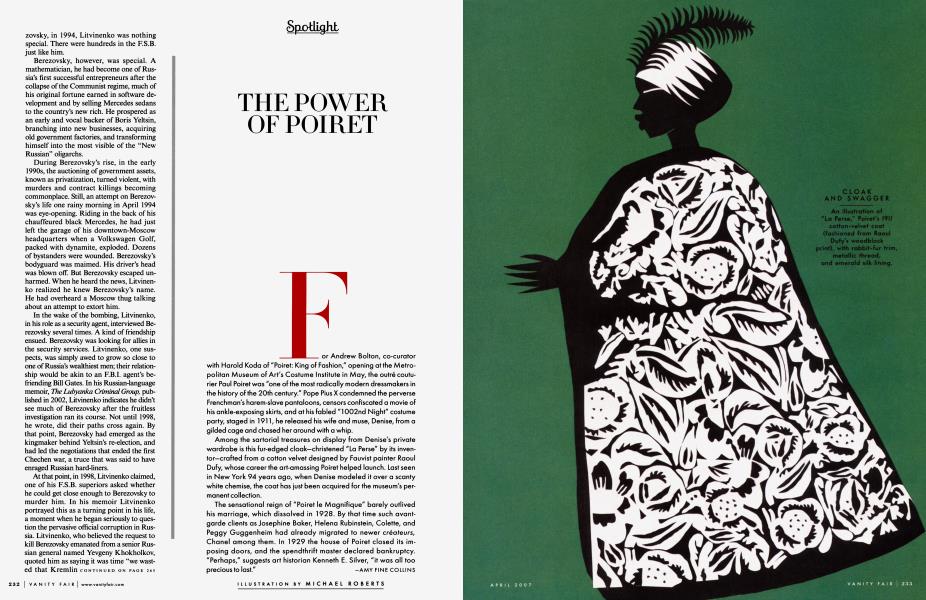
Among the sartorial treasures on display from Denise's private wardrobe is this fur-edged cloak—christened "La Perse" by its inventor-crafted from a cotton velvet designed by Fauvist painter Raoul Dufy, whose career the art-amassing Poiret helped launch. Last seen in New York 94 years ago, when Denise modeled it over a scanty white chemise, the coat has just been acquired for the museum's permanent collection.
The sensational reign of "Poiret le Magnifique" barely outlived his marriage, which dissolved in 1928. By that time such avant garde clients as Josephine Baker, Helena Rubinstein, Colette, and Peggy Guggenheim had already migrated to newer createurs, Chanel among them. In 1929 the house of Poiret closed its imposing doors, and the spendthrift master declared bankruptcy. "Perhaps," suggests art historian Kenneth E. Silver, "it was all too precious to last."
Subscribers have complete access to the archive.
Sign In Not a Subscriber?Join Now
