
Sign In to Your Account
Subscribers have complete access to the archive.
Sign In Not a Subscriber?Join NowAN UNFORGETTABLE FACE
Spotlight
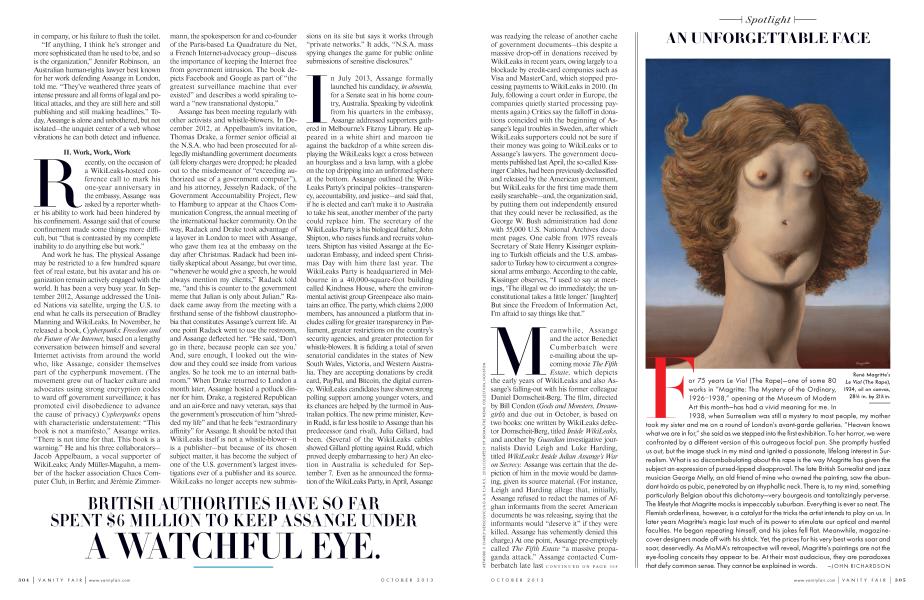
For 75 years Le Viol (The Rape)—one of some 80 works in "Magritte: The Mystery of the Ordinary, 1926—1938," opening at the Museum of Modern Art this month—has had a vivid meaning for me. In 1938, when Surrealism was still a mystery to most people, my mother took my sister and me on a round of London's avant-garde galleries. "Heaven knows what we are in for," she said as we stepped into the first exhibition. To her horror, we were confronted by a different version of this outrageous facial pun. She promptly hustled us out, but the image stuck in my mind and ignited a passionate, lifelong interest in Surrealism. What is so discombobulating about this rape is the way Magritte has given the subject an expression of pursed-lipped disapproval. The late British Surrealist and jazz musician George Melly, an old friend of mine who owned the painting, saw the abundant hairdo as pubic, penetrated by an ithyphallic neck. There is, to my mind, something particularly Belgian about this dichotomy—very bourgeois and tantalizingly perverse. The lifestyle that Magritte mocks is impeccably suburban. Everything is ever so neat. The Flemish orderliness, however, is a catalyst for the tricks the artist intends to play on us. In later years Magritte's magic lost much of its power to stimulate our optical and mental faculties. He began repeating himself, and his jokes fell flat. Meanwhile, magazinecover designers made off with his shtick. Yet, the prices for his very best works soar and soar, deservedly. As MoMA's retrospective will reveal, Magritte's paintings are not the eye-fooling conceits they appear to be. At their most audacious, they are paradoxes that defy common sense. They cannot be explained in words.
JOHN RICHARDSON
Subscribers have complete access to the archive.
Sign In Not a Subscriber?Join Now