Sign In to Your Account
Subscribers have complete access to the archive.
Sign In Not a Subscriber?Join NowFor V.F.’s 20th Hollywood Issue, Annie Leibovitz, who pioneered its foldout cover, turned her shoots into celebrations. Renowned portraitist Chuck Close set firm rules for his 20 subjects. KRISTA SMITH reports
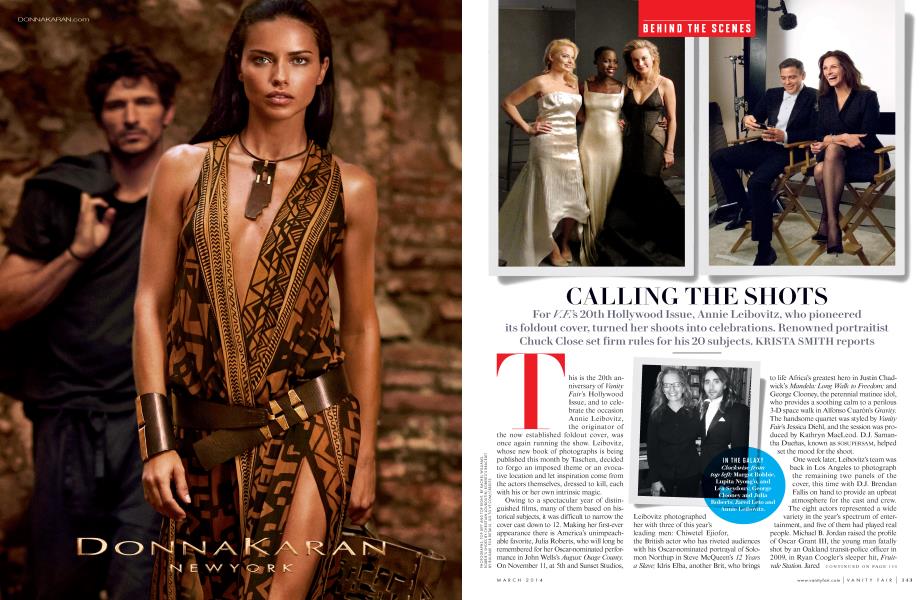
This is the 20th anniversary of Vanity Fair’s Hollywood Issue, and to celebrate the occasion Annie Leibovitz, the originator of the now established foldout cover, was once again running the show. Leibovitz, whose new book of photographs is being published this month by Taschen, decided to forgo an imposed theme or an evocative location and let inspiration come from the actors themselves, dressed to kill, each with his or her own intrinsic magic.
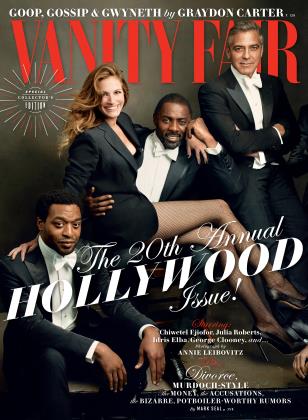
Owing to a spectacular year of distinguished films, many of them based on historical subjects, it was difficult to narrow the cover cast down to 12. Making her first-ever appearance there is America’s unimpeachable favorite, Julia Roberts, who will long be remembered for her Oscar-nominated performance in John Wells’s August: Osage County. On November 11, at 5th and Sunset Studios, Leibovitz photographed her with three of this year’s leading men: Chiwetel Ejiofor, the British actor who has riveted audiences with his Oscar-nominated portrayal of Solomon Northup in Steve McQueen’s 12 Years a Slave; Idris Elba, another Brit, who brings to life Africa’s greatest hero in Justin Chadwick’s Mandela: Long Walk to Freedom; and George Clooney, the perennial matinee idol, who provides a soothing calm to a perilous 3-D space walk in Alfonso Cuaron’s Gravity. The handsome quartet was styled by Vanity Fair’s Jessica Diehl, and the session was produced by Kathryn MacLeod. D.J. Samantha Duenas, known as SOSUPERSAM, helped set the mood for the shoot.
One week later, Leibovitz’s team was back in Los Angeles to photograph the remaining two panels of the cover, this time with D.J. Brendan Lallis on hand to provide an upbeat atmosphere for the cast and crew. The eight actors represented a wide variety in the year’s spectrum of entertainment, and five of them had played real people. Michael B. Jordan raised the profile of Oscar Grant III, the young man fatally shot by an Oakland transit-police officer in 2009, in Ryan Coogler’s sleeper hit, Fruitvale Station. Jared Leto won Golden Globe for his heartbreaking, Oscarnominated performance as the transgender Rayon in Jean-Marc Vallee’s Dallas Buyers Club. Lupita Nyong’o, a recent Yale Drama School grad, won universal approval in the role of the beautiful, tortured Patsey in 12 Years a Slave, for which she got an Oscar nomination. Naomie Harris—a Bond Girl as recently as 2012—starred opposite Idris Elba as Winnie Mandela in the biopic about her late husband.
Grouped in the cover’s third panel by Leibovitz were Brie Larson, who had her breakout lead role last year in Destin Daniel Cretton’s Short Term 12; Chadwick Boseman, who moved up to the majors with his performance as the baseball legend Jackie Robinson in Brian Helgeland’s 42; Margot Robbie, the Australian sensation who metamorphosed into the Duchess of Bay Ridge (the fifth real person) in Martin Scorsese’s The Wolf of Wall Street; and Lea Seydoux, who, in Abdellatif Kechiche’s controversial love story, Blue Is the Warmest Color, proved yet again that she is one of Lrance’s most compelling young talents.
For the portfolio of 20 Hollywood brand names that begins on page 328, Graydon Carter invited as our guest artist the world-renowned American portraitist Chuck Close, who for five decades has been depicting his friends and heroes, most notably through his photo-realistic style in oil paintings. Lor the portfolio, he chose to work exclusively with a rare and impressive 20-by24-inch Polaroid camera. He shot the subjects in three studios: at 20 Jay Street, in Brooklyn (pictured here); at the Elinor Bunin Munroe Lilm Center, at Lincoln Center; and at Go Studios, on West 29th Street, in Manhattan. The sittings were spread out over six months, the first, with Steven Spielberg, on the day after Memorial Day, and the last, with Martin Scorsese, just before Christmas.
Close’s ground rules for his famous subjects—who all posed on a little stool directly in front of the massive bellows of the camera—were specific and non-negotiable: (1) Arrive alone or with one close friend or associate. (2) Be available for three hours. (3) Be responsible for your own look—no professional styling or hair or makeup. (4) Be content with coffee and deli sandwiches or salads—nothing fancy will be served. (5) Get to the studio under your own steam.
Each of the Polaroids took only seven to ten minutes to produce, but with an eye and taste and talent acquired over a lifetime. □
Subscribers have complete access to the archive.
Sign In Not a Subscriber?Join Now
