



Sign In to Your Account
Subscribers have complete access to the archive.
Sign In Not a Subscriber?Join NowIN THE VELVET SEA
Vanities/Fashion
Alexis Cheung
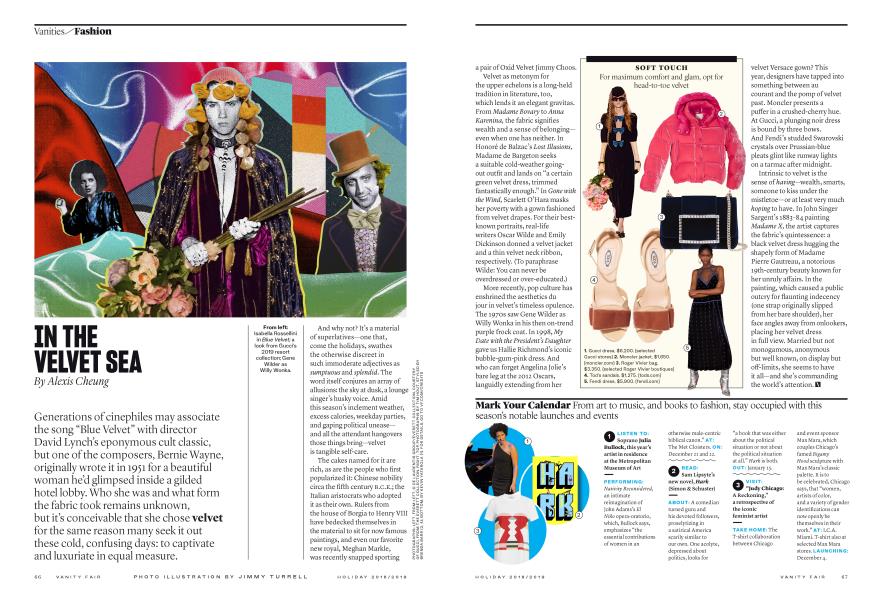
Generations of cinephiles may associate the song "Blue Velvet" with director David Lynch's eponymous cult classic, but one of the composers, Bernie Wayne, originally wrote it in 1951 for a beautiful woman he'd glimpsed inside a gilded hotel lobby. Who she was and what form the fabric took remains unknown, but it's conceivable that she chose velvet for the same reason many seek it out these cold, confusing days: to captivate and luxuriate in equal measure.
And why not? It's a material of superlatives—one that, come the holidays, swathes the otherwise discreet in such immoderate adjectives as sumptuous and splendid. The word itself conjures an array of allusions: the sky at dusk, a lounge singer's husky voice. Amid this season's inclement weather, excess calories, weekday parties, and gaping political unease— and all the attendant hangovers those things bring—velvet is tangible self-care.
The cakes named for it are rich, as are the people who first popularized it: Chinese nobility circa the fifth century B.C.E.; the Italian aristocrats who adopted it as their own. Rulers from the house of Borgia to Henry VIII have bedecked themselves in the material to sit for now famous paintings, and even our favorite new royal, Meghan Markle, was recently snapped sporting a pair of Oxid Velvet Jimmy Choos.
SOFT TOUCH
For maximum comfort and glam, opt for head-to-toe velvet
Velvet as metonym for the upper echelons is a long-held tradition in literature, too, which lends it an elegant gravitas. From Madame Bovary to Anna Karenina, the fabric signifies wealth and a sense of belongingeven when one has neither. In Honore de Balzac's Lost Illusions, Madame de Bargeton seeks a suitable cold-weather goingout outfit and lands on "a certain green velvet dress, trimmed fantastically enough." In Gone with the Wind, Scarlett O'Hara masks her poverty with a gown fashioned from velvet drapes. For their bestknown portraits, real-life writers Oscar Wilde and Emily Dickinson donned a velvet jacket and a thin velvet neck ribbon, respectively. (To paraphrase Wilde: You can never be overdressed or over-educated.)
More recently, pop culture has enshrined the aesthetics du jour in velvet's timeless opulence. The 1970s saw Gene Wilder as Willy Wonka in his then on-trend purple frock coat. In 1998, My Date with the President's Daughter gave us Hallie Richmond's iconic bubble-gum-pink dress. And who can forget Angelina Jolie's bare leg at the 2012 Oscars, languidly extending from her velvet Versace gown? This year, designers have tapped into something between au courant and the pomp of velvet past. Moncler presents a puffer in a crushed-cherry hue. At Gucci, a plunging noir dress is bound by three bows. And Fendi's studded Swarovski crystals over Prussian-blue pleats glint like runway lights on a tarmac after midnight.
Intrinsic to velvet is the sense of having—wealth, smarts, someone to kiss under the mistletoe—or at least very much hoping to have. In John Singer Sargent's 1883-84 painting Madame X, the artist captures the fabric's quintessence: a black velvet dress hugging the shapely form of Madame Pierre Gautreau, a notorious 19th-century beauty known for her unruly affairs. In the painting, which caused a public outcry for flaunting indecency (one strap originally slipped from her bare shoulder), her face angles away from onlookers, placing her velvet dress in full view. Married but not monogamous, anonymous but well known, on display but off-limits, she seems to have it all—and she's commanding the world's attention.
Subscribers have complete access to the archive.
Sign In Not a Subscriber?Join Now
