Sign In to Your Account
Subscribers have complete access to the archive.
Sign In Not a Subscriber?Join NowTRANSFORMERS
Oscar historically loves actresses who play icons—and this year, two in particular stand out
BEST ACTRESS
Joanna Robinson
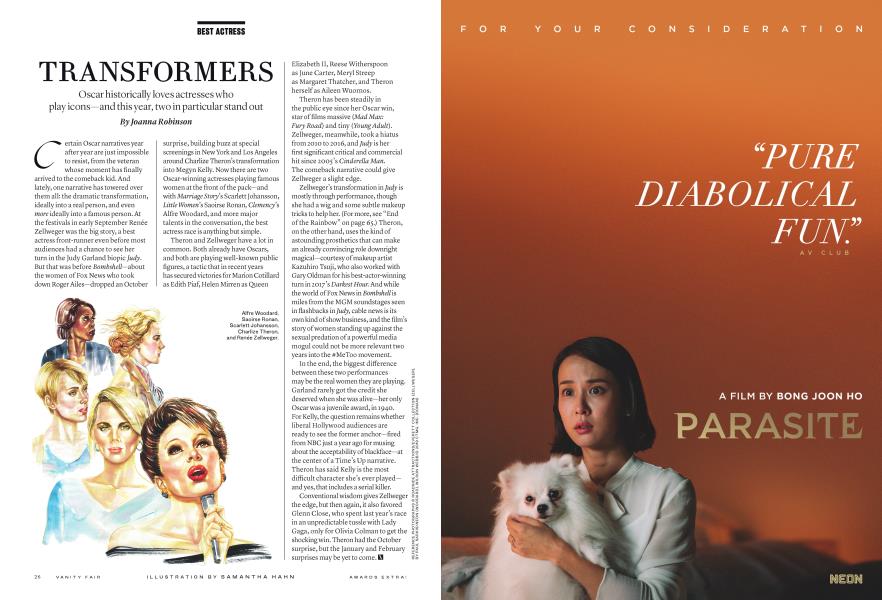
Certain Oscar narratives year after year are just impossible to resist, from the veteran whose moment has finally arrived to the comeback kid. And lately, one narrative has towered over them all: the dramatic transformation, ideally into a real person, and even more ideally into a famous person. At the festivals in early September Renee Zellweger was the big story, a best actress front-runner even before most audiences had a chance to see her turn in the Judy Garland biopic Judy. But that was before Bombshell—about the women of Fox News who took down Roger Ailes—dropped an October surprise, building buzz at special screenings in New York and Los Angeles around Charlize Theron's transformation into Megyn Kelly. Now there are two Oscar-winning actresses playing famous women at the front of the pack—and with Marriage Story's Scarlett Johansson, Little Women's Saoirse Ronan, Clemency's Alfre Woodard, and more major talents in the conversation, the best actress race is anything but simple.
Theron and Zellweger have a lot in common. Both already have Oscars, and both are playing well-known public figures, a tactic that in recent years has secured victories for Marion Cotillard as Edith Piaf, Helen Mirren as Queen Elizabeth II, Reese Witherspoon as June Carter, Meryl Streep as Margaret Thatcher, and Theron herself as Aileen Wuornos.
Theron has been steadily in the public eye since her Oscar win, star of films massive (Mad Max: Fury Road) and tiny (Young Adult). Zellweger, meanwhile, took a hiatus from 2010 to 2016, and Judy is her first significant critical and commercial hit since 2005's Cinderella Man. The comeback narrative could give Zellweger a slight edge.
Zellweger's transformation in Judy is mostly through performance, though she had a wig and some subtle makeup tricks to help her. (For more, see "End of the Rainbow" on page 65.) Theron, on the other hand, uses the kind of astounding prosthetics that can make an already convincing role downright magical—courtesy of makeup artist Kazuhiro Tsuji, who also worked with Gary Oldman for his best-actor-winning turn in 2017's Darkest Hour. And while the world of Fox News in Bombshell is miles from the MGM soundstages seen in flashbacks in Judy, cable news is its own kind of show business, and the film's story of women standing up against the sexual predation of a powerful media mogul could not be more relevant two years into the #MeToo movement.
In the end, the biggest difference between these two performances may be the real women they are playing. Garland rarely got the credit she deserved when she was alive—her only Oscar was a juvenile award, in 1940. For Kelly, the question remains whether liberal Hollywood audiences are ready to see the former anchor—fired from NBC just a year ago for musing about the acceptability of blackface—at the center of a Time's Up narrative. Theron has said Kelly is the most difficult character she's ever played— and yes, that includes a serial killer.
Conventional wisdom gives Zellweger the edge, but then again, it also favored Glenn Close, who spent last year's race in an unpredictable tussle with Lady Gaga, only for Olivia Colman to get the shocking win. Theron had the October surprise, but the January and February surprises may be yet to come.
Subscribers have complete access to the archive.
Sign In Not a Subscriber?Join Now