Sign In to Your Account
Subscribers have complete access to the archive.
Sign In Not a Subscriber?Join NowWith two wildly different movies in the Oscar race, producer Christine Vachon is an iconoclast who's become an icon
With two wildly different movies in the Oscar race, producer Christine Vachon is an iconoclast who's become an icon
With two wildly different movies in the Oscar race, producer Christine Vachon is an iconoclast who’s become an icon
vision matters, that ticket buyers want to see themselves onscreen almost as much as they want to see stars. The Manhattan-born producer remembers Todd Haynes’s movie Poison bringing LGBTQ+ people in droves to the theater in 1991 simply because they hadn’t been represented anywhere near enough yet. “Half of them walked out of the theater going, ‘What the fuck was that?’ And some of those guys were like, ‘I just wanted to see some boys kiss,’” Vachon says. “But I realized that, if you made a movie targeted specifically to that audience, it didn’t have to cross over if you made it for the right amount of money. That was an incredibly liberating feeling—the true collision of art and commerce.”
Past Lives and Haynes’s May December critically adored and in the hunt. She’s been getting career tributes and lifetime achievement awards, and has amassed a global fan base for everything from her Twitter reviews of wine and her affection for combat boots to her cinematic contributions. She feels the love but may be the least sentimental person I’ve ever interviewed. “I’m not nostalgic,” she says. And yet: “It’s stunning to me to take that step back and realize how extraordinary some of these movies are.”
Far From Heaven (2002) and Carol (2015) as well as groundbreaking social dramas like Boys Don’t Cry (1999), Vachon came up as an avant-garde figure in New York’s burgeoning indie scene, backing polarizing movies now regarded as cult classics like Larry Clark’s Kids (1995), Todd Graff’s Camp (2003), and John Waters’s A Dirty Shame (2004). With Haynes and others, she emerged as a pivotal tastemaker in the New Queer Cinema movement, producing scrappy and transgressive visions borne out of the AIDS epidemic while intensively working alongside ACT UP. “That lent a sense of urgency to the movies that we made—you can’t wait around, people are dying, you’ve got to tell the story now,” she says. The movies got attention, the cause got advanced, but Vachon rarely got the credit. As Haynes puts it, “All these gay male directors of these movies that she produced—the attention was on us. Yet with all these movies, she was making them happen.”
Poison, Vachon noticed potential buyers exclusively addressing the movie’s male executive producer rather than her. After Samuel Goldwyn acquired the 1994 lesbian hit Go Fish, she met with “a room full of men” from the company who asked her, “Can you tell us the cities that have the most lesbians in them?” (Vachon replied, “I don’t know, Northampton?”) Even now, certain producers refer to her and her partner at Killer Films, Pamela Koffler, as “girls.” This will go on as long as Vachon plans to make movies.
Vachon’s value system has remained intact, even as she waded through decades of uncertainty: the move from VHS to DVD, the end of video rental stores, and the shift to digital, not to mention COVID and the labor strikes. “The only reason Killer is still standing is because we are very good at listening to the marketplace and pivoting quickly,” Vachon says. “I don’t cry about ‘We aren’t shooting on film anymore’… and I don’t know what’s on the other end of these strikes. I’m just trying to figure out the way that we can keep switching seats on the Titanic.”
Safe, marked the first time Vachon cast a big star, in Julianne Moore. Before then, she’d run audition ads in Backstage magazine; now she was on the phone with Moore’s agent and manager, learning about Hollywood dealmaking in real time: “I remember them yelling at me, ‘You have to make her pay or play!’ And I was like, Okay…what does that mean?” (Vachon calls this moment her induction “to dealing with the wonderful world of representation.”) The film kick-started a shift into the mainstream for both her and Haynes. “We were enlisted in a cultural moment together,” Haynes says. “That’s a unique way to start a creative life and a professional life.” They’ve become very close friends.
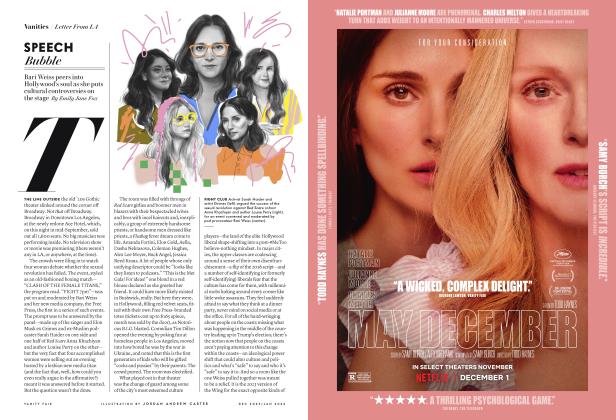
May December, which welcomes Moore back into the Vachon-Haynes fold and introduces Oscar winner Natalie Portman and Riverdale alum Charles Melton to the company. The movie is loosely inspired by the story of Mary Kay Letourneau, a teacher who committed statutory rape with her 12-year-old student (whom she later married). Vachon and Koffler have a naughty logline for the dark comedy that they’ve kept to themselves: “Pedophile Barbie.” Vachon booms with laughter after I prod her into sharing it with me. “That probably shouldn’t go in there,” she says, eyes on my notepad. “That’s something Netflix will get mad at me for saying.” Her static grin suggests it’s worth including anyway.
May December premiered in Cannes to rave reviews; Netflix promptly acquired rights in a splashy deal, aiming to mount perhaps the biggest awards campaigns ever for both Vachon and Haynes. The movie is caustically funny, gorgeously shot, and sensationally acted as it studies the dynamic between a deeply repressed homemaker (Moore), the husband she first met and had sex with when he was a seventh grader (Melton), and the actor assigned to play her in a movie (Portman). It’s somehow both a big studio release and a brilliantly weird indie. “The hot dogs are going to be the first gay meme,” Vachon predicts. No spoilers as to the moment in May December she’s referring to here.
Past Lives, of course, is utterly different. Song had been a noted playwright long before deciding to write and direct her first movie, an achingly romantic, semi-autobiographical love triangle between a Korean American woman, her American husband, and her Korean childhood friend who’s flown across the world to find her. Its specificity and its New York–iness made Vachon the dream collaborator. “It was like meeting a historical figure,” Song says of their first encounter.
Boys Don’t Cry’s Kimberly Peirce to Zola’s Janicza Bravo. “Every day, I would show up and say, ‘I believe this,’ and then Christine would be like, ‘If you believe that, that’s now my belief,’” Song says of their dynamic on the Past Lives set. “She just believed in me.”
Past Lives had a successful box office run this summer—a rarity today for films of its scale—and is a strong Oscar contender. And Vachon isn’t above admitting that she cares about recognition. “Two things can be true at once—you can say, ‘I don’t make movies for the awards,’ and you can also say, ‘It would mean an extraordinary amount to me to get a best-picture nomination,’” she says. “I’m not writing my speech or anything…. Sometimes I feel like the only time I’m ever going to be up there is when they finally have no one else to give the Irving Thalberg to. They’ll wheel me out, and I’ll gum an acceptance speech.”
Subscribers have complete access to the archive.
Sign In Not a Subscriber?Join Now
