

Sign In to Your Account
Subscribers have complete access to the archive.
Sign In Not a Subscriber?Join NowTHE PEOPLE'S PRINCES
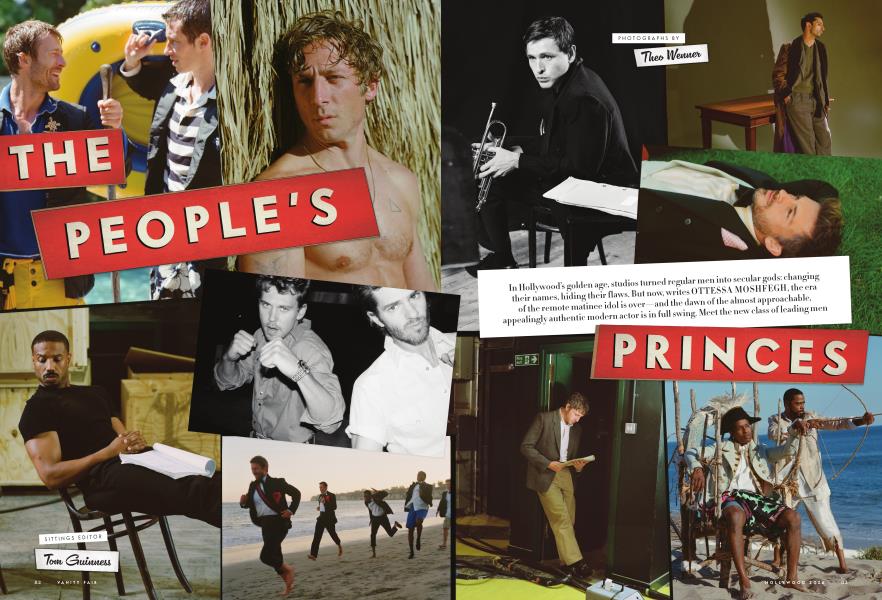
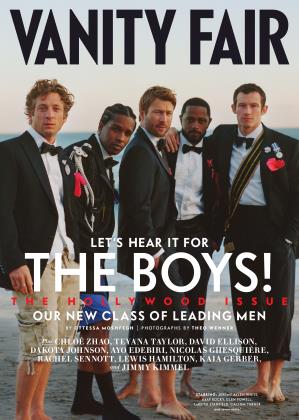
In Hollywood's golden age, studios turned regular men into secular gods: changing their names, hiding their flaws. But now, writes OTTESSA MOSHFEGH, the era of the remote matinee idol is over—and the dawn of the almost approachable, appealingly authentic modern actor is in full swing. Meet the new class of leading men
OTTESSA MOSHFEGH
There's a scene in the 2 0 0 6 Martin Scorsese film The Departed that acts as a hinge in the story of modern masculinity onscreen. It goes like this:
Leonardo DiCaprio plays Billy Costigan, an undercover cop in Boston who has infiltrated the Mob. He's skinny but strong, impulsive but elegant, gaunt, tired, and smarter than everyone else. What drives him is not a hamstrung instinct to conquer or do the right thing— for him, it's personal. He is, like many of us, fueled by the fumes of his own trauma. Halfway through the film, he finds himself in over his head, his true identity under threat of total erasure.
In search of refuge, he runs in the rain to the home of Madolyn Madden, a clinical psychiatrist played by a luminous Vera Farmiga. Billy can't explain who he really is. Instead, his body tells his story. He keeps his distance, tense, lonely, aroused, unmoored.
Madolyn makes him a cup of tea, then studies him, unnerved. "I have to say, your vulnerability is really freaking me out right now," she says. "Is it real?"
Billy pauses for a second, checks himself, then answers, "I think so."
DiCaprio delivers the line with quiet surprise. We see that he has been illuminated, and so we trust that we are seeing the true man now. We recognize real vulnerability. It looks just like this. And it drives Billy toward Madolyn, his body moving like a slow whip across her kitchen. When they kiss, we nearly die. It's better than a normal kiss because Billy has been converted into a new cinematic archetype, a guy we can now recognize as the prototype of the "evolved" male star.
Enter the "internet boyfriend." The phrase has a wink, but the phenomenon is seriously embedded in our cultural DNA at this point. Today's leading men aren't unreachable idols. They feel like real people, very special people who hover just half an inch beyond our grasp. They're still fantasy men, yes, but boyfriend-shaped: accessible, kind, vulnerable, and recognizably human. It's not enough to watch these men working as actors on our screens. We want to know them, how they feel, what makes them tick. We follow their playlists, their breakups, their skin-care routines.
The internet is the perfect environment for forging parasocial bonds because it traffics in illusions and accessibility. And because of streaming, and Instagram, and YouTube, et al., we get to watch and rewatch our favorite moments from our favorite movies.
Let's be honest: When Tom Cruise slid across the floor in socks and a shirt m Risky Business, he wasn't sexy. But the studio sold him as God's gift to women. Maybe we bought it because there were few alternatives. One is reminded of another male sex symbol, Marlon Brando. His voice in A Streetcar Named Desire WAS nasal and weird, but we still saw him as manly. And so was Cruise, though every part of his image has been calibrated: his shortness minimized in press photos, his unnerving intensity recast as ambition.
The approach has shifted now, where the difference between a male star's sculpted pose and his unguarded presence is also the story of how masculinity has become expressive and safe at the same time. "Big dick energy" doesn't mean dominance, but presence, sincerity, and authenticity.
Still, any performance of authenticity is suspect—and these are, after all, brilliant actors. There's a fine line between the man unashamed of feeling and the one demanding to be comforted. The former seduces; the latter regresses. The true internet boyfriend doesn't want to be mothered. He already has a mother, and he loves her.
The evolution from DiCaprio's trembling "I think so" to Paul Mescal's tearful silences and Jeremy Allen White's openwounds maps a profound cultural shift. Is the shift real?
Like DiCaprio in The Departed, today's leading men look up from the depths of themselves. Humbled, emotional, and beautiful, they answer, "I think so."
We hope it's real. So we keep watching.
JONATHAN BAILEY
The Triple Threat
Jonathan Bailey has chemistry with seemingly anyone and anything: Matt Borner in the decades-spanning romance Fellow Travelers; Simone Ashley on Shonda Rhimes's insanely popular bodice ripper Bridgerfon; practically all of Oz as crooning, soft-shoeing Fiyero in Wicked; a mosasaur in this summer's Jurassic World Rebirth. "I know that people acknowledge me as charming," he says. "I feel quite kooky." That ethos is reflected in Bailey's personal leadingman pantheon, which includes Gene Wilder, Jim Carrey, and Robin Williams—versatile clowns whose work has a vivid, sometimes tragic dimension. "I feel like there's just this brilliant sort of throbbing orb that's to be reclaimed from those incredible performances," he says. (Of course it had to be throbbing.)
As a kid in Oxfordshire, England, Bailey learned the art of being publicly enchanting from his three older sisters, who taught him dances they'd seen while with friends or out clubbing and then made him perform them for the family. "I was a sort of tiny little Shetland pony that was being broken into dressage," the actor jokes. He'll enjoy even more audience adoration with a return to Bridgerfon and Wicked: For Good. But there's one place he does not seek connection: "I hate group chats," Bailey says, twice requesting that this information be published in VF. "That, and tepid baths." —ANNA PEELE
THE METHOD MAN
AUSTIN BUTLER
It's one thing to win hearts as a heroic World War II pilot. As a black-toothed psychopath, it's a little harder. But whether swaying in Masters of the Air or deploying a devilish wink during a Dune: Part Two fight to the death, Austin Butler manages.
Off-screen, he's a famously shy person whose interest in others (and powerful eye contact) reads as charisma: "I want to know about you," he tells an interviewer, wearing a white tee that does the same thing for him as it did for Robert Redford and James Dean. A consummate California boy, Butler grew up between Disneyland and Knott's Berry Farm and got his start playing heartthrobs on YA TV before tipping toward darkness in Quentin Tarantino's Once Upon a Time...in Hollywood. His career shows that total immersion—once a macho pursuit—can be a hallmark of true devotion; after 2022's Elvis, he spent months shaking the accent that earned him an Oscar nomination. "I used to think that in order to be a great artist, I had to destroy the rest of my life," he says. It's "this fear that my own experience, my own emotions, my own soul isn't enough."
These days he's stripping back for roles like Zoe Kravitz's tortured former-ballplayer boyfriend in Darren Aronofsky's gritty crime caper Caught Stealing. High on his wish list is a part like Ryan Gosling's in Blue Valentine: one that explores "the complexities" of two people "coming together and falling in love." In other words, charm, and everything underneath.
KEZIAH WEIR
The Toast of Texas
GLEN POWELL
Only the most capable leading man can hold audiences in the palm of his hand even when he's playing a dick, as the square-jawed, gym-cut Glen Powell so often does. He's embodied charming alphas in box office hits like Anyone but You and Twisters while proving his screenwriting chops with Hit Man and the Hulu series Chad Powers. Powell's secret is simple: a warm smile, unexpected self-awareness—he knows he's beautiful, but he knows you know too—and good old-fashioned grind. "The reality is, I've never considered myself to be the most talented person," he says. "But I knew that no one would ever outwork me."
Even years after he ground his way onto the A-list, Powell—speaking with his fluffy pup, Brisket, lying in his lap—seems genuinely starstruck by his own career. He's just as excited to be here—on a film set, on a red carpet, or in a movie theater—as we are to see him. And for that, the consummate Southern gentleman issues heartfelt thanks. "If somebody wants a selfie and they're like, 'Hey, my mom's over there. She's embarrassed to talk to you. Can you go say hi?' I will walk across that restaurant," he says. "I'll go say hi to your mom. I'll make a birthday video for whoever." Though really, he'd much rather talk shop and keep his eyes on the future. "I hope I get to do this job until I die," he says with utter sincerity before pausing to clarify. "Which I hope is at an old age, fingers crossed. I love this job."
DANIELA TIJERINA
MICHAEL B. JORDAN THE OLD SOUL
"Man, I'm born in '87," Michael B. Jordan says with a world-weary laugh. But being a Dragon Ball Z-loving elder millennial has its benefits. In his teens and 20s, the Newark-raised actor learned to ply his trade in genres that are now practically extinct: soaps like All My Children and prestige dramas like The Wire and Friday Night Lights. He became a household name after Fruitvale Station, a film that positions Jordan as the rational evolution of the traditional stoic hero—one that was made right before casting directors began to care more about Instagram followers than raw talent. That heartwrenching drama also happened to be Jordan's first movie with the man he calls Coog: Ryan Coogler, the Scorsese to Jordan's De Niro.
In interviews Jordan uses the language of self-improvement and emotional regulation—therapy-speak as masculine poetry. Coogler's highly commercial auteurism perfectly complements Jordan's old-fashioned movie-star aura. Their mind meld has given us the Creed franchise—about the inheritance of pain, the way strength can contain tenderness without apology—as well as the Black Panther films and Sinners. Yet despite their record, "we've been underestimated," Jordan says. Nobody should make that mistake with Jordan's upcoming "reimagining" of suave crime flick The Thomas Crown Affair, which feels newly relevant following October's Louvre heist. Though the original came out in 1968, Jordan naturally has a soft spot for the 1999 remake starring Pierce Brosnan. Maybe his take will inspire Gen Alpha's answer to Michael B. Jordan.
CHRIS MURPHY
CALLUM TURNER
The Guy Next Door
There's a disarming normalcy to Callum Turner, whose inward gaze and hesitant charm channel a kind of erotic modesty. Unpresuming but cheeky, Turner speaks so casually that it takes a beat to realize when he talks about texting with "Daniel," he means Day-Lewis. Turner is buddies with the three-time Oscar winner, who's given the younger actor invaluable advice: "Dance to the rhythm of your own beat. If you want to be a soap star, be a soap star. If you want to be in franchise movies, be in franchise movies. It's your personal journey."
Raised by a single mom in working-class London, Turner established himself as a successful model before heeding his mentor's advice—graduating from charming supporting bloke to leading man status in sober period pieces like Masters of the Air and The Boys in the Boat. Perhaps Turner's humble beginnings explain the grounded quality he exudes even when talking about his high-profile engagement to Grammy-winning pop star Dua Lipa. "There's nothing hard about it at all," he says when asked about navigating a public romance, though his rosy cheeks suggest otherwise. "It's the easiest thing in the world—it really is."
Turner prefers to stay off social media and out of the spotlight; he withholds not out of control but care. Still, he'd like to clear up one headline: He and Lipa have no current plans to relocate.
"There's lots of things that pop up saying we're going to buy a house.... 'Are you going to buy a house somewhere in Spain?' That came up yesterday," he says. "That's pretty outlandish."
The same could be said for two high-concept 2025 films starring Turner: Mark Jenkin's meditative Rose of Nevada and A24's Eternity, in which Turner portrays the embodiment of the perfect man. He's far too unassuming to admit he fits the type. —SAVANNAH WALSH
The Auteur
HARRIS DICKINSON
Harris Dickinson is shirtless and slow dancing to George Michael's "Father Figure" in the most talked about scene of Babygirl—the 2024 film that catapulted the Brit from Cannes Film Festival breakout to full-fledged internet obsession. Though the film's about a BDSM relationship, he isn't performing dominance here; he's radiant, embodied, free. Dickinson is feeling himself, and we feel him feeling himself. Even more impressive, he's magnetic enough to sell the idea that Nicole Kidman would risk her high-powered career and marriage to Antonio Banderas, all for him. The improvised sequence was so sexy that it inspired a TikTok frenzy, a Pedro Pascal tribute, and at least one lusty article titled "Be Our Father Figure, Harris." This year Dickinson made an even greater leap, premiering his feature directorial debut, Urchin, to rave reviews and a standing ovation at Cannes. The applause was somewhat mortifying for Dickinson, who's more comfortable on or behind a camera than in a theater as himself: "I can hide between 'action' and 'cut,'" he says. Dickinson is as modest about his charms as he is about these public displays of attention—only acknowledging that he can consciously enchant a specific demographic. "I'm good with old people if I need to be," he says with a wily smile. That population might be particularly primed for Dickinson in his highest-profile role yet: John Lennon in Sam Mendes's Beatles biopics. After months of preparation, there's still something about the Fab Four's frontman that seems enigmatic, says Dickinson: "I don't know if I'll ever feel like I've fully figured him out." Maybe a slow dance with his onscreen Yoko Ono, Anna Sawai, will be the key. —JULIE MILLER
The Maverick
LAKEITH STANFIELD
Like an apparition, LaKeith Stanfield appears from behind a column: tall and rangy in a Yankees cap and Gucci loafers, a sly expression on his face. It's a perfectly LaKeith Stanfield moment— delightful and a little creepy, an echo of his role as Andre, the haunted character from Jordan Peele's Get Out, probably the movie most responsible for putting Stanfield on the map. "I've always been mischievous," he tells me. "I think that's what I like about characters too. It's like finding little things about them that are just off of what was there on the page."
Stanfield gravitated to drama class in high school and landed his first role in a 2008 short that was later made into a feature film called Short Term 12, costarring other future A-listers like Rami Malek and Brie Larson. Best known for the head trips Sorry to Bother You and Atlanta, he brings his peculiar presence to other critically acclaimed projects in 2025, appearing alongside Channing Tatum in Roofman and with Jennifer Lawrence in Die My Love. Next year he will star in a new movie by Sorry auteur Boots Riley, / Love Boosters. Stanfield won't reveal much about it except to say it's "one of the craziest things I've ever played."
Looking ahead, he's hungry for more complex and riskier roles. He wants to play a "well-written villain," he says, like Heath Ledger's in The Dark Knight or Bryan Cranston's in Breaking Bad. Says Stanfield: "I love a cunning character that's always plotting on something that other people don't really know he's plotting." We've noticed. —JOE HAGAN
THE PHILOSOPHER
RIZ AHMED
Riz Ahmed's fans think he lives in America—an assumption he's happy not to correct. The Oscar winner proudly calls himself "a hermit," though as we speak, he's openly strolling through a park in his native London; anyone who's paying attention can hear him explain how he considers the internet a necessary evil. When social media comes up, the actor and rapper delivers a line with the precision of someone who's workshopped this thought perhaps too carefully: "I never scroll." But Ahmed still has to promote his projects online, using the same internet that has, on occasion, accused him of being part of the Illuminati.
When Ahmed posts about his wife, his identity, or his work, the gesture feels studied but sincere, like a poem pretending not to be one. His performances in projects like Sound of Metal and The Night Of are exercises in precision—men whose vulnerability is framed by intellect. In person, too, he marries theory to passion, politics to compassion. Though he admires Tom Cruise— his costar in Alejandro G. Indrritu's upcoming Warner Bros, film— Ahmed is less of a showman than his colleague; he's measured, earnest, thoughtful. It's no surprise that he lists Denzel Washington, Jackie Chan, and Irrfan Khan as three actors who have inspired him for vastly different reasons: Washington is "unapologetically himself," says Ahmed. Chan has "put forward a complicated and layered mold of manhood." Khan, meanwhile, was "one of the first actors to truly bridge East and West." What connects the three is that they "didn't fit the mold." Neither does Ahmed.—JOHN ROSS
The Strong Sensitive Type
ANDREW GARFIELD
Earlier this year, on a press tour for Luca Guadagnino's After the Hunt, Andrew Garfield fielded a jarringly inappropriate question about #MeToo and Black Lives Matter by quietly shifting his body toward his costars Julia Roberts and Ayo Edebiri—smiling, faintly, while instinctively deferring to the women beside him. That's what sets the two-time Oscar nominee apart: not his classically handsome looks or puckish allure, but his profound emotional intelligence. Whether he's slinging webs as Spider-Man, wrestling with his faith in Silence, or teaching Elmo how to cope with grief, he brings an extraordinary sensitivity to every role. After the Hunt—which casts Garfield as a professor accused of sexual assault—challenges him to play against type, pushing him further than ever before. "That really felt scary," he says. "I've not really played a part that has the darkness this person has."
For his next trick, Garfield delves into another appealingly complicated man. Fifteen years after he found fame portraying Facebook cofounder Eduardo Saverin in The Social Network, Garfield is returning to the tech world with Guadagnino's new film, Artificial, as embattled OpenAI CEO Sam Altman. Garfield took the role because he's "curious and cautious about the people leading us into what they call an inevitable future." He finds that certainty fascinating: "I'm very curious about people who have the self-delusion— maybe self-belief—that they're the ones that should run the world."
REBECCA FORD
The Heartbreaker
PAUL MESCAL
A beige T-shirt pockmarked with holes, gently mussed bedhead, a sheepish smile: This is Paul Mescal's ordinary-guy armor. Since catapulting to fame in the pandemicera sensation Normal People, the Irish actor has cornered the market in approachablelooking characters with tortured souls. His characters seem to leak emotion through their pores. In projects like that Sally Rooney adaptation and Aftersun, he gives us male suffering so delicate, it feels like grace. We don't just watch Mescal; we ache for him.
Mescal is currently promoting Chloé Zhao's emotionally devastating Hamnef while preparing to play Paul McCartney in Sam Mendes's Beatles movies. But soon, he hopes to move past characters who radiate varying degrees of sadness—even if those magnetically melancholy roles are the very parts that have earned him a fervent following. He felt particularly "uncomfy" about the way he was objectified when Normal People's sex scenes shot to the top of streaming queues across the globe, he says, and is currently determined to keep his romantic life private—a pivot from the days when his Twitter flirtation with musician Phoebe Bridgers blossomed into a lengthy relationship before the public's eyes.
"I am grateful to the people that care about the work I do, but I can't care too deeply about the people who don't," Mescal says. Which is a white lie, he confesses with a wink, putting his head in his hands. "That's a permanent fixture in my therapy session: Why doesn't everybody love me?" — JOY PRESS
JEREMY ALLEN WHITE
The Contrarian
Jeremy Allen White is not a brooding native son of Chicago, a brooding juvenile delinquent and science prodigy, or a brooding superstar musician. In fact he's not even Jeremy Allen White. The Emmy-winning star of culinary pressure cooker The Bear, the long-running family dramedy Shameless, and this year's Boss biopic, Springsteen: Deliver Me From Nowhere, uses his middle name professionally only because when he registered with the Screen Actors Guild, there had already been another Jeremy White in the union. "That's not how I understand myself," White says. When he hears himself addressed by all three names, "it does feel like people are talking about someone I don't know."
So, who is White? Coming up in the business, he looked up to (and in interviews sometimes consciously imitated) Sean Penn. When Calvin Klein cast him in its spring 2024 underwear campaign, it was less about abs than aura; he was giving the fantasy of the emotionally overworked man who still texts back. Now, at 34, he's just happy that by the time The Bear launched him into a new stratosphere of fame, he was already fully cooked as a person: "I don't need to put on any self-serious or troubled attitudes." He knows he seems intense, but he claims that, too, is not the real Jeremy White. As if to prove it, he makes a joke: "I'm allowed to smile, although I won't do it very often." —KASE WICKMAN
For additional credits, see page 177.
The Virtuoso
A$AP ROCKY
As a Harlem rapper mixing street tales with Rick Owens and Raf Simons, ASAP Rocky cultivated a unique persona: flamboyant, insouciant, all clever wordplay and soaring cheekbones. Today, he speaks his own language, tending toward what could be called Rockyisms: affably serious proclamations of his own charisma and good looks. "Acting is just another component of the great arts," he says, squinting one early evening in the Los Angeles sun. "And I'm a Renaissance man."
Rocky's next phase is less a pivot than a fresh application of some immutable, sumptuous essence. He's leaned way into film work, taking on meaty roles in the parenting drama If I Had Legs I'd Kick You and Spike Lee's crime thriller Highest 2 Lowest. Off-screen, his third child with his costar in domestic bliss, Rihanna, was born shortly after he shot VPs cover: a girl he and his superstar partner named Rocki Irish. "As soon as I got off set," he says, "I had some really great news." Rocky also cochaired the Met Gala less than three months after his acquittal in a felony assault trial, where his courtroom suits were hotly cnticipated by Instagram commentators. He practically walks red carpets with a stroller. Who doesn't love that kind of confidence?
Rocky knows that fashion is fickle, and that he won't be king forever. But he isn't mourning yet. "After me, it'll be somebody special, and hopefully I know who that person is. And it'll be a person who I feel like deserves it." —DAN ADLER
CONTINUED FROM PAGE 111
ROLL THE CREDITS
On the covers:
Jeremy Allen White's tuxedo jacket by Louis Vuitton Men's; shirt by Emma Willis; archive shorts by Abercrombie & Fitch; bow tie by Brunello Cucinelli; brooches by Stephen Russell; ring by Lizzie Mandler Fine Jewelry. ASAP Rocky's tuxedo jacket by Saint Laurent by Anthony Vaccarello; shirt by Ralph Lauren Purple Label; shorts by Stiissy; bow tie by Tom Ford; pocket square by Charvet; socks by Pantherella; aiguillettes from Angels Costumes. Glen Powell's clothing, bow tie, and cummerbund by Tom Ford. LaKeith Stanfield's jacket and pants by Dior; shirt by Ralph Lauren Purple Label; bow tie by Notch; cummerbund by Brunello Cucinelli; dress set from Beladora; brooch and charm (worn as brooch) by Dezso by Sara Beltran; scarf (worn as pocket square) from Angels Costumes. Callum Turner's tuxedo jacket and pants by Louis Vuitton Men's; shirt and cummerbund by Tom Ford; bow tie by La Bowtique; pocket square by Charvet; clip by Van Cleef & Arpels; watch by Rolex; sash and medal brooch from Angels Costumes.
Riz Ahmed's clothing by Ralph Lauren Purple Label; shoes by Carmina; bow tie by Brooks Brothers; cummerbund by Todd Snyder; socks by Pantherella. Jonathan Bailey's tuxedo tailcoat, pants, and bow tie by Ralph Lauren Purple Label; shirt and waistcoat by Dunhill; shoes by Manolo Blahnik; socks by Pantherella. Harris Dickinson's tuxedo jacket by Polo Ralph Lauren; shirt by Emma Willis; pants by Cardings; bow tie by Emporio Armani; umbrella by Dunhill. Andrew Garfield's jacket, shirt, and cuff links by Dunhill; sweater by Polo Ralph Lauren; pants by Cardings; shoes by Carmina; pocket square by Echo; socks by Pantherella.
Paul Mescal's clothing and shoes by Gucci; hat by Lock & Co. Hatters; brooches by Cartier. Michael B. Jordan's jacket by Hermes; shirt by Emma Willis; jeans by Levi's; shoes by Jacques Soloviere Paris; bow tie by Ralph Lauren Purple Label; cummerbund by Dunhill; cane by Swaine; earrings, tuxedo studs, and cuff links by David Yurman. Austin Butler's tuxedo jacket by Saint Laurent by Anthony Vaccarello; shirt by Ralph Lauren Purple Label; archive jeans by Abercrombie & Fitch; shoes by Church's; bow tie by Giorgio Armani; pocket square by Dunhill; belt by Maximum Henry; brooch by Boucheron; cuff links by Briony Raymond; watch by Breitling.
Page 82: Top left: Powell's tuxedo jacket by Tom Ford; sweater by Maison Margiela; rugby shirt (tied around waist) by Polo Ralph Lauren; shorts by Phipps; brooches from Beladora. Center: Butler's watch by Breitling. Garfield's shirt from Angels Costumes. Bottom left: Jordan's earrings by David Yurman. Bottom right: Powell's sash from Angels Costumes. Page 83: Center: Bailey's pocket square by Charvet. Bottom right: Rocky's ring by A. Codognato. Stanfield's clothing by Ralph Lauren Purple Label. Page 95: Top left: Jordan's earrings and tuxedo studs by David Yurman. Butler's brooch by Boucheron. Center left: Garfield's boots by Stetson; belt by Artemas Quibble; vintage jeans by Wrangler. Butler's watch by Breitling. Bottom left: Turner's tuxedo jacket by Louis Vuitton Men's; archive shirt and shorts by Abercrombie & Fitch; bandanna from The Vintage Showroom.
Bottom right: Rocky's ring by A. Codognato. Stanfield's hat from Angels Costumes. Page 106: Top right: Rocky's medal brooch by Chanel High Jewelry; skeleton earring (worn as brooch) by A. Codognato; hat from Angels Costumes. Center left: Butler's watch by Breitling. Center right: Garfield's jacket, sweater, jeans, shoes, and belt by Celine. Bottom left: Stanfield's dress set from Beladora; brooch by Deszo by Sara Beltran. Page 107: Top left: Bailey's shirt by Loro Piana; tuxedo pants by Saint Laurent by Anthony Vaccarello; tie by Dunhill. Top right: Powell's archive shirt
by Abercrombie & Fitch; T-shirt by Polo Ralph Lauren; jeans by Levi's. Bottom left: White's vintage jeans by Lee.
Hair products by Hair by Sam McKnight (Mescal), Oribe (Butler, Jordan), R&Co Bleu (Ahmed, Bailey, Dickinson, Garfield, models), Sally Hershberger 24K (Powell, Turner, White); grooming products by Bleu de Chanel (Jordan, Stanfield), Chanel (Rocky), Circa 1970 (Powell, Turner, White), iS Clinical (Butler), La Roche-Posay (Mescal), Omorovicza (Ahmed, Bailey, Dickinson, Garfield, models).
Set design, Julia Wagner. Hair, Tasha
Reiko Brown (Jordan), Jillian Halouska (Butler), Sally Hershberger (Powell, Turner, White), Josh Knight (Mescal), Tashana Miles (Rocky), Liz Taw (Ahmed, Bailey, Dickinson, Garfield, models); barbers, Kevin Duke (Stanfield), Jove Edmund (Jordan); grooming, Tasha Reiko Brown (Jordan, Rocky, Stanfield), KC Fee (Powell, Turner, White), Jillian Halouska (Butler), Josh Knight (Mescal), Liz Taw (Ahmed, Bailey, Dickinson, Garfield, models); manicures, Emi Kudo (Stanfield, Turner, White), Adam Slee (Ahmed, Butler, Dickinson, Garfield, Mescal); Kim Truong (Powell, Rocky);
tailors, Audra Budvytiene, Hasmik Kourinian, Laima Lupeikiene, Irina Tshartaryan; animal handler, The Animal Talent (horse). Produced on location by Connect the Dots (Powell, Rocky, Stanfield, Turner, White), Casa Projects (all others). Location: Ealing Studios, London (Ahmed, Bailey, Butler, Dickinson, Garfield, Jordan, Mescal). Photos (Bailey): Fred Astaire: John Kobal Foundation/Hulton Archive. Marlon Brando, Gregory Peck, and Ann Todd: Bettmann Archive. Ramon Novarro: Clarence Sinclair Bull/ John Kobal Foundation. All: Getty Images. For details, go to VF.com/credits.
Subscribers have complete access to the archive.
Sign In Not a Subscriber?Join Now


